The Effects of Lithium Chloride Exposure on the Reproduction of Caenorhabditis elegans
George Hatzis, Olivia Rossi, Izabella Testiler, Grace Dobbins, Erica Homan

TL;DR
This study shows that lithium chloride negatively affects the reproduction of C. elegans, which could inform its impact on human health.
Contribution
The study introduces new evidence on the reproductive toxicity of lithium chloride using C. elegans as a model organism.
Findings
Lithium chloride exposure caused a statistically significant increase in egg retention in C. elegans.
The results suggest lithium chloride may harm reproductive health in model organisms.
Abstract
Caenorhabditis elegans ( C. elegans) are model organisms that share similar anatomical structures to humans. By exploring the effects of lithium chloride (LiCl) on C. elegans, we can collect crucial data regarding the compound’s impact on patients taking psychiatric medications containing LiCl. Here we performed an egg retention assay on nematode populations to explore how LiCl can influence reproduction. We found a statistically significant difference in eggs retained between control and experimental groups, suggesting that LiCl has negative effects on reproductive health.
Genes, proteins, chemicals, diseases, species, mutations and cell lines named across the full text — each resolved to its canonical identifier and authoritative record.
Click any figure to enlarge with its caption.
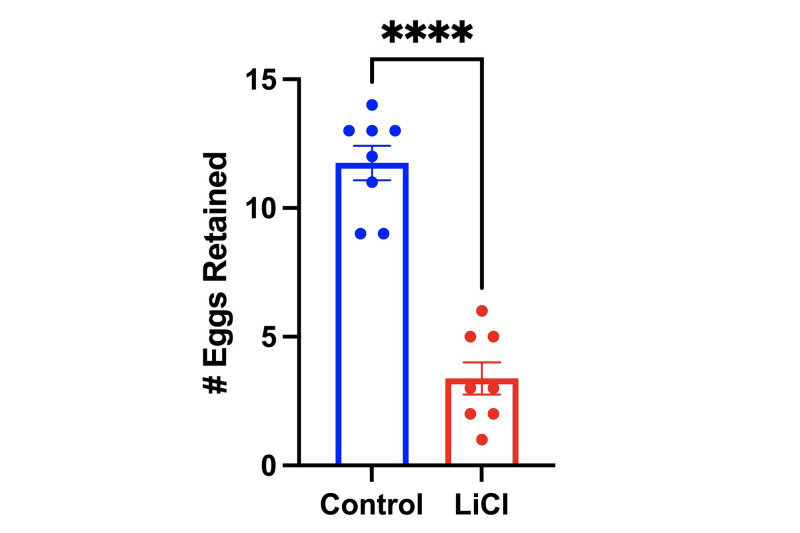 Figure 1
Peer Reviews
No public reviews on file for this paper yet. If you reviewed it on a platform where reviews are public (OpenReview, ICLR, NeurIPS, ICML), you can paste yours below so the community can read it here.
Videos
No videos yet. Explain this paper in a talk, walkthrough, or lecture? Add one.
Taxonomy
TopicsGenetics, Aging, and Longevity in Model Organisms · Birth, Development, and Health