From compost to culver: genome sequence and annotation of a cluster CQ1 Gordonia phage
William K. Alexander, Rianna R. Allen, Jaden D. Anderson, Amber N. Brumfield, Tiffany M. Cook, Giana M. Dana, Gregory J. Ethridge, Emily C. Gailey, Rebekah A. Netzley, Joshua V. Nguyen, Phillip J. Souza, Briggs M. Yoder, Jamie R. Wallen, Maria D. Gainey, Tonya C. Bates

TL;DR
This paper presents the genome sequence and annotation of a new phage called Culver, isolated from Gordonia bacteria and belonging to the CQ1 cluster.
Contribution
The study identifies unique genomic features of Culver, including two putative integrase genes not seen in other CQ1 phages.
Findings
Culver is a siphovirus isolated from Gordonia terrae CAG3 and belongs to the CQ1 phage cluster.
The genome encodes eight tRNAs and lysin A via two adjacent genes.
Culver uniquely contains two putative integrase genes, distinguishing it from other CQ1 phages.
Abstract
Phage Culver, with a siphovirus morphology, was isolated using Gordonia terrae CAG3. Culver is assigned to phage cluster CQ1 based on gene content similarity to actinobacteriophages. Notably, Culver is predicted to encode eight tRNAs, lysin A by two adjacent genes, and, unlike other CQ1 phages, two putative integrase genes.
Genes, proteins, chemicals, diseases, species, mutations and cell lines named across the full text — each resolved to its canonical identifier and authoritative record.
Click any figure to enlarge with its caption.
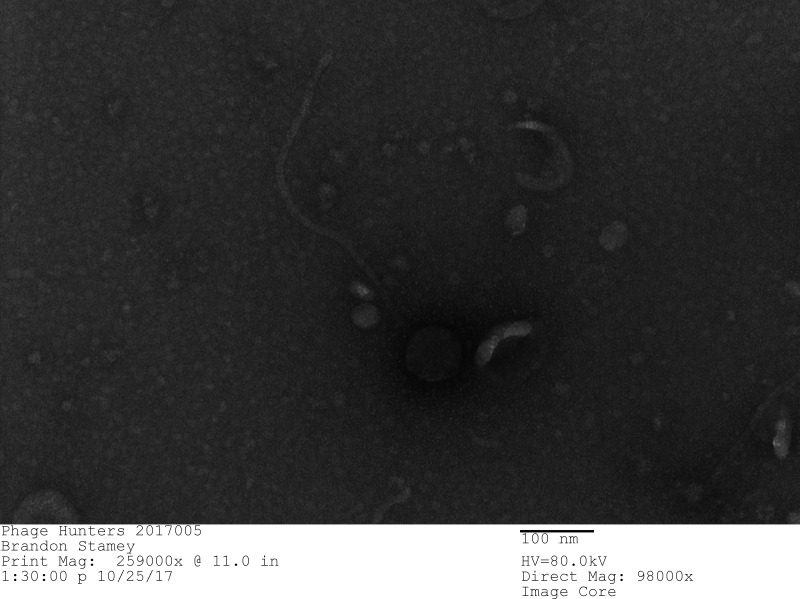 Figure 1
Peer Reviews
No public reviews on file for this paper yet. If you reviewed it on a platform where reviews are public (OpenReview, ICLR, NeurIPS, ICML), you can paste yours below so the community can read it here.
Videos
No videos yet. Explain this paper in a talk, walkthrough, or lecture? Add one.
Taxonomy
TopicsBacteriophages and microbial interactions · Genomics and Phylogenetic Studies · Plant Disease Resistance and Genetics