Dual tagging of GFP and Degron on endogenous COSA-1 in Caenorhabditis elegans as a crossover investigation tool
Arome Solomon Odiba, Guiyan Liao, Haiyan Yuan, Wenxia Fang, Bin Wang

TL;DR
This study creates a tool to study COSA-1 in C. elegans by enabling its controlled degradation, revealing its role in meiosis.
Contribution
A novel C. elegans strain with inducible COSA-1 degradation using the AID system was developed.
Findings
Auxin treatment depletes COSA-1, causing a 96% decrease in progeny viability.
Degradation results in 12 univalent chromosomes in diakinesis oocytes.
The strain maintains normal fertility and COSA-1::GFP foci before treatment.
Abstract
COSA-1 is essential for accurate meiosis in C. elegans . Two null mutants ( cosa-1 ( me13 ) and cosa-1 ( tm3298 ) ) have been notably studied. These null mutants exhibit severe meiotic defects, hindering the observation of the subtle or dynamic nature of COSA-1 function. To overcome these limitations, we developed a C. elegans strain with inducible COSA-1 degradation using the Auxin-Inducible Degron (AID) system. This strain exhibits normal fertility and COSA-1::GFP foci. Auxin treatment successfully depletes COSA-1, resulting in a 96% decrease in progeny viability and 12 univalent chromosomes in diakinesis oocytes. This strain serves as a valuable tool for studying the dynamics of COSA-1.
Genes, proteins, chemicals, diseases, species, mutations and cell lines named across the full text — each resolved to its canonical identifier and authoritative record.
Click any figure to enlarge with its caption.
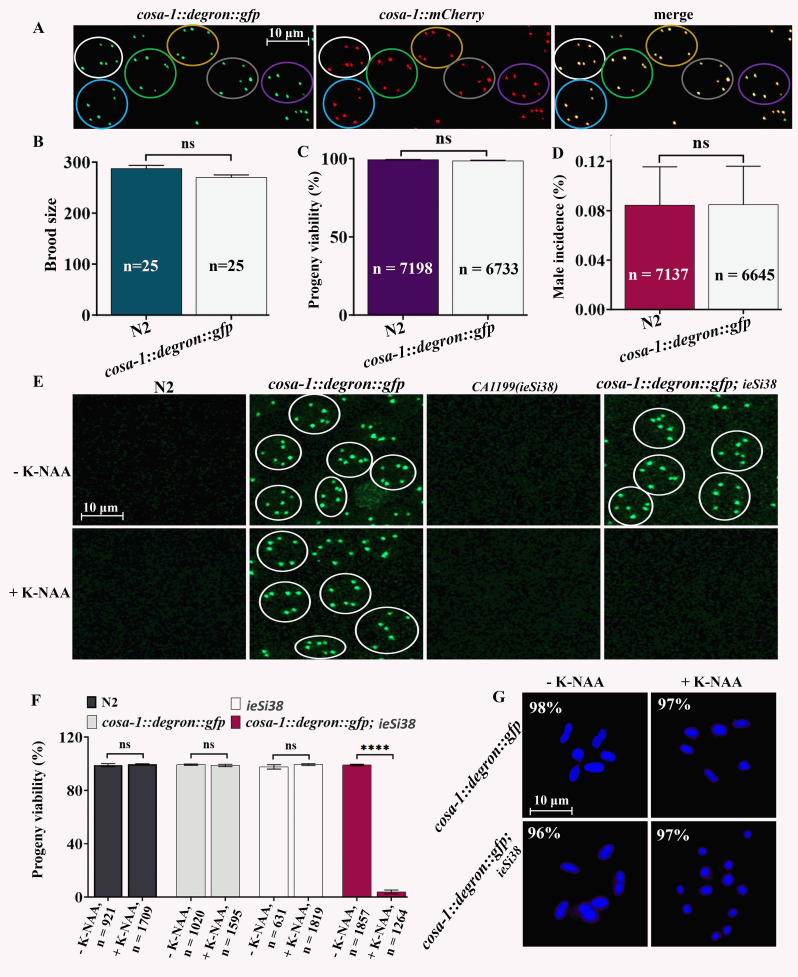 Figure 1
Peer Reviews
No public reviews on file for this paper yet. If you reviewed it on a platform where reviews are public (OpenReview, ICLR, NeurIPS, ICML), you can paste yours below so the community can read it here.
Videos
No videos yet. Explain this paper in a talk, walkthrough, or lecture? Add one.
Taxonomy
TopicsGenetics, Aging, and Longevity in Model Organisms · Photosynthetic Processes and Mechanisms · CRISPR and Genetic Engineering