On the antimagicness of generalized edge corona graphs
Nivedha D, Devi Yamini S

TL;DR
This paper explores antimagic labelings in a new type of graph called generalized edge corona graphs.
Contribution
The paper introduces and proves antimagicness of generalized edge corona graphs under specific structural conditions.
Findings
A generalized edge corona graph G ⋄ (H1,H2,...,Hm) is antimagic under certain conditions.
The proof uses an algorithmic approach for graphs with specific degree constraints.
The result excludes spider graphs with uneven legs.
Abstract
Given a graph G, a function of assigning distinct labels {1,2,...,|E(G)|} to E(G) such that w(a)≠w(b), ∀ a,b∈V(G) is an antimagic labeling of G where w(a) indicates the vertex sum obtained by summing up all the labels assigned to the edges incident on the vertex a. Let G, Hi, 1≤i≤m be connected graphs such that E(G)={e1,e2,...,em}. A new graph is constructed from G, Hi, 1≤i≤m by adding all possible edges between the end vertices of ei and V(Hi), i∈{1,2,...,m}. The resulting graph is called the generalized edge corona of G and (H1,H2,...,Hm) which is denoted as G⋄(H1,H2,...,Hm). We prove G ⋄ (H1,H2,...,Hm) is antimagic under certain conditions using an algorithmic approach where G has only one vertex of maximum degree three (excluding spider graphs containing uneven legs) and |V(Hi)|≥2, i∈{1,2,...,m}.
Genes, proteins, chemicals, diseases, species, mutations and cell lines named across the full text — each resolved to its canonical identifier and authoritative record.
Click any figure to enlarge with its caption.
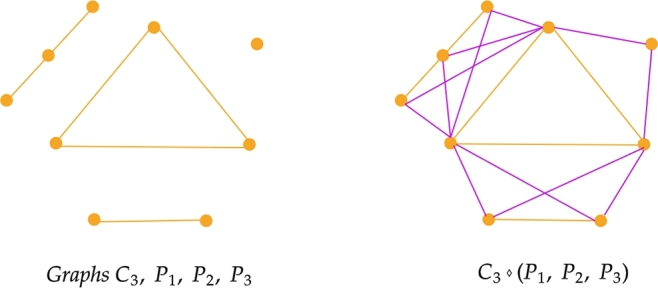 Figure 1
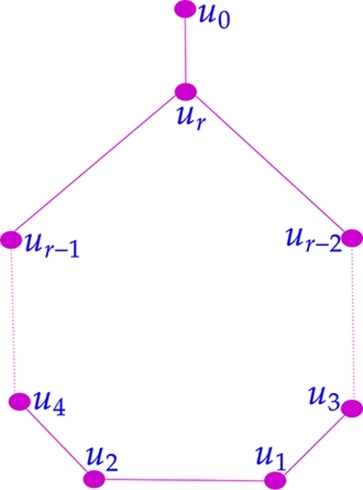 Figure 2
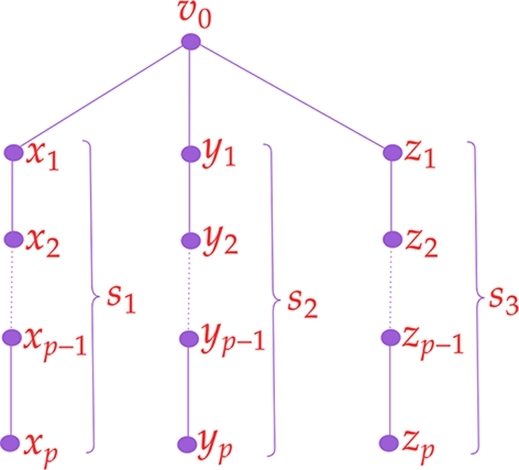 Figure 3
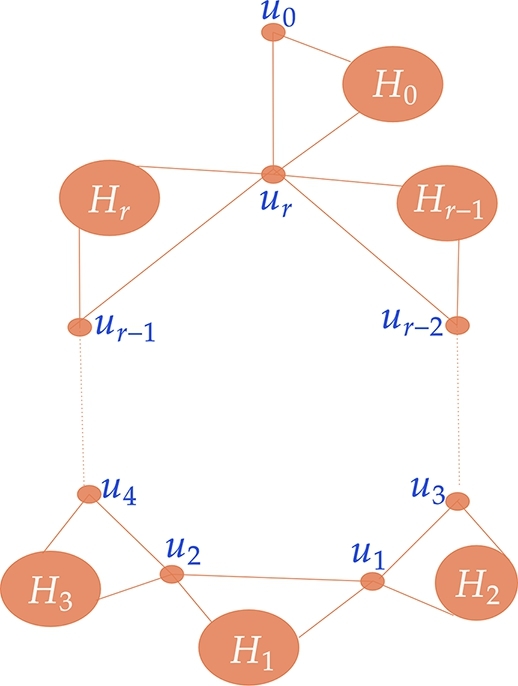 Figure 4
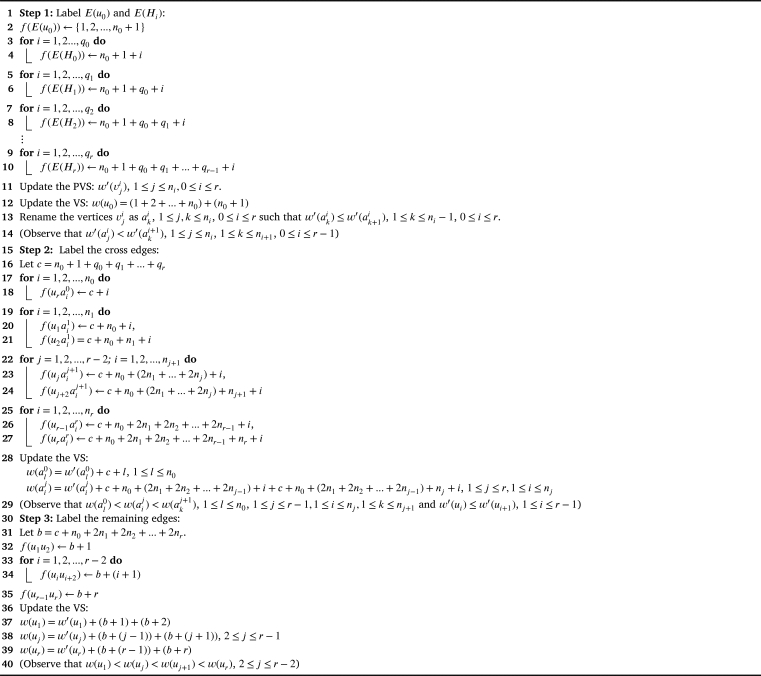 Figure 5
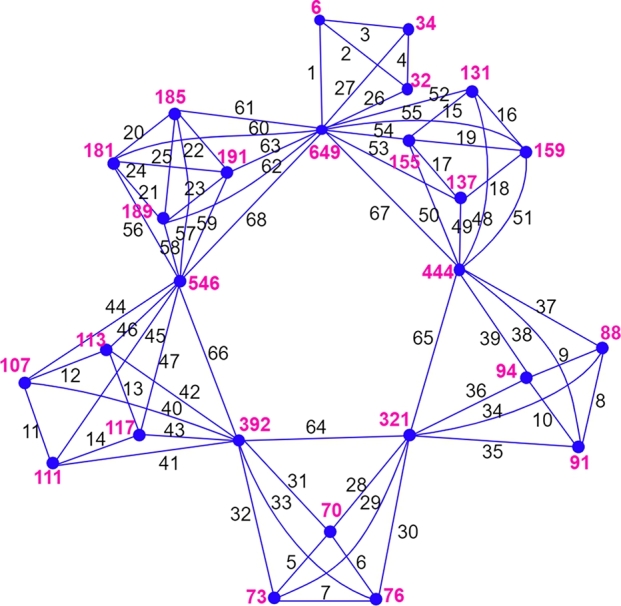 Figure 6
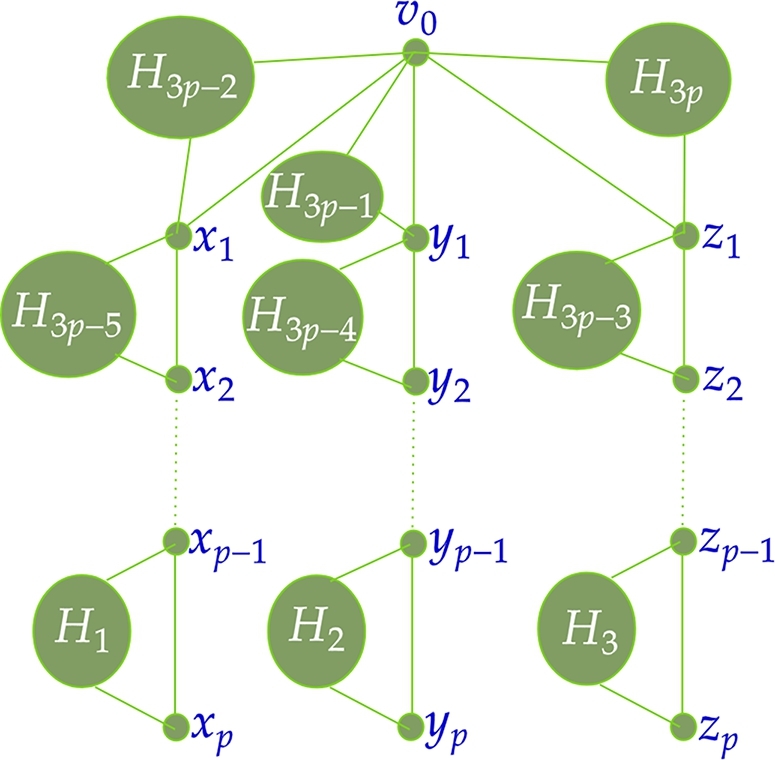 Figure 7
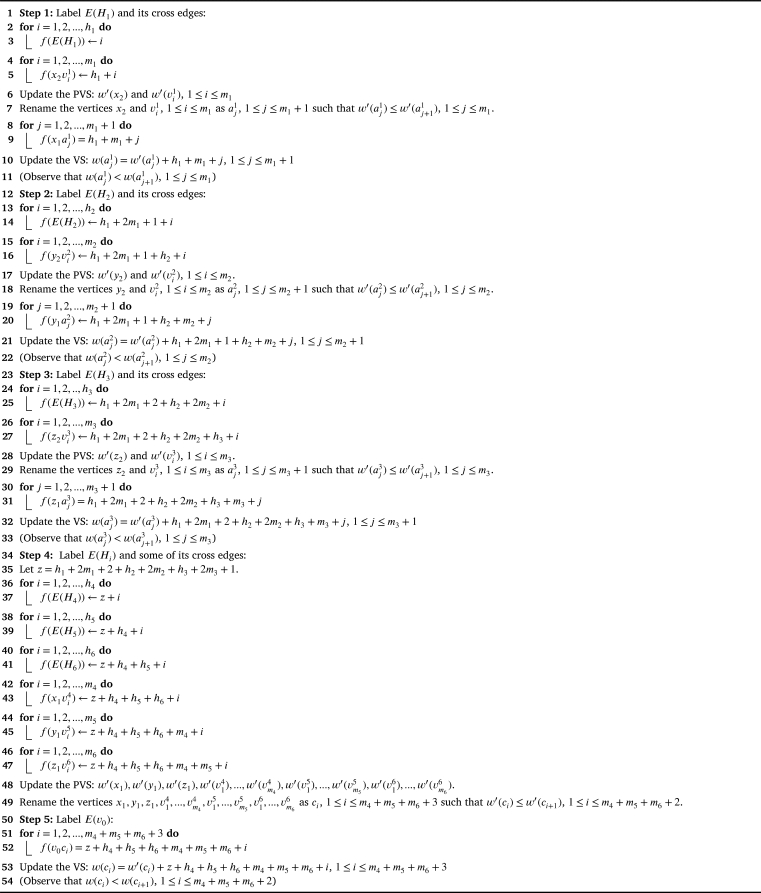 Figure 8
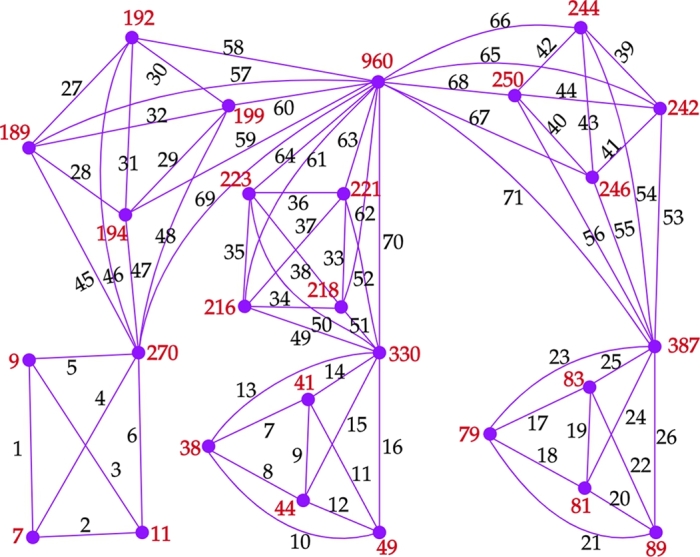 Figure 9
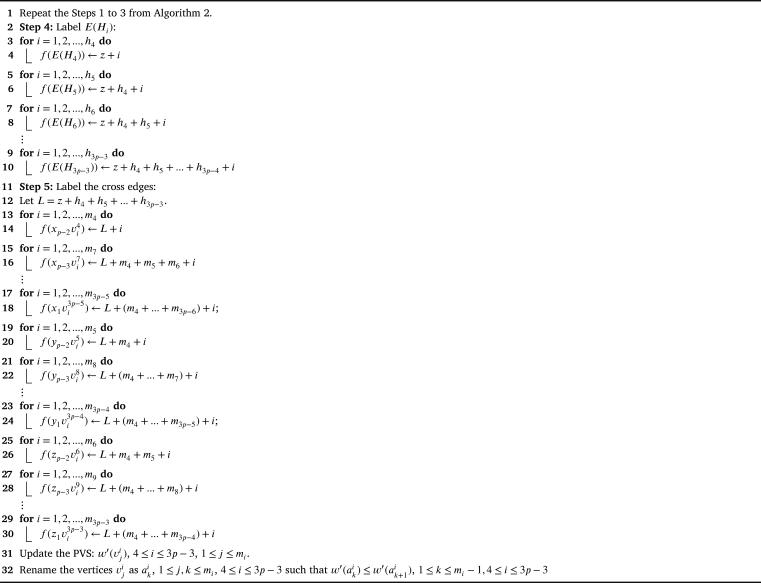 Figure 10
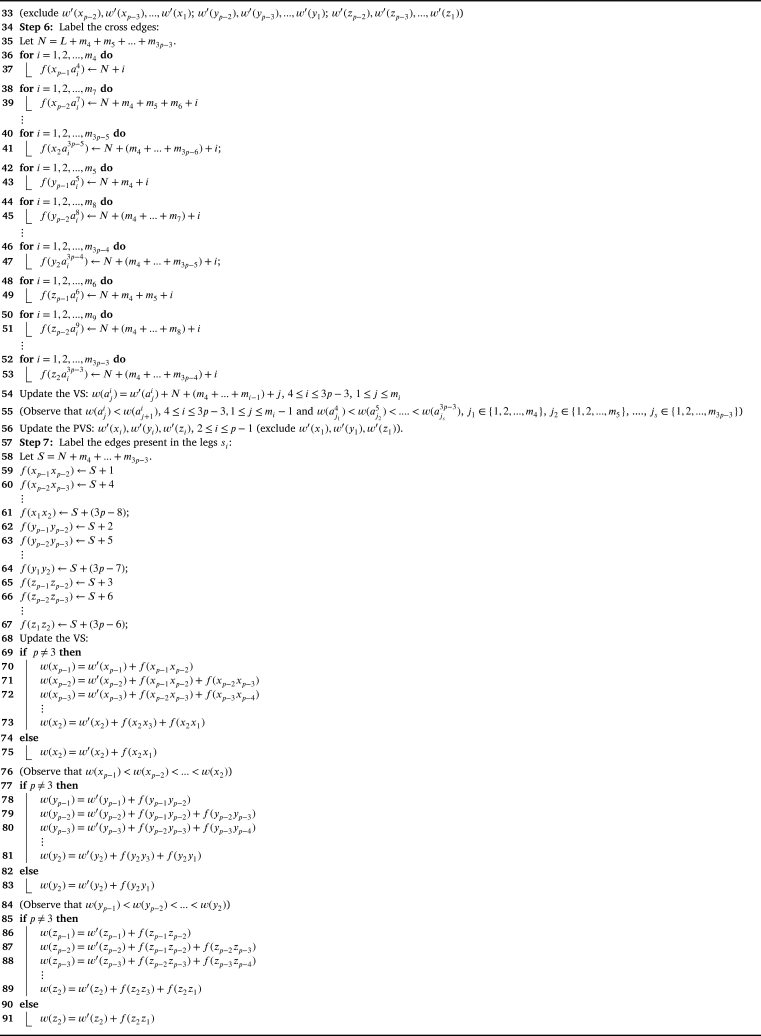 Figure 11
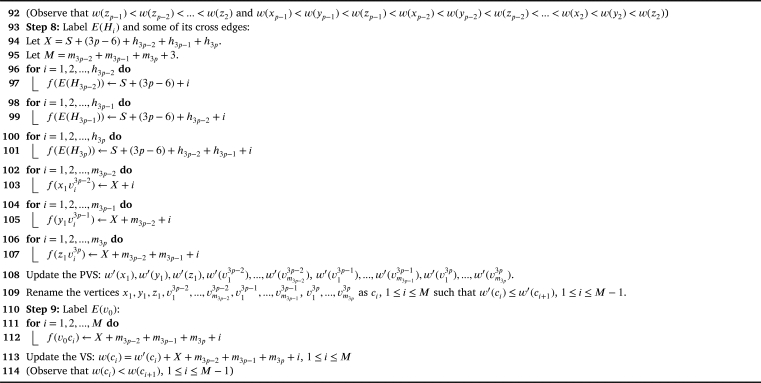 Figure 12
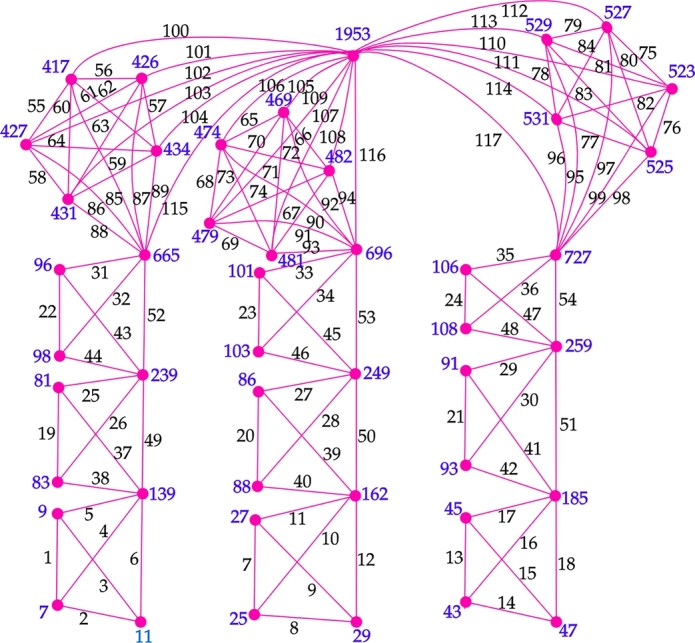 Figure 13
Peer Reviews
No public reviews on file for this paper yet. If you reviewed it on a platform where reviews are public (OpenReview, ICLR, NeurIPS, ICML), you can paste yours below so the community can read it here.
Videos
No videos yet. Explain this paper in a talk, walkthrough, or lecture? Add one.
Taxonomy
TopicsGraph Labeling and Dimension Problems · Graph theory and applications · Advanced Graph Theory Research
Introduction
1
Any graph G in this work has no self loops and parallel edges. Most of the real life situations can be modeled as a graph problem which has attracted the researchers to work on graph theory. Graph labeling is one of the topics in graph theory which has more than 200 techniques. Graph labeling was initiated by Alexander Rosa in 1967. A graph labeling of G is a function from to under restrictions [6]. The origin of antimagic labeling can be traced all the way back to Hartsfield et al. in 1990 [8]. Antimagic labeling has numerous results and still a lot of work is under process.
Let . An antimagic labeling of G is a bijection and is distinct for all the vertices where denotes the set of incident edges on x. A graph which preserves an antimagic labeling is recognized as an antimagic graph. In [8], the following conjectures were proposed and remain open for more than three decades.
Conjecture 1[8] All connected graphs but is antimagic.
Conjecture 2[8] All trees but is antimagic.
The Table 1 provides a few existing results on antimagic labeling.Table 1. Existing results on antimagic labeling.Table 1Graphs**Ref.- Paths- Cycles- Wheels- Complete graphs[8] - Graphs with △(G)≥n − 3[17] - Toroidal grids- Higher dimensional toroidal grids- Cartesian product of cycle and k-regular graph[15] - Sequential generalized corona graphs- Generalized snowflake graphs[5] - n-barbell graph n ≥ 3- Edge corona of bistar graph and k-regular graph- Edge corona of cycles[12] - Binomial trees- Fibonacci trees[14] Complete m-ary trees[3]Subclasses of trees[10]Caterpillars[11]Regular graphs[2], [4]Biregular bipartite graphs[16]Hexagonal latticePrismatic lattice[1]
Motivation and applications
2
A few graph classes and products of graphs were proved to be antimagic, but the antimagic labeling is yet to be explored for the edge corona product of graphs. So, this motivated us to work on the generalized edge corona graph (denoted by G ⋄ ).
There are techniques used in surveillance or security model for various buildings which are based on antimagic labeling of double wheel graph, centreless wheel graph, helm, and regular actinia graphs [9]. A few antimagic graphs such as double wheel, helm, path, web, etc. are used in encryption techniques for the security purpose in data transfer [7].
Preliminaries
3
The generalized edge corona is defined as follows:
where A denotes the cross edges between each and [13]. An illustration of the generalized edge corona of and is given in the Fig. 1.Figure 1A generalized edge corona of graphs.Figure 1
Let represent the set of labeled edges incident on x for . For a vertex, the degree is the count of incident edges on the vertex. For , define
and of v in . In a similar manner, we define the maximum degrees △, and the minimum degrees δ, . Vertex sum of is , denoted by VS; partial vertex sum of is , denoted by PVS. A pendant edge attached to a vertex of a cycle is a Pan graph. A spider graph is a tree such that there exist a unique vertex with more than two neighbors and the remaining vertices with less than three neighbors
Generalized edge corona of graphs
4
G is connected with a unique maximum degree vertex such that (except spider graphs containing uneven legs) and the other vertices with degree 2 or 1. Let the graphs , be connected with at least two vertices. Note that the graph G can be classified into two types as follows:
Type I: A pan graph with where is the pendant vertex and , ordered as in the Fig. 2 (the dotted line from to represents a path and the dotted line from to represent a path ).Figure 2. Type I graph G1.Figure 2
Type II: A spider graph with as the vertex of degree 3. Let , be the leg of the spider where each leg represents a path on vertices as in the Fig. 3 (the dotted line from to represents a path , the dotted line from to represent a path , and the dotted line from to represents a path ). We omit the spider graph with only one vertex of △ as three containing uneven legs from Type II.Figure 3. Type II graph G2.Figure 3
G1⋄(H0,H1,...,Hr) is antimagic
4.1
Note that is a Type I graph. Without the loss of generality, let , and . Recall that the graph , is connected with at least two vertices. Let ( ) and . Arrange the graphs satisfying the following condition: , ∀ .
Construction of :
The graph is constructed in the following manner.
The Fig. 4 gives a general representation of .Figure 4A general representation of G1⋄(H0,H1,...,Hr).Figure 4
Main results
4.2
Theorem 4.1 , is antimagic subject to the following conditions:
ProofWe prove that is antimagic using an algorithmic approach (Algorithm 1). In each algorithm, the input is the generalized edge corona graph and the output is the antimagic labeling of the graph.Algorithm 1G1⋄(H0,H1,...,Hr) is antimagic.Algorithm 1Proof of distinctness: In Steps 2 and 3, we have shown the distinctness on the vertex sums , , and , respectively. Note that , (using ). Clearly, where and are the labels given to and , respectively. Hence,
LetSet 1: }Set 2: }Set 3: Set 4: Set 5: Set 6: Note that (using ). All the vertices in receive labels of Set 6 where , one of the labels of Set 4, and one of the labels of Set 5 whereas is the sum of the labels of Set 1, Set 2, and Set 3. Hence,
Therefore, from , Step 2, and Step 3, we get,
, , . Hence, all the vertex sums of the graph are distinct. □ An illustration of the above labeling for the graph is given in the Fig. 5. Note that , , , , , ; , , , , , ; and the vertex sums , , , , , , , , , , , , , , , , , , , , , , , , , .Figure 5. An antimagic labeling of G1⋄(K2,C3,C3,C4, a diamond graph, K4).Figure 5
G2⋄(H1,H2,...,H3p) is antimagic
4.3
Note that is a spider graph (except spider graphs containing uneven legs) on vertices and 3p edges containing a vertex of △ as 3 and the other vertices with degree 2 or 1 where . The graphs are connected with at least two vertices where ( ) and , . Arrange the graphs satisfying the following condition: , .
Construction of :
The graph is constructed in the following manner.
where
The general representation of the graph is given in the Fig. 6. Note that the graph has vertices and edges. The following theorem deals with the graph as a spider containing legs as a path on at most 2 vertices. Theorem 4.2 , is antimagic subject to the following conditions:
and no restrictions when .ProofTo prove the antimagicness of there are two cases to be discussed: (i) (ii) .Case(i): Here ≅ . Since, the maximum degree of the graph is , is antimagic (refer Lemma 2.1 in [17]). Hence the proof.Case(ii): The labeling technique is represented by an Algorithm 2 which is as follows.Algorithm 2G2⋄(H1,H2,...,H6) is antimagic.Algorithm 2Proof of distinctness: Let and . The condition,
Note that and where and are the labels given to and , respectively. Observe that , . Hence,
Note that and where and are the labels given to and , respectively. Observe that , . Hence,
Note that and where and are the labels given to and , respectively. Hence,
Therefore, from Steps , the inequalities , and (3), we get
( , , ). Also, . Note that the degree and vertex sum of will be greater than the degree and the vertex sum of any other vertex in the graph . Hence, and . Therefore, all the vertex sums of the graph are distinct. Hence proved. □ An illustration of the above labeling for the graph is given in the Fig. 7. Note that , , , , , , , , , , , , and the vertex sums .Figure 6A general representation of G2⋄(H1,H2,...,H3p).Figure 6. Figure 7An antimagic labeling of G2⋄(K2,C3,C3,K4,K4,K4).Figure 7
Theorem 4.3 , is antimagic subject to the following conditions:
ProofWe follow the Algorithm 2 till Step 3 by replacing with respectively and with respectively.Algorithm 3G2⋄(H1,H2,...,H3p) is antimagic, p > 2.Algorithm 3Proof of distinctness: The condition (ii),
We follow the same procedure as in the proof of distinctness of Theorem 4.2 to obtain the inequalities (1) and (2).Note that and where and are the labels given to and , respectively. Hence,
The condition (iii), where is adjacent to and , leads to . Observe that (since is adjacent to and ). Hence, . LetSet A: Set B: Set C: All the vertices in receive labels of Set A where , one of the labels of Set B, and one of the labels of Set C whereas . Hence,
The condition (iv), where is adjacent to and leads to . Clearly, where and are the labels given to and , respectively. Hence,
Therefore, from Steps , the inequalities , and (6), we get
( , , , , , ..., ). Also, . Note that the degree and the vertex sum of will be greater than the degree and the VS of any other vertex in the graph . Hence, and . Therefore, all the vertex sums of the graph are distinct. □ An illustration of the above labeling for the graph is given in the Fig. 8. Note that , , , , , , , and the vertex sums , , , , , , , , , , , , , , , , , , , , , , , , , , , , , , , , , , , , , , , , , , , , , .Figure 8. An antimagic labeling of G2⋄(K2,K2,K2,K2,K2,K2,K2,K2,K2,K5,K5,K5), (p = 4).Figure 8
Conclusion
5
Though most of the research focus was on antimagic labeling of general graphs and various products of graphs, there have been no results on antimagic labeling of generalized edge corona of graphs until now. Hence, we were concerned with antimagic labeling of where under certain restrictions. In our future work, we intend to focus on the antimagicness of the spider graphs with the maximum degree three having uneven legs. In addition, we pose the following problem as a future direction of research: ‘For any connected graph G with exactly one vertex of maximum degree three, is antimagic?’
CRediT authorship contribution statement
Nivedha D: Writing – review & editing, Writing – original draft, Validation, Resources, Methodology, Investigation, Conceptualization. Devi Yamini S: Writing – review & editing, Validation, Supervision, Methodology, Investigation, Formal analysis, Conceptualization.
Declaration of Competing Interest
The authors declare no conflict of interest.
The reference list from the paper itself. Each links out to its DOI / PubMed record.
- 1Afzal H.U.Alamer A.Javaid M.Computing antimagic labeling of lattically designed symmetric networks IEEE Access 1020223239432405
- 2Chang F.Liang Y.-C.Pan Z.Zhu X.Antimagic labeling of regular graphs J. Graph Theory 8242016339349
- 3Chawathe P.D.Krishna V.Antimagic labeling of complete m-ary trees Agarwal A.K.Berndt B.C.Krattenthaler C.F.Mullen G.L.Ramachandra K.Waldschmidt M.Number Theory and Discrete Mathematics, Trends in Mathematics 2002 Birkhauser Basel
- 4Cranston D.W.Liang Y.-C.Zhu X.Regular graphs of odd degree are antimagic J. Graph Theory 80120152833
- 5Daykin J.W.Iliopoulos C.S.Miller M.Antimagicness of generalized corona and snowflake graphs Math. Comput. Sci.92015105111
- 6Gallian J.A.A dynamic survey of graph labeling Electron. J. Comb. Dyn. Surv.DS 62021
- 7Gurjar D.K.Krishnaa A.Various antimagic labeled graphs from graph theory for cryptography applications Int. J. Sci. Res. Math. Stat. Sci.932022
- 8Hartsfield N.Ringel G.A Comprehensive Introduction(revised version, 1994)Pearls in Graph Theory 1990 Academic Press, INC.Boston 108109