Remote homology identification of the Drosophila melanogaster ortholog of the RNA Polymerase I subunit Rpa34/POLR1G
Ryan Palumbo, Bruce Knutson

TL;DR
This paper identifies a missing RNA polymerase subunit in fruit flies using structural and evolutionary analysis.
Contribution
CG11076 is identified as the Drosophila ortholog of Rpa34/POLR1G using remote homology and structural analysis.
Findings
CG11076 shows high structural conservation with Rpa34/POLR1G.
Phylogenetic analysis confirms CG11076 is closely related to Rpa34/POLR1G.
Combining sequence and structure improves identification of divergent orthologs.
Abstract
Highly conserved orthologous proteins are easily identified by sequence homology alone, whereas poorly conserved orthologs require additional structural information to be identified. All Drosophila orthologs of RNA polymerase I, II, and III subunits—except one—have been identified by sequence homology. Here, we identified CG11076 as the missing Rpa34/POLR1G ortholog in Drosophila . Remote homology detection and secondary structure analysis showed that CG11076 is predicted to have high structural conservation with Rpa34/POLR1G, and phylogenetic analysis demonstrated that these proteins are closely related. Our work underscores the importance of utilizing both sequence and structure to identify highly divergent orthologous proteins in different species.
Genes, proteins, chemicals, diseases, species, mutations and cell lines named across the full text — each resolved to its canonical identifier and authoritative record.
Click any figure to enlarge with its caption.
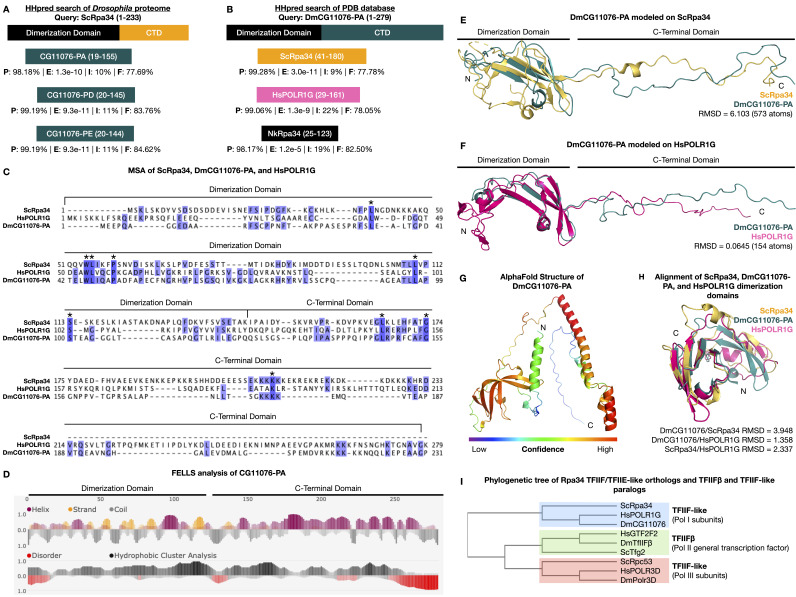 Figure 1
- —National Institute of General Medical Sciences (United States)https://ror.org/04q48ey07
Peer Reviews
No public reviews on file for this paper yet. If you reviewed it on a platform where reviews are public (OpenReview, ICLR, NeurIPS, ICML), you can paste yours below so the community can read it here.
Videos
No videos yet. Explain this paper in a talk, walkthrough, or lecture? Add one.
Taxonomy
TopicsRNA and protein synthesis mechanisms · Genomics and Phylogenetic Studies · Plant biochemistry and biosynthesis
Description
RNA Polymerase I (Pol I) is an essential multiprotein complex required for the synthesis of pre-ribosomal RNA. In the yeast Saccharomyces cerevisiae , Pol I is made up of 14 subunits, whereas in humans, Pol I is made up of only 13 subunits. Rpa34 and Rpa49 in S. cerevisiae , and POLR1G and POLR1E in humans, are Pol I subunits that form a TFIIF/TFIIE-like heterodimer through a conserved beta barrel dimerization domain. This heterodimer functions at many steps throughout the transcription cycle (Geiger et al. 2010; Vannini and Cramer 2012; Knutson et al. 2020) . Although Rpa34 and POLR1G are conserved in S. cerevisiae and humans, the fruit fly *Drosophila melanogaster * lacks an identifiable ortholog of Rpa34 based on sequence homology (Marygold et al. 2020) . This is surprising because the *Drosophila * genome encodes an ortholog of the Rpa34 dimerization partner, Rpa49 (Polr1E). It is unlikely that one protein from this heterodimer would be lost from the *Drosophila * genome, therefore, we hypothesized that *Drosophila * does encode an ortholog of Rpa34/POLR1G, but that it has diverged considerably such that sequence homology alone cannot detect it. To overcome this, we employed remote homology detection that considers structural information along with sequence homology to increase the sensitivity and depth of our search.
To search for a *Drosophila * ortholog of S. cerevisiae Rpa34, we used HHpred (Söding 2005; Hildebrand et al. 2009; Meier and Söding 2015; Zimmermann et al. 2018; Gabler et al. 2020). HHpred is a powerful and highly sensitive remote homology search method that readily detects homology between distantly related proteins, or those that have diverged considerably in sequence, as we predicted was the case for a Drosophila Rpa34 ortholog. The protein sequence of Rpa34 was used to query the *Drosophila * proteome, and the only three matches with high probability and significant E-values corresponded to three isoforms of uncharacterized Drosophila protein CG11076 ( Figure 1A ). The top two matches were identical isoforms of CG11076: CG11076-PD and CG11076-PE. Each isoform comprises 260 amino acids and appear to be expressed from the same promoter, but with different transcription start sites (TSS; FlyBase.org). The third match was CG11076-PA, which is identical to CG11076-PD and CG11076-PE, except for an additional 19 amino acids at the N-terminus. CG11076-PA is expressed from a different promoter with a distinct TSS.
Sequence identity between the CG11076 isoforms and Rpa34 was low (Figures 1A, 1C). There was only 10-11% identity between the residues of the CG11076 isoforms that aligned to Rpa34. Alternatively, we considered the percent of aligned residues predicted to have a similar fold (i.e., coil or random coil structure, helix structure, beta strand or extended conformation, or isolated beta bridge residue). In contrast with sequence identity, the percent of aligned residues predicted to have a similar fold was high, ranging from 77.69% to 84.62% ( Figure 1A ). These results suggest that CG11076, the putative Drosophila ortholog of S. cerevisiae Rpa34, has strong secondary structure conservation with Rpa34, but very little sequence identity. The lack of sequence identity between CG11076 and Rpa34 likely accounts for why previous work to identify Drosophila Pol subunits via sequence homology was unable to identify a Drosophila ortholog of S. cerevisiae Rpa34 (Marygold et al. 2020) .
Given that CG11076 and Rpa34 have similar predicted secondary structure features ( Figure 1A ), we next compared the predicted secondary structure of CG11076 to experimentally determined structures of Rpa34 orthologs. To do this, we used the sequence of CG11076-PA (the canonical UniProt isoform) to query the PDB database using HHpred (Söding 2005; Hildebrand et al. 2009; Meier and Söding 2015; Zimmermann et al. 2018; Gabler et al. 2020). The only three matches with high probability and significant E-values all corresponded to Rpa34 orthologs ( Figure 1B ). The top match was S. cerevisiae Rpa34, from the Cryo-EM structure of the S. cerevisiae Pol I preinitiation complex (PDB 6RUI, chain N; Sadian et al. 2019). The second match was the human ortholog of S. cerevisiae Rpa34, POLR1G, from the Cryo-EM structure of elongating human Pol I (PDB 7VBB, chain N; Zhao et al. 2021). The third match was the Nakaseomyces glabratus (the yeast formerly known as Candida glabrata ) ortholog of Rpa34, from the crystal structure of the Rpa34/Rpa49 heterodimer (PDB 3NFG, chain B; Geiger et al. 2010). Again, the sequence identity between CG11076 and the orthologs was low (Figures 1B, 1C). There was only 9-22% identity between the residues of CG11076-PA that aligned to *S. cerevisiae * Rpa34, human POLR1G, or *N. glabratus * Rpa34. In contrast with sequence identity, the percent of aligned residues predicted to have a similar fold was very high, ranging from 77.78% to 82.50%. The results suggest that the predicted secondary structure of CG11076 is like those of the experimentally determined structures of three different Rpa34 orthologs.
Both S. cerevisiae Rpa34 and human POLR1G consist of an N-terminal TFIIF/TFIIE-like beta barrel dimerization domain followed by a disordered C-terminal domain (CTD; Sadian et al. 2019; Zhao et al. 2021). To determine whether CG11076-PA follows a similar structural synteny, we analyzed the secondary structure of CG11076-PA using FELLS (Piovesan et al. 2017) . Secondary structure analysis of CG11076-PA ( Figure 1D ) showed that the N-terminus is enriched in beta sheet segments, as expected for a TFIIF-like beta barrel domain. Likewise, the CG11076-PA C-terminal domain, particularly near the last third of the CTD, lacked high confidence secondary structure and was predicted to be disordered like its S. cerevisiae and human orthologs. These observations are also supported by the AlphaFold structure of CG11076-PA, which predicted that the N-terminus of CG11076 comprises beta sheet segments, but that the very end of the CTD is highly disordered ( Figure 1G ).
To further assess the structural similarity between CG11076-PA and either S. cerevisiae Rpa34 or human POLR1G, the protein sequence of CG11076-PA was modeled onto the Cryo-EM structures of S. cerevisiae Rpa34 and human POLR1G using MODELLER (Šali et al. 1995; Webb and Sali 2016; Zimmermann et al. 2018; Gabler et al. 2020). The resulting structures of CG11076-PA were aligned to S. cerevisiae Rpa34 ( Figure 1E ) and human POLR1G ( Figure 1F ) using PyMol. We also used PyMol to calculate the root mean square deviation (RMSD) for each alignment, which assesses the similarity between the aligned structures. While the RMSD of the CG11076-PA/Rpa34 alignment was 6.103, the RMSD for the CG11076-PA/POLR1G alignment was 0.645. These RMSD values indicate that model of CG11076 aligns better to human POLR1G than to S. cerevisiae Rpa34. This is expected, given that *Drosophila * and human are both metazoans and are more closely related than either is to S. cerevisiae . Nevertheless, both CG11076-PA models aligned well to either the S. cerevisiae Rpa34 or human POLR1G Cryo-EM structures, especially within the highly conserved N-terminal beta sheets that make up the dimerization domain. Moreover, the N-terminus of CG11076-PA is predicted with high confidence by AlphaFold to form beta sheet segments ( Figure 1G ). Therefore, we aligned the beta sheet regions from the AlphaFold structures of S. cerevisiae Rpa34 and human POLR1G to that of CG11076-PA to determine whether the predicted structures also aligned well ( Figure 1H ). The RMSD value for the CG11076/Rpa34 alignment was 3.948 (154 atoms), for the CG11076/POLR1G alignment was 1.358 (199 atoms), and for the Rpa34/POLR1G alignment was 2.337 (326 atoms). Overall, these results suggest strong structural conservation between Drosophila CG11076 and human POLR1G.
*S. cerevisiae * Rpa34 (TFIIF-like subunit of Pol I) is a paralog of both S. cerevisiae Tfg2 (subunit of Pol II general transcription factor TFIIFβ) and S. cerevisiae Rpc53 (TFIIF-like subunit of Pol III). Drosophila TfIIFβ and human GFT2F2 are homologous to S. cerevisiae Tfg2, and Drosophila Polr3D and human POLR3D are homologous to *S. cerevisiae * Rpc53. To determine the evolutionary relationships between CG11076 and these Rpa34 orthologs/paralogs in Pols I, II, and III, we constructed an unrooted phylogenetic tree from multiple HHPred sequence alignments encompassing the conserved beta barrel dimerization domains of these proteins ( Figure 1I ). As expected, CG11076 clusters with S cerevisiae Rpa34 and human POLR1G (i.e., its Pol I counterparts), demonstrating that they are evolutionarily related.
Together, our *in silico * analysis of the structural properties of *Drosophila * CG11076 in comparison with those of *S. cerevisiae * Rpa34 and human POLR1G suggest strong structural homology between the three proteins. Therefore, we propose that CG11076 is the missing *Drosophila * ortholog of Rpa34/POLR1G, bringing the total number of *Drosophila * Pol I subunits to 13, as in humans. Following the naming convention of Marygold et al. (2020), we suggest hereon referring to CG11076 as Polr1G.
Methods
The protein sequence of Saccharomyces cerevisiae Rpa34 (UniProt P47006, release 2023_05) was used to query the entire Drosophila proteome (Euk_Drosophila_melanogaster_19_Jul_2017) using HHpred ( https://toolkit.tuebingen.mpg.de/tools/hhpred ; Söding 2005; Hildebrand et al. 2009; Meier and Söding 2015; Zimmermann et al. 2018; Gabler et al. 2020). The protein sequence of CG11076-PA (the canonical UniProt isoform, Q9V493, release 2023_05) was used to query the PDB_mmCIF70_4_Oct structural/domain database using HHpred. The protein sequences of CG11076-PA (UniProt Q9V493, release 2023_05), *S. cerevisiae * Rpa34 (PDB 6RUI, chain N; Sadian et al. 2019), and human POLR1G (PDB 7VBB, chain N, lacking the C-terminal domain, for clarity; Zhao et al. 2021) were aligned using HHpred, and colored by percent identity in Jalview (Waterhouse et al. 2009) . The secondary structure and predicted disorder of CG11076-PA were analyzed and displayed using the FELLS server with default settings ( http://old.protein.bio.unipd.it/fells/ ; Piovesan et al. 2017). The protein sequence of CG11076-PA was modeled onto *S. cerevisiae * Rpa34 using MODELLER ( https://toolkit.tuebingen.mpg.de/tools/modeller ; Šali et al. 1995; Zimmermann et al. 2018; Gabler et al. 2020), and the resulting structure of CG11076-PA was aligned to *S. cerevisiae * Rpa34 using PyMol (via the “super” alignment method). The protein sequence of CG11076-PA was modeled onto human POLR1G using MODELLER, and the resulting structure of CG11076-PA was aligned to human POLR1G using PyMol [via the “align” alignment function with outlier rejection (cycles: 5, cutoff: 2.0)]. To determine the structural conservation between CG11076, *S. cerevisiae * Rpa34, and human POLR1G, the N-terminal beta sheet segments from the AlphaFold structures of Rpa34 (AF-P47006-F1-model_v4, residues 32-142), CG11076-PA (AF-Q9V493-F1-model_v4, residues 40-122), and POLR1G (AF-O15446-F1-model_v4, residues 21-120) were reciprocally aligned using PyMol [via the “align” alignment function in PyMol with outlier rejection (cycles: 5, cutoff: 2.0)]. This produced RMSD values for each pairwise alignment. To align and perform phylogenetic analysis of TFIIF-like and TFIIFβ subunits, the *Drosophila * and human orthologs of *S. cerevisiae * Tfg2 and Rpc53 (paralogs of Rpa34) were identified using the FlyBase Homolog Search tool (FlyBase.org, release FB2023_06). Drosophila TfIIFβ (UniProt P41900, release 2023_05) and human GFT2F2 (UniProt P13984, release 2023_05) are homologous to S. cerevisiae Tfg2 (UniProt P41896, release 2023_05), and Drosophila Polr3D (UniProt Q8SYM9, release 2023_05) and human POLR3D (UniProt P05423, release 2023_05) are homologous to *S. cerevisiae * Rpc53 (UniProt P25441, release 2023_05). HHpred was used to produce multiple sequence alignments (MSA) of the conserved beta barrel dimerization domains of S. cerevisiae, Drosophila , and human Rpa34 orthologs/paralogs. These alignments were combined and converted to FASTA format. Phylogenetic analysis and tree construction was performed using the Simple Phylogeny program ( https://www.ebi.ac.uk/Tools/phylogeny/simple_phylogeny/ ; Madeira et al. 2022). Default settings were used, except for using a NEXUS tree format and the UPGMA clustering method. The resulting tree was viewed with a cladogram branch length.
The reference list from the paper itself. Each links out to its DOI / PubMed record.
- 1Gabler F Nam SZ Till S Mirdita M Steinegger M Söding J Lupas AN Alva V 2020121 Protein Sequence Analysis Using the MPI Bioinformatics Toolkit.Curr Protoc Bioinformatics 7211934-3396 e 108e 10810.1002/cpbi.10833315308 · doi ↗ · pubmed ↗
- 2Geiger SR Lorenzen K Schreieck A Hanecker P Kostrewa D Heck AJ Cramer P 2010827 RNA polymerase I contains a TFIIF-related DNA-binding subcomplex.Mol Cell 3941097-276558359410.1016/j.molcel.2010.07.02820797630 · doi ↗ · pubmed ↗
- 3Hildebrand A Remmert M Biegert A Söding J 2009 Fast and accurate automatic structure prediction with H Hpred.Proteins 77 Suppl 90887-358512813210.1002/prot.2249919626712 · doi ↗ · pubmed ↗
- 4Knutson BA Mc Namar R Rothblum LI 20201030 Dynamics of the RNA polymerase I TFIIF/TFIIE-like subcomplex: a mini-review.Biochem Soc Trans 4850300-51271917192710.1042/BST 2019084832915199 PMC 10793690 · doi ↗ · pubmed ↗
- 5Madeira F Pearce M Tivey ARN Basutkar P Lee J Edbali O Madhusoodanan N Kolesnikov A Lopez R 202275 Search and sequence analysis tools services from EMBL-EBI in 2022.Nucleic Acids Res 50W 10305-1048 W 276W 27910.1093/nar/gkac 24035412617 PMC 9252731 · doi ↗ · pubmed ↗
- 6Marygold SJ Alic N Gilmour DS Grewal SS 20201020 In silico identification of Drosophila melanogaster genes encoding RNA polymerase subunits.Micro Publ Biol 202010.17912/micropub.biology.00032033274328 PMC 7704258 · doi ↗ · pubmed ↗
- 7Meier A Söding J 20151023 Automatic Prediction of Protein 3D Structures by Probabilistic Multi-template Homology Modeling.P Lo S Comput Biol 11101553-734Xe 1004343 e 100434310.1371/journal.pcbi.100434326496371 PMC 4619893 · doi ↗ · pubmed ↗
- 8Piovesan D Walsh I Minervini G Tosatto SCE 2017615 FELLS: fast estimator of latent local structure.Bioinformatics 33121367-48031889189110.1093/bioinformatics/btx 08528186245 · doi ↗ · pubmed ↗