Local spin polarization of $\Lambda$ hyperons and its interaction corrections
Cong Yi, Shuo Fang, Dong-Lin Wang, Shi Pu

TL;DR
This paper calculates the spin polarization of $\\Lambda$ hyperons in heavy-ion and proton-lead collisions using hydrodynamics, successfully matching Au+Au data but highlighting puzzles in p+Pb collisions, and discusses recent theoretical developments.
Contribution
It introduces a hydrodynamic calculation of hyperon spin polarization and explores interaction corrections, addressing experimental data and theoretical advancements.
Findings
Successfully describes Au+Au collision data
Highlights unresolved issues in p+Pb collisions
Discusses recent progress in quantum kinetic theory
Abstract
We have computed the second Fourier sine coefficient of the longitudinal spin polarization, , as a function of multiplicity or centrality in Au+Au collisions at GeV and in +Pb collisions at TeV using the CLVisc hydrodynamic framework. The numerical results successfully describe the data in Au+Au collisions. However, understanding the data in +Pb collisions remains a puzzle. Additionally, we have reported some recent developments in quantum kinetic theory and spin hydrodynamics.
Click any figure to enlarge with its caption.
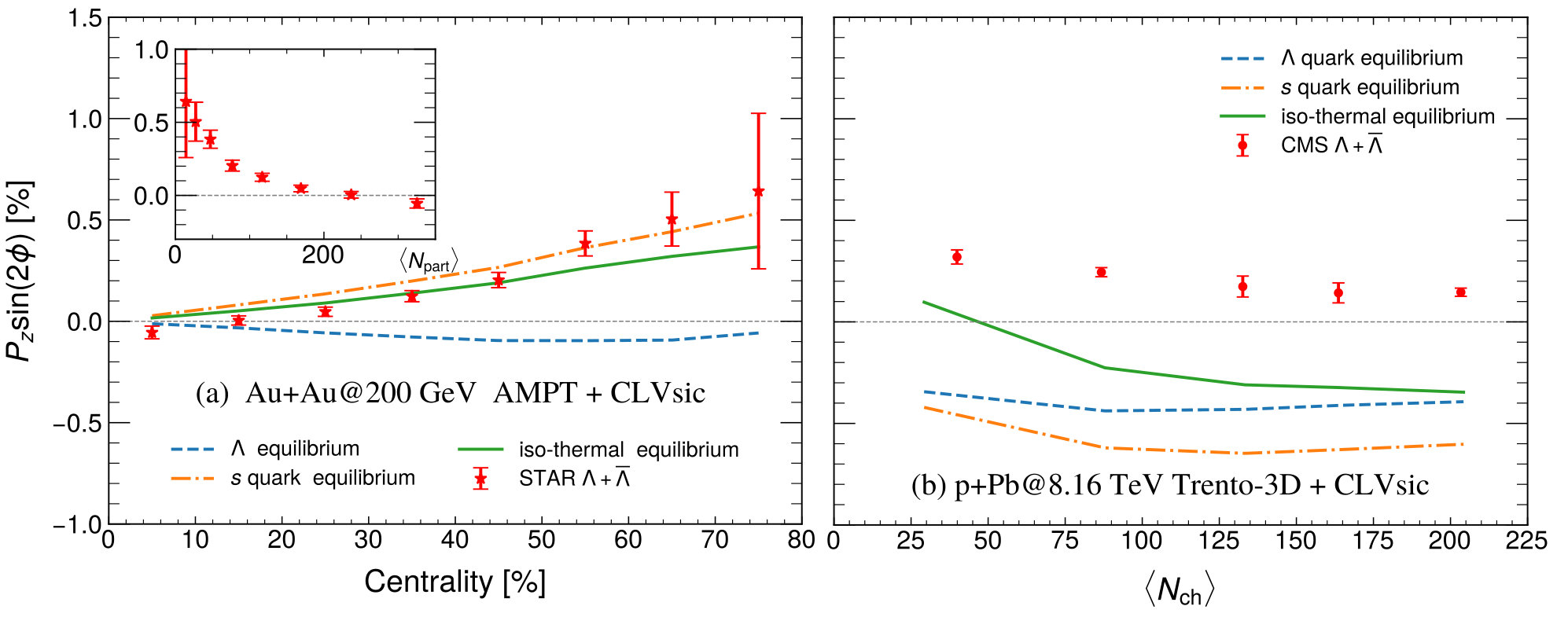 Figure 1
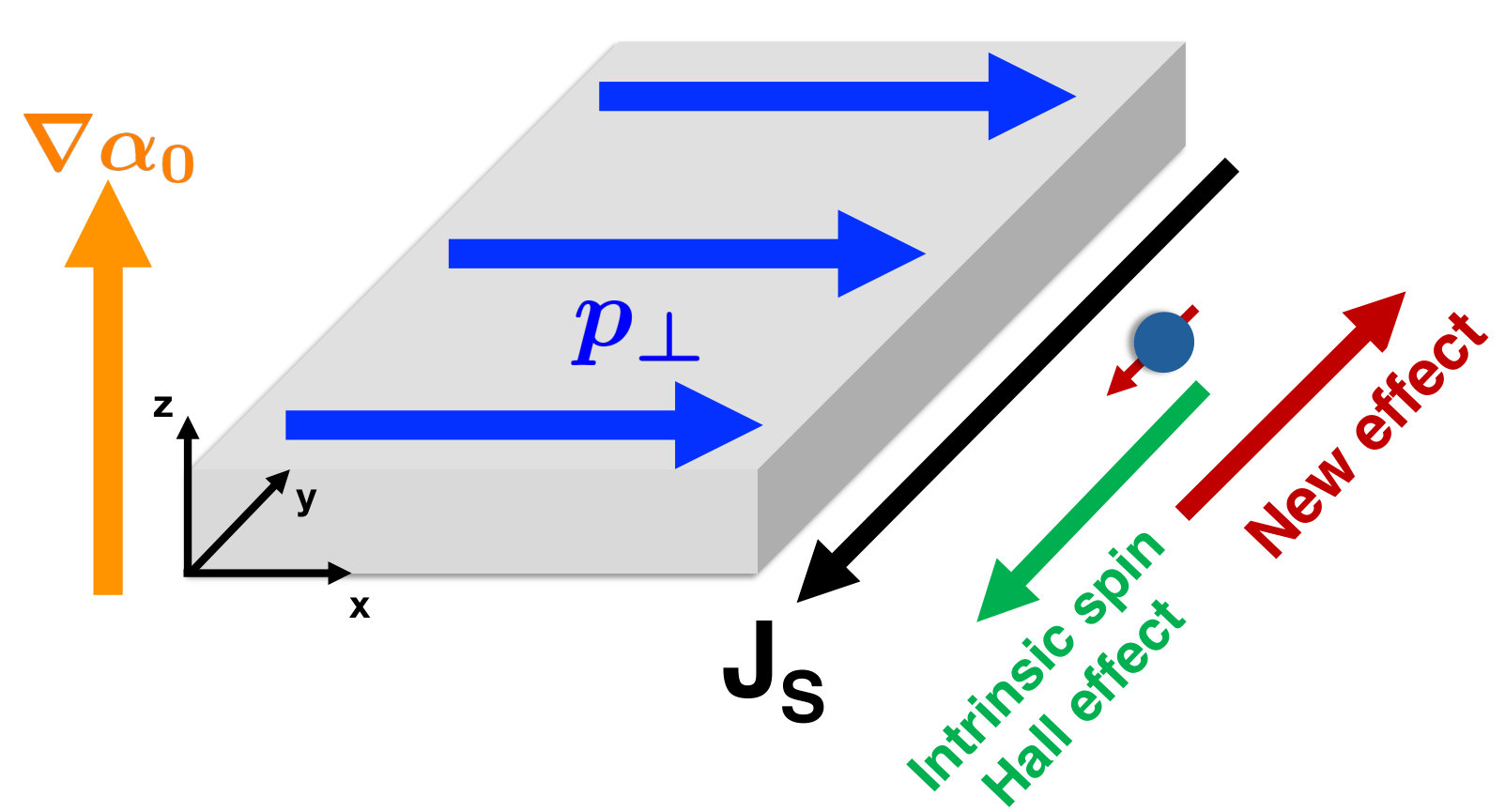 Figure 2
 Figure 3
Peer Reviews
No public reviews on file for this paper yet. If you reviewed it on a platform where reviews are public (OpenReview, ICLR, NeurIPS, ICML), you can paste yours below so the community can read it here.
Videos
No videos yet. Explain this paper in a talk, walkthrough, or lecture? Add one.
Taxonomy
TopicsHigh-Energy Particle Collisions Research · Quantum Chromodynamics and Particle Interactions · Particle physics theoretical and experimental studies
11institutetext: Institute of Particle Physics and Key Laboratory of Quark and Lepton Physics (MOE), Central China Normal University, Wuhan 430079, China 22institutetext: Department of Modern Physics, University of Science and Technology of China, Hefei, Anhui 230026, China 33institutetext: Technical University of Munich, TUM School of Natural Sciences, Physics Department, James-Franck-Str. 1, 85748 Garching, Germany
Local spin polarization of hyperons and its interaction corrections
\firstnameCong \lastnameYi 1122
\firstnameShuo \lastnameFang 2233
\firstnameDong-Lin \lastnameWang 22
\firstnameShi \lastnamePu\fnsep Speaker: [email protected]
Abstract
We have computed the second Fourier sine coefficient of the longitudinal spin polarization, , as a function of multiplicity or centrality in Au+Au collisions at GeV and in +Pb collisions at TeV using the CLVisc hydrodynamic framework. The numerical results successfully describe the data in Au+Au collisions. However, understanding the data in +Pb collisions remains a puzzle. Additionally, we have reported some recent developments in quantum kinetic theory and spin hydrodynamics.
1 Introduction
In relativistic heavy-ion collisions, two nuclei are accelerated close to the speed of light, accompanied by a huge initial orbital angular momentum on the order of . Such a large initial orbital angular momentum can lead to the spin polarization of hyperons and the spin alignment of vector mesons, as proposed in the early pioneering work Liang:2004ph . The RHIC-STAR collaboration has measured the global polarization of hyperons STAR:2017ckg . This global polarization can be well described as being induced by the thermal vorticity Becattini:2017gcx . Subsequently, the polarization along the beam direction as a function of the azimuthal angle , referred to as the local polarization of hyperons, has also been measured STAR:2019erd . It was found that the polarization induced by the shear viscous tensor plays a crucial role in understanding the local polarization, in addition to the contribution from thermal vorticity Fu:2021pok ; Becattini:2021iol ; Yi:2021ryh . For further details, we refer the reader to the recent review Becattini:2024uha and references therein.
Very recently, the LHC-CMS collaboration measured the second Fourier sine coefficient of the longitudinal spin polarization of hyperons, namely , as a function of centrality or multiplicity in p+Pb collisions at TeV CMS:2025nqr , as shown in Fig. 1(b). Surprisingly, the magnitude and trend of as a function of multiplicity in p+Pb collisions are very similar to those in Au+Au collisions, as shown in Fig. 1(a). The data suggests a very weak system and collisional energy dependence. It remains unclear how to interpret the results in p+Pb collisions at this stage. In this work, we summarize the main results obtained using hydrodynamic simulations and briefly discuss possible corrections arising from interactions between particles. Finally, we also introduce some very recent developments in relativistic spin hydrodynamics.
2 Centrality dependence of in Au+Au and p+Pb collisions
We implement the (3+1)-D CLVisc hydrodynamic framework to investigate the local polarization of hyperons under three scenarios: equilibrium Fu:2021pok ; Yi:2021ryh , -quark equilibrium Fu:2021pok ; Yi:2021ryh , and iso-thermal equilibrium Becattini:2021iol . The centrality or multiplicity dependence of is presented in Fig. 1(a) for Au+Au collisions and Fig. 1(b) for p+Pb collisions. The parameters used in our simulations are tuned to reproduce the observed multiplicity and elliptic flow. More details about the theoretical framework and simulation setup can be found in Ref. Wu:2022mkr for Au+Au collisions and Ref. Yi:2024kwu for p+Pb collisions.
In Fig. 1(a), we observe that our numerical results for of hyperons in both the -quark equilibrium and iso-thermal equilibrium scenarios agree with the experimental data, whereas the results in the equilibrium scenario fail to capture the correct trend. These findings are consistent with those reported in Refs. Fu:2021pok ; Becattini:2021iol . On the other hand, in Fig. 1(b), we find that our theoretical predictions of for p+Pb collisions under all three scenarios cannot describe the data. The main reason is that the shear-induced polarization in p+Pb collisions is insufficient to flip the sign of the total local polarization Yi:2024kwu . Understanding the local polarization in small systems remains an open puzzle.
3 Interaction corrections from quantum kinetic theory
Though several puzzles regarding the local spin polarization of hyperons remain, significant efforts have been made in recent years to investigate off-equilibrium and interaction modifications based on quantum kinetic theory (QKT). QKT provides a systematic framework that incorporates particle and spin transport on the same footing through Wigner functions, rooted in non-equilibrium quantum field theory (for a detailed review, see Ref. (Hidaka:2022dmn, ) and references therein). The phase-space spin-current density can be expressed in terms of the axial-vector fermion two-point Wigner function, , under the canonical pseudo-gauge. Currently, there are two primary approaches to incorporate interaction corrections to local polarization. The first approach involves directly solving the axial-vector kinetic equation, which includes collisional and background-field effects under quasi-particle approximations. Interaction corrections to the spin current can then be calculated from perturbative solutions of the axial-vector Wigner function. The second approach coarse-grains QKT into relativistic spin hydrodynamics, where the interaction information is encoded in transport coefficients, such as the spin relaxation time. In this method, off-equilibrium corrections to spin-dependent distribution functions are obtained by solving the spin hydrodynamic equations, which govern the evolution of the moments of these spin-dependent distributions. Consequently, the off-equilibrium modifications to the modified Cooper-Frye formula are derived.
The calculation of the collisional contribution with NJL-type interactions was presented using QKT and the method of moments expansion (Weickgenannt:2022zxs, ; Weickgenannt:2022qvh, ) under the Hilgevoord-Wouthuysen pseudogauge. Subsequently, a resummed spin hydrodynamics was derived using the inverse-Reynolds dominance approach (Wagner:2024fry, ), and similar corrections were calculated. These corrections depend on independent fields, which include the components of the spin potential and the spin-stress tensor . Numerical simulations of such relativistic spin hydrodynamics, expressed in terms of , and their influence on spin polarization were presented in Ref. (Sapna:2025yss, ).
An alternative calculation of the off-equilibrium corrections was performed by directly solving quantum kinetic equations, including solving vector and axial-vector distribution functions, , as presented in Ref. (Fang:2024vds, ). The leading gradient contribution originates from the collisional term , with , and results in a cancellation of the coupling constant. For instance, in the QED-type -to- scattering process under the hard-thermal-loop approximation, this contribution is expressed as,
[TABLE]
where is the inverse temperature, are functions of the particle’s energy , with being the chemical potential, and is the shear viscous tensor. Eq. (1) captures the side-jump mechanism in the phase-space spin Hall effect, which results from the accumulation of jump shifts during each collision event and can be traced back to Berry curvature effects and is illustrated in Fig. 2. The explicit expressions for and additional relevant works can be found in Ref. (Fang:2024vds, ). On the other hand, the skew-scattering contribution, arising from spin-dependent (non-local) collisions via , is of the order (Fang:2024vds, ). In a weakly coupled quark-gluon plasma, another contribution arises from medium semi-long-wavelength excitations of . Here, the spacetime gradient of the in-medium quark self-energy, , acts as an effective background electromagnetic field that serves as a source of spin torque and induces Hall-type currents (Fang:2023bbw, ). Nevertheless, it remains an open question how to investigate spin polarization in a strongly coupled QCD plasma by generalizing QKT beyond the quasi-particle regime.
4 Some developments on spin hydrodynamics
The macroscopic approach to describe spin evolution in relativistic heavy-ion collisions is to add the spin degree of freedom to relativistic hydrodynamics, leading to the framework of relativistic spin hydrodynamics Florkowski:2018fap ; Hattori:2019lfp ; Fukushima:2020ucl . The basic idea in canonical spin hydrodynamics is to decompose the rank-3 total angular momentum tensor as, where and represent the energy-momentum tensor and spin tensor, respectively. The first two terms in the decomposition constitute the orbital angular momentum. The evolution equation for the spin tensor follows from the decomposition of the total angular momentum and the conservation of energy, momentum, and total angular momentum, , where the antisymmetric part of the energy-momentum tensor, , serves as a spin torque that describes the transfer of angular momentum between orbital and spin components. For more details, we refer to recent reviews in Refs. Becattini:2024uha ; Shi:2023sxh and references therein. Recently, spin hydrodynamics with a totally antisymmetric spin tensor has been proposed in Ref. Fang:2025aig . The resulting evolution equation for spin density incorporates the effects of Thomas precession and couplings between spin and hydrodynamic motion, such as rotation and expansion, thereby generalizing the well-known Bargmann-Michel-Telegdi equation to hydrodynamics.
Despite significant progress in recent years, several challenges remain in the development of spin hydrodynamics. One major issue is the choice of pseudo-gauges. Different pseudo-gauges lead to different definitions of the spin tensor and, consequently, distinct evolution equations Speranza:2020ilk . For instance, in the canonical gauge, , and spin tensor is not conserved Hattori:2019lfp ; Fukushima:2020ucl , whereas in the Hilgevoord-Wouthuysen gauge, , and spin tensor is conserved Weickgenannt:2022zxs . Notably, the spin tensor vanishes in the Belinfante gauge Fukushima:2020ucl . Presently, there is no consensus on which gauge is physically preferred (see also the recent discussions in Refs. Buzzegoli:2021wlg ; Buzzegoli:2024mra ; Becattini:2025twu ). Another issue lies in the thermodynamic relationships commonly used in spin hydrodynamics, which have been shown to be incomplete. More comprehensive versions have been proposed using quantum statistical methods Becattini:2023ouz ; Becattini:2025oyi and kinetic theory Florkowski:2024bfw , but further investigations are required to understand the implications of new corrections. Additionally, spin hydrodynamic equations are known to exhibit acausal modes Xie:2023gbo and unstable modes Daher:2022wzf . Acausal modes can be eliminated by properly including relaxation times, while the unstable modes require distinguishing spin susceptibilities for the electric and magnetic components of the spin density. However, this approach lacks a clear physical interpretation and requires further exploration.
5 Summary
The observable , as a function of centrality or multiplicity in high-energy nucleus-nucleus collisions, has been successfully described by hydrodynamic models. However, these models fail to reproduce the behavior of in +Pb collisions. There have been significant advancements in both microscopic and macroscopic approaches. Within the framework of quantum kinetic theory, various interaction corrections have been computed, contributing to local spin polarization. On the other hand, in spin hydrodynamics, although substantial progress has been made, the pseudo-gauge dependence remains an unresolved puzzle.
Acknowledgements:
This work is supported in part by the National Key Research and Development Program of China under Contract No. 2022YFA1605500, by the Chinese Academy of Sciences (CAS) under Grant No. YSBR-088.
The reference list from the paper itself. Each links out to its DOI / PubMed record.
- 1(1) Z.T. Liang, X.N. Wang, Globally polarized quark-gluon plasma in non-central A+A collisions, Phys. Rev. Lett. 94 , 102301 (2005), [Erratum: Phys.Rev.Lett. 96, 039901 (2006)], nucl-th/0410079 . \doiwoc 10.1103/Phys Rev Lett.94.102301
- 2(2) L. Adamczyk et al. (STAR), Global Λ \Lambda hyperon polarization in nuclear collisions: evidence for the most vortical fluid, Nature 548 , 62 (2017), 1701.06657 . \doiwoc 10.1038/nature 23004
- 3(3) F. Becattini, I. Karpenko, Collective Longitudinal Polarization in Relativistic Heavy-Ion Collisions at Very High Energy, Phys. Rev. Lett. 120 , 012302 (2018), 1707.07984 . \doiwoc 10.1103/Phys Rev Lett.120.012302
- 4(4) J. Adam et al. (STAR), Polarization of Λ \Lambda ( Λ ¯ \bar{\Lambda} ) hyperons along the beam direction in Au+Au collisions at s N N \sqrt{s_{{}_{NN}}} = 200 Ge V, Phys. Rev. Lett. 123 , 132301 (2019), 1905.11917 . \doiwoc 10.1103/Phys Rev Lett.123.132301
- 5(5) B. Fu, S.Y.F. Liu, L. Pang, H. Song, Y. Yin, Shear-Induced Spin Polarization in Heavy-Ion Collisions, Phys. Rev. Lett. 127 , 142301 (2021), 2103.10403 . \doiwoc 10.1103/Phys Rev Lett.127.142301
- 6(6) F. Becattini, M. Buzzegoli, G. Inghirami, I. Karpenko, A. Palermo, Local Polarization and Isothermal Local Equilibrium in Relativistic Heavy Ion Collisions, Phys. Rev. Lett. 127 , 272302 (2021), 2103.14621 . \doiwoc 10.1103/Phys Rev Lett.127.272302
- 7(7) C. Yi, S. Pu, D.L. Yang, Reexamination of local spin polarization beyond global equilibrium in relativistic heavy ion collisions, Phys. Rev. C 104 , 064901 (2021), 2106.00238 . \doiwoc 10.1103/Phys Rev C.104.064901
- 8(8) F. Becattini, M. Buzzegoli, T. Niida, S. Pu, A.H. Tang, Q. Wang, Spin polarization in relativistic heavy-ion collisions, Int. J. Mod. Phys. E 33 , 2430006 (2024), 2402.04540 . \doiwoc 10.1142/9789811294679_0005