B$_\Lambda$($^5_\Lambda$He) from short range effective field theory
Lorenzo Contessi, Nir Barnea, Avraham Gal

TL;DR
This paper develops a pionless effective field theory to describe light hypernuclei with a single Lambda particle, accurately predicting binding energies and resolving overbinding issues in $_\Lambda^5$He.
Contribution
It introduces a leading-order pionless EFT with 5 low energy constants, fitted to scattering data and hypernuclear energies, to model Lambda-nuclear interactions.
Findings
Successfully predicts Lambda separation energy in $_\Lambda^5$He.
Resolves the overbinding problem in $_\Lambda^5$He.
Provides a framework for hypernuclear calculations using EFT.
Abstract
We present an effective field theory (EFT) at leading order to describe light single- hypernuclei. Owing to the weak binding and to the short interaction range, meson exchange forces are approximated by contact interactions within a pionless EFT where the only degrees of freedom are baryons. At leading order, the -nuclear interaction contains two 2-body (singlet and triplet) and three 3-body interaction terms, a total of 5 terms associated with 5 coupling strengths or low energy constants (LECs). We adopt the 2-body LECs from hyperon-nucleon scattering data and interaction models that constrain the scattering lengths, while the 3-body LECs are adjusted using both 3-body and 4-body hypernuclear binding energies. To calculate the binding energies for A-body systems with A2, we expand the wavefunctions using a correlated Gaussian…
Click any figure to enlarge with its caption.
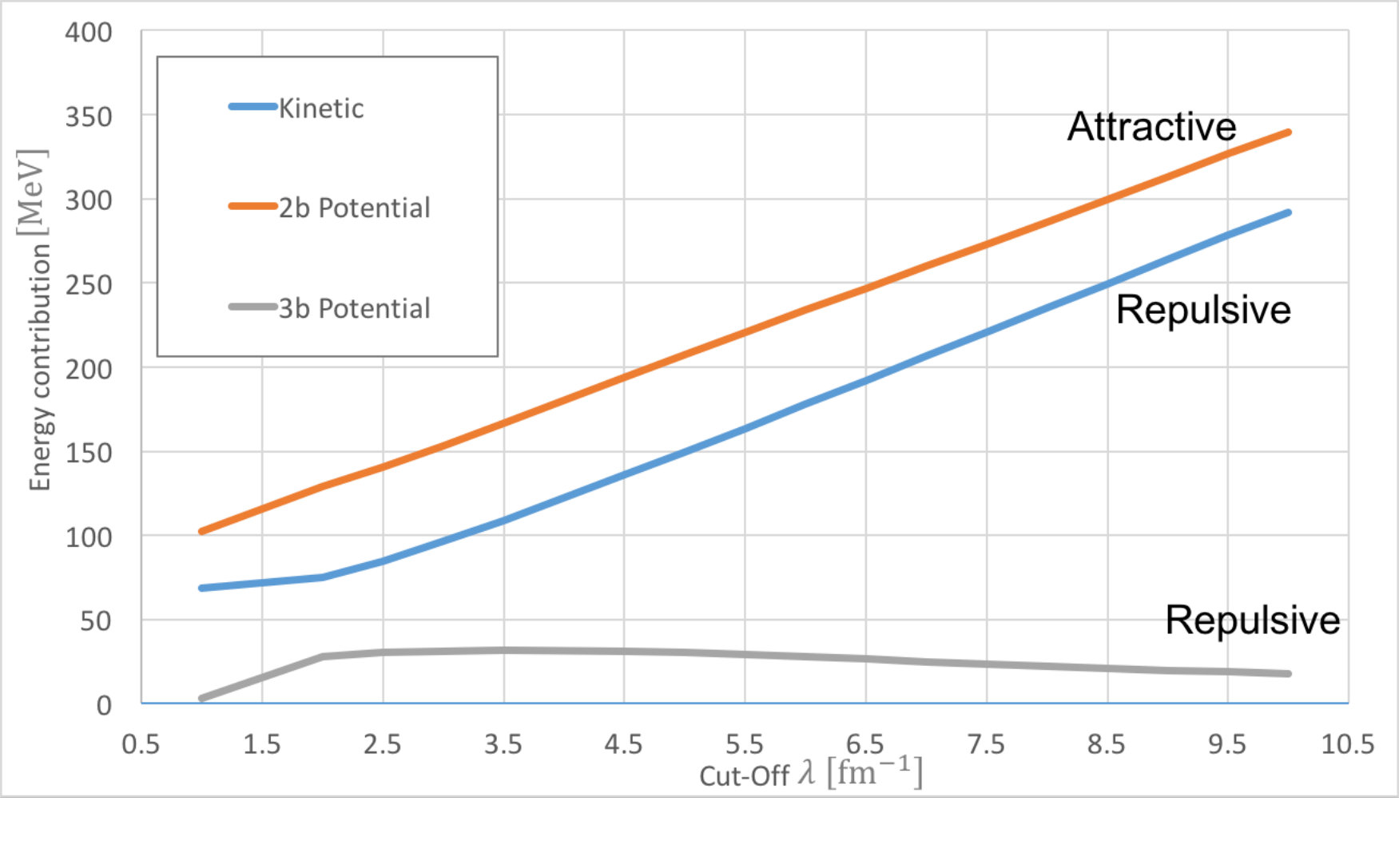 Figure 1
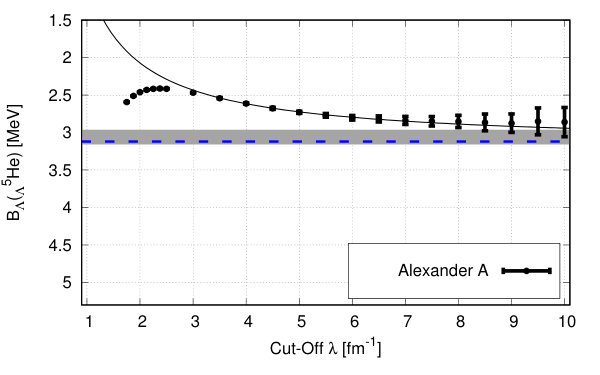 Figure 2
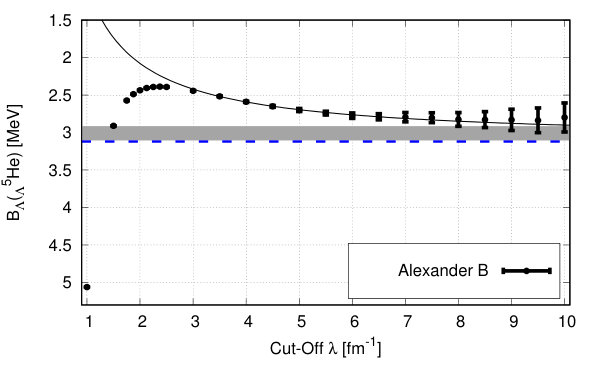 Figure 3
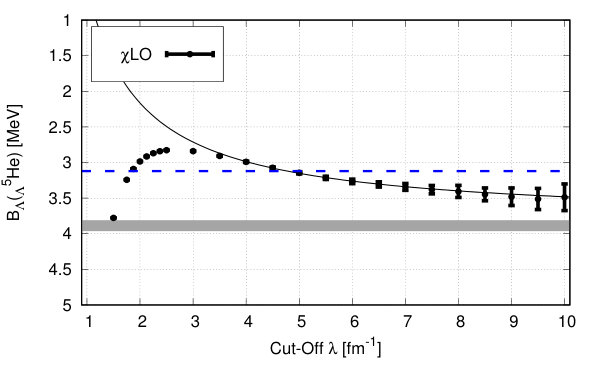 Figure 4
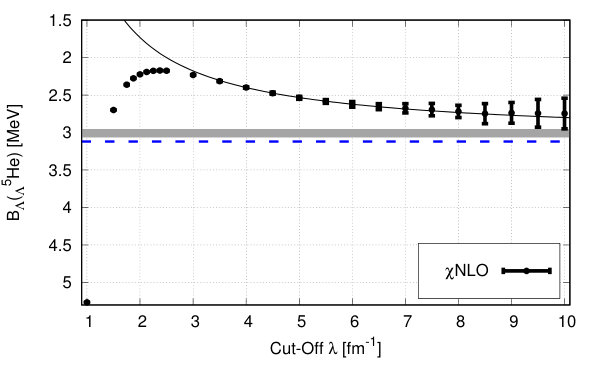 Figure 5
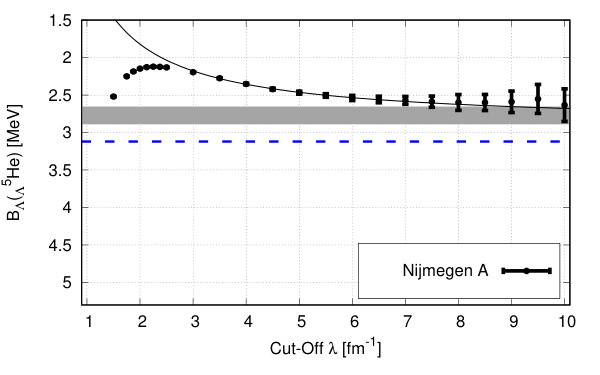 Figure 6
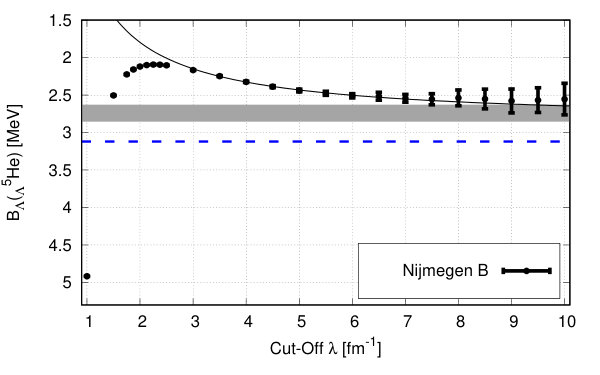 Figure 7
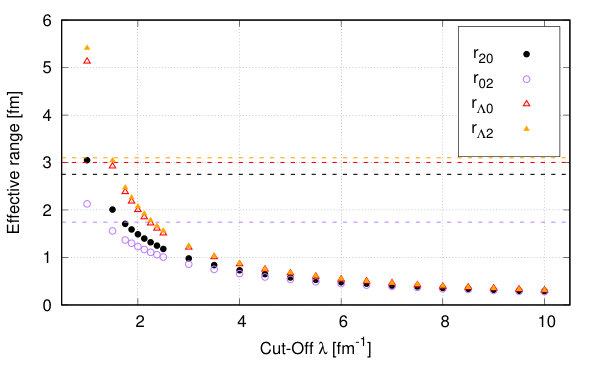 Figure 8
| H) | Hg.s.) | Hexc.) | He) | |
|---|---|---|---|---|
| Exp. | 0.13(5) [9] | 2.16(8) [6, 7] | 1.09(2) [8] | 3.12(2) [9] |
| Dalitz et al. [10] | 0.10 | 2.24 | 0.36 | 5.16 |
| AFDMC (I) | – | 1.97(11) [11] | – | 5.1(1) [12] |
| AFDMC (II) | 1.22(15) [11] | 1.07(8) [11] | – | 3.22(14) [11] |
| AFDMC (III) | 0.23(9) [13] | 1.95(9) [13] | – | 2.75(5) [13] |
| EFT(LO600) | 0.11(1) [14] | 2.31(3) [15, 16] | 0.95(15) [15, 16] | 5.82(2) [17] |
| EFT(LO700) | – | 2.13(3) [15, 16] | 1.39(15) [15, 16] | 4.43(2) [17] |
| He | Alexander[A] | Alexander[B] | Nijmegen[A] | Nijmegen[B] | LO | NLO |
|---|---|---|---|---|---|---|
| =4 fm-1 | 2.61(3) | 2.59(3) | 2.35(3) | 2.32(3) | 2.99(3) | 2.40(3) |
| 3.06(10)(30) | 3.01(10)(30) | 2.77(12)(30) | 2.74(11)(30) | 3.96(08)(35) | 3.01(06)(30) |
Peer Reviews
No public reviews on file for this paper yet. If you reviewed it on a platform where reviews are public (OpenReview, ICLR, NeurIPS, ICML), you can paste yours below so the community can read it here.
Videos
No videos yet. Explain this paper in a talk, walkthrough, or lecture? Add one.
1]Racah Institute of Physics, The Hebrew University, Jerusalem 91904, Israel \corresp[cor1]Corresponding author: [email protected]
BΛ(He) from short range effective field theory
L. Contessi
N. Barnea
A. Gal
[
Abstract
We present an effective field theory (EFT) at leading order to describe light single- hypernuclei. Owing to the weak binding and to the short interaction range, meson exchange forces are approximated by contact interactions within a pionless EFT (EFT) where the only degrees of freedom are baryons. At leading order, the -nuclear interaction contains two 2-body (singlet and triplet) and three 3-body interaction terms, a total of 5 terms associated with 5 coupling strengths or low energy constants (LECs). We adopt the 2-body LECs from hyperon-nucleon scattering data and interaction models that constrain the scattering lengths, while the 3-body LECs are adjusted using both 3-body and 4-body hypernuclear binding energies. To calculate the binding energies for A-body systems with A2, we expand the wavefunctions using a correlated Gaussian basis. The stochastic variational method is employed to select the non-linear parameters. The resulting EFT is then applied to calculate the separation energy in He, where the adjusted 3-body interactions largely resolve the known overbinding problem of He.
1 INTRODUCTION
The inclusion of a particle in nuclei is the first natural step in extending the periodic table into the strangeness sector. While other hyperons such as and might be considered in a theoretical framework, the available hypernuclear data consist almost exclusively of single- hypernuclei which present some fascinating questions, and complications, for theory to resolve. In the present work, we aim to address two of several unsolved problems in hypernuclei: (i) the difficulties in establishing precise scattering parameters from experimental results, and (ii) the so called overbinding problem of He in modern -nuclear interactions.
The experimental difficulties in measuring scattering parameters stem from the unavailability of hyperon beams or hyperon targets, thereby limiting all measurements to the use of secondary interactions. Most of the data available in this 2-body sector, which is of great importance for theory, consist of spin-independent scattering total cross sections at insufficiently low energies [1, 5]. Table 1 demonstrates the uncertainty exhibited by adopting scattering lengths directly from fits to scattering cross sections [1] or from several leading hyperon-nucleon (YN) interaction models, with spin-singlet values varying between 1.91 and 2.91 fm and spin-triplet values varying between 1.23 and 1.71 fm. Interestingly, the uncertainty in the listed values of the spin-independent scattering length combination is somewhat smaller. Hypernuclear data too are not as abundant as nuclear data are. The known hypernuclear binding energies are limited to a few dozens of systems, for many of which the deduced information is further limited to ground states. In spite of several recent experiments on light hypernuclei [6, 7, 8] our knowledge in this sector remains incomplete. Altogether one is far from having the precision and extension of experimental data that is found in standard nuclear physics.
It is not surprising, given this background, that many interaction models have been formulated to describe hypernuclei. Most of these models describe well the few-body (A4) sector but overbind heavier hypernuclei starting from He which is overbound by 1-2 MeV and for which precise ab initio calculations are still possible. In Table 2 several of the most commonly used interaction models are listed together with their resulting ground-state separation energies and excitation energies for the relevant 3-, 4-, and 5-body hypernuclei. Already in 1972 Dalitz et al. [10] realized that He was overbound by using a phenomenological + model, and this overbinding problem has persisted in modern EFT interaction models [15, 16, 17] at leading order (LO) and for a wide range of cut-off values (calculations for NLO in EFT have not been reported yet). The only published calculation which seems not to be plagued by the overbinding problem is the one using the AFDMC (II) interaction model [11] which is based on a Bodmer-type interaction [18] and on refitted Urbana-like interactions. However, this interaction model underbinds the 3- and 4-body systems, thus shifting the He overbinding problem to an underbinding problem for the lighter hypernuclei. Recently these authors presented a version of the same interaction, AFDMC (III) [13], in which the separation energies in the 3- and 4-body systems are well reproduced and He is even underbound, implying that He still requires to be fully understood. These calculations suggest that a 2-body interaction is indeed insufficient to reproduce hypernuclear ground-state separation energies, but also that the mere introduction of 3-body interactions does not guarantee that He) is reproduced.
The aim of this report is to show how pionless EFT may be used within error-controlled ab initio few-body calculations to come close to a good reproduction of (He) without incurring substantial overbinding. To this end we review and expand on our recent application of EFT to single hypernuclei [19]. In the following, (He) is calculated for all of the input two-body scattering parameters shown in Table 1, thereby linking binding energy calculations of -shell hypernuclei directly with scattering data and model predictions.
2 PIONLESS EFT
Effective field theories rely on the relevant symmetries of the underlying interactions for the phenomena of interest: Quantum Chromo Dynamics for nuclear and hypernuclear physics. In the present problem, the applicable degrees of freedom are baryons, which along with the low values of the exchanged momentum involved justifies the use of a non-relativistic approach. Moreover, since in light (A5) nuclear and hypernuclear systems is small, explicit meson exchange plays an insignificant role while contact (or pionless) potentials become more appropriate. This is especially true for hyperons which are weakly bound in light hypernuclei, but also for standard nuclei with A4 where the contact approach proved to give exceptionally good results despite the less clear separation of scales [20]. Here we use a regular EFT approach for the nuclear interaction as described by van Kolck in [21] with two 2-body and one 3-body free parameter and, further, develop a EFT approach for hypernuclear systems by adding two 2-body and three 3-body interaction terms.
In both cases, nuclei and hypernuclei, EFT is applied within the same procedure: the interaction at LO assigns one 2-body or a 3-body contact term for each possible 2- and 3-body -wave (=0) state. The and contact terms may be viewed as arising dominantly from and coupled channel interactions, respectively, promoted from subleading order to LO. Momentum dependent operators, spin-orbit and tensor force, which also appear at subleading order in this approach, are not included in the calculation, as well as the Coulomb interaction. The free parameters of the theory are the LECs which are directly related to the structure of the possible few-body states, and are included in the theory as strengths of zero-range contact interactions. However, because a zero-range interaction is too singular to be used without introducing a regularization/renormalization scheme, it is customary to introduce a Gaussian regulator specified by by its momentum cut-off (see e.g. [22]):
[TABLE]
thereby making the LECs cut-off dependent. Choosing other local or nonlocal regulators affects mostly the fitted LECs. The resulting LO two-baryon interaction reads then:
[TABLE]
where are projection operators on pairs with isospin and spin and the coefficients are the respective LECs. The LO three-body interaction consists of a single term associated with the = channel, and three terms associated with the = -wave configurations, with explicit forms given by
[TABLE]
[TABLE]
where the first sum in Eq. (3) runs over all triplets, the second sum in Eq. (4) runs over all pairs, are projection operators on baryon triplets with isospin and spin , and denote the corresponding LECs.
The two nuclear 2-body LECs were fitted here to the deuteron binding energy (2.22 MeV) and two different spin-singlet scattering lengths in the cases Alexander[A] - Alexander[B] and Nijmegen[A] - Nijmegen[B], introduced to test the resilience of the hypernuclear theory against small changes in the nuclear input. parameters are fitted to the 2-body scattering lengths shown in Table 1. All the other parameterizations have different scattering lengths as listed in Table 1. Two of the 3-body coefficients were fitted to reproduce H) and H), but to determine the two remaining LECs it is not possible to use any other 3-body system because of the lack of experimental data. Therefore, Hg.s.) and Hexc.) for the two known levels of the isodoublet hypernuclei with spins , respectively, have been used. He) and He) emerge then as predictions of the theory.
In hypernuclei, a one-pion exchange in the interaction is forbidden by isospin conservation, making two-pion exchange the longest range meson exchange possible and thereby defining an energy breaking scale of , higher than the scale in the nuclear case. Therefore, we expect a truncation error of order 9% for the theoretical prediction of separation energies in single hypernuclei, where the momentum scale is provided in light hypernuclei by MeV/c.
3 RESULTS
In the present work, as in [19], EFT was developed and applied to -shell hypernuclei up to A5 using the Numerov algortihm and the stocastic variational method (SVM) [23] for a range of cut-offs between 1 to 10 fm*-1*. The deuteron binding energy , the 2-body scattering lengths listed in Table 1, H), H), Hg.s.) and Hexc.) were used to determine the three nuclear LECs and the five hypernuclear LECs. The separation energy in He was evaluated by subtracting He) from He) for all the cut-offs considered here. These binding energies were found to depend only moderately on , for fm*-1*, exhibiting renormalization scale invariance in the limit . For example, using fm, one obtains in this limit MeV which compares well with MeV, given that our EFT is truncated at LO and that the Couolomb force should reduce He) further by about 1 MeV. Results for He) are shown in Figure 1.
The calculated separation energies were extrapolated to infinite cut-off using inverse power expansion as suggested by EFT: . In Figure 1, the extrapolated values are represented by gray bands which account for the calculational uncertainty and the estimated systematic extrapolation error. Truncation errors, due to not including subleading orders in the theory, are listed in Table 3.
The He) values shown in Fig. 1 vary from a moderate underbinding for fm*-1*, with a maximum around =2-3 fm*-1*, to few MeV of overbinding for smaller cut-offs, comparable with overbindings produced in other interaction models described in the Introduction. The graphs highlight a convergent pattern between =4 and 10 fm*-1*, with a moderate cut-off dependence when fm*-1*. The extrapolated result is in good agreement with the experimental value of He) upon using the experimentally-based Alexander ([A] or [B]) parametrization and also the EFT(NLO) parametrization. The parametrization of extracted from EFT(LO) leads to overbinding of 1 MeV, while based on the soft-core Nijmegen model ([A] or [B]) leads even to underbinding of a few hundreds of keV. We conclude that EFT applications at LO prefer the smaller input values of from Table 1. The extrapolations also show that changing slightly the nuclear input (from Alexander[A] to Alexander[B] or from Nijmegen[A] to Nijmegen[B]) hardly affects the final results, suggesting that the hypernuclear applications are only weakly affected by the nuclear interaction input used.
3.1 Relevant cut-offs
The results shown in Fig. 1 and Table 3 allow different interpretations than the one arrived at by extrapolating to . While a normal EFT prescription is to extrapolate the results to large values of in order to drop residual cut-off dependence, the cut-off may be taken to reproduce a physically reasonable momentum scale between =2 to 3 fm*-1* which represents a mass scale larger than the EFT breaking scale but smaller than vector-meson masses starting at fm*-1*. Here we disregard possible pseudoscalar -meson exchange contributions ( fm*-1*) which are known to be insignificant [24]. In this case, EFT(LO) gives results closer to experiment for He than the other models do.
Another possibly relevant cut-off choice is one in which the regulated contact interaction reproduces the effective range of the two body system. According to the Wigner Bound theorem [26, 27] it is not possible to fix the effective range of the system with contact interactions in LO-EFT for . In fact, EFT orders are in a one-to-one correspondence with effective-range expansion parameters in two body systems, the LO of the theory is associated with the 2-body scattering length in -wave and further parameters can only be described by considering subleading corrections. However, this correspondence holds only in the limit of large cut-offs, and for each finite it is possible to associate a finite value of the effective range. In Figure 2a we plot the effective ranges for the four possible 2-body systems described in this work as a function of the cut-off ; and represent the spin singlet effective range in the nuclear and hypernucler sectors, respectively, and and represent the ones in the spin triplet channel. The experimentally derived values of these effective ranges are listed in Table 4 together with cut-off values that reproduce these actual effective ranges. Values of 3 fm for the effective ranges, as listed in Table 1 and marked in Figure 2a, hold in most of the interaction models listed in Table 1.
It is remarkable that the cut-off values are close to the ones corresponding to the crossing of the He) curves as a function of with the value He) in Figure 1. Indeed, fitting the cut-off to the effective range practically brings in subleading-order contributions that are likely to enhance the predictive precision of the theory. However, this procedure is not guaranteed to have the same outcome for all systems, and the predictability regarding the truncation uncertainty of the theory is partly lost because of powers of which do not disappear in the expansion parameters of successive orders of the EFT.
Another interesting case of cut-off is 1 fm*-1*, where the interaction is relatively of long range, similar to that of one pion exchange. In this case, we recover many features arising in other calculations, such as a slightly attractive 3-body potential along with He overbound by as much as MeV.
3.2 Energy expectation values
The 3-body interaction plays a fundamental role in the EFT description of hypernuclei. On the one hand it prevents by design systems from Thomas collapse [28], and on the other hand it fine-tunes the interaction to reproduce the experimental data. The interaction shape becomes stiffer with large cut-off s and, as shown in Fig. 2b for He, the 2-body potential energy and kinetic energy each diverge, although their sum as well as the 3-body potential energy remain finite. This behavior might appear unexpected, since in the absence of 3-body forces the 2-body potential energy diverges without getting fully compensated by the kinetic energy, thereby leading to collapse. The resolution of this paradox is that the 3-body interaction is extremely stiff and the sizable repulsion induced when three baryons move closer creates a strong correlation between triplets that suppresses the wavefunction, consequently reducing the 3-body potential energy expectation value.
4 CONCLUSION
In this report we reviewed and expanded on our recent application of EFT to single hypernuclei [19]. The developed theory extends the standard formulation of EFT at LO for nuclei that uses three nuclear LECs, fitted to nuclear 2- and 3-body observables, by adding five new LECs fitted to hypernuclear 2-, 3- and 4-body observables. The two 2-body LECs were determined using a wide range of input models and experimental data to account for the large uncertainty involved in extracting reliable values of the scattering lengths. hypernuclear systems other than the observed H g.s. with spin were not involved in the fitting procedure while also not showing any sign of being bound or almost bound. In this scheme He) and He) are a prediction of the theory and are compared with experimental data.
No alarming divergences are found in (He) and the results for differ from the experimental value from an underbinding of few hundred of keV to overbinding of almost 1 MeV, depending on the input 2-body model on which the theory is based. The theory shows good agreement with the experimental data for the extrapolated result both using the experimental parametrization and the scattering parameters extracted from the EFT(NLO) model. The EFT(LO) parametrization leads to a slight overbinding in the extrapolated result, but for cut-off values around the breaking scale ( fm*-1*) it reproduces the experimental value more accurately than the other models do.
We have demonstrated how it is possible to develop a EFT which correlates the solution to the overbinding problem of single -shell hypernuclei with tested 2-body input parameters. The results suggest a larger dependence of (He) on the spin-triplet interaction than on the spin-singlet, implying that fairly small values of triplet scattering lengths (roughly between 1.5 to 1.7 fm) are favored in order to overcome the overbinding problem.
Lastly, we compared the kinetic energy and the 2- and 3-body potential energy expectation values, noticing a monotonic increase of the 2-body potential energy and the kinetic energy upon increasing the cut-off, while the three-body potential energy reaches a maximum value for cut-off values fm*-1*. This behavior is intimately connected to the role played by the interaction in averting collapse for and by the interaction in fine-tuning the calculated separation energy in -shell hypernuclei.
5 ACKNOWLEDGMENTS
The work of LC and NB was supported by the Pazy Foundation and by the Israel Science Foundation grant 1308/16.
The reference list from the paper itself. Each links out to its DOI / PubMed record.
- 1[1] G. Alexander, U. Karshon, A. Shapira, G. Yekutieli, R. Engelmann, H. Filthuth, and W. Lughofer. Study of the Λ Λ \Lambda N system in low-energy Λ Λ \Lambda p elastic scattering. Phys. Rev. , 173:1452–1460, 1968.
- 2[2] Th. A. Rijken, V. G. J. Stoks, and Y. Yamamoto. Soft-core hyperon-nucleon potentials. Phys. Rev. C , 59:21–40, 1999.
- 3[3] H Polinder, J Haidenbauer, and Ulf-G. Meißner. Hyperon - nucleon interactions - a chiral effective field theory approach. Nucl. Phys. A , 779:244 – 266, 2006.
- 4[4] J. Haidenbauer, S. Petschauer, N. Kaiser, U.-G. Meißner, A. Nogga, and W. Weise. Hyperon - nucleon interaction at next-to-leading order in chiral effective field theory. Nucl. Phys. A , 915:24 – 58, 2013.
- 5[5] B. Sechi-Zorn, B. Kehoe, J. Twitty, and R. A. Burnstein. Low-energy Λ Λ \Lambda -proton elastic scattering. Phys. Rev. , 175:1735–1740, 1968.
- 6[6] A. Esser et al. Observation of H Λ 4 subscript superscript H 4 Λ {}_{\mathrm{\Lambda}}^{4}\mathrm{H} hyperhydrogen by decay-pion spectroscopy in electron scattering. Phys. Rev. Lett. , 114, 2015.
- 7[7] F. Schulz et al. Ground-state binding energy of 4 Λ superscript subscript absent Λ 4 {}_{\Lambda}^{4} H from high-resolution decay-pion spectroscopy. Nucl. Phys. A , 954:149 – 160, 2016.
- 8[8] T. O. Yamamoto et al. Observation of spin-dependent charge symmetry breaking in Λ Λ \mathrm{\Lambda} N interaction: Gamma-ray spectroscopy of He Λ 4 subscript superscript He 4 Λ {}_{\mathrm{\Lambda}}^{4}\mathrm{He} . Phys. Rev. Lett. , 115:222501, 2015.