Dynamic nuclear spin polarization induced by Edelstein effect at Bi(111) surfaces
Zijian Jiang, Victoria Soghomonian, and Jean J. Heremans

TL;DR
This study demonstrates how the Edelstein effect in Bi(111) thin films can induce and quantify dynamic nuclear spin polarization through quantum transport measurements, revealing interactions between electron spins and nuclear spins.
Contribution
It introduces a transport-based method to generate and measure nuclear polarization induced by the Edelstein effect in Bi(111) surfaces, highlighting a new approach for spintronic applications.
Findings
Nuclear polarization achieved via Edelstein effect at Bi(111) surfaces.
Suppression of antilocalization indicates strong Overhauser field influence.
Quantification of nuclear polarization through quantum magnetotransport measurements.
Abstract
Nuclear spin polarization induced by hyperfine interaction and the Edelstein effect due to strong spin-orbit interaction is investigated by quantum transport in Bi(111) thin film samples. The Bi(111) films are deposited on mica by van der Waals epitaxial growth. The Bi(111) films show micrometer-sized triangular islands with 0.39 nm step height, corresponding to the Bi(111) bilayer height. At low temperatures a high current density is applied to generate a non-equilibrium carrier spin polarization by the Edelstein effect at the Bi(111) surface, which then induces dynamic nuclear polarization by hyperfine interaction. Comparative quantum magnetotransport antilocalization measurements indicate a suppression of antilocalization by the in-plane Overhauser field from the nuclear polarization and allow a quantification of the Overhauser field. Hence nuclear polarization was both achieved and…
Click any figure to enlarge with its caption.
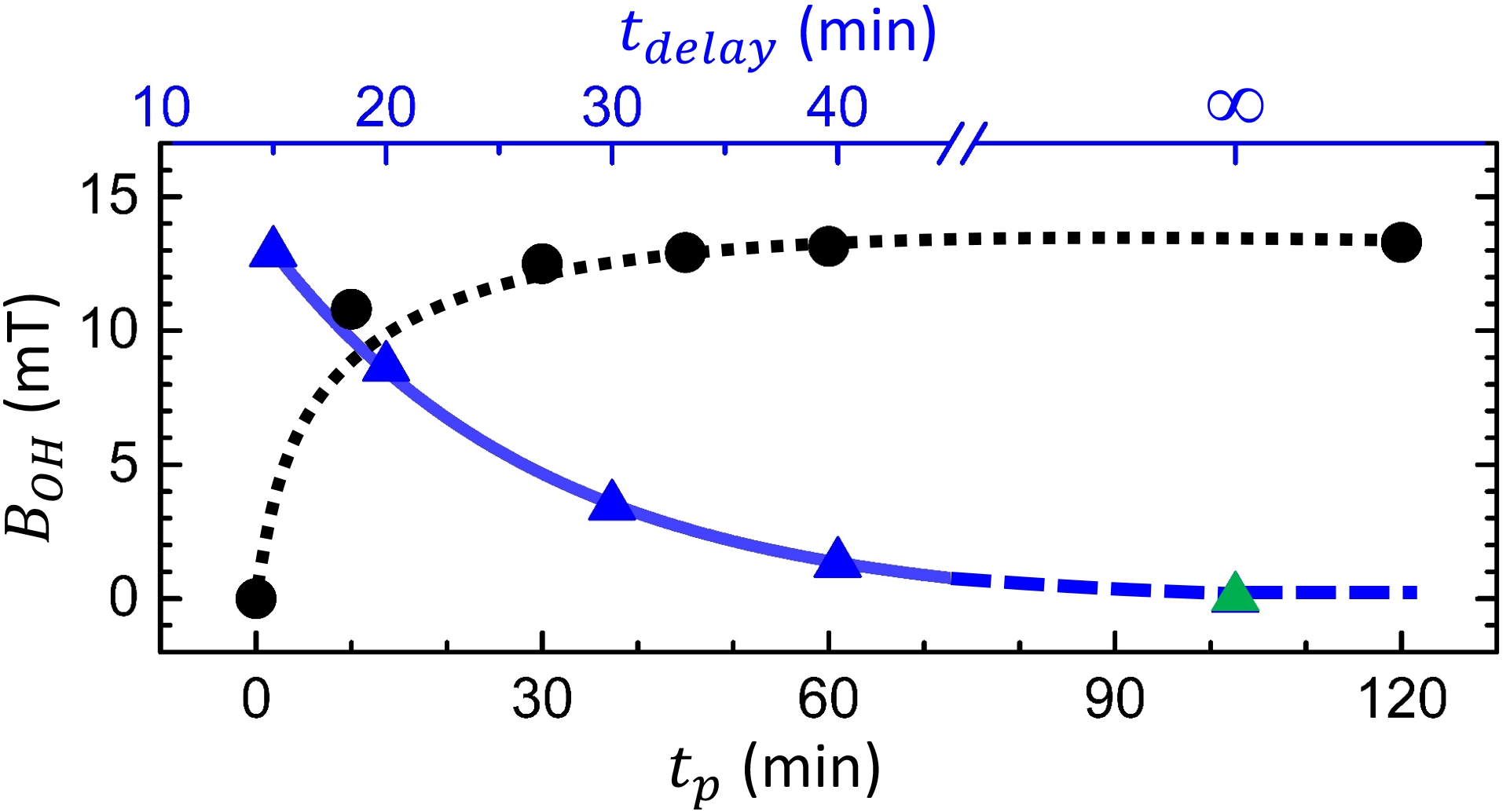 Figure 1
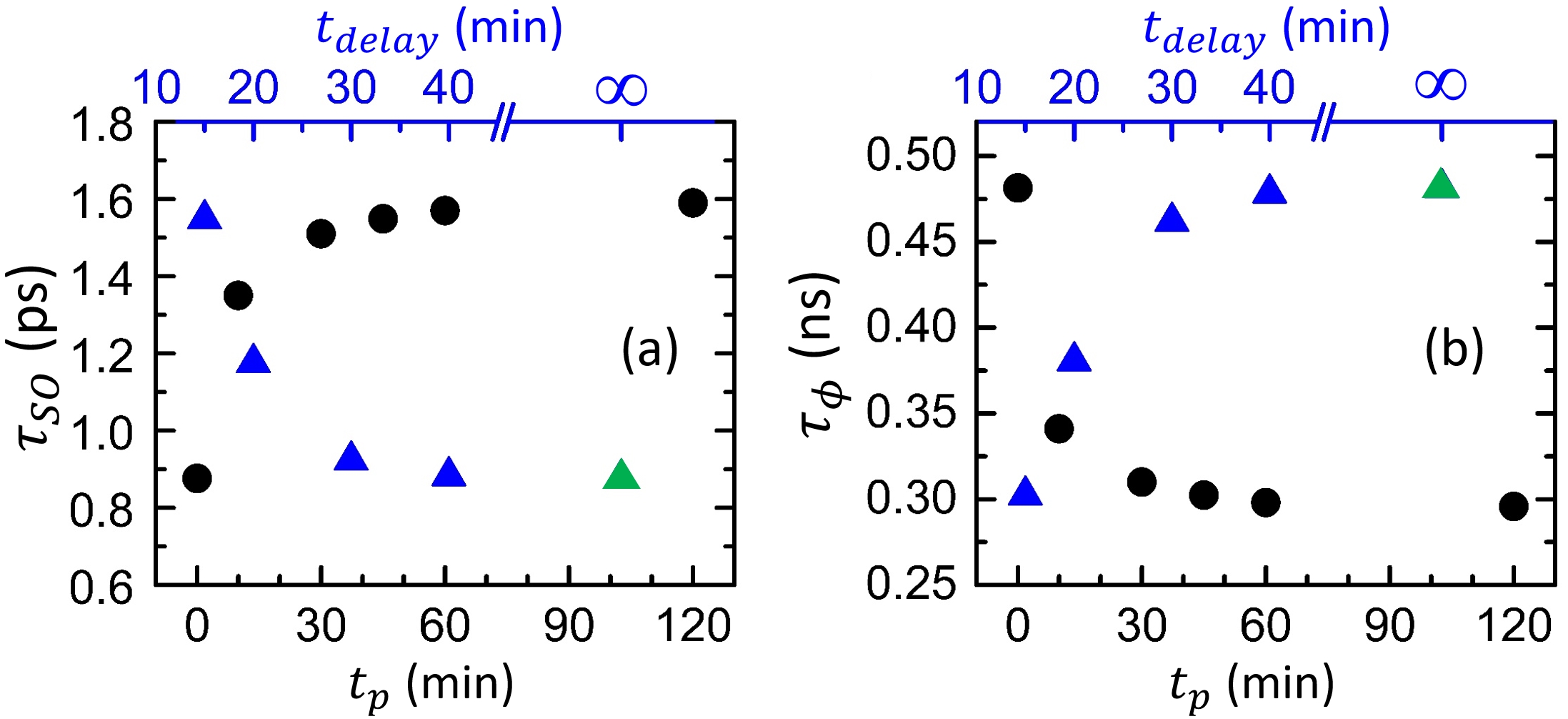 Figure 2
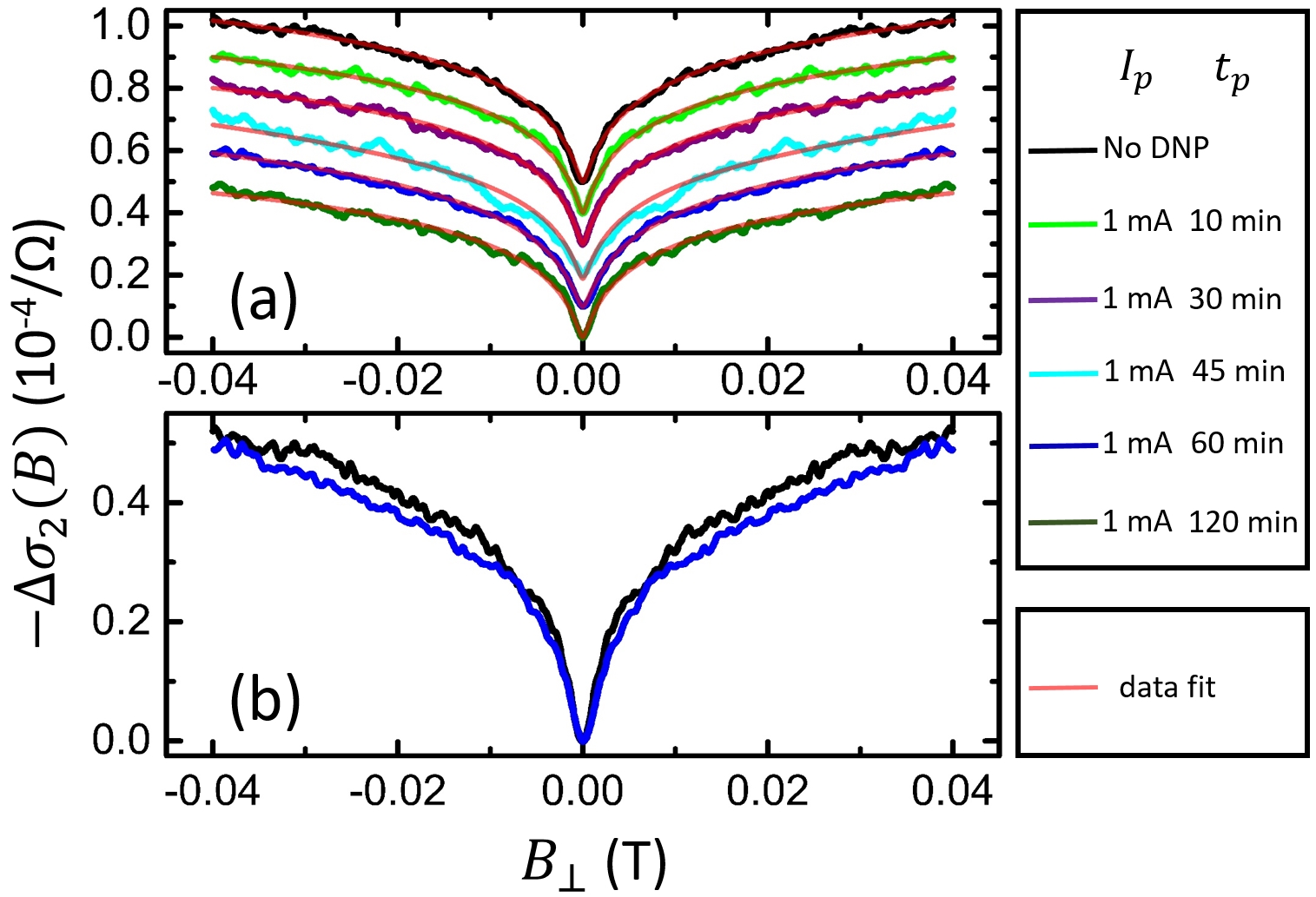 Figure 3
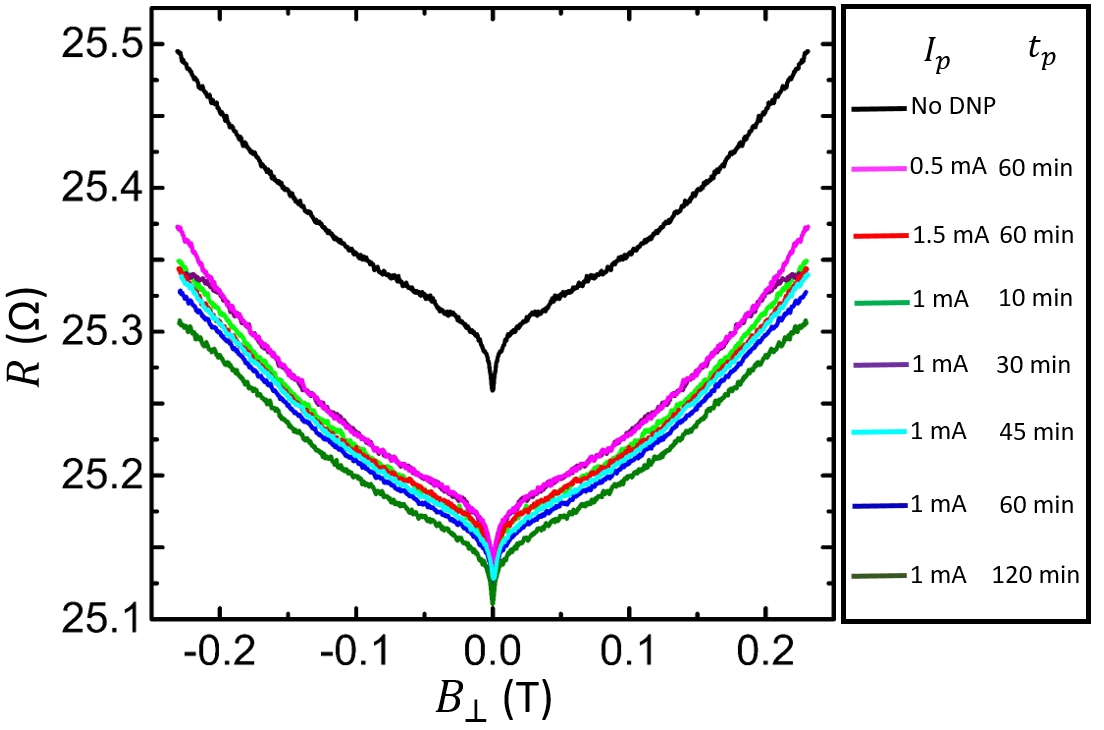 Figure 4
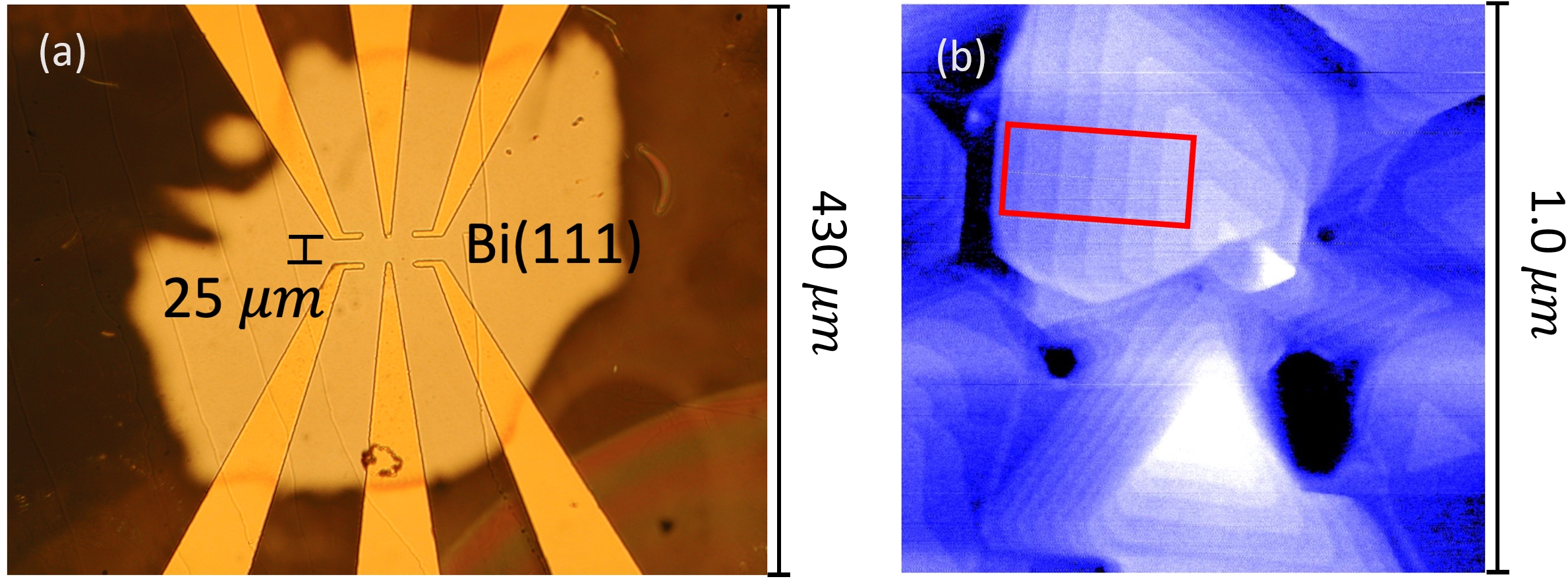 Figure 5
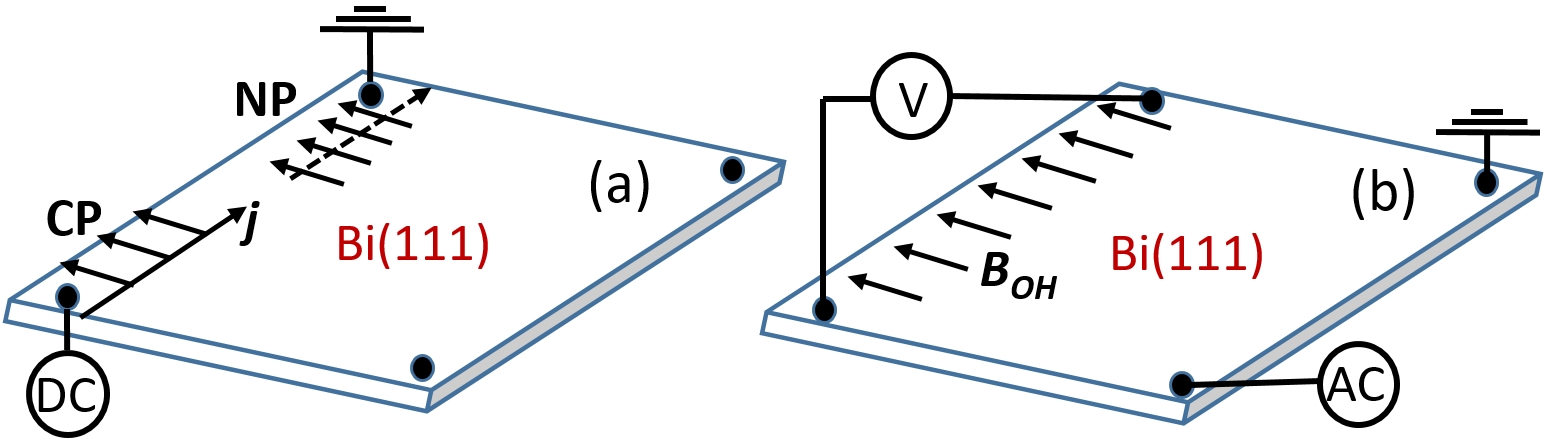 Figure 6
 Figure 7
Peer Reviews
No public reviews on file for this paper yet. If you reviewed it on a platform where reviews are public (OpenReview, ICLR, NeurIPS, ICML), you can paste yours below so the community can read it here.
Videos
No videos yet. Explain this paper in a talk, walkthrough, or lecture? Add one.
Dynamic nuclear spin polarization induced by Edelstein effect at Bi(111) surfaces
Zijian Jiang
V. Soghomonian
J. J. Heremans
Author to whom correspondence should be addressed: Department of Physics, Virginia Tech, Blacksburg, VA 24061, USA
Department of Physics, Virginia Tech, Blacksburg, Virginia 24061, USA
Abstract
Nuclear spin polarization induced by hyperfine interaction and the Edelstein effect due to strong spin-orbit interaction is investigated by quantum transport in Bi(111) thin film samples. The Bi(111) films are deposited on mica by van der Waals epitaxial growth. The Bi(111) films show micrometer-sized triangular islands with 0.39 nm step height, corresponding to the Bi(111) bilayer height. At low temperatures a high current density is applied to generate a non-equilibrium carrier spin polarization by the Edelstein effect at the Bi(111) surface, which then induces dynamic nuclear polarization by hyperfine interaction. Comparative quantum magnetotransport antilocalization measurements indicate a suppression of antilocalization by the in-plane Overhauser field from the nuclear polarization and allow a quantification of the Overhauser field. Hence nuclear polarization was both achieved and quantified by a purely electronic transport-based approach.
Spatial inversion symmetry exists in the Bi bulk but is broken normal to the surface, leading to strong Rashba-like spin-orbit interaction (SOI) due to the asymmetry of the surface-confinement potential for the two-dimensional (2D) surface states supported at the Bi(111) surface Koroteev2004 ; HofmannPrSfSci2006 ; Hirahara2007 . The Rashba parameter can reach 0.5 eV Å, substantially larger than in e.g. InSb heterostructures Martin2011 ; RayInSb-PRB . Bi thin films further show a high carrier mobility and a long mean free path Zhu2011 . The Bi (111) surface states have therefore been of recent interest FeldmanScience-2016 ; Du2016 . The Edelstein effect generates a non-equilibrium carrier spin polarization (CP) in materials with SOI in response to an applied electric field or a current density j, with the spin polarization direction normal to j and the surface normal EdelsteinSSC1990 ; Borge2014 ; Shen2014 ; Pesin2012 . The Edelstein effect has its origin in spin-momentum locking due to SOI. The effect can be pronounced at surfaces and interfaces with strong SOI, such as the Ag/Bi(111) Rojas2013 and Cu/Bi(111) Isasa2016 interfaces. Given the strong SOI at the Bi(111) surface, an in-plane j in a Bi thin film is expected to generate a non-equilibrium in-plane CP. In the present work the Edelstein effect appears as the most plausible dominant origin of the CP under application of j, rather than e.g. lateral or top-and-bottom spin Hall effects, as explained in Ref. SuppMatls . Hyperfine interaction (HI) can by dynamic nuclear polarization (DNP) transfer the CP to a non-equilibrium in-plane nuclear spin polarization (NP). The present work shows such Edelstein-induced DNP, an example of the interplay between strong SOI, HI, and the Edelstein effect. The work also demonstrates that the effect of NP on quantum-coherent transport allows for a quantification of the polarization. The work is reminiscent of recent experiments where CP from the Edelstein effect generates a spin-transfer torque on magnetic moments EmoriPRB93-2016 , compared to this work where HI effectively mediates a spin-transfer torque on the nuclear spins. DNP from CP resulting from spin injection was previously predicted JohnsonAPL-2000 and the interplay between NP and CP from spin injection, mediated by HI, was studied in Fe/GaAs SalisPRB80-2009 . Another study used Faraday rotation to study DNP from current-induced NP in InGaAs TrowbridgePRB90-2014 . The present experiments however differ from the latter TrowbridgePRB90-2014 by using quantum magnetotransport measurements to quantify the DNP in an all-electrical setup, and by showing that the relatively higher carrier density in the Bi(111) surface states compared to semiconductors SalisPRB80-2009 ; TrowbridgePRB90-2014 ; PagetPRB15-1977 ; Optorientbook allows DNP without application of an external magnetic field, relying only on the effective electronic field created by CP.
HI refers to the coupling of carrier spins to the nuclear spins by an energy term , where represents the hyperfine coupling constant Nisson2013 ; Tifrea2011 , the nuclear spin and the total carrier angular momentum. Two mechanisms contribute to HI Tifrea2011 ; Mukhopadhyay2015 ; Feher1959 , Fermi contact interaction (dominant when carrier and nuclear orbitals overlap Bucher2000 ) and dipolar interaction Mukhopadhyay2015 ; Tifrea2011 . HI can be more pronounced for heavy atoms featuring atomic parameters with higher energy scales Nisson2013 ; Feher1959 , and for nuclei with large . Both effects play a role strengthening HI for Bi, with = 9/2. Further, electrons in Bi have a substantial s-orbital component at the Fermi energy, 10%, increasing the contact term and HI. The strong SOI in Bi may also enhance HI. Quantitative information on the strength of HI in semimetallic Bi is lacking. Yet experiments have studied the interaction between Bi donors in Si and the Si s-like conduction band carriers George2010 ; Morley2010 ; Feher1959 , concluding = 6.1 eV. The Knight shift in Bi2Se3 shows = 27 eV Nisson2013 . Such values for indicate that consequential HI is expected in semimetallic Bi as well as in Bi compounds. HI can lead to DNP where spin polarization is transferred from the carriers to the nuclei Economou2019 ; Maestro2013 and CP then generates NP. With NP established, the carriers experience HI as an effective in-plane magnetic field having the same effect as an external Zeeman field, the Overhauser field Maestro2013 ; Tifrea2011 ; Tripathi2008 ; SuppMatls . Similarly, via HI the electronic CP results in an in-plane effective magnetic field experienced by the nuclei Optorientbook ; SuppMatls . For DNP to occur, the dipole-dipole interaction field between neighboring nuclei ( 0.024 mT SuppMatls ) needs to be overcome by a nuclear Zeeman energy preventing a rapid T2 relaxation of NP SalisPRB80-2009 ; PagetPRB15-1977 ; Optorientbook ; SuppMatls . can be overcome by a sufficiently large Optorientbook . In semiconductor experiments is low due to the low carrier density, and overcoming the decay of NP then requires an external magnetic field SalisPRB80-2009 ; TrowbridgePRB90-2014 ; PagetPRB15-1977 ; Optorientbook . In contrast, the present work shows that the higher carrier density in the Bi(111) surface states provides a so that DNP can occur without an in-plane external magnetic field, and in fact application of an in-plane field keeps results unchanged SuppMatls .
and the NP are here quantified by the antilocalization (AL) quantum coherence corrections to the conductance of the Bi(111) surface states, caused by quantum interference between backscattered time-reversed carrier trajectories under SOI. At low temperatures , the AL corrections lead to a resistance with a specific dependence on an external magnetic field normal to the surface Golub2005 ; DeoYaoTM ; Bergmann2010 . The magnetoresistance (MR, ) due to AL is determined by three characteristic times DeoYaoTM ; Bergmann2010 : the elastic scattering time as deduced from the areal surface state density and mobility , the SOI spin decoherence time , and the quantum phase decoherence time . Here where denotes the SOI splitting at the Fermi wavevector. The times are experimentally determined by quantitative fitting of the MR data to the AL theory developed by Iordanskii, Lyanda-Geller and Pikus (ILP) Iordanskii1994 appropriate for the Bi(111) 2D surface states with Rashba-like SOI SuppMatls . The influence of magnetization on AL in ferromagnetic materials has been theoretically studied Dugaev2001 . We expect similar effects due to NP, supported by the theoretical treatment of as an effective in-plane magnetic field Komnik2007 ; Malshukov1997 . Specifically, generates an effective Zeeman splitting which aligns the carrier spins and hence suppresses the Cooperon in the spin singlet channel and thereby inhibits AL Dugaev2001 . The inhibition of AL is visible in the data as an increase in with increasing . Further, AL is a sensitive probe of quantum and spin coherence DeoYaoTM , and is sensitive to the time-reversal symmetry (TRS) breaking due to Dugaev2001 ; Meijer2004 ; Altshuler1981 . The breaking of TRS due to the interplay of Zeeman splitting and SOI results in a quantifiable decrease in Meijer2004 with increasing , also visible in the data. Identifying , we thus use AL as a sensitive probe of DNP and HI which allows a quantification of .
An optimized van der Waals epitaxy (vdWE) Koma1999 was used to grow the Bi(111) films on mica substrates, resulting in large grain sizes with the trigonal axis perpendicular to the film plane SuppMatls . vdWE is particularly suited to the unstrained growth of weakly bonding materials such as Bi Osten1991 ; Littlejohn2017 . The 40 nm thick Bi(111) was deposited through a shadowmask, yielding samples of diameter 350 m. Au contacts were photolithographically patterned after film deposition (Fig. 1a). Atomic force microscopy indicated a layered step surface with triangular terraces (Fig. 1b) and showed a step height between adjacent terraces of 0.391 0.015 nm, corresponding to one Bi(111) bilayer height (BL111 = 0.39 nm) SuppMatls .
The AL and transport coefficient characterization were carried out by magnetotransport in a 3He immersion cryostat down to = 0.39 K, using standard 4-contact AC lock-in techniques with current of 2 A rms under applied . To develop DNP a high DC polarization current, = 0.5 mA to 1.5 mA, j A/m2 to A/m2, was applied at = 0.39 K between a pair of contacts for variable polarization durations from 10 to 120 min. was removed after the DNP step, letting the NP and decay slowly with a spin-lattice relaxation time T1 characteristic of the nuclear decoherence Yusa2005 ; Keane2011 . The slow decay allowed time for the subsequent observation of DNP from AL measurements. For AL measurements the voltage was measured over the same contacts to which was applied and hence over the path of which develops, as depicted in Fig. 2. For the AL data it is sufficient to sweep over 0.2 T, achievable in as little as 15 min, of the order of the expected T1 Lampel1968 ; Heil1995 . Experiments were also performed with different delay times , from 15 to 40 min, inserted between removing and performing the AL measurement, to characterize the decay in and estimate T1.
and were determined from magnetotransport at 0.39 K, indicating predominantly n-type surface carrier contribution. We determine = 1.95 m*-2*, = 1.00 m2/Vs, = 0.0856 ps and mean free path = = 20.4 nm, where is the Fermi velocity derived from . As appropriate for surface states we use the 2D diffusion constant calculated as , at = 0.39 K yielding = 0.00243 m2/s. AL results in a characteristic positive quantum correction in at 0.4 T, expressed as a small correction to the 2D conductivity . We define and where . Since , we have , allowing fits to from the experimental MR. To fit the data ILP theory Iordanskii1994 is applied, including only the Rashba SOI term (details in SuppMatls ). Since merely produces a shift in , and are the only two free fitting parameters. The fits are performed for AL obtained after different and under different . From the fits, we find the dependences on , and of and . From the latter the dependences of are determined.
Figure 3 depicts representative MR of the Bi film sample at K before and after DNP using variable ranging from 0.5 mA to 1.5 mA and ranging from 0 (before DNP) to 120 min (at ). The positive MR characteristic of AL is observed both before and after DNP. The negative of (reproducing ) at low is displayed in Fig. 4a for variable when = 1 mA (at ). Best fits to the ILP theory Iordanskii1994 ; SuppMatls overlay the data in Fig. 4a in red and indicate that the theory excellently captures the AL in the Bi(111) surface states and will allow reliable extraction of values for and . The traces for (Fig. 3) and for (Fig. 4a) show a widening vs for after DNP, characteristic of an increase in (decreasing effect of SOI) and a decrease in as confirmed below. The widening shows a dependence on and , with long = 120 min at = 1 mA resulting in the largest effect. The dependence on and suggests DNP and hence play a role in changing and . The widening of the minimum in is further illustrated in Fig. 4b where the black trace represents before DNP and the blue trace after DNP with = 60 min and = 1 mA (at ). Before we present quantitative data on and , we note that the AL results after DNP are qualitatively consistent with the existence of in-plane . Phenomenologically, after removing , persists and generates an effective Zeeman energy , where denotes the in-plane -factor (for Bi(111) surface states, Du2016 ) and denotes the Bohr magneton. partially aligns the carrier spins and suppresses the spin phase shift due to SOI and thereby weakens AL Dugaev2001 ; Meijer2004 ; MeijerPRL2005 . The effect leads to a widening of the characteristic sharp minimum in vs and is quantified by a lengthening of . Further, results in a spin-induced TRS breaking Malshukov1997 ; Meijer2004 ; MeijerPRL2005 , leading to a decrease in . While it is not in the scope of this experimental study to modify the ILP theory to include HI, future theoretical studies specific to the influence of HI and NP on AL may help refine quantitative aspects of the experiments, as was performed for ferromagnetic order Dugaev2001 and for Zeeman interaction Malshukov1997 .
The dependences of and on at fixed = 1 mA with are presented in Fig. 5a-b. The value of increases with increasing (Fig. 5a), indicative of the influence of the in-plane . A phenomenological understanding was presented above. Theoretical studies of the combined influence of SOI and on an inhomogeneous interfacial spin distribution Froltsov2001 show that even a weak results in a decrease of the spin density proportional to 1/(2), relating an increase in to the influence of . Figure 5b shows a decrease of with increasing , and similar to Fig. 5a manifests a saturation at higher . The decrease of with increasing is indicative of the interplay of the effective Zeeman energy and SOI Malshukov1997 ; Meijer2004 , predicted to result in a quadratic dependence of on Meijer2004 :
[TABLE]
where . The estimated average value of can be calculated from the data using Eq. 1. Figure 5a-b depicts the dependences of and on at = 1 mA and = 60 min ( in SuppMatls ). With increasing , decreases and increases to their values without DNP, consistent with a decay in . Figure 6 shows the average calculated from in Fig. 5b. Since the AL measurement (sweeping over 0.2 T after removing and waiting ) spans 15 min, by estimated average is meant the value after averaging over these 15 min. Current spreading between the current contacts over the sample geometry during DNP will likely lead to non-uniform DNP, and hence encompasses spatial averaging as well. To minimize handling of the data, the averaging effects are not accounted for in Fig. 6 but should be kept in mind. In Fig. 6 the average increases with increasing , and saturates at about 13 mT. An exponential fit showed that the increase towards saturation occurs with a characteristic time T1e = 6 … 11 min, with T1e characterizing the expected nuclear spin alignment by DNP Optorientbook . In Fig. 6, the average decays exponentially with increasing , with spin-lattice relaxation time T1 = 11.4 min. The value T1 = 11.4 min is of the order of expected values Lampel1968 ; Heil1995 . depends on the average nuclear spin after NP, as PRB92Tenberg2015 ; Optorientbook ; SuppMatls , and follows a Brillouin function in the average carrier spin after CP Optorientbook ; SuppMatls . Using values of = 6.1 eV to 27 eV George2010 ; Morley2010 ; Feher1959 ; Nisson2013 we find that 13 mT is reached for if = 6.1 eV and for if = 27 eV SuppMatls . Since we do not expect full NP () and involves averages described above, the saturation value of 13 mT is consistent with the knowledge of in Bi and with plausible values of . For 13 mT and in this range of it is calculated that , consistent with the observation of DNP without external magnetic field SuppMatls . Also, the dependence of on strongly resembles the expected Brillouin function SuppMatls , strengthening the consistency between expectations and data. The saturation value 13 mT and the dependences on , and firmly suggest that the CP due to the Edelstein effect was transferred by HI to the Bi nuclei, demonstrating Edelstein-induced DNP and its measurement by quantum transport.
In conclusion, Bi(111) thin films were deposited by van der Waals epitaxy on mica substrates. Using antilocalization quantum-coherent transport measurements on the Bi(111) surface states to detect in-plane magnetic fields, quantitative evidence was obtained for a transfer of carrier spin polarization to Bi nuclear spin polarization by hyperfine interaction. The carrier spin polarization was obtained via the Edelstein effect in the Bi(111) surface states. The experiments verify the existence of Edelstein-induced dynamic nuclear polarization, in an example of interaction between spin-orbit interaction and hyperfine interaction via the nuclear spin bath, with possible applications in nuclear spintronics and to polarize nuclei to mitigate spin decoherence via HI in quantum devices. The experiments also show that antilocalization forms a sensitive probe for hyperfine interaction and nuclear polarization.
I Acknowledgments
The work was supported by the U.S. Department of Energy, Office of Basic Energy Sciences, Division of Materials Sciences and Engineering under award DOE DE-FG02-08ER46532.
The reference list from the paper itself. Each links out to its DOI / PubMed record.
- 1(1) Yu. M. Koroteev, G. Bihlmayer, J. E. Gayone, E. V. Chulkov, S. Blügel, P. M. Echenique, and Ph. Hofmann, Phys. Rev. Lett. 93 , 046403 (2004).
- 2(2) Ph. Hofmann, Prog. Surf. Sci. 81 , 191 (2006).
- 3(3) T. Hirahara, K. Miyamoto, I. Matsuda, T. Kadono, A. Kimura, T. Nagao, G. Bihlmayer, E. V. Chulkov, S. Qiao, K. Shimada, H. Namatame, M. Taniguchi, and S. Hasegawa, Phys. Rev. B 76 , 153305 (2007).
- 4(4) M. Rudolph and J. J. Heremans, Phys. Rev. B 83 , 205410 (2011).
- 5(5) R. L. Kallaher, J. J. Heremans, N. Goel, S. J. Chung, and M. B. Santos, Phys. Rev. B 81 , 075303 (2010).
- 6(6) Z. Zhu, B. Fauqué, Y. Fuseya, and K. Behnia, Phys. Rev. B 84 , 115137 (2011).
- 7(7) B. E. Feldman, M. T. Randeria, A. Gyenis, F. Wu, H. Ji, R. J. Cava, A. H. Mac Donald, and A. Yazdani, Science 354 , 316 (2016).
- 8(8) H. Du, X. Sun, X. Liu, X. Wu, J. Wang, M. Tian, A. Zhao, Y. Luo, J. Yang, B. Wang, and J. G. Hou, Nat. Commun. 7 , 10814 (2016).