First measurement of neutrino oscillation parameters using neutrinos and antineutrinos by NOvA
M. A. Acero, P. Adamson, L. Aliaga, T. Alion, V. Allakhverdian, S., Altakarli, N. Anfimov, A. Antoshkin, A. Aurisano, A. Back, C. Backhouse, M., Baird, N. Balashov, P. Baldi, B. A. Bambah, S. Bashar, K. Bays, S. Bending,, R. Bernstein, V. Bhatnagar, B. Bhuyan, J. Bian

TL;DR
The NOvA experiment has for the first time measured neutrino oscillation parameters using both neutrinos and antineutrinos, providing new insights into neutrino properties and mass hierarchy.
Contribution
This paper presents the first combined measurement of neutrino and antineutrino oscillation parameters by NOvA, improving understanding of neutrino mass hierarchy and mixing angles.
Findings
Measured $| riangle m^2_{32}|$ with high precision
Favored normal neutrino mass hierarchy by 1.9$\sigma$
Excluded most $\delta_{CP}$ values near $ rac{\pi}{2}$ for inverted hierarchy
Abstract
The NOvA experiment has made a -significant observation of appearance in a 2 GeV beam at a distance of 810 km. Using protons on target delivered to the Fermilab NuMI neutrino beamline, the experiment recorded 27 candidates with a background of 10.3 and 102 candidates. This new antineutrino data is combined with neutrino data to measure the oscillation parameters eV, in the normal neutrino mass hierarchy and upper octant and excludes most values near for the inverted mass hierarchy by more than 3. The data favor the normal neutrino mass hierarchy by 1.9 and values in the upper octant by…
Click any figure to enlarge with its caption.
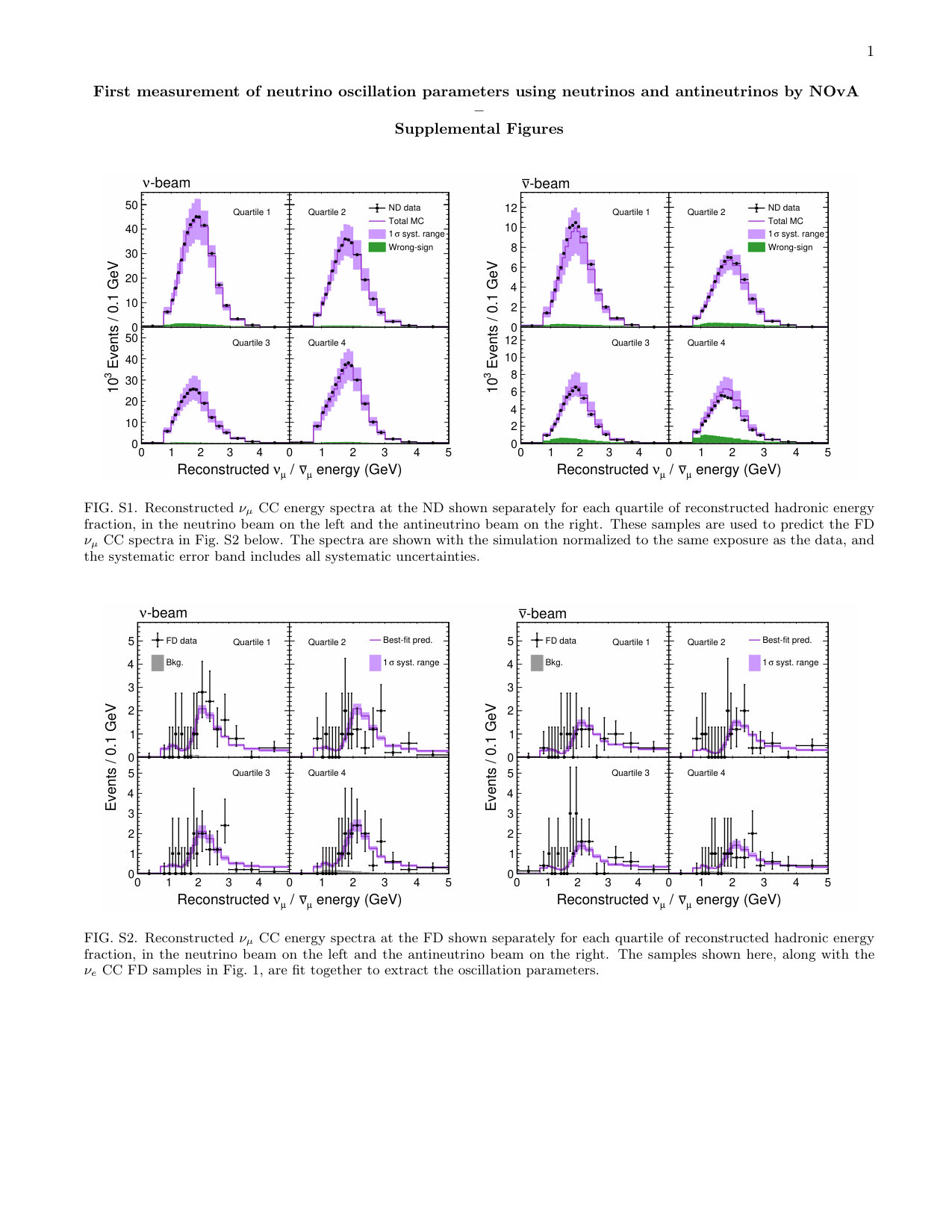 Figure 1
 Figure 2
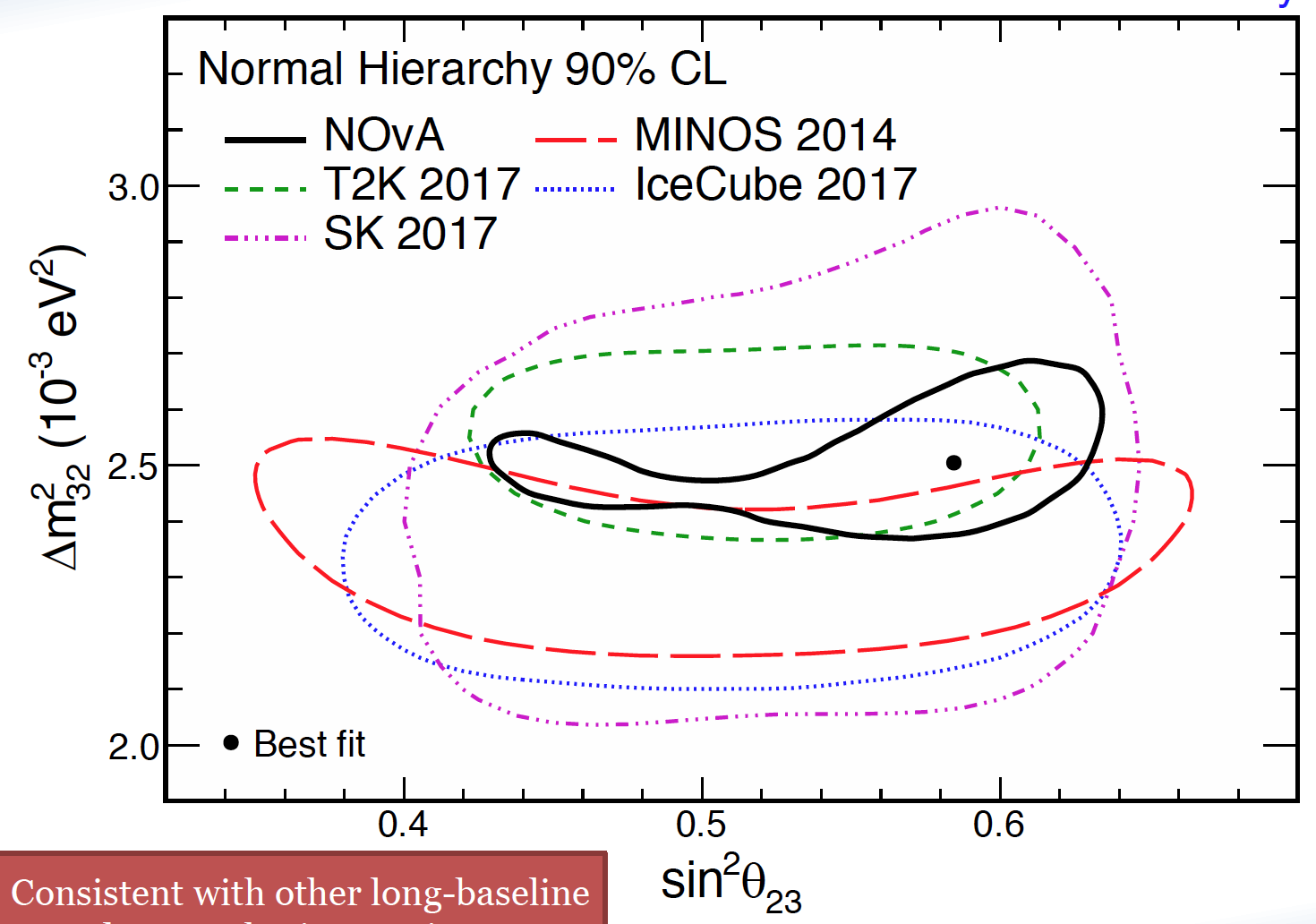 Figure 3
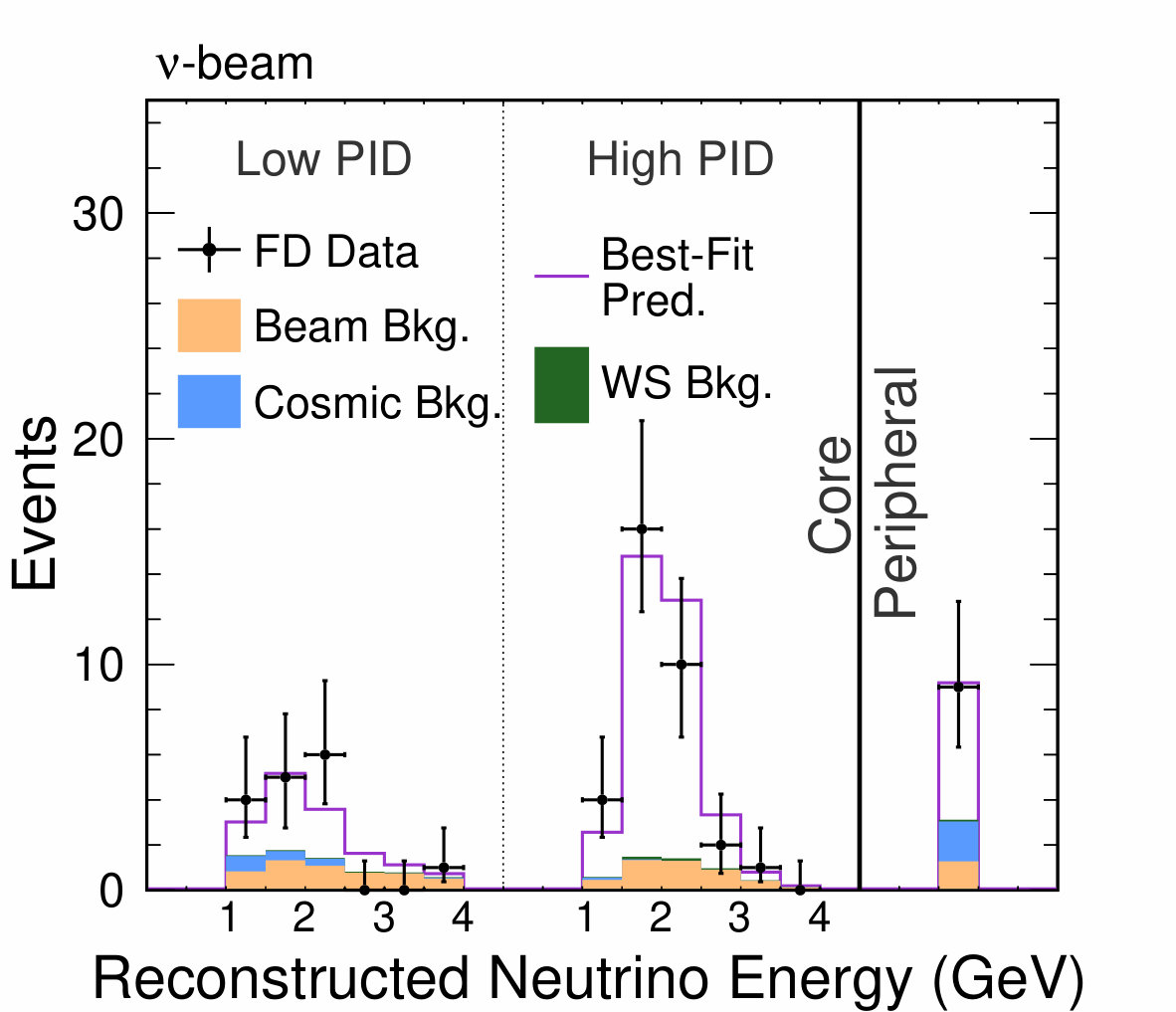 Figure 4
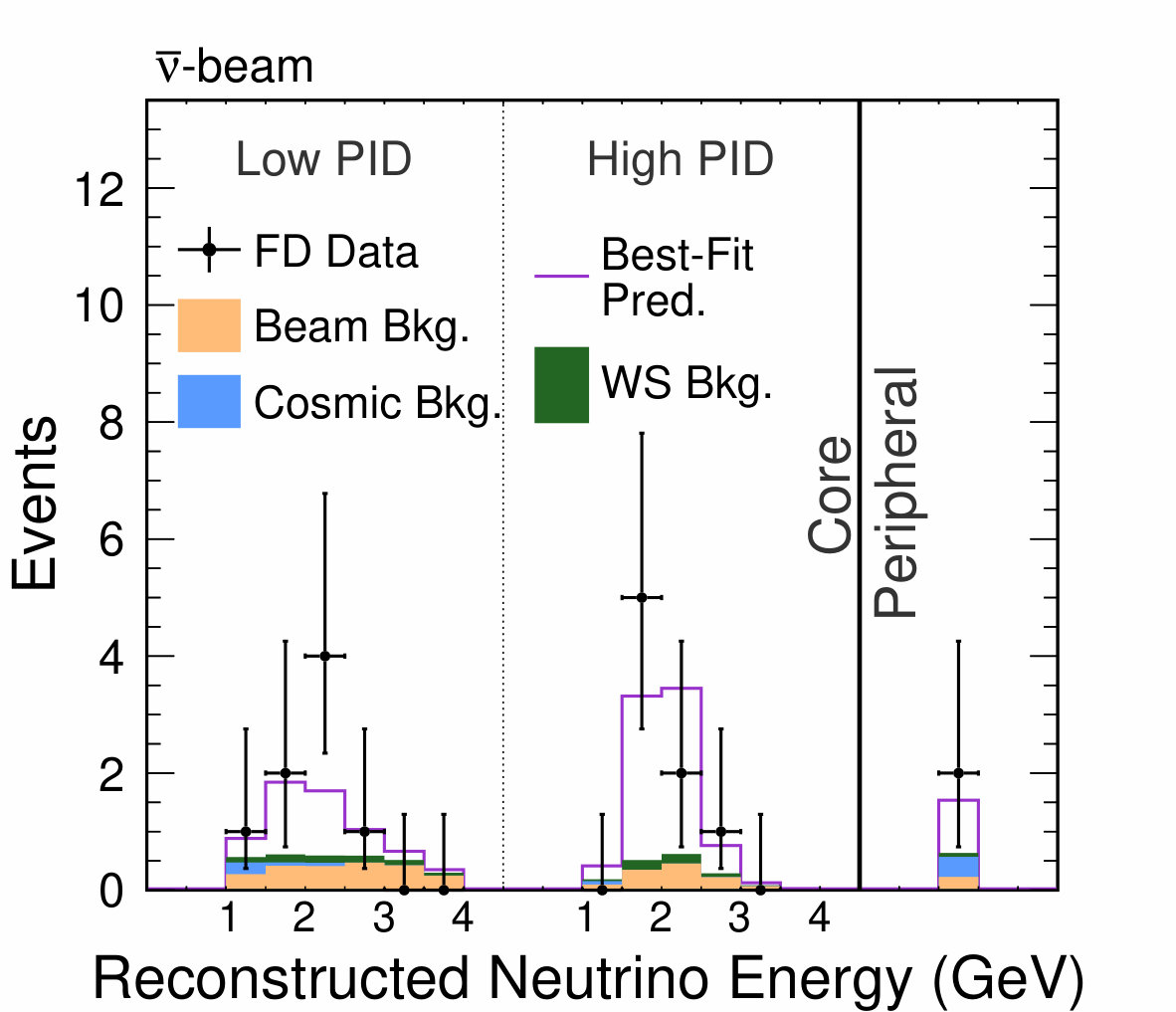 Figure 5
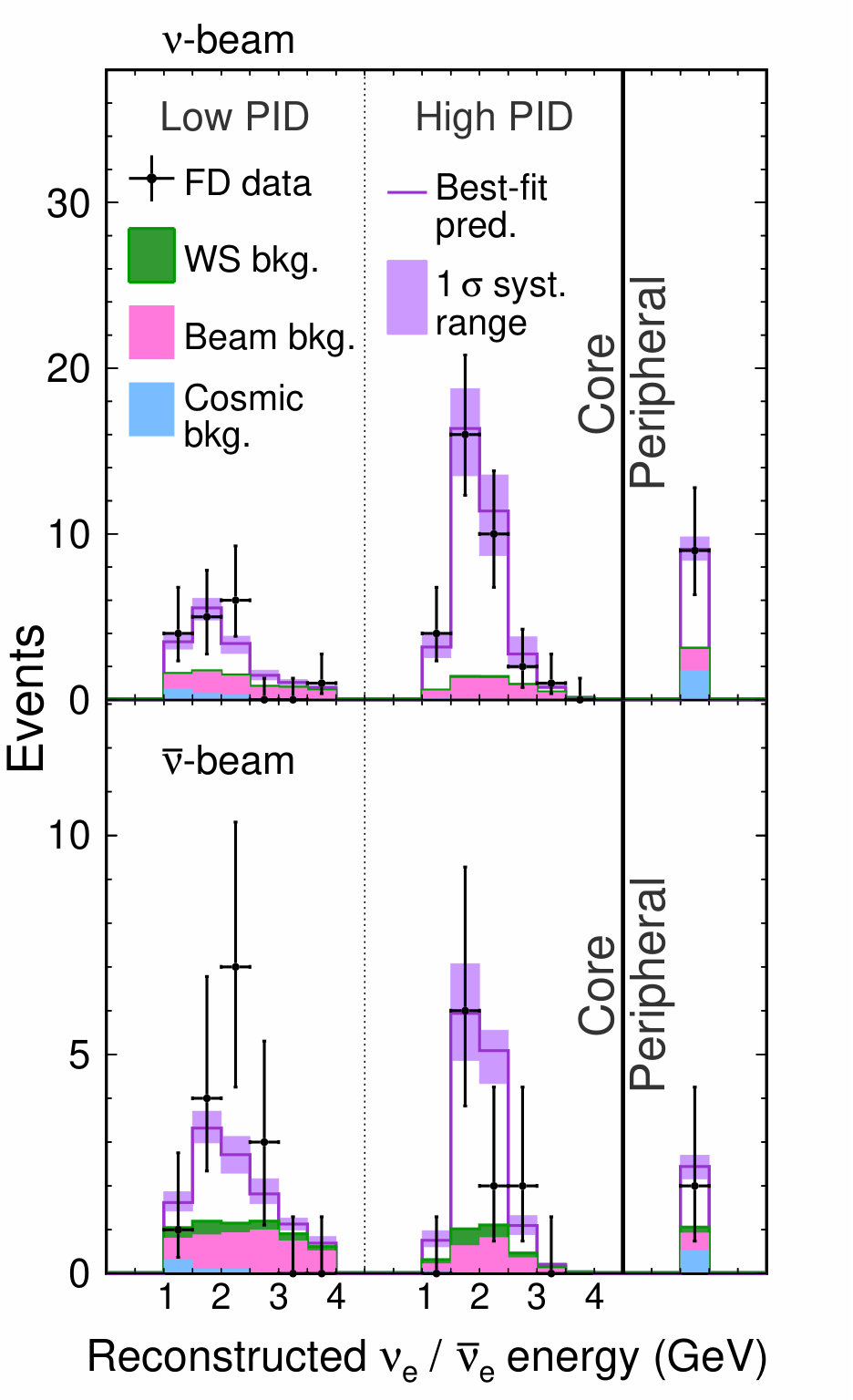 Figure 6
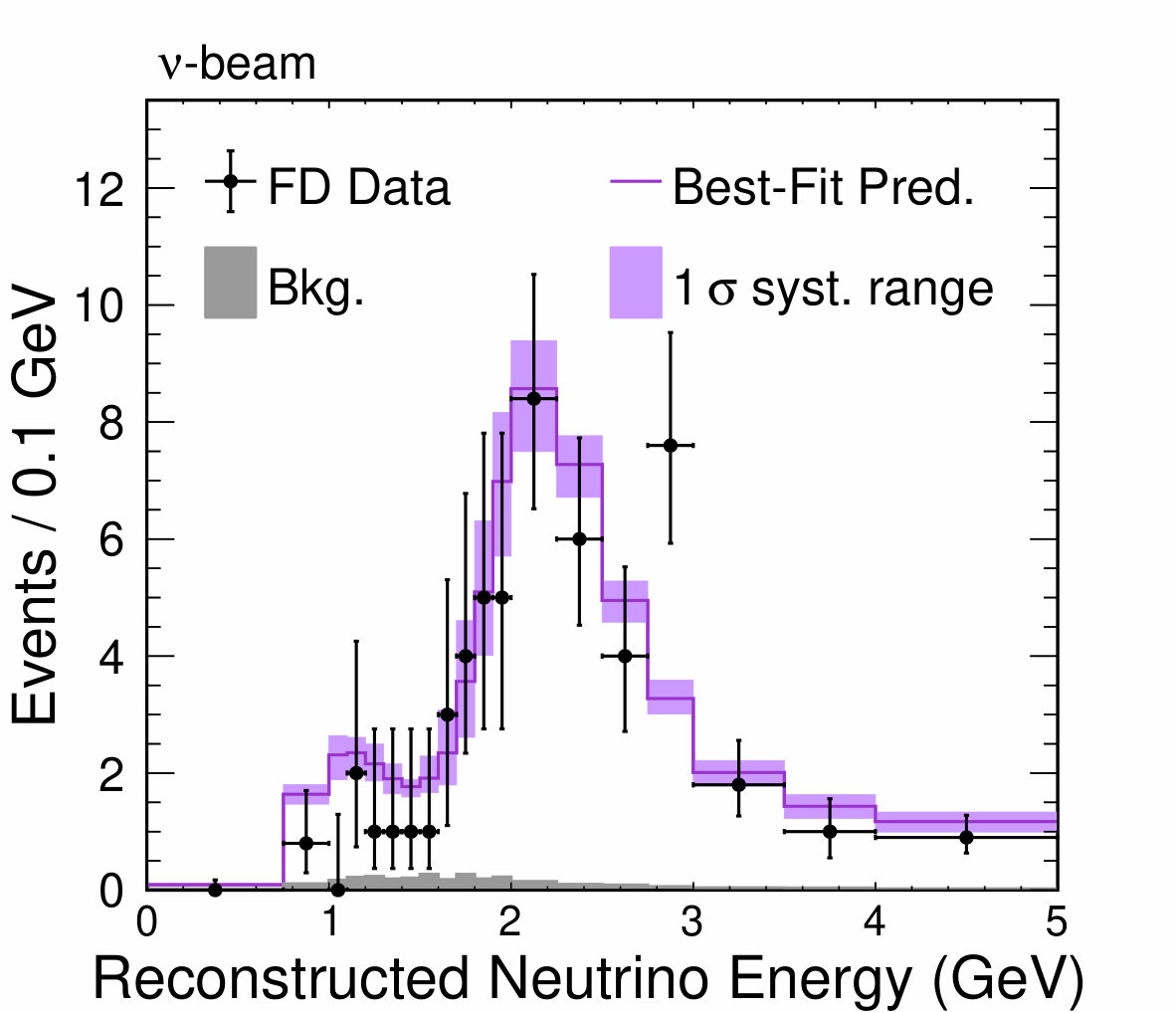 Figure 7
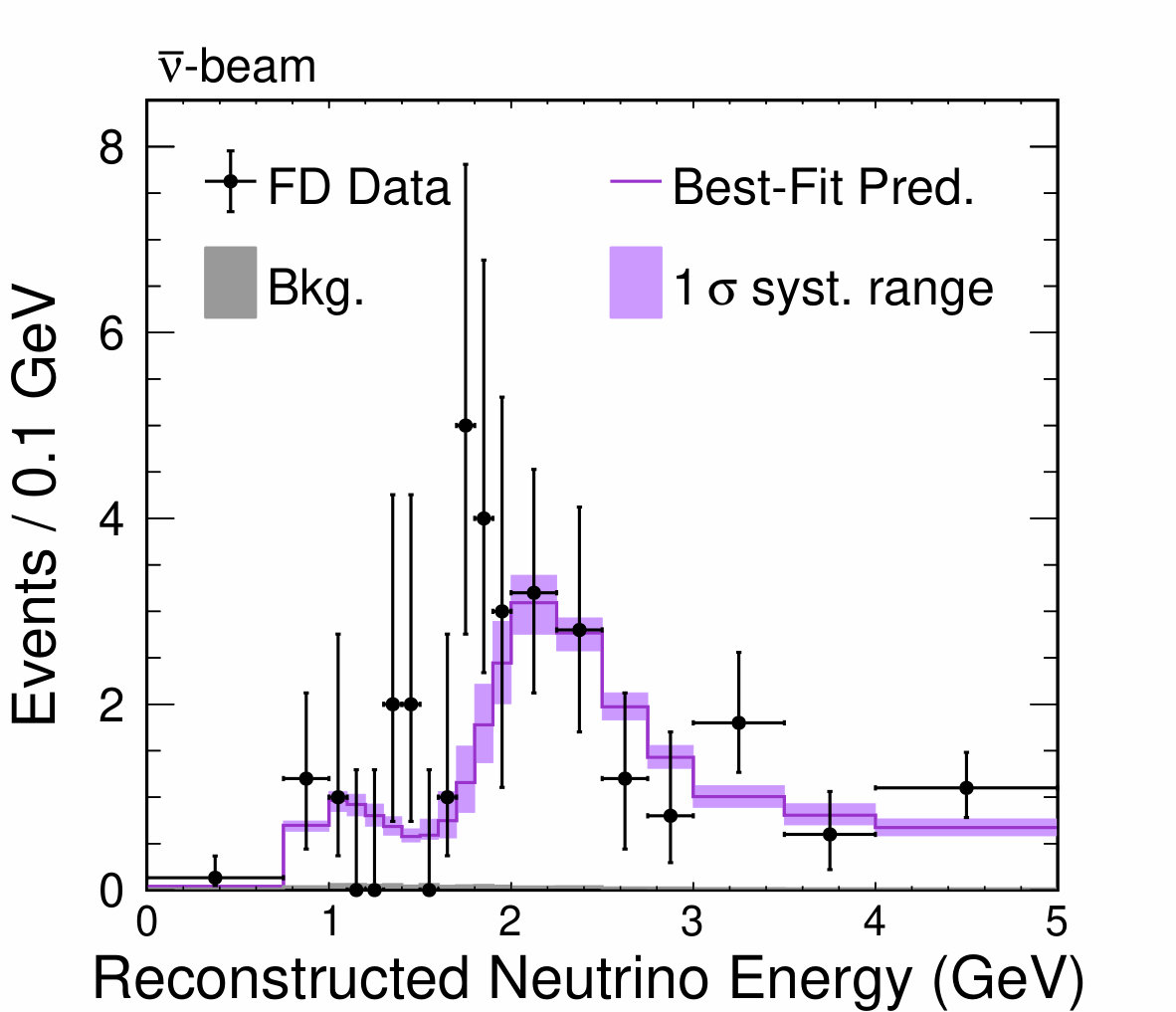 Figure 8
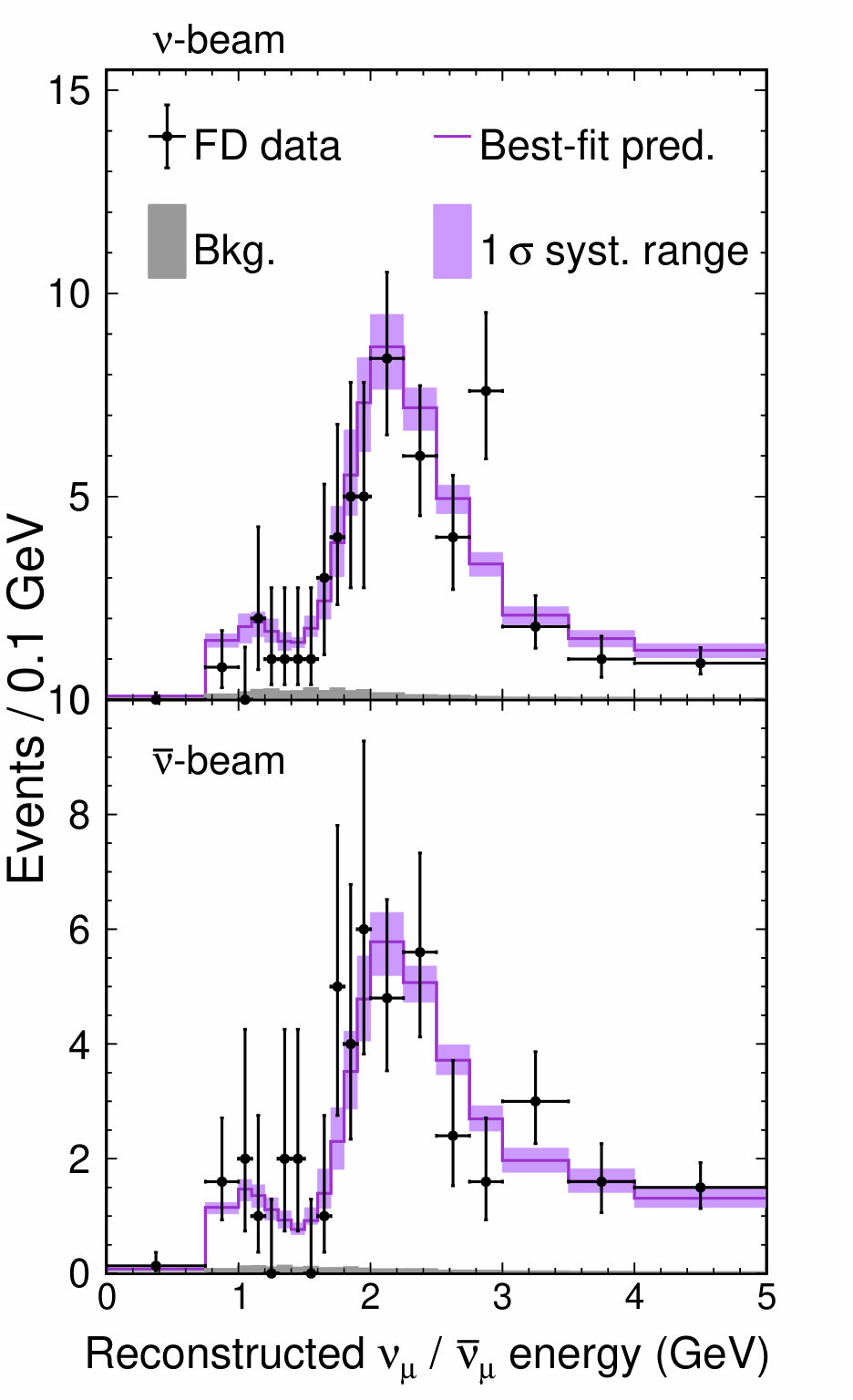 Figure 9
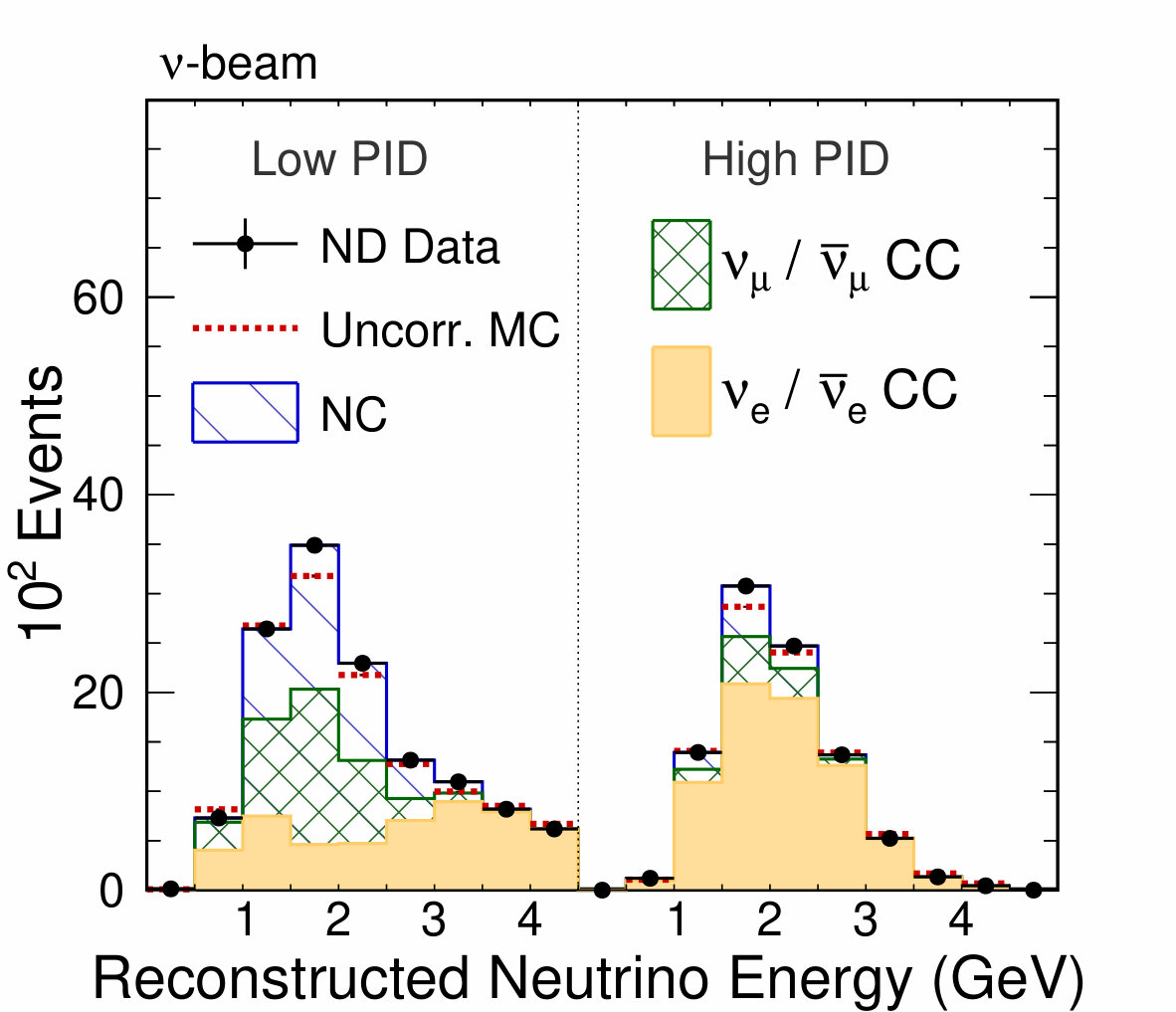 Figure 10
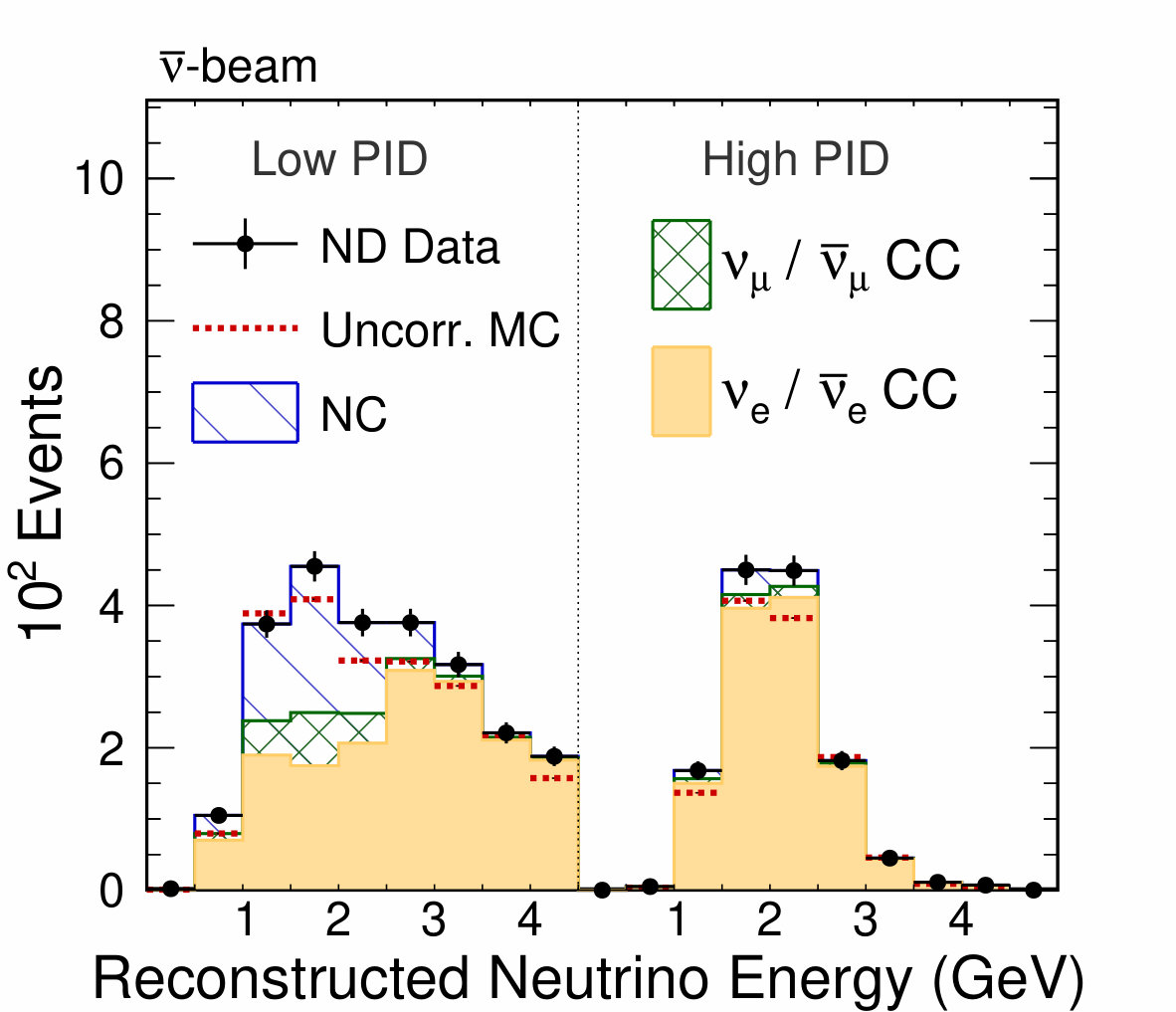 Figure 11
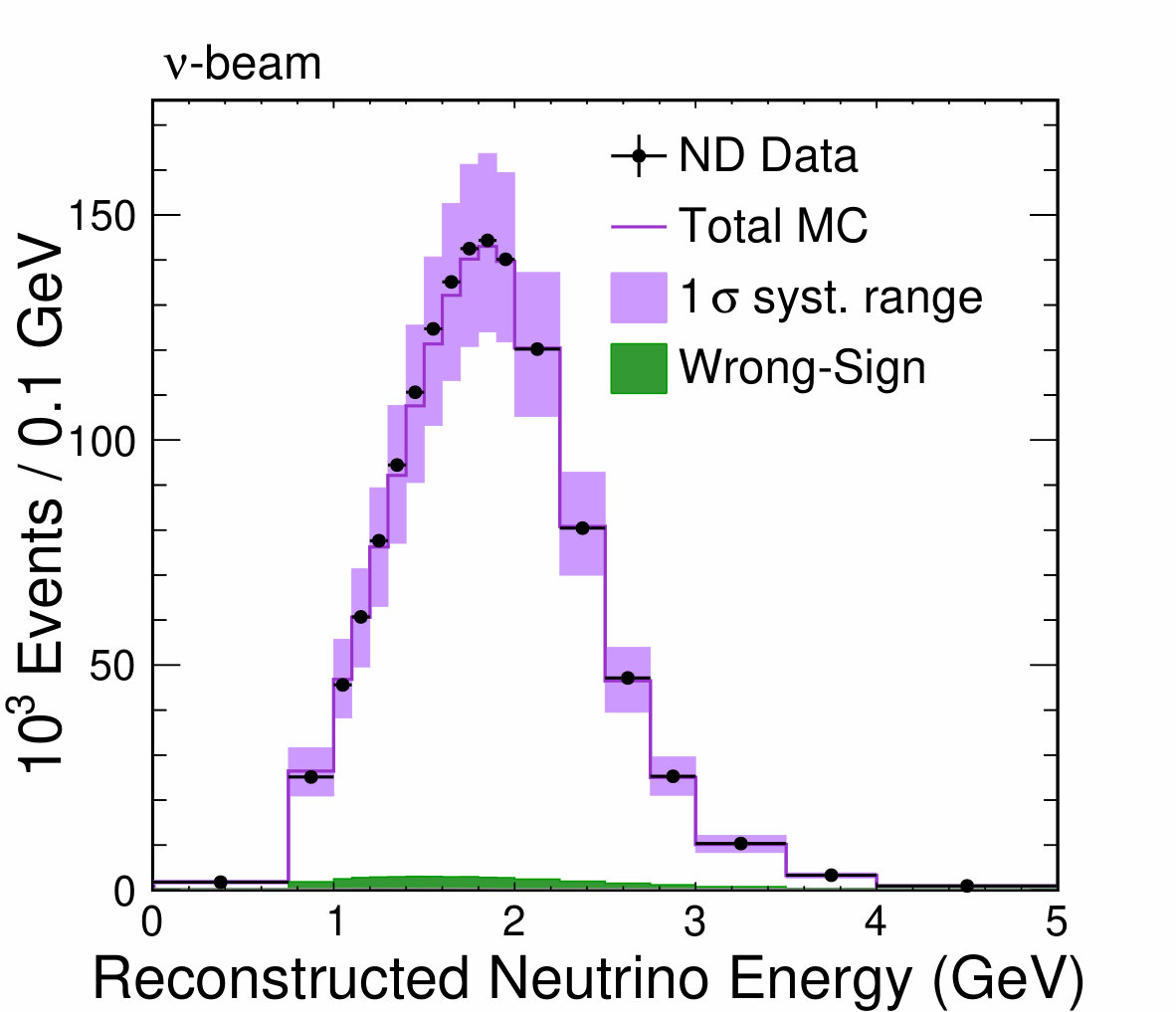 Figure 12
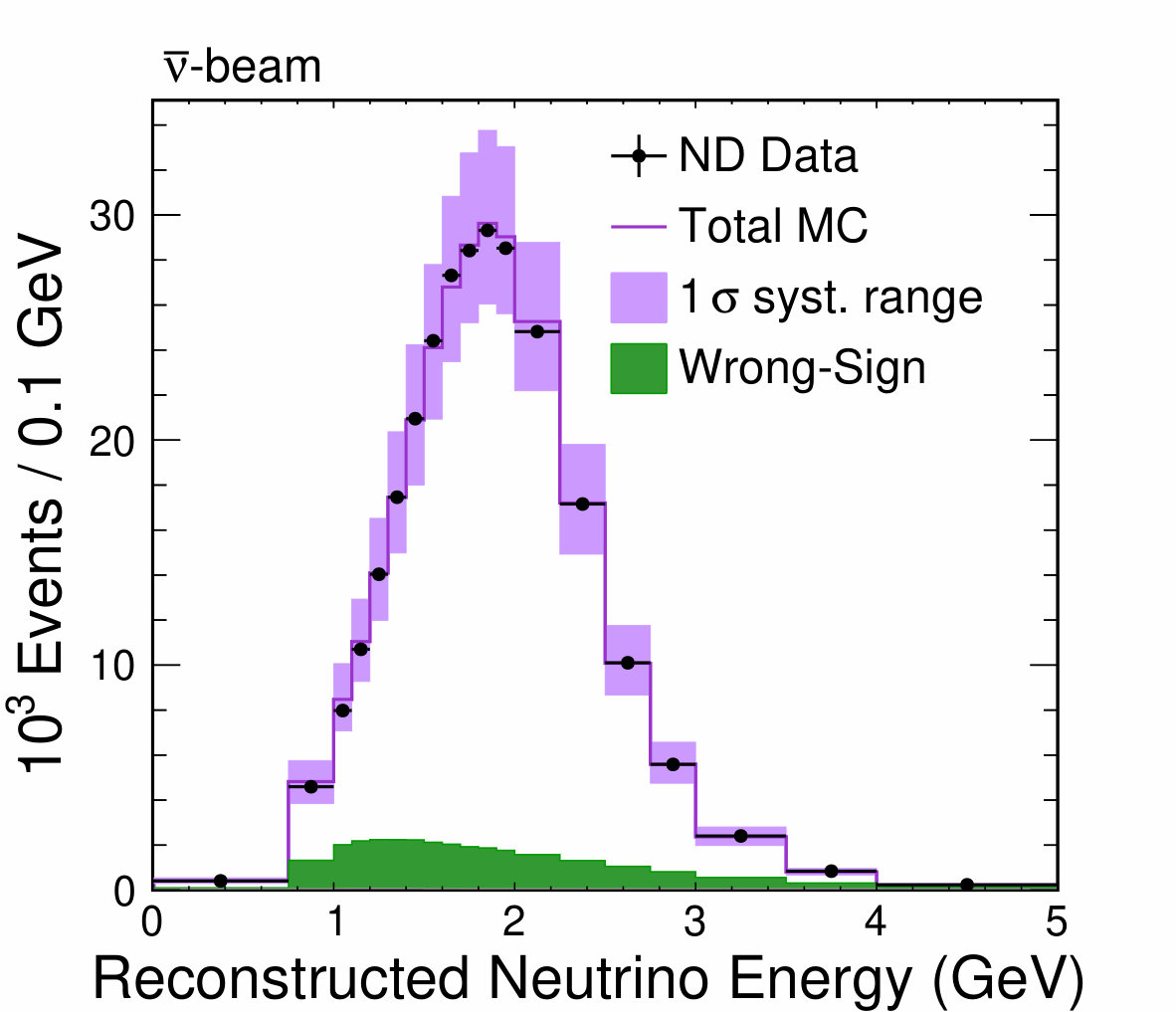 Figure 13
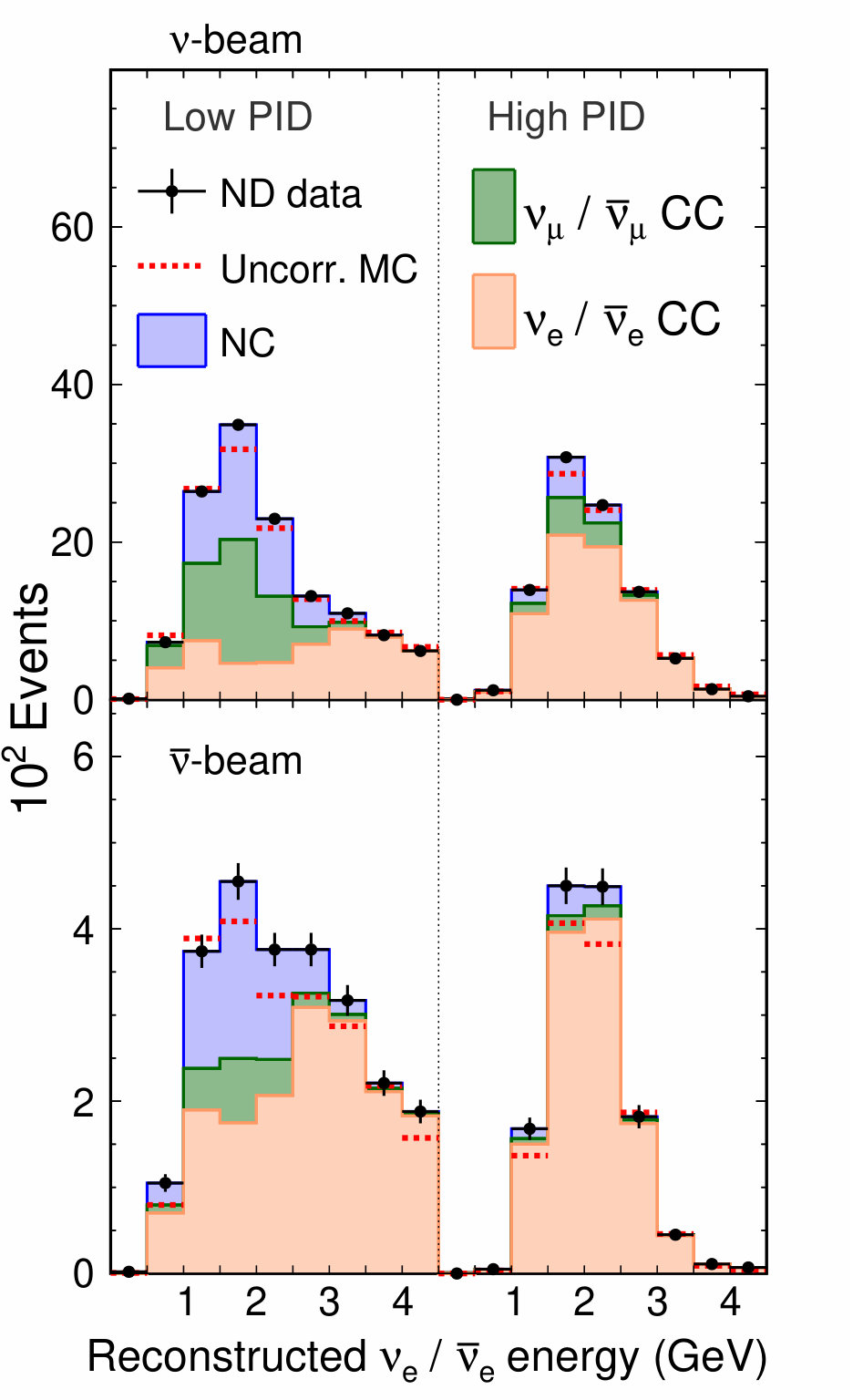 Figure 14
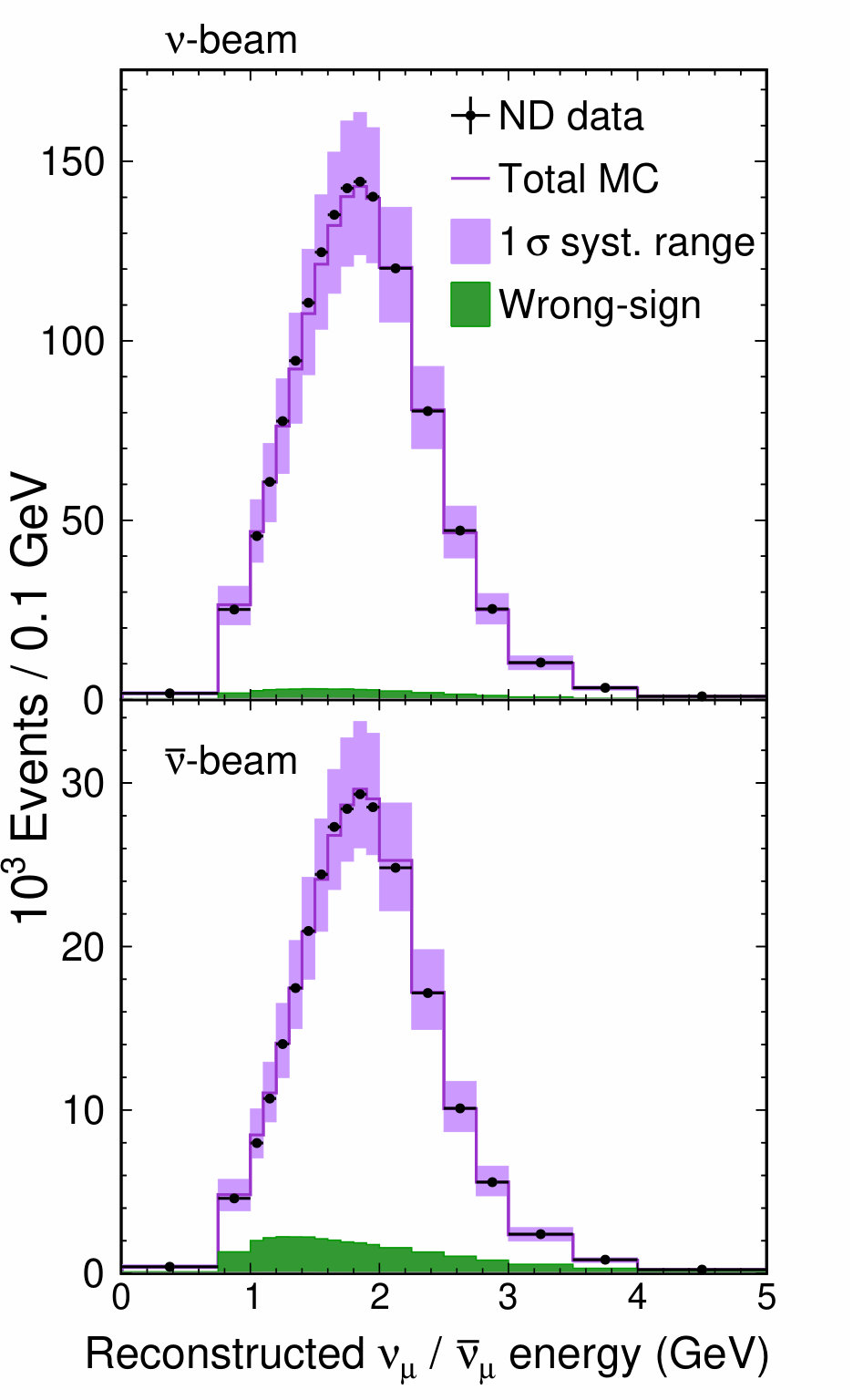 Figure 15
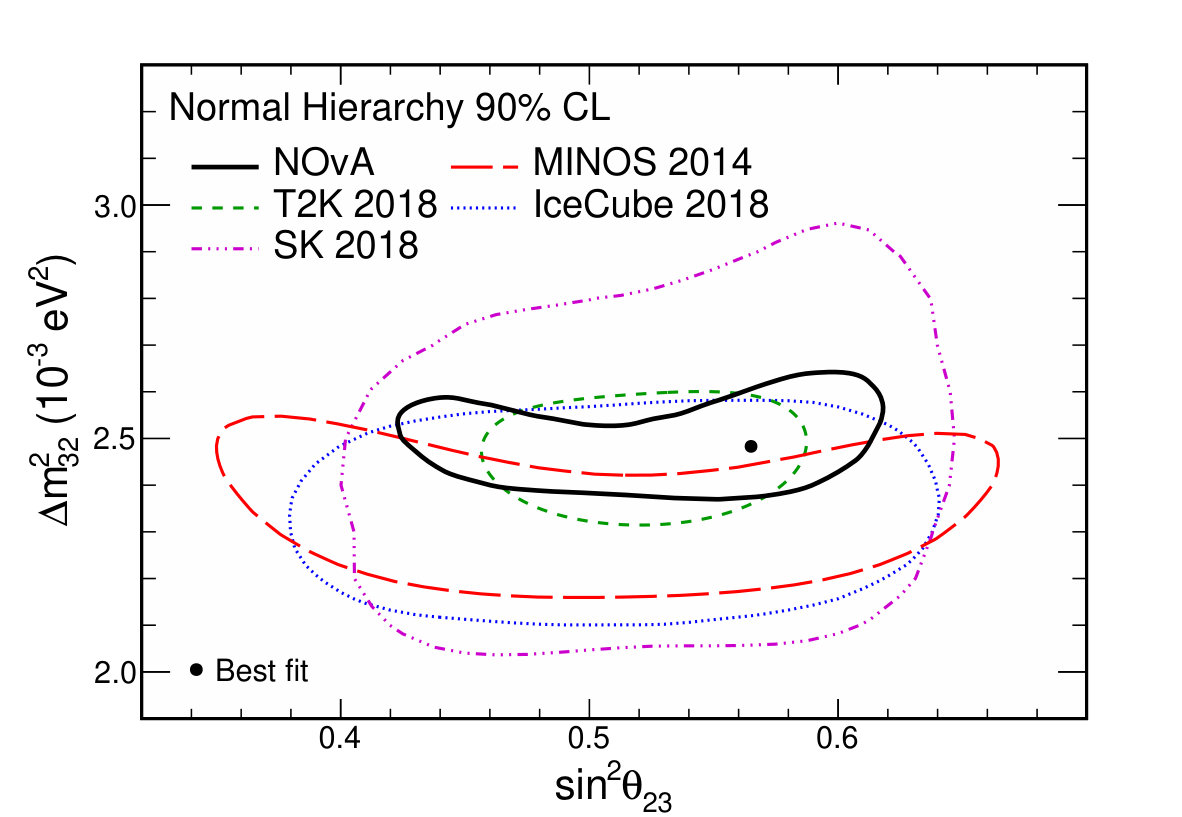 Figure 16
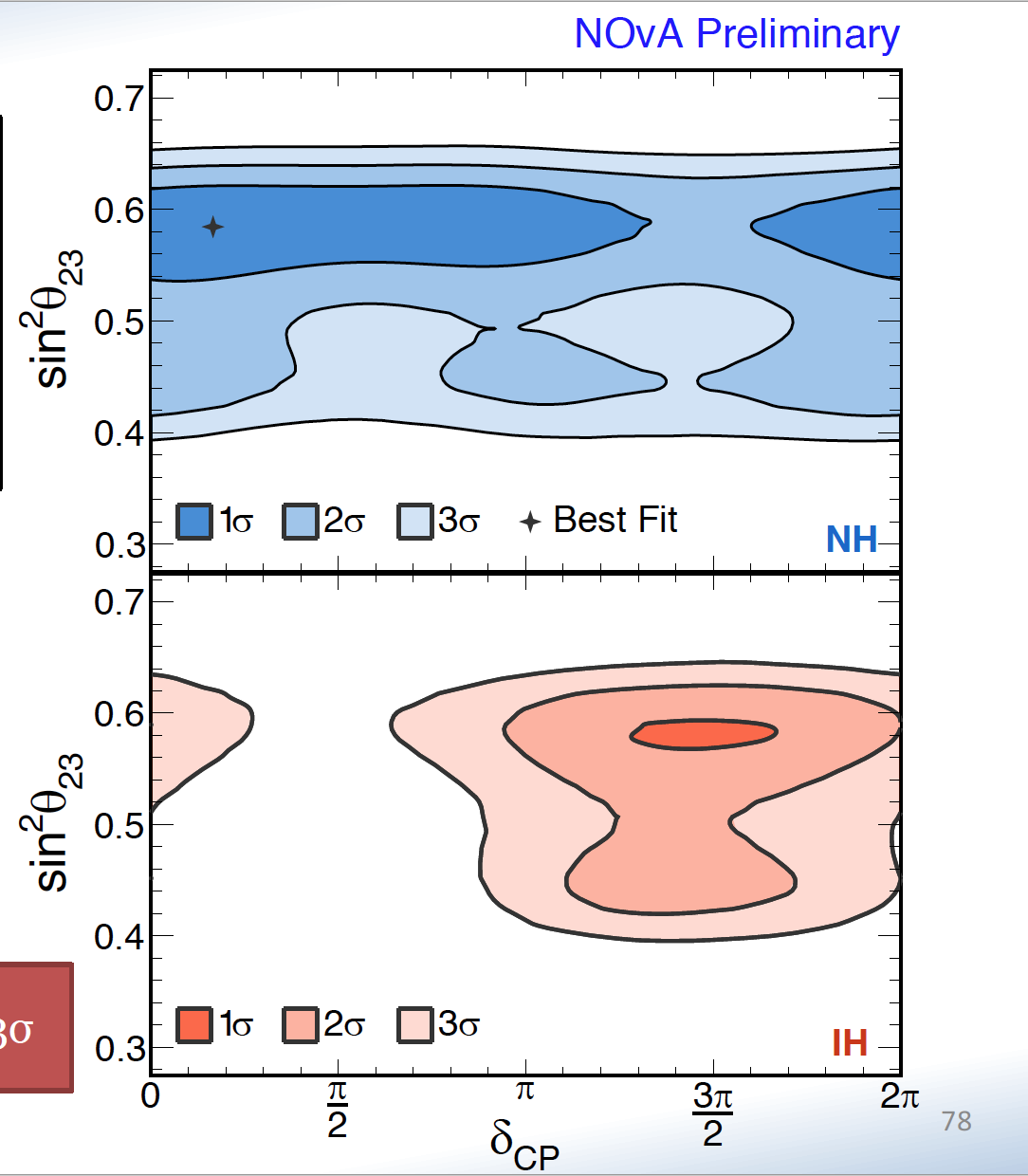 Figure 17
| Signal | Bkg. | Signal | Bkg. | |
|---|---|---|---|---|
| Source | (%) | (%) | (%) | (%) |
| Cross-sections | +4.7/-5.8 | +3.6/-3.4 | +3.2/-4.2 | +3.0/-2.9 |
| Detector model | +3.7/-3.9 | +1.3/-0.8 | +0.6/-0.6 | +3.7/-2.6 |
| ND/FD diffs. | +3.4/-3.4 | +2.6/-2.9 | +4.3/-4.3 | +2.8/-2.8 |
| Calibration | +2.1/-3.2 | +3.5/-3.9 | +1.5/-1.7 | +2.9/-0.5 |
| Others | +1.6/-1.6 | +1.5/-1.5 | +1.4/-1.2 | +1.0/-1.0 |
| Total | +7.4/-8.5 | +5.6/-6.2 | +5.8/-6.4 | +6.3/-4.9 |
| Source | () | () | () |
|---|---|---|---|
| Calibration | +5.4 / -9.2 | +2.2 / -2.6 | +0.03 / -0.03 |
| Neutron model | +6.0 / -13.0 | +0.5 / -1.3 | +0.01 / -0.00 |
| Cross-sections | +4.1 / -7.7 | +1.0 / -1.1 | +0.06 / -0.07 |
| scale | +2.3 / -3.0 | +1.0 / -1.1 | +0.00 / -0.00 |
| Detector model | +1.9 / -3.2 | +0.4 / -0.5 | +0.05 / -0.05 |
| Normalizations | +1.3 / -2.7 | +0.1 / -0.2 | +0.02 / -0.03 |
| ND/FD diffs. | +1.0 / -4.0 | +0.2 / -0.2 | +0.06 / -0.07 |
| Beam flux | +0.4 / -0.8 | +0.1 / -0.1 | +0.00 / -0.00 |
| Total syst. | +9.7 / -20 | +2.6 / -3.2 | +0.11 / -0.12 |
| Neutrino beam | Antineutrino beam | |||
| CC | CC | CC | CC | |
| 112.5 | 0.7 | 24.0 | 0.1 | |
| 7.2 | 0.0 | 70.0 | 0.1 | |
| 0.1 | 44.3 | 0.0 | 2.2 | |
| 0.0 | 0.6 | 0.0 | 16.6 | |
| Beam | 0.0 | 7.0 | 0.0 | 5.3 |
| NC | 1.3 | 3.1 | 0.8 | 1.2 |
| Cosmic | 2.1 | 3.3 | 0.8 | 1.1 |
| Others | 0.7 | 0.4 | 0.6 | 0.3 |
| Signal | 120 | 44.3 | 93.9 | 16.6 |
| Background | 4.2 | 15.0 | 10.3 | |
| Best fit | 124 | 59.3 | 96.2 | 26.8 |
| Observed | 113 | 58 | 102 | 27 |
| NH, UO | NH, LO | IH, UO | IH, LO | |
|---|---|---|---|---|
| ) | ||||
| - | ||||
Peer Reviews
No public reviews on file for this paper yet. If you reviewed it on a platform where reviews are public (OpenReview, ICLR, NeurIPS, ICML), you can paste yours below so the community can read it here.
Videos
No videos yet. Explain this paper in a talk, walkthrough, or lecture? Add one.
The NOvA Collaboration
First measurement of neutrino oscillation parameters
using neutrinos and antineutrinos by NOvA
M. A. Acero
Universidad del Atlantico, Km. 7 antigua via a Puerto Colombia, Barranquilla, Colombia
P. Adamson
Fermi National Accelerator Laboratory, Batavia, Illinois 60510, USA
L. Aliaga
Fermi National Accelerator Laboratory, Batavia, Illinois 60510, USA
T. Alion
Department of Physics and Astronomy, University of Sussex, Falmer, Brighton BN1 9QH, United Kingdom
V. Allakhverdian
Joint Institute for Nuclear Research, Dubna, Moscow region 141980, Russia
S. Altakarli
Department of Mathematics, Statistics, and Physics, Wichita State University, Wichita, Kansas 67206, USA
N. Anfimov
Joint Institute for Nuclear Research, Dubna, Moscow region 141980, Russia
A. Antoshkin
Joint Institute for Nuclear Research, Dubna, Moscow region 141980, Russia
School of Physics and Astronomy, University of Minnesota Twin Cities, Minneapolis, Minnesota 55455, USA
A. Aurisano
Department of Physics, University of Cincinnati, Cincinnati, Ohio 45221, USA
A. Back
Department of Physics and Astronomy, Iowa State University, Ames, Iowa 50011, USA
C. Backhouse
Physics and Astronomy Dept., University College London, Gower Street, London WC1E 6BT, United Kingdom
M. Baird
Indiana University, Bloomington, Indiana 47405, USA
Department of Physics and Astronomy, University of Sussex, Falmer, Brighton BN1 9QH, United Kingdom
Department of Physics, University of Virginia, Charlottesville, Virginia 22904, USA
N. Balashov
Joint Institute for Nuclear Research, Dubna, Moscow region 141980, Russia
P. Baldi
Department of Physics and Astronomy, University of California at Irvine, Irvine, California 92697, USA
B. A. Bambah
School of Physics, University of Hyderabad, Hyderabad, 500 046, India
S. Bashar
Department of Physics and Astronomy, Tufts University, Medford, Massachusetts 02155, USA
K. Bays
California Institute of Technology, Pasadena, California 91125, USA
Department of Physics, Illinois Institute of Technology, Chicago IL 60616, USA
S. Bending
Physics and Astronomy Dept., University College London, Gower Street, London WC1E 6BT, United Kingdom
R. Bernstein
Fermi National Accelerator Laboratory, Batavia, Illinois 60510, USA
V. Bhatnagar
Department of Physics, Panjab University, Chandigarh, 160 014, India
B. Bhuyan
Department of Physics, IIT Guwahati, Guwahati, 781 039, India
J. Bian
Department of Physics and Astronomy, University of California at Irvine, Irvine, California 92697, USA
School of Physics and Astronomy, University of Minnesota Twin Cities, Minneapolis, Minnesota 55455, USA
T. Blackburn
Department of Physics and Astronomy, University of Sussex, Falmer, Brighton BN1 9QH, United Kingdom
J. Blair
Department of Physics, University of Houston, Houston, Texas 77204, USA
A. C. Booth
Department of Physics and Astronomy, University of Sussex, Falmer, Brighton BN1 9QH, United Kingdom
P. Bour
Czech Technical University in Prague, Brehova 7, 115 19 Prague 1, Czech Republic
C. Bromberg
Department of Physics and Astronomy, Michigan State University, East Lansing, Michigan 48824, USA
N. Buchanan
Department of Physics, Colorado State University, Fort Collins, CO 80523-1875, USA
A. Butkevich
Inst. for Nuclear Research of Russia, Academy of Sciences 7a, 60th October Anniversary prospect, Moscow 117312, Russia
S. Calvez
Department of Physics, Colorado State University, Fort Collins, CO 80523-1875, USA
M. Campbell
Physics and Astronomy Dept., University College London, Gower Street, London WC1E 6BT, United Kingdom
T. J. Carroll
Department of Physics, University of Texas at Austin, Austin, Texas 78712, USA
E. Catano-Mur
Department of Physics and Astronomy, Iowa State University, Ames, Iowa 50011, USA
Department of Physics, College of William & Mary, Williamsburg, Virginia 23187, USA
A. Cedeno
Department of Mathematics, Statistics, and Physics, Wichita State University, Wichita, Kansas 67206, USA
S. Childress
Fermi National Accelerator Laboratory, Batavia, Illinois 60510, USA
B. C. Choudhary
Department of Physics and Astrophysics, University of Delhi, Delhi 110007, India
B. Chowdhury
Department of Physics and Astronomy, University of South Carolina, Columbia, South Carolina 29208, USA
T. E. Coan
Department of Physics, Southern Methodist University, Dallas, Texas 75275, USA
M. Colo
Department of Physics, College of William & Mary, Williamsburg, Virginia 23187, USA
J. Cooper
Fermi National Accelerator Laboratory, Batavia, Illinois 60510, USA
L. Corwin
South Dakota School of Mines and Technology, Rapid City, South Dakota 57701, USA
L. Cremonesi
Physics and Astronomy Dept., University College London, Gower Street, London WC1E 6BT, United Kingdom
G. S. Davies
Indiana University, Bloomington, Indiana 47405, USA
P. F. Derwent
Fermi National Accelerator Laboratory, Batavia, Illinois 60510, USA
P. Ding
Fermi National Accelerator Laboratory, Batavia, Illinois 60510, USA
Z. Djurcic
Argonne National Laboratory, Argonne, Illinois 60439, USA
D. Doyle
Department of Physics, Colorado State University, Fort Collins, CO 80523-1875, USA
E. C. Dukes
Department of Physics, University of Virginia, Charlottesville, Virginia 22904, USA
H. Duyang
Department of Physics and Astronomy, University of South Carolina, Columbia, South Carolina 29208, USA
S. Edayath
Department of Physics, Cochin University of Science and Technology, Kochi 682 022, India
R. Ehrlich
Department of Physics, University of Virginia, Charlottesville, Virginia 22904, USA
M. Elkins
Department of Physics and Astronomy, Iowa State University, Ames, Iowa 50011, USA
G. J. Feldman
Department of Physics, Harvard University, Cambridge, Massachusetts 02138, USA
P. Filip
Institute of Physics, The Czech Academy of Sciences, 182 21 Prague, Czech Republic
W. Flanagan
University of Dallas, 1845 E Northgate Drive, Irving, Texas 75062 USA
M. J. Frank
Department of Physics, University of South Alabama, Mobile, Alabama 36688, USA
Department of Physics, University of Virginia, Charlottesville, Virginia 22904, USA
H. R. Gallagher
Department of Physics and Astronomy, Tufts University, Medford, Massachusetts 02155, USA
R. Gandrajula
Department of Physics and Astronomy, Michigan State University, East Lansing, Michigan 48824, USA
F. Gao
Department of Physics, University of Pittsburgh, Pittsburgh, Pennsylvania 15260, USA
S. Germani
Physics and Astronomy Dept., University College London, Gower Street, London WC1E 6BT, United Kingdom
A. Giri
Department of Physics, IIT Hyderabad, Hyderabad, 502 205, India
R. A. Gomes
Instituto de Física, Universidade Federal de Goiás, Goiânia, Goiás, 74690-900, Brazil
M. C. Goodman
Argonne National Laboratory, Argonne, Illinois 60439, USA
V. Grichine
Nuclear Physics and Astrophysics Division, Lebedev Physical Institute, Leninsky Prospect 53, 119991 Moscow, Russia
M. Groh
Indiana University, Bloomington, Indiana 47405, USA
R. Group
Department of Physics, University of Virginia, Charlottesville, Virginia 22904, USA
B. Guo
Department of Physics and Astronomy, University of South Carolina, Columbia, South Carolina 29208, USA
A. Habig
Department of Physics and Astronomy, University of Minnesota Duluth, Duluth, Minnesota 55812, USA
F. Hakl
Institute of Computer Science, The Czech Academy of Sciences, 182 07 Prague, Czech Republic
J. Hartnell
Department of Physics and Astronomy, University of Sussex, Falmer, Brighton BN1 9QH, United Kingdom
R. Hatcher
Fermi National Accelerator Laboratory, Batavia, Illinois 60510, USA
A. Hatzikoutelis
Department of Physics and Astronomy, University of Tennessee, Knoxville, Tennessee 37996, USA
K. Heller
School of Physics and Astronomy, University of Minnesota Twin Cities, Minneapolis, Minnesota 55455, USA
J. Hewes
Department of Physics, University of Cincinnati, Cincinnati, Ohio 45221, USA
A. Himmel
Fermi National Accelerator Laboratory, Batavia, Illinois 60510, USA
A. Holin
Physics and Astronomy Dept., University College London, Gower Street, London WC1E 6BT, United Kingdom
B. Howard
Indiana University, Bloomington, Indiana 47405, USA
J. Huang
Department of Physics, University of Texas at Austin, Austin, Texas 78712, USA
J. Hylen
Fermi National Accelerator Laboratory, Batavia, Illinois 60510, USA
F. Jediny
Czech Technical University in Prague, Brehova 7, 115 19 Prague 1, Czech Republic
C. Johnson
Department of Physics, Colorado State University, Fort Collins, CO 80523-1875, USA
M. Judah
Department of Physics, Colorado State University, Fort Collins, CO 80523-1875, USA
I. Kakorin
Joint Institute for Nuclear Research, Dubna, Moscow region 141980, Russia
D. Kalra
Department of Physics, Panjab University, Chandigarh, 160 014, India
D. M. Kaplan
Department of Physics, Illinois Institute of Technology, Chicago IL 60616, USA
R. Keloth
Department of Physics, Cochin University of Science and Technology, Kochi 682 022, India
O. Klimov
Joint Institute for Nuclear Research, Dubna, Moscow region 141980, Russia
L. W. Koerner
Department of Physics, University of Houston, Houston, Texas 77204, USA
L. Kolupaeva
Joint Institute for Nuclear Research, Dubna, Moscow region 141980, Russia
S. Kotelnikov
Nuclear Physics and Astrophysics Division, Lebedev Physical Institute, Leninsky Prospect 53, 119991 Moscow, Russia
A. Kreymer
Fermi National Accelerator Laboratory, Batavia, Illinois 60510, USA
Ch. Kulenberg
Joint Institute for Nuclear Research, Dubna, Moscow region 141980, Russia
A. Kumar
Department of Physics, Panjab University, Chandigarh, 160 014, India
C. D. Kuruppu
Department of Physics and Astronomy, University of South Carolina, Columbia, South Carolina 29208, USA
V. Kus
Czech Technical University in Prague, Brehova 7, 115 19 Prague 1, Czech Republic
T. Lackey
Indiana University, Bloomington, Indiana 47405, USA
K. Lang
Department of Physics, University of Texas at Austin, Austin, Texas 78712, USA
S. Lin
Department of Physics, Colorado State University, Fort Collins, CO 80523-1875, USA
M. Lokajicek
Institute of Physics, The Czech Academy of Sciences, 182 21 Prague, Czech Republic
J. Lozier
California Institute of Technology, Pasadena, California 91125, USA
S. Luchuk
Inst. for Nuclear Research of Russia, Academy of Sciences 7a, 60th October Anniversary prospect, Moscow 117312, Russia
K. Maan
Department of Physics, Panjab University, Chandigarh, 160 014, India
S. Magill
Argonne National Laboratory, Argonne, Illinois 60439, USA
W. A. Mann
Department of Physics and Astronomy, Tufts University, Medford, Massachusetts 02155, USA
M. L. Marshak
School of Physics and Astronomy, University of Minnesota Twin Cities, Minneapolis, Minnesota 55455, USA
M. Martinez-Casales
Department of Physics and Astronomy, Iowa State University, Ames, Iowa 50011, USA
V. Matveev
Inst. for Nuclear Research of Russia, Academy of Sciences 7a, 60th October Anniversary prospect, Moscow 117312, Russia
D. P. Méndez
Department of Physics and Astronomy, University of Sussex, Falmer, Brighton BN1 9QH, United Kingdom
M. D. Messier
Indiana University, Bloomington, Indiana 47405, USA
H. Meyer
Department of Mathematics, Statistics, and Physics, Wichita State University, Wichita, Kansas 67206, USA
T. Miao
Fermi National Accelerator Laboratory, Batavia, Illinois 60510, USA
W. H. Miller
School of Physics and Astronomy, University of Minnesota Twin Cities, Minneapolis, Minnesota 55455, USA
S. R. Mishra
Department of Physics and Astronomy, University of South Carolina, Columbia, South Carolina 29208, USA
A. Mislivec
School of Physics and Astronomy, University of Minnesota Twin Cities, Minneapolis, Minnesota 55455, USA
R. Mohanta
School of Physics, University of Hyderabad, Hyderabad, 500 046, India
A. Moren
Department of Physics and Astronomy, University of Minnesota Duluth, Duluth, Minnesota 55812, USA
L. Mualem
California Institute of Technology, Pasadena, California 91125, USA
M. Muether
Department of Mathematics, Statistics, and Physics, Wichita State University, Wichita, Kansas 67206, USA
S. Mufson
Indiana University, Bloomington, Indiana 47405, USA
K. Mulder
Physics and Astronomy Dept., University College London, Gower Street, London WC1E 6BT, United Kingdom
R. Murphy
Indiana University, Bloomington, Indiana 47405, USA
J. Musser
Indiana University, Bloomington, Indiana 47405, USA
D. Naples
Department of Physics, University of Pittsburgh, Pittsburgh, Pennsylvania 15260, USA
N. Nayak
Department of Physics and Astronomy, University of California at Irvine, Irvine, California 92697, USA
J. K. Nelson
Department of Physics, College of William & Mary, Williamsburg, Virginia 23187, USA
R. Nichol
Physics and Astronomy Dept., University College London, Gower Street, London WC1E 6BT, United Kingdom
G. Nikseresht
Department of Physics, Illinois Institute of Technology, Chicago IL 60616, USA
E. Niner
Fermi National Accelerator Laboratory, Batavia, Illinois 60510, USA
A. Norman
Fermi National Accelerator Laboratory, Batavia, Illinois 60510, USA
T. Nosek
Charles University, Faculty of Mathematics and Physics, Institute of Particle and Nuclear Physics, Prague, Czech Republic
A. Olshevskiy
Joint Institute for Nuclear Research, Dubna, Moscow region 141980, Russia
T. Olson
Department of Physics and Astronomy, Tufts University, Medford, Massachusetts 02155, USA
J. Paley
Fermi National Accelerator Laboratory, Batavia, Illinois 60510, USA
R. B. Patterson
California Institute of Technology, Pasadena, California 91125, USA
G. Pawloski
School of Physics and Astronomy, University of Minnesota Twin Cities, Minneapolis, Minnesota 55455, USA
D. Pershey
California Institute of Technology, Pasadena, California 91125, USA
O. Petrova
Joint Institute for Nuclear Research, Dubna, Moscow region 141980, Russia
R. Petti
Department of Physics and Astronomy, University of South Carolina, Columbia, South Carolina 29208, USA
D. D. Phan
Department of Physics, University of Texas at Austin, Austin, Texas 78712, USA
R. K. Plunkett
Fermi National Accelerator Laboratory, Batavia, Illinois 60510, USA
B. Potukuchi
Department of Physics and Electronics, University of Jammu, Jammu Tawi, 180 006, Jammu and Kashmir, India
C. Principato
Department of Physics, University of Virginia, Charlottesville, Virginia 22904, USA
F. Psihas
Indiana University, Bloomington, Indiana 47405, USA
A. Radovic
Department of Physics, College of William & Mary, Williamsburg, Virginia 23187, USA
V. Raj
California Institute of Technology, Pasadena, California 91125, USA
R. A. Rameika
Fermi National Accelerator Laboratory, Batavia, Illinois 60510, USA
B. Rebel
Fermi National Accelerator Laboratory, Batavia, Illinois 60510, USA
Department of Physics, University of Wisconsin-Madison, Madison, Wisconsin 53706, USA
P. Rojas
Department of Physics, Colorado State University, Fort Collins, CO 80523-1875, USA
V. Ryabov
Nuclear Physics and Astrophysics Division, Lebedev Physical Institute, Leninsky Prospect 53, 119991 Moscow, Russia
O. Samoylov
Joint Institute for Nuclear Research, Dubna, Moscow region 141980, Russia
M. C. Sanchez
Department of Physics and Astronomy, Iowa State University, Ames, Iowa 50011, USA
S. Sánchez Falero
Department of Physics and Astronomy, Iowa State University, Ames, Iowa 50011, USA
I. S. Seong
Department of Physics and Astronomy, University of California at Irvine, Irvine, California 92697, USA
P. Shanahan
Fermi National Accelerator Laboratory, Batavia, Illinois 60510, USA
A. Sheshukov
Joint Institute for Nuclear Research, Dubna, Moscow region 141980, Russia
P. Singh
Department of Physics and Astrophysics, University of Delhi, Delhi 110007, India
V. Singh
Department of Physics, Institute of Science, Banaras Hindu University, Varanasi, 221 005, India
E. Smith
Indiana University, Bloomington, Indiana 47405, USA
J. Smolik
Czech Technical University in Prague, Brehova 7, 115 19 Prague 1, Czech Republic
P. Snopok
Department of Physics, Illinois Institute of Technology, Chicago IL 60616, USA
N. Solomey
Department of Mathematics, Statistics, and Physics, Wichita State University, Wichita, Kansas 67206, USA
E. Song
Department of Physics, University of Virginia, Charlottesville, Virginia 22904, USA
A. Sousa
Department of Physics, University of Cincinnati, Cincinnati, Ohio 45221, USA
K. Soustruznik
Charles University, Faculty of Mathematics and Physics, Institute of Particle and Nuclear Physics, Prague, Czech Republic
M. Strait
School of Physics and Astronomy, University of Minnesota Twin Cities, Minneapolis, Minnesota 55455, USA
L. Suter
Fermi National Accelerator Laboratory, Batavia, Illinois 60510, USA
A. Sutton
Department of Physics, University of Virginia, Charlottesville, Virginia 22904, USA
R. L. Talaga
Argonne National Laboratory, Argonne, Illinois 60439, USA
B. Tapia Oregui
Department of Physics, University of Texas at Austin, Austin, Texas 78712, USA
P. Tas
Charles University, Faculty of Mathematics and Physics, Institute of Particle and Nuclear Physics, Prague, Czech Republic
R. B. Thayyullathil
Department of Physics, Cochin University of Science and Technology, Kochi 682 022, India
J. Thomas
Physics and Astronomy Dept., University College London, Gower Street, London WC1E 6BT, United Kingdom
Department of Physics, University of Wisconsin-Madison, Madison, Wisconsin 53706, USA
E. Tiras
Department of Physics and Astronomy, Iowa State University, Ames, Iowa 50011, USA
D. Torbunov
School of Physics and Astronomy, University of Minnesota Twin Cities, Minneapolis, Minnesota 55455, USA
J. Tripathi
Department of Physics, Panjab University, Chandigarh, 160 014, India
A. Tsaris
Fermi National Accelerator Laboratory, Batavia, Illinois 60510, USA
Y. Torun
Department of Physics, Illinois Institute of Technology, Chicago IL 60616, USA
J. Urheim
Indiana University, Bloomington, Indiana 47405, USA
P. Vahle
Department of Physics, College of William & Mary, Williamsburg, Virginia 23187, USA
J. Vasel
Indiana University, Bloomington, Indiana 47405, USA
L. Vinton
Department of Physics and Astronomy, University of Sussex, Falmer, Brighton BN1 9QH, United Kingdom
P. Vokac
Czech Technical University in Prague, Brehova 7, 115 19 Prague 1, Czech Republic
T. Vrba
Czech Technical University in Prague, Brehova 7, 115 19 Prague 1, Czech Republic
M. Wallbank
Department of Physics, University of Cincinnati, Cincinnati, Ohio 45221, USA
B. Wang
Department of Physics, Southern Methodist University, Dallas, Texas 75275, USA
T. K. Warburton
Department of Physics and Astronomy, Iowa State University, Ames, Iowa 50011, USA
M. Wetstein
Department of Physics and Astronomy, Iowa State University, Ames, Iowa 50011, USA
M. While
South Dakota School of Mines and Technology, Rapid City, South Dakota 57701, USA
D. Whittington
Department of Physics, Syracuse University, Syracuse NY 13210, USA
Indiana University, Bloomington, Indiana 47405, USA
S. G. Wojcicki
Department of Physics, Stanford University, Stanford, California 94305, USA
J. Wolcott
Department of Physics and Astronomy, Tufts University, Medford, Massachusetts 02155, USA
N. Yadav
Department of Physics, IIT Guwahati, Guwahati, 781 039, India
A. Yallappa Dombara
Department of Physics, Syracuse University, Syracuse NY 13210, USA
K. Yonehara
Fermi National Accelerator Laboratory, Batavia, Illinois 60510, USA
S. Yu
Argonne National Laboratory, Argonne, Illinois 60439, USA
Department of Physics, Illinois Institute of Technology, Chicago IL 60616, USA
S. Zadorozhnyy
Inst. for Nuclear Research of Russia, Academy of Sciences 7a, 60th October Anniversary prospect, Moscow 117312, Russia
J. Zalesak
Institute of Physics, The Czech Academy of Sciences, 182 21 Prague, Czech Republic
B. Zamorano
Department of Physics and Astronomy, University of Sussex, Falmer, Brighton BN1 9QH, United Kingdom
R. Zwaska
Fermi National Accelerator Laboratory, Batavia, Illinois 60510, USA
Abstract
The NOvA experiment has made a -significant observation of appearance in a 2 GeV beam at a distance of 810 km. Using protons on target delivered to the Fermilab NuMI neutrino beamline, the experiment recorded 27 candidates with a background of 10.3 and 102 candidates. This new antineutrino data is combined with neutrino data to measure the oscillation parameters eV, in the normal neutrino mass hierarchy and upper octant and excludes most values near for the inverted mass hierarchy by more than 3. The data favor the normal neutrino mass hierarchy by 1.9 and values in the upper octant by 1.6.
††preprint: FERMILAB-PUB-19-272-ND
The observations of neutrino oscillations by many experiments Fukuda et al. (1998, 2002); Ahmad et al. (2002); Eguchi et al. (2003); Michael et al. (2006); Abe et al. (2011, 2012); An et al. (2012); Ahn et al. (2012) are well described by the mixing of three neutrino mass eigenstates , , and with the flavor eigenstates , , and . The mixing is parameterized by a unitary matrix, , which depends on three angles and a phase, , that may break Charge-Parity (CP) symmetry. The oscillation frequencies are proportional to the neutrino mass splittings, 7.5\text{\times}{10}^{-5}\text{,}\mathrm{e}\mathrm{V}^{2}\mathrm{/}{\it c}^{4} and $|\Delta m^{2}_{32}|\simeq$2.5\text{\times}{10}^{-3}\text{\,}\mathrm{e}\mathrm{V}^{2}\mathrm{/}{\it c}^{4}, and the angles are known to be large: , , Patrignani et al. (2016); , however, is largely unknown.
Within this framework, several questions remain unanswered. The angle produces nearly maximal mixing but has large uncertainties. If maximal, it would introduce an unexplained symmetry; should it differ from , its octant would determine whether or couples more strongly to . Furthermore, while it is known that the two independent mass splittings differ by a factor of 30, the sign of the larger splitting is unknown. The and states that contribute most to the state could be lighter (“normal hierarchy”, NH) or heavier (“inverted hierarchy”, IH) than the state. This question has important implications for models of neutrino mass Mohapatra and Smirnov (2006); Nunokawa et al. (2008); Altarelli and Feruglio (2010); King (2015); Petcov (2018) and for the study of the Dirac vs. Majorana nature of the neutrino Pascoli and Petcov (2002); Bahcall et al. (2004). Additionally, neutrino mixing may be a source of CP violation if is non-zero.
These questions can be addressed by the measurement of , , , and oscillations in matter over baselines of order , with neutrino energies . Several long-baseline experiments have reported observations of Ahn et al. (2006); Adamson et al. (2014); Abe et al. (2018a); Acero et al. (2018), Adamson et al. (2014); Abe et al. (2018a); Acero et al. (2018), and Adamson et al. (2014); Abe et al. (2018a), but a statistically significant observation of has not previously been made. This report combines the first antineutrino measurements using the NOvA detectors with the neutrino data reported in Ref. Acero et al. (2018) in a reoptimized analysis yielding a new determination of the oscillation parameters , , , and the neutrino mass hierarchy.
The NOvA experiment measures oscillations by comparing the energy spectra of neutrino interactions in two detectors placed in the Fermilab NuMI beam Adamson et al. (2016) at distances of (Near Detector, ND) and (Far Detector, FD) from the production target. The FD measures 15\text{\,}\mathrm{m}$\times$15\text{\,}\mathrm{m}$\times$60\text{\,}\mathrm{m} while the ND consists of a 3.8\text{\,}\mathrm{m}$\times$3.8\text{\,}\mathrm{m}$\times$12.8\text{\,}\mathrm{m} main detector followed by a muon range stack. Both detectors use liquid scintillator Mufson et al. (2015) contained in PVC cells that are 6.6\text{\,}\mathrm{c}\mathrm{m}$\times$3.9\text{\,}\mathrm{c}\mathrm{m} (0.15 radiation lengths 0.45 Molière radii) in cross section and span the height and width of the detectors in planes of alternating vertical and horizontal orientation. The ND is located underground. The FD operates on the surface with modest shielding resulting in of cosmic-ray activity. The detectors are located off the beam axis where the neutrino energy spectrum peaks at . Magnetic focusing horns in the beamline charge-select neutrino parents giving 96% (83%) pure () event samples between 1 and . Most contamination is wrong-sign ( in the beam, or vice versa) with contamination.
This Letter reports data from an antineutrino beam run spanning from June 29, 2016 to February 26, 2019, with an exposure of protons-on-target (POT) delivered during of beam-on time, combined with the previously reported Acero et al. (2018) neutrino beam exposure of POT and . During these periods, the proton source achieved a peak hourly-averaged power of .
The flux of neutrinos delivered to the detectors is calculated using a simulation of the production and transport of particles through the beamline components Adamson et al. (2016); Agostinelli et al. (2003) and reweighted Aliaga et al. (2016) to incorporate external measurements of hadron production and interactions Paley et al. (2014); Alt et al. (2007); Abgrall et al. (2011); Barton et al. (1983); Seun (2007); Tinti (2010); Lebedev (2007); Baatar et al. (2013); Skubic et al. (1978); Denisov et al. (1973); Carroll et al. (1979); Abe et al. (2013); Gaisser et al. (1975); Cronin et al. (1957); Allaby et al. (1969); Longo and Moyer (1962); Bobchenko et al. (1979); Fedorov et al. (1978); Abrams et al. (1970). Neutrino interactions in the detector are simulated using the genie event generator Andreopoulos et al. (2010). The cross section model has been tuned to improve agreement with external measurements and ND data, reducing uncertainties in the extrapolation of measurements in the ND to the FD. As in Ref. Acero et al. (2018), we set in the quasielastic dipole form factor to Meyer et al. (2016) and use corrections to the charged-current (CC) quasielastic cross section derived from the random phase approximation Nieves et al. (2004); Gran (2017). In this analysis, we also apply this effect to baryon resonance production as a placeholder for the unknown nuclear effect that produces a suppression observed at low four-momentum transfer in our and other measurements Adamson et al. (2015); Aguilar-Arevalo et al. (2011); McGivern et al. (2016); Altinok et al. (2017). Additionally, we increase the rate of deep-inelastic scattering with hadronic mass 1.7\text{,}\mathrm{G}\mathrm{e}\mathrm{V}\mathrm{/}{\it c}^{2}$$ by 10% to match our observed rates of short track-length CC events. We model multi-nucleon ejection interactions following Ref. Katori (2015) and adjust the rates in bins of energy transfer, , and 3-momentum transfer, , for and separately to maximize agreement in the ND. The calculation of the and rates uses these same models.
The energy depositions of final-state particles are simulated with geant4 Agostinelli et al. (2003) and input to a custom simulation of the production of, and the detector response to, scintillation and Cherenkov light Aurisano et al. (2015). The absolute energy scale of the detectors is calibrated to within using the minimum ionizing portion of cosmic-ray muon tracks that stop in the detectors.
Cells with activity above threshold (hits) are grouped based on their proximity in space and time to produce candidate neutrino events. Events are assigned a vertex, and clusters are formed from hits likely to be associated with particles produced there Baird et al. (2015). These clusters are categorized as electromagnetic or hadronic in origin using a convolutional neural network (CNN) Psihas (2018). Hits forming tracks are identified as muons by combining information on the track length, , vertex activity, and scattering into a single particle identification (PID) score Raddatz (2016). The same reconstruction algorithms are applied to events from data and simulation in both detectors.
The and candidates are required to have a vertex inside the fiducial volume and no evidence of particles exiting the detector. The and candidates are divided into a “core” sample which satisfies these containment requirements, and a “peripheral” sample which loosens these requirements for the most signal-like event topologies. A second CNN Aurisano et al. (2016) serves as the primary PID, classifying event topologies as CC, CC, CC, neutral-current (NC), or cosmic ray. The network is trained on simulated neutrino events and cosmic-ray data, separately for neutrino and antineutrino beam conditions. It has an improved architecture and higher rate of cosmic ray rejection over the previous network Acero et al. (2018). Events identified as CC are further required to contain at least one track classified as a muon.
Several requirements further reduce cosmic-ray backgrounds. For the CC sample, a boosted decision tree (BDT) algorithm based on vertex position and muon-like track properties is used. Events in the core sample not aligned with the beam direction and that are near the top of the detector are rejected. Events characterized as detached bremsstrahlung showers from cosmic tracks are also removed, as are events whose topology is consistent with photons entering from the detector north side where there is less shielding. Events in the peripheral sample are tested against a BDT classifier using event position and direction information to separate them from cosmic-ray topologies.
The selection of and CC events is 31.2% (33.9%) efficient relative to true interactions in the fiducial volume, resulting in 98.6% (98.8%) pure samples at the FD during neutrino (antineutrino) beam operation. Both and are counted as signal for the disappearance measurements. Selections against exiting particle tracks are the largest source of inefficiency. The efficiency for selecting signal CC ( CC) events is 62% (67%). Purities for the signal () samples fall in the range 57–78% (55–77%) depending on the impact of oscillations on the signal and wrong-sign background levels. These efficiencies and purities differ from those quoted in Ref. Acero et al. (2018) due to a reoptimization of the selection algorithms Blackburn (2019). The wrong-sign component of the selected sample in the ND is calculated to be and for the neutrino and antineutrino beams. These fractions were found to be consistent with a data-driven estimate based on the rate of CC and NC interactions with associated detector activity indicative of neutron capture.
The incident neutrino energy is reconstructed from the measured energies of the final-state lepton and recoil hadronic system. The lepton energy is estimated from track length for muon candidates and from calorimetric energy for electron candidates. The hadronic energy is estimated from the sum of the calibrated hits not associated with the primary lepton. The neutrino energy resolution at the FD is 9.1% (8.1%) for CC ( CC) events and 10.7% (8.8%) for CC ( CC) events. The and events with the lowest hadronic energy fraction give the best energy resolution and lowest backgrounds, yielding the most precise measurement of the oscillated spectral shape, so we analyzed the spectra separately in quartiles of this variable Acero et al. (2018).
The energy spectra of the selected CC and CC interactions in the ND during neutrino and antineutrino beam operations are shown in Fig. 1. The selected ND sample consists entirely of background sources for the appearance measurement, predominantly the intrinsic beam component, along with misidentified CC and NC interactions. We analyze the candidate energy spectra in two bins of PID (“low” and “high”) to isolate a highly pure sample of and at the FD. In the ND, the high-PID sample is dominated by intrinsic beam . A third bin containing the “peripheral” events is added for the FD.
The and signal spectra at the FD are predicted for the neutrino and antineutrino beams separately and are based on the observed spectra of candidate events in the ND. The true neutrino energy spectrum at the ND is estimated using the measured event rates in bins of reconstructed energy and the energy distributions of simulated events found to populate those bins. This true spectrum is corrected for differences in flux and acceptance between the ND and FD, as well as differences in the and cross sections; oscillations are then applied to yield predictions for the true and spectra at the FD. These spectra are then transformed into reconstructed energy using the underlying energy distributions from simulated neutrino interactions in the FD.
The predicted background spectra at the FD are also primarily data-driven. Data collected out-of-time with the NuMI beam provide a measurement of the rate of cosmic-ray backgrounds in the and samples. Neutrino backgrounds calculated to populate the FD spectra are corrected based on the reconstructed candidates at the ND. The procedure from Ref. Acero et al. (2018) is followed to determine corrections for each background component in the neutrino-mode beam, while for the antineutrino-mode beam a single scale factor is used. The remaining backgrounds, which include any misidentified neutrino events in the samples and misidentified interactions in the samples, make up less than 2% of the FD candidates and are taken directly from simulation.
To evaluate the impact of systematic uncertainties we recompute the extrapolation from the ND to the FD varying the parameters used to model the neutrino fluxes, neutrino cross sections, and the detector response. The procedure accounts for changes in the composition of the background, and for impact on the transformation to and from true and reconstructed energies due to variations in the model parameters. We parameterize each systematic variation and compute its effect in each analysis bin. These parameters are included in the oscillation fit constrained within their estimated uncertainties by penalty terms in the likelihood function.
The oscillation parameters that best fit the FD data are determined through minimization of a Poisson negative log-likelihood, , considering three unconstrained parameters, , , and , as well as 53 constrained parameters covering the other PMNS oscillation parameters and the sources of systematic uncertainty summarized in Tables 1 and 2. The two-detector design and extrapolation procedure significantly reduce the effect of the 10–20% a priori uncertainties on the beam flux and cross sections. The principal remaining uncertainties are neutrino cross sections, the energy scale calibration, the detector response to neutrons, and differences between the ND and FD that cannot be corrected by extrapolation.
The selection criteria and techniques used in the analysis were developed on simulated data prior to inspection of the FD data distributions. Figure 1 shows the energy spectra of the CC, CC, CC, and CC candidates recorded at the FD overlaid on their oscillated best-fit expectations. Table 3 summarizes the total event counts and estimated compositions of the selected samples. We recorded 102 candidate events at the FD, reflecting a significant suppression from the unoscillated expectation of 476. We find 27 candidate events with an estimated background of , a excess over the predicted background. This observation is the first evidence of appearance in a beam over a long baseline. These new antineutrino data are analyzed together with 113 and 58 candidates from the previous data set.
Table 4 shows the overall best-fit parameters, as well as the best fits for each choice of octant and hierarchy. The best-fit point is found for the normal hierarchy with in the upper octant where = 157.1 for 175 degrees of freedom (goodness-of-fit from simulated experiments). The measured values of and are consistent with the previous NOvA measurement Acero et al. (2018) that used only neutrino data, and are consistent with maximal mixing within .
Confidence intervals for the oscillation parameters are determined using the unified approach Feldman and Cousins (1998), as detailed in Ref. Sousa et al. (2019). Figure 2 compares the 90% confidence level contours in and with those of other other experiments Adamson et al. (2014); Aartsen et al. (2018); Abe et al. (2018b, a). Figure 3 shows the allowed regions in and . These results exclude most values near in the inverted mass hierarchy by more than 3; specifically the intervals between -0.040.97$$\pi in the lower octant and 0.040.91$$\pi in the upper octant. The data prefer the normal hierarchy with a significance of (, Read (2002)) and the upper octant with a significance of (), profiling over all other parameter choices.
Acknowledgements.
We are grateful to Stephen Parke (FNAL) for useful discussions. This document was prepared by the NOvA collaboration using the resources of the Fermi National Accelerator Laboratory (Fermilab), a U.S. Department of Energy, Office of Science, HEP User Facility. Fermilab is managed by Fermi Research Alliance, LLC (FRA), acting under Contract No. DE-AC02-07CH11359. This work was supported by the U.S. Department of Energy; the U.S. National Science Foundation; the Department of Science and Technology, India; the European Research Council; the MSMT CR, GA UK, Czech Republic; the RAS, RFBR, RMES, RSF, and BASIS Foundation, Russia; CNPq and FAPEG, Brazil; STFC, and the Royal Society, United Kingdom; and the state and University of Minnesota. This work used resources of the National Energy Research Scientific Computing Center (NERSC), a U.S. Department of Energy Office of Science User Facility operated under Contract No. DE-AC02-05CH11231. We are grateful for the contributions of the staffs of the University of Minnesota at the Ash River Laboratory and of Fermilab.
The reference list from the paper itself. Each links out to its DOI / PubMed record.
- 1Fukuda et al. (1998) Y. Fukuda et al. (Super-Kamiokande), Phys. Rev. Lett. 81 , 1562 (1998) , ar Xiv:hep-ex/9807003 [hep-ex] . · doi ↗
- 2Fukuda et al. (2002) S. Fukuda et al. (Super-Kamiokande), Phys. Lett. B 539 , 179 (2002) , ar Xiv:hep-ex/0205075 [hep-ex] . · doi ↗
- 3Ahmad et al. (2002) Q. R. Ahmad et al. (SNO), Phys. Rev. Lett. 89 , 011301 (2002) , ar Xiv:nucl-ex/0204008 [nucl-ex] . · doi ↗
- 4Eguchi et al. (2003) K. Eguchi et al. (Kam LAND), Phys. Rev. Lett. 90 , 021802 (2003) , ar Xiv:hep-ex/0212021 [hep-ex] . · doi ↗
- 5Michael et al. (2006) D. G. Michael et al. (MINOS), Phys. Rev. Lett. 97 , 191801 (2006) , ar Xiv:hep-ex/0607088 [hep-ex] . · doi ↗
- 6Abe et al. (2011) K. Abe et al. (T 2K), Phys. Rev. Lett. 107 , 041801 (2011) , ar Xiv:1106.2822 [hep-ex] . · doi ↗
- 7Abe et al. (2012) Y. Abe et al. (Double Chooz), Phys. Rev. Lett. 108 , 131801 (2012) , ar Xiv:1112.6353 [hep-ex] . · doi ↗
- 8An et al. (2012) F. P. An et al. (Daya Bay), Phys. Rev. Lett. 108 , 171803 (2012) , ar Xiv:1203.1669 [hep-ex] . · doi ↗