Directed aging, memory and Nature's greed
Nidhi Pashine, Daniel Hexner, Andrea J. Liu, Sidney R. Nagel

TL;DR
This paper explores how disordered materials can encode memories of their deformation history through a process called directed aging, where their elastic properties evolve in a way that reflects their past strains, acting like a natural greedy algorithm.
Contribution
It introduces the concept of directed aging in disordered materials, demonstrating how their elastic properties evolve based on their aging history through experiments and simulations.
Findings
Elastic properties evolve with aging history.
Materials develop new responses not inherent initially.
Directed aging acts as a natural greedy algorithm.
Abstract
Disordered materials are often out of equilibrium and evolve very slowly. This allows a memory of the imposed strains or preparation conditions to be encoded in the material. Here we consider "directed aging", where the elastic properties of a material evolve in the direction defined by its aging history. The evolution to a lower-energy configuration is controlled by steepest decent and affects stressed regions differently from unstressed ones. This process can be considered to be a "greedy algorithm" of Nature. Our experiments and simulations illustrate directed aging in examples in which the material's elasticity evolves as a direct consequence of the imposed deformation; the material itself decides how to evolve in order to produce responses that were not present inherently in the material.
Click any figure to enlarge with its caption.
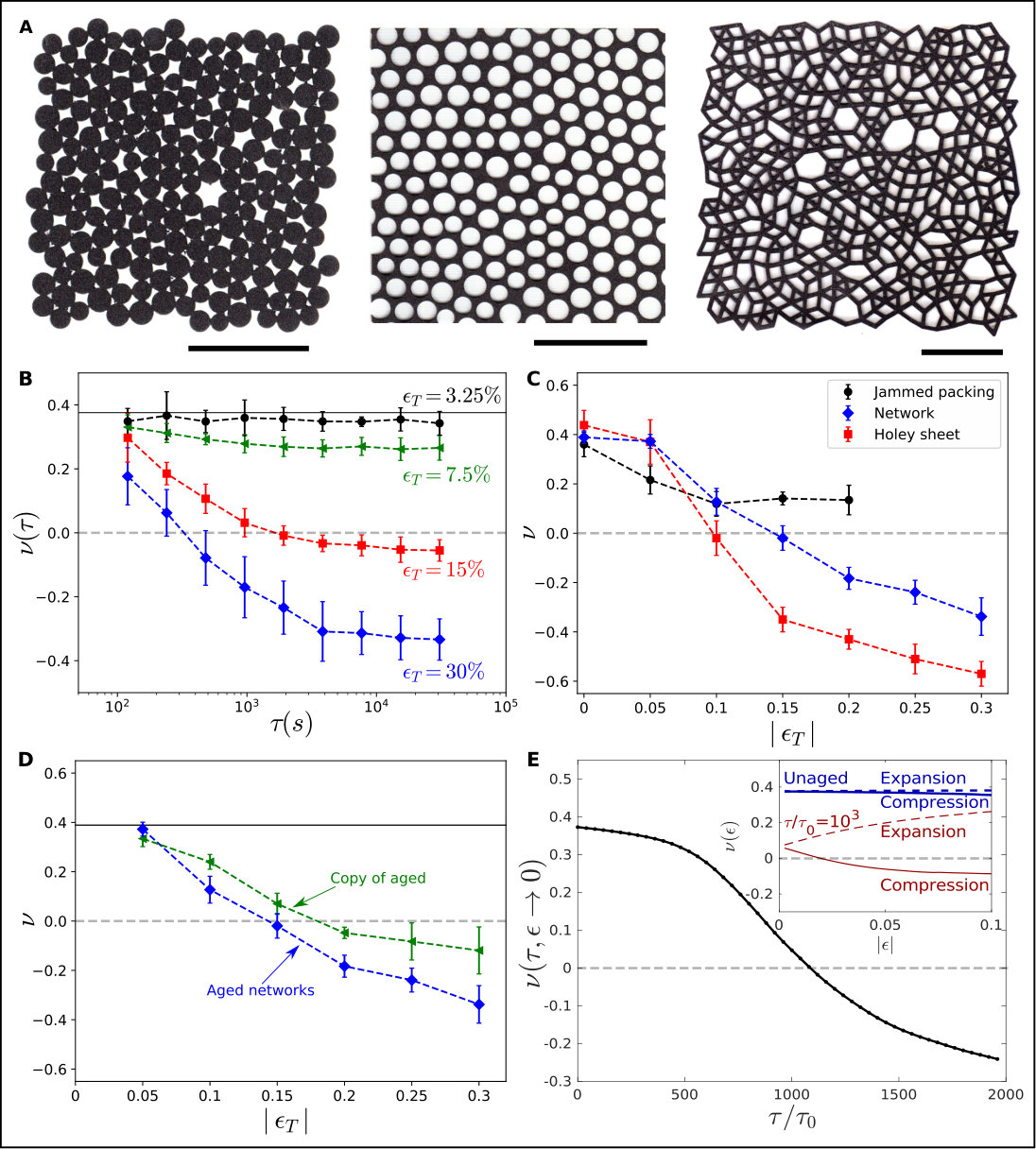 Figure 1
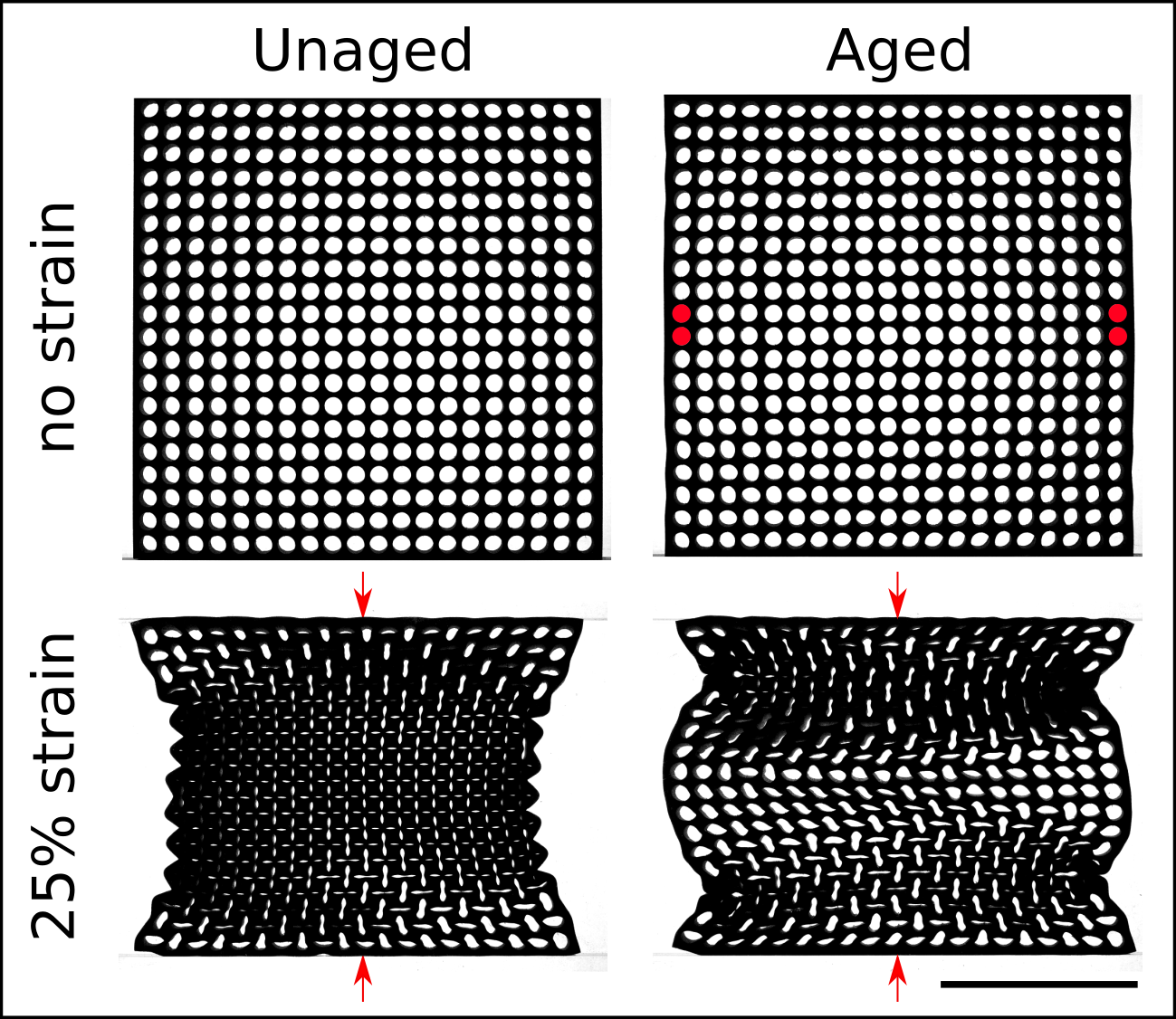 Figure 2
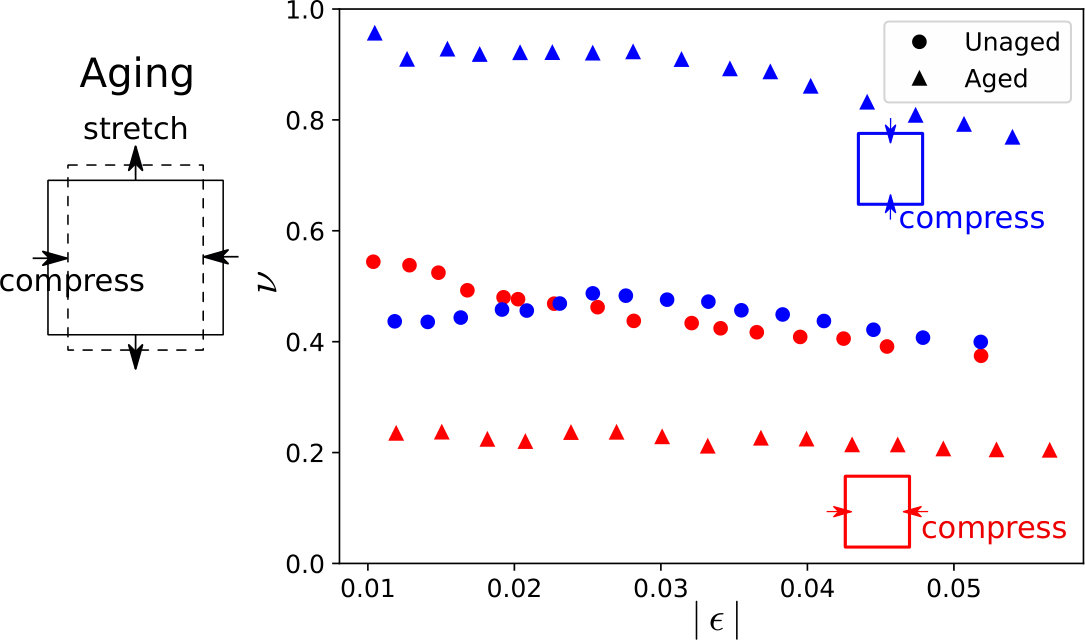 Figure 3
Peer Reviews
No public reviews on file for this paper yet. If you reviewed it on a platform where reviews are public (OpenReview, ICLR, NeurIPS, ICML), you can paste yours below so the community can read it here.
Videos
No videos yet. Explain this paper in a talk, walkthrough, or lecture? Add one.
Directed aging, memory and Nature’s greed
Nidhi Pashine,†∗a Daniel Hexner,∗a,b Andrea J. Liu,b Sidney R. Nagela
aDepartment of Physics and The James Franck and Enrico Fermi Institutes,
University of Chicago, Chicago IL, 60637
bDepartment of Physics and Astronomy,
University of Pennsylvania, Philadelphia PA, 19104
∗ Equal contribution. † E-mail: [email protected]
Directed aging, memory and Nature’s greed
Nidhi Pashine,†∗a Daniel Hexner,∗a,b Andrea J. Liu,b Sidney R. Nagela
aDepartment of Physics and The James Franck and Enrico Fermi Institutes,
University of Chicago, Chicago IL, 60637
bDepartment of Physics and Astronomy,
University of Pennsylvania, Philadelphia PA, 19104
∗ Equal contribution. † E-mail: [email protected]
Abstract
Disordered materials are often out of equilibrium and evolve very slowly. This allows a memory of the imposed strains or preparation conditions to be encoded in the material. Here we consider “directed aging”, where the elastic properties of a material evolve in the direction defined by its aging history. The evolution to a lower-energy configuration is controlled by steepest decent and affects stressed regions differently from unstressed ones. This process can be considered to be a “greedy algorithm” of Nature. Our experiments and simulations illustrate directed aging in examples in which the material’s elasticity evolves as a direct consequence of the imposed deformation; the material itself decides how to evolve in order to produce responses that were not present inherently in the material.
Introduction
The incremental process of aging affects materials over extended periods of time [1, 2, 3, 4]; for example, a plastic may become more brittle or a glass may slowly shrink in volume. These changes occur without the apparent influence of an external force directing the evolution. They are simply part of the inexorable aging process, which often leads merely to a degradation of physical properties. However, it comes as no surprise that in other cases, such as a beam sagging under the influence of gravity, an externally imposed stress forces the material to deform over time in an obvious and well-defined manner. Here, while the geometry of the beam has perceptibly changed so that it may no longer do the job for which it was originally intended, changes in the material’s elastic properties are less apparent.
Our purpose here is to highlight how the mechanics of materials can evolve in unexpected ways due to a process of directed aging. Materials that have not reached equilibrium often retain a memory of how they were processed, trained, stored or manipulated [5]. During aging, they evolve in a direction dictated by those conditions. The resulting properties contain a memory of the applied load. We unite these concepts of directed aging and memory with the idea that Nature often follows a greedy algorithm in its evolution. We first recall how materials can be manipulated on the computer and then explore how natural evolution can be harnessed to produce a similar outcome.
Materials can often be considered on an atomic scale as a network of bonds between nodes [6, 7]. Previous work has shown that networks can easily be tuned to have specific properties by removing a small subset of computationally determined links between nodes. For example, a spring network can be transformed from being nearly incompressible with a positive Poisson’s ratio, , to being almost completely auxetic with (i.e., so that compression along one axis causes the transverse directions to become equally compressed) [8, 9, 10, 11]; the network can be tuned over the entire spectrum of elastic behavior into a regime where few materials exist. Likewise, networks can be pruned for allosteric behavior so that a local applied strain induces a large displacement at a distant point [12, 13, 14].
It takes surprisingly few alterations in the original network to create either of these functionalities. A take-away message is that structures generated from packings with rugged energy landscapes are often extremely malleable – with seemingly modest modifications, they can be easily manipulated to have unusual, esoteric and finely tuned properties.
In these examples, a “greedy” computer algorithm was used at each stage to find the alteration (i.e., pruning of a bond) that brings the network closest to the desired final state. The algorithm does not require – nor necessarily benefit from – a more sophisticated evolutionary process that samples many alternative paths to reach an optimal outcome.
Here we explore the extent to which a material in the process of aging can be considered as following Nature’s – as distinct from a computer’s – greediness to achieve new properties. Can a material, without the intervention of a computer, transform by retaining a distinct memory of the forces it has encountered in its lifetime?
Auxetic behavior derived from aging
Gedanken experiment
We start with a highly idealized gedanken experiment on a large heap of sand. Grains in this heap are under pressure from the material above it. Deep in the pile, the pressure is enormous and some of the contacts between grains experience immense forces. As they age, it is reasonable to expect that the contacts deform plastically, with those experiencing the largest forces deforming most rapidly. Over long times, these incremental deformations could become substantial and change the contacts between grains significantly. While this seems straightforward, this system is interesting because there is preferential alteration of the bond characteristics depending on the magnitude of stress that each individual contact feels under the applied stress.
To gain insight into the effect of such preferential alteration, we recall the evolution under selective bond pruning of a spring network under compression. An idealized example of frictionless spherical grains jammed by compression [15] can be converted into a network by replacing spheres with nodes and replacing contacts between spheres with unstretched springs connecting the nodes [16, 17]. In such disordered networks, the contribution of any specific bond to the bulk modulus, , is to a large extent independent of its contribution to the shear modulus, [8]. If bonds are pruned according to how much stress they feel due to an externally applied stress, it can alter the system’s bulk and shear moduli in different ways 111We note that we prune a bond according to the stress it is under and not according to how much it would change a modulus if it were removed. While the latter is a more effective way to prune a network [10, 9], it is not essential.. In particular, when placed under isotropic compression, pruning of bonds experiencing the largest stress causes to decrease more rapidly than so that the ratio increases [8].
For an isotropic material, the Poisson’s ratio, , is a monotonic function of :
where is the spatial dimension. Therefore, as increases, the material is driven to have a negative Poisson’s ratio. This result for pruned networks suggests that a sandpile under pressure could evolve towards auxetic behavior as well – a surprising and novel outcome.
Note that our gedanken experiment neglects any particle rearrangements that could occur during aging and is therefore valid only at the early stages before particle rearrangements occur. The experiments and simulations we describe below also do not allow particle rearrangements.
Laboratory experiments
The gedanken experiment inspires the following experiments on aging under compression.
From a sheet of EVA (ethylene vinyl acetate) foam, we laser-cut two-dimensional (2D) systems as shown in Fig. 1A. We make three different kinds of systems: jammed packings of discs, networks derived from jammed packings, and random holey sheets, also derived from jammed packings.
In order to create the jammed packing, we start with a foam sheet and cut out a jammed configuration of discs obtained from a 2D computer simulation. The parts of discs that are overlapping with each other are left undisturbed, and this ensures that we have a fully connected sample. The networks are designed as explained in the previous section, where nodes represent particle centers and narrow struts connect nodes corresponding to overlapping pairs of particles. For the holey sheets, we again start with a jammed configuration, and shrink all the particles uniformly so they do not overlap. We cut holes corresponding to these smaller particles out of a sheet of EVA foam, leaving a sheet with a disordered pattern of holes. The jammed discs and holey sheets explicitly retain the circular nature of a 2D granular packing and are thus closer to the gedanken sandpile experiment discussed above.
All three kinds of systems are then aged by confining them for a time in a square rigid box that has a smaller edge length, , than the original length of the system, . We define the training strain as . Since we train our samples under compression, our values for are always negative. We measure the Poisson’s ratio, , by removing our sample from the box, compressing it along one axis and measuring the deformation in the perpendicular direction. Fig. 1B shows data for Poisson’s ratio of networks as a function of . For , becomes negative at sufficiently long times. Fig. 1C shows how changes on aging for sufficiently long times. All three systems show that decreases as a function of , as predicted for our gedanken experiment. For networks and holey sheets, becomes negative at larger values of .
In this example of directed aging, the material naturally acquires an auxetic response. The fact that all three systems show similar behavior suggests that directed aging of isotropic disordered systems under compression may lead more generally to reduced values of the Poisson’s ratio.
There are two ways in which aging may have affected the network: (1) bond strengths change due to the stresses to which they were exposed, and (2) the geometry of the network changes due to internal rotation, deformation and/or buckling of bonds. To assess the relative contributions of these two effects, we image an aged network. We use that image to pattern another network out of unaged material that is as geometrically identical as possible to the aged one. The difference between the Poisson’s ratio of these two (nearly) identical networks, is presumably due solely to the aging of the stiffness of the contacts.
The Poisson’s ratio of these geometrically identical but unaged networks is shown in green triangles in Fig. 1D. We consistently find that the unaged, copied networks have a lower Poisson’s ratio than the original networks but not as low as that of the aged networks. This implies that some of the contribution to the aging process derives from a change in the network geometry and some is due to a change in the material stiffness.
Our experimental protocol is similar to earlier work by Lakes [18], in which foam was made auxetic by heating it while under compression. In that work, the geometry of the structure evolved and concave polygons were observed after the foam was returned to ambient temperature. The evolution of auxetic behavior was attributed to the creation of concave polygons, which are known to decrease the Poisson’s ratio of a material [19, 11, 20]. In contrast, our results show that geometrical changes are not the only contribution; changes in bond stiffness also participate in creating auxetic behavior.
Aging in simulations
We consider a network in which each spring, , has spring constant and an unstretched length . When compressed, the spring has length . Due to disorder, each spring will in general be compressed by a different amount. The energy of the resulting network is the sum of the energies of all the springs:
[TABLE]
For simplicity, we have omitted the energy due to bending angles around a node [11].
We consider two limiting cases. The first corresponds to the case in which aging is due completely to evolution of the bond strengths under the imposed stresses. The second corresponds to aging arising completely from the evolution of the equilibrium distances between nodes, , as proposed by Lakes [18].
Here we focus on the first case, deferring the second to a future publication. We evolve so that it decreases in time according to the elastic energy stored in that bond:
[TABLE]
The proportionality constant, and the average equilibrium length of the bonds, , are material dependent and set the units of time and length. Bonds under greater stress evolve more rapidly. At late times, ; we therefore consider Eq. 2 as an approximation valid only at early times. We evolve the system at a prescribed training strain, , and then measure the elastic response with respect to the zero-strain state, which remains the global energy minimum.
Fig. 1E shows the evolution of the Poisson’s ratio calculated at , when the system is aged under compression. Evidently, decreases in time, consistent with the experimental data in Fig. 1C, and eventually becomes negative. The aging evolves in a directed manner – under compression the bulk modulus decreases with respect to the shear modulus, , leading to an auxetic material.
This model also predicts non-linear behavior. The nonlinear Poisson’s ratio is defined by , where is the imposed strain along one axis and is the resulting transverse strain after minimizing the energy with respect to the locations of all the nodes and the box shape. The inset of Fig. 1E shows for the unaged network as well as for a network that has been aged until . The original, unaged network depends only weakly on the measuring strain , even up to 10% strain. For aged networks, however, the nonlinear Poisson’s ratio, depends on , the strain at which it is measured, as shown in Fig. 1E. The material can become auxetic even when it is not auxetic in linear response. In other words, compressing the system along one axis leads to transverse expansion at small strains, and to transverse compression under larger strains. This nonlinear behavior is difficult to achieve by design, but here occurs naturally.
Both the experiments and simulations demonstrate that aging is directed towards a non-trivial elastic state with a lower Poisson’s ratio. The elastic properties start to change as soon as aging commences under the applied stress and evolve to be significantly different from those of the freshly-prepared material.
Directed aging under shear
Not all aging protocols evolve towards the same limit. Here, we evolve a system under shear stress instead of compression. We return to the experimental networks described in Sec. 2.2, aging our networks under pure shear by compressing them in one direction and stretching them in the perpendicular direction.
We measure the Poisson’s ratio in two perpendicular directions: (i) compressing the network first along one axis and measuring the response along the second axis and (ii) exchanging which axis is compressed and which measured.
Initially, the Poisson’s ratio of the network measured by compressing the network along either direction gives . However, once it has been aged under shear, the same measurements give very different results. The Poisson’s ratio drops to when compressed in the same direction as the one along which it was aged. However, when compressed along the perpendicular direction, increases from to . Fig. 2 shows that the material encodes a memory of the direction in which it was aged. Similar anisotropic behavior has been observed in a crosslinked actin network under shear [21].
Response under local distortion
So far, we have considered a material’s response to the global distortions of compression and pure shear. Here we show that directed aging can train a more exotic response by applying local as well as global strains during aging.
Sheets with a square lattice of circular holes [22, 23, 24] have when compressed along the axis directions [22]. When this “holey sheet” is compressed, alternating holes distort in perpendicular directions. This ordered collapse results in the transverse edges of the sheet moving closer together, making the sheet auxetic as shown in Fig. 3A.
To obtain a more varied response, we age the sheet in the following way. We plug the holes at the end of the middle two rows so that they retain their circular shape and stay in place as we compress the system along the direction perpendicular to these rows. These rows separate the sheet into two halves that do not communicate with each other. Approximately half of the time that these sheets are compressed the pattern of holes in one half is out of phase with those in the other so that the central region does not buckle inward. In these cases, compression along the perpendicular direction creates an overall scallop pattern along the side edges where the sheet juts out in the middle as shown in Fig. 3.
Directed aging during cyclic loading
Directed aging occurs in a host of other contexts. For example, it has been shown that cyclic shearing of a suspension of non-Brownian particles can drive the system towards a ground state where, under subsequent shearing, it simply repeats its former motion [25, 26, 27, 28, 29]. This can also be seen in glassy and jammed solids [30, 31, 32, 33, 34]. Cyclic driving produces a memory of how the system was prepared. As the cyclic shearing is applied, the training cycles force rearrangements in the particle positions.
The system ages in a directed fashion in that it eventually learns how to navigate the phase space to produce a periodic response. In some cases, it can find the periodic orbit rapidly; in other cases, it takes many training cycles before it finds an orbit with possibly higher-order periodicity [35, 36, 32, 34]. Nevertheless, the system directly ages to develop this highly unusual dynamic property. It does so by a locally greedy algorithm of nature – the system simply minimizes its energy (or enthalpy) at each time step (in the case of the solid) or it simply pushes other particles out of the way (in the case of the suspensions). The way in which the material is handled directs the evolution into non-generic states.
Conclusion
We have demonstrated that aging, which is typically considered to be a detrimental process, can be harnessed to encode a desired elastic response in a material. This directed-aging process relies on incremental changes in stiffness and distortion of the microscopic structure brought about by plastic deformation. We have given several examples in which directed aging exploits the structural disorder of the initial state to achieve a broad range of responses. Using these ingredients, we can then tune the linear and non-linear response simply by controlling the boundary conditions during the aging process.
The idea of directed aging can be more general, as shown by the scalloped pattern that emerges from the compression of the sheet with a lattice of circular holes. Simply letting a system age under specially-constructed constraining boundary conditions can encode novel functions.
This suggests that material properties, which are normally considered to be a function of the material composition and structure, can depend strongly on the history of the imposed deformations. One could ask whether this dependence on history could be used to read out the history of a material. For example, could we learn from the elasticity of a rock about geological flows that occurred over millions of years?
The different elastic responses we have discussed have been trained with remarkable ease. Designing elastic properties numerically typically requires a detailed knowledge of the precise interactions, as well as intensive optimization of the parameters. Here we showed that despite the complex structure of the networks, and the nonlinear strains at which they were aged, all that is required is patience while the system memorizes the training conditions and ages towards the target state. This makes our approach well suited to designing materials with novel functionality and elastic properties [11, 12, 13, 37].
To realize a design strategy that implements directed aging, we could exploit the strong temperature dependence of the aging process. For example, we could strongly enhance the rate at which new functionality is acquired by raising the temperature towards the glass transition temperature. Lowering the temperature could then freeze in this functionality.
This approach provides an avenue to reach the “holy grail” of metamaterials – producing them on macroscopic scales. Scaling up metamaterials is usually difficult; if they are designed on a computer, increasing their size increases the required computer resources. Moreover, scaling down the “bond size” is perhaps even more difficult since it requires a precise control of the detailed structure on small length scales. Directing aging provides a way to alter properties of specific individual bonds by applying only macroscopic strains.
Acknowledgements
We are grateful to Heinrich Jaeger, Arvind Murugan and Juan de Pablo for enlightening discussions. Work was supported by the NSF MRSEC Program DMR-1420709 (NP), NSF DMR- 1404841(SRN) and DOE DE-FG02-03ER46088 (DH) and the Simons Foundation for the collaboration “Cracking the Glass Problem” award 348125 at the University of Chicago. We acknowledge the University of Chicago Research Computing Center for support of this work.
The reference list from the paper itself. Each links out to its DOI / PubMed record.
- 1[1] Ian M Hodge. Physical aging in polymer glasses. Science , 267(5206):1945–1947, 1995.
- 2[2] LCE Struik. Physical aging in plastics and other glassy materials. Polymer Engineering & Science , 17(3):165–173, 1977.
- 3[3] John M Hutchinson. Physical aging of polymers. Progress in Polymer Science , 20(4):703–760, 1995.
- 4[4] James K Mitchell. Aging of sand–a continuing enigma? International Conference on Case Histories in Geotechnical Engineering , 8, 2008.
- 5[5] Nathan C Keim, Joseph Paulsen, Zorana Zeravcic, Srikanth Sastry, and Sidney R Nagel. Memory formation in matter. ar Xiv preprint ar Xiv:1810.08587 , 2018.
- 6[6] JC Phillips. Structural principles of amorphous and glassy semiconductors. Journal of Non-Crystalline Solids , 35:1157–1165, 1980.
- 7[7] MF Thorpe and EJ Garboczi. Elastic properties of central-force networks with bond-length mismatch. Physical Review B , 42(13):8405, 1990.
- 8[8] Carl P. Goodrich, Andrea J. Liu, and Sidney R. Nagel. The principle of independent bond-level response: Tuning by pruning to exploit disorder for global behavior. Phys. Rev. Lett. , 114:225501, Jun 2015.