Emergent Universe Scenario, Bouncing and Cyclic Universes in Degenerate Massive Gravity
Shou-Long Li, H. L\"u, Hao Wei, Puxun Wu, Hongwei Yu

TL;DR
This paper explores alternative cosmological models within degenerate massive gravity, including emergent, bouncing, and cyclic universes, analyzing their stability and exact solutions.
Contribution
It introduces new exact solutions for bouncing and cyclic universes in degenerate massive gravity and examines the stability of the Einstein static universe.
Findings
Stable Einstein static universe regions identified
Exact solutions for bouncing universes constructed
Feasibility of emergent universe scenario demonstrated
Abstract
We consider alternative inflationary cosmologies in massive gravity with degenerate reference metrics and study the feasibilities of the emergent universe scenario, bouncing and cyclic universes. We focus on the construction of the Einstein static universe, classes of exact solutions of bouncing and cyclic universes in degenerate massive gravity. We further study the stabilities of the Einstein static universe against both homogeneous and inhomogeneous scalar perturbations and give the parameters region for a stable Einstein static universe.
Click any figure to enlarge with its caption.
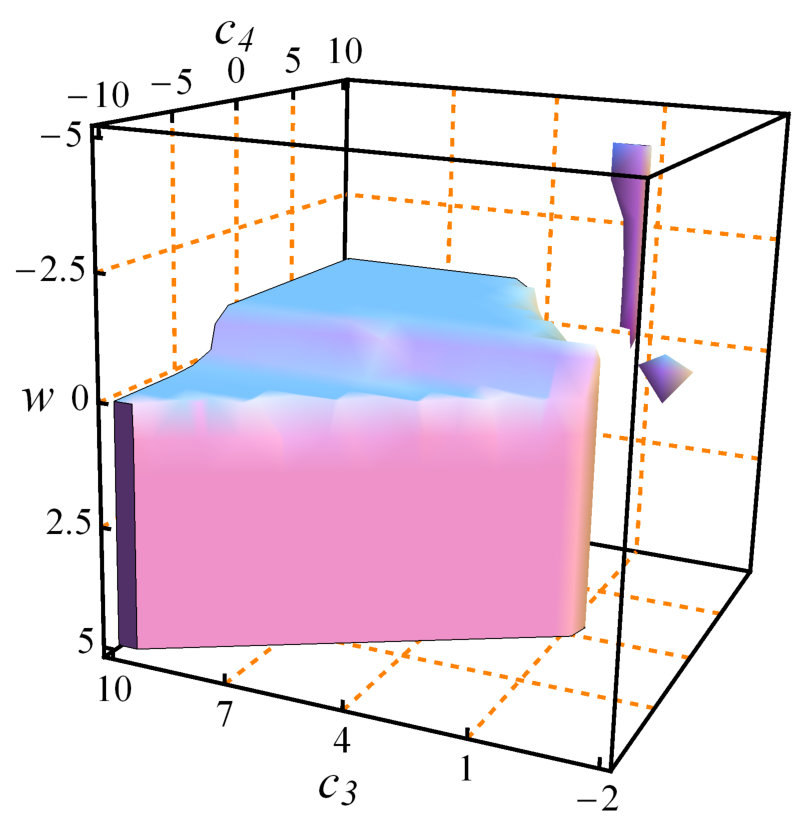 Figure 1
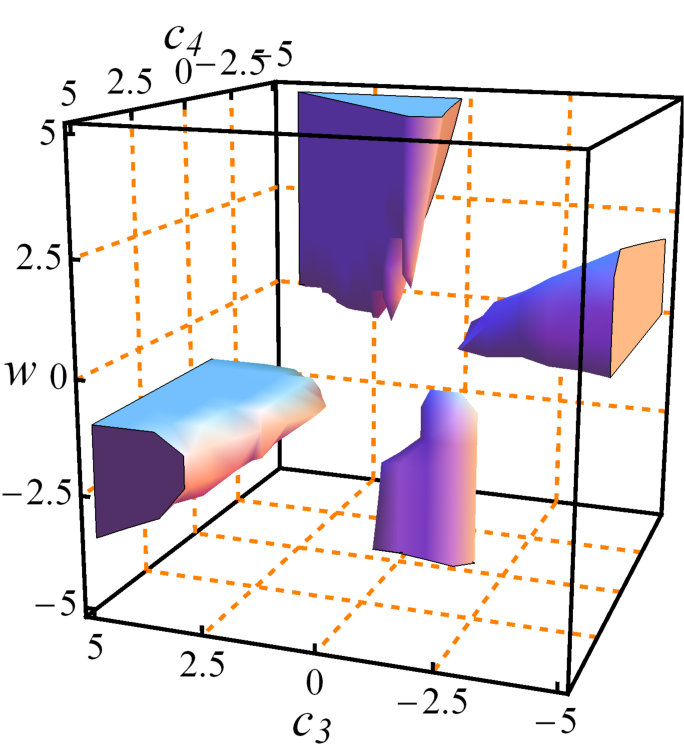 Figure 2
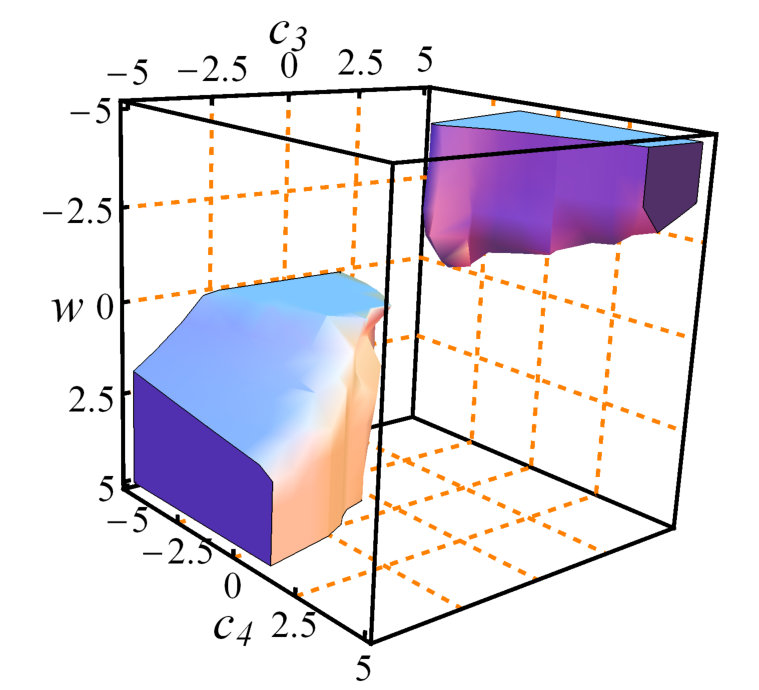 Figure 3
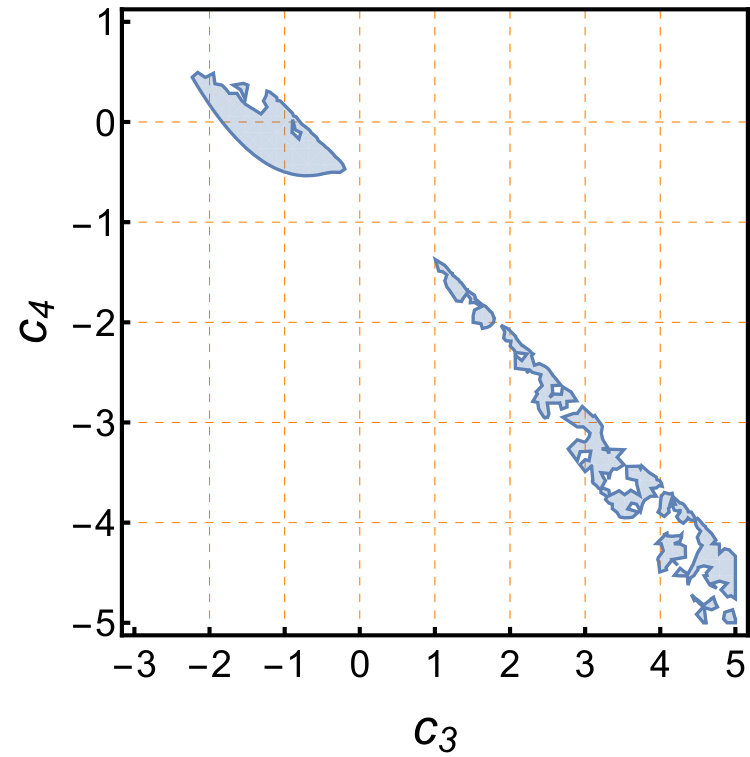 Figure 4
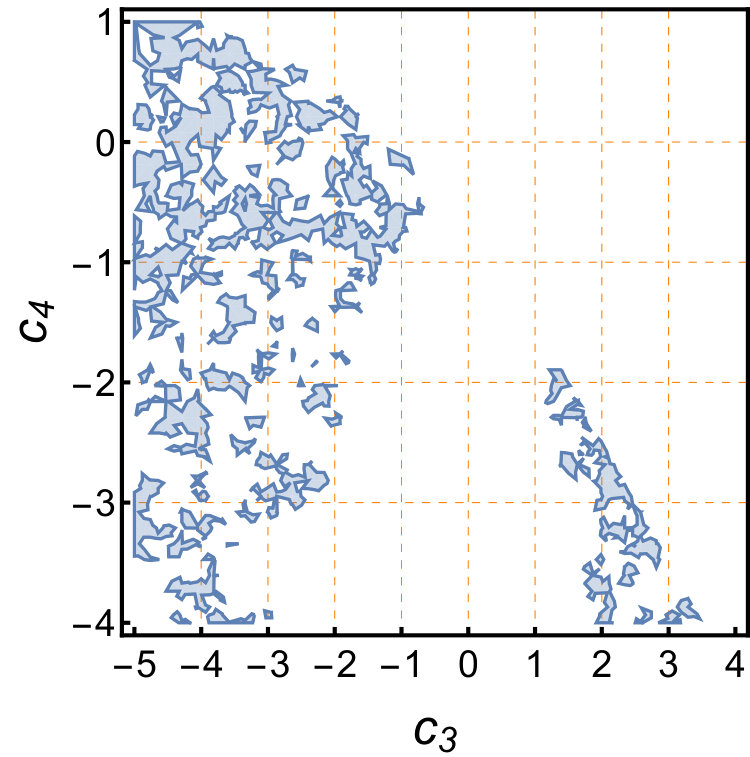 Figure 5
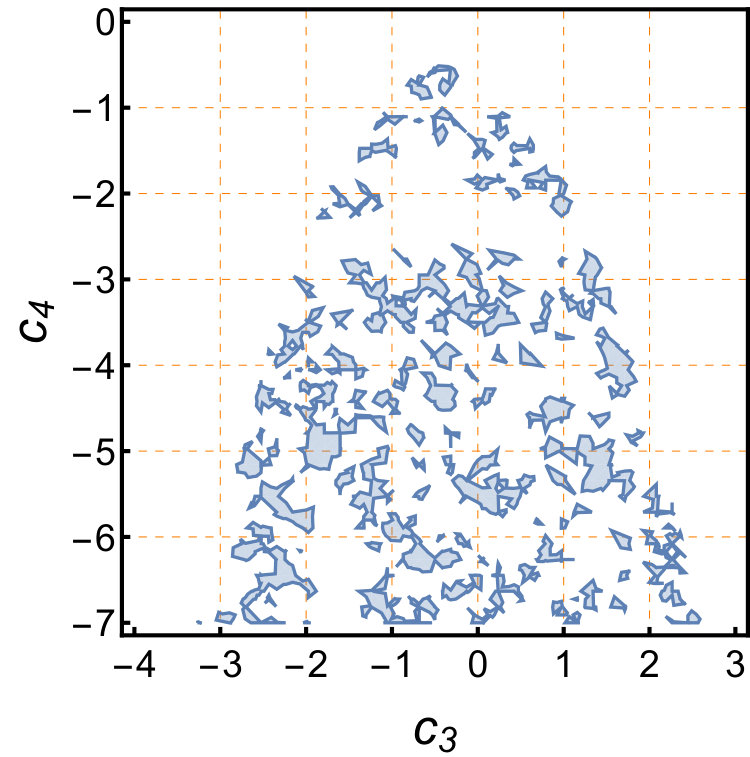 Figure 6
Peer Reviews
No public reviews on file for this paper yet. If you reviewed it on a platform where reviews are public (OpenReview, ICLR, NeurIPS, ICML), you can paste yours below so the community can read it here.
Videos
No videos yet. Explain this paper in a talk, walkthrough, or lecture? Add one.
Emergent Universe Scenario, Bouncing Universes, and Cyclic Universes in Degenerate Massive Gravity
Shou-Long Li, H. Lü, Hao Wei, Puxun Wu and Hongwei Yu
Department of Physics and Synergetic Innovation Center for Quantum Effect and Applications, Hunan Normal University, Changsha 410081, China
School of Physics, Beijing Institute of Technology, Beijing 100081, China
Center for Joint Quantum Studies, School of Science, Tianjin University, Tianjin 300350, China
ABSTRACT
We consider alternative inflationary cosmologies in massive gravity with degenerate reference metrics and study the feasibilities of the emergent universe scenario, bouncing universes, and cyclic universes. We focus on the construction of the Einstein static universe, classes of exact solutions of bouncing universes, and cyclic universes in degenerate massive gravity. We further study the stabilities of the Einstein static universe against both homogeneous and inhomogeneous scalar perturbations and give the parameters region for a stable Einstein static universe.
[email protected] [email protected] [email protected] [email protected] [email protected]
1 Introduction
General relativity (GR), as a classical theory describing the non-linear gravitational interaction of massless spin-2 fields, is widely accepted at the low energy limit. Nevertheless, there are still several motivations to modify GR, based on both theoretical considerations (e.g. [1, 2]) and observations (e.g.[3, 4].) One proposal, initiated by Fierz and Pauli [2], is to assume that the mass of a graviton is nonzero. Unfortunately, the interactions for massive spin-2 fields in Fierz-Pauli massive gravity have long been thought to give rise to ghost instabilities [5]. Recently, the problem has been resolved by de Rham, Gabadadze, and Tolley (dRGT) [6], and dRGT massive gravity has attracted great attention and is studied in various areas such as cosmology [7, 8, 9, 10] and black holes [11, 12]. We refer to e.g. [13, 14, 15] and reference therein for a comprehensive introduction of massive gravity.
There are several extensions of dRGT massive gravity for different physical motivations, such as bi-gravity [16], multi-gravity [17], minimal massive gravity [18], mass-varying massive gravity [19], degenerate massive gravity [20] and so on [21]. Thereinto, the degenerate massive gravity was initially proposed by Vegh [20] to study holographically a class of strongly interacting quantum field theories with broken translational symmetry. Later this theory has been studied widely in the holographic framework [22, 23, 24, 25] and black hole physics [26, 27, 28, 29, 30]. However, the cosmological applications of this theory are few. Recently, together with suitable cubic Einstein-Riemann gravities and some other matter fields, degenerate massive gravity was used to construct exact cosmological time crystals [31] with two jumping points, which provides a new mechanism of spontaneous time translational symmetry breaking to realize the bouncing and cyclic universes that avoid the initial spacetime singularity. It is worth noting that it is higher derivative gravity, not massive gravity, that is indispensable for the realization of cosmological time crystals, which involves discontinuity in the time derivative of the cosmological scale factor at the turning points. On the other hand, one can also consider smooth bouncing universes, and cyclic models. In the framework of Einstein gravity such models will necessarily violate the energy condition. In this paper, we consider degenerated massive gravity to study these models.
Actually, it is valuable to investigate alternative inflationary cosmological models within the standard big bang framework, because traditional inflationary cosmology [32, 33, 34, 35] suffers from both initial singularity problem [36] and trans-Planckian problem [37]. By introducing a mechanism for a bounce in cosmological evolution, both the trans-Planckian problem and an initial singularity can be avoided. The bouncing scenario can be constructed via many approaches such as matter bounce scenario [38], pre-big-bang model [39], ekpyrotic model [40], string gas cosmology [41], cosmological time crystals [31] and so on [42, 43, 44]. The cyclic universe, e.g. [45], can be viewed as the extension of the bouncing universe since it brings some new insight into the original observable Universe [46]. Another direct solution to the initial singularity proposed by Ellis et al. [47, 48], i.e., the emergent universe scenario, is assuming that the universe inflates from a static beginning, i.e., the Einstein static universe, and reheats in the usual way. In this scenario, the initial universe has a finite size and some past-eternal inflation, and then evolves to an inflationary era in the standard way. Both horizon problem and the initial singularity are absent due to the initial static state. Actually, these alternative inflationary cosmologies have been studied in different class of massive gravities. The bouncing universes, and cyclic universes have been studied in mass-varying massive gravity [49]. The emergent scenario has been also studied in dRGT massive gravity [50, 51] and bi-gravity [52, 53]. To our knowledge, these alternative inflationary models have not been studied in degenerate massive gravity. For our purpose, we would like to study the feasibilities of an emergent universe, bouncing universes, and cyclic universes in massive gravity with degenerate reference metrics.
The remaining part of this paper is organized as follows. In Sec. 2, we give a brief review of the massive gravity and its equations of motion. In Sec. 3, we study the emergent universe in degenerate massive gravity with a perfect fluid. First we obtain the exact Einstein static universe solutions in several cases. Then we give the linearized equations of motion and discuss the stabilities against both homogeneous and inhomogeneous scalar perturbations. We give the parameters regions of stable Einstein static universes. In Sec. 4, we construct exact solutions of the bouncing universes, and cyclic universes in degenerate massive gravity with a cosmological constant and axions. We conclude our paper in Sec. 5.
2 Massive gravity
In this section, following e.g. [6], we briefly review massive gravity. The four-dimensional action of massive gravity is given by
[TABLE]
where is the Plank mass and we assume in the rest discussion, is the action of matters, is the Ricci scalar, represents the determinant of , represents the mass of graviton, are free parameters and are interaction potentials which can be expressed as follows:
[TABLE]
where the regular brackets denote traces such as . is given by
[TABLE]
and obeys
[TABLE]
where is a fixed symmetric tensor and called a reference metric, which is given by
[TABLE]
where is the Minkowski background and are the Stückelberg fields introduced to restore diffeomorphism invariance [54]. In the limit of , massive gravity reduces to GR. The equations of motion are given by
[TABLE]
with
[TABLE]
where the energy-momentum tensor . We refer to e.g. [13, 14, 15] and reference therein for more details of massive gravity.
Generally, all the Stückelberg fields are nonzero in massive gravity and the rank of the matrix (2.5) is full, i.e., . In Ref. [20], there are two spatial nonzero Stückelberg fields which break the general covariance in massive gravity. The matrix has a rank 2 and thus, is degenerate. The massive gravity with degenerate reference metrics is called degenerate massive gravity. For our purpose, we set only the temporal Stückelberg field to equal to zero. It follows that the massive gravity we consider in this paper has degenerate reference metrics of rank 3. And the unitary gauge of the corresponding Stückelberg fields is defined simply by . So are given by [31]
[TABLE]
in the basis , where is a positive constant.
3 Emergent universe scenario
In this section, we consider the realization of the emergent universe scenario in the context of degenerate massive gravity. We consider only a spatially flat Friedmann-Lemaître-Robertson-Walker (FLRW) metric because the Stückelberg fields in degenerate massive gravity are chosen in a spatially flat basis. On the other hand, based on the latest astronomical observations [55, 56], the Universe is at good consistency with the standard spatially flat case. In the following discussion, we assume that the matter field is composed of perfect fluids. Firstly we construct the Einstein static universe in several cases. Then we study the stability against both homogeneous and inhomogeneous scalar perturbations.
3.1 Einstein static universe
The spatially flat FLRW metric is given by
[TABLE]
The energy-momentum tensor corresponding to perfect fluids is given by
[TABLE]
where and represent the energy density and pressure respectively, is the constant equation-of-state (EOS) parameter, and velocity 4-vector is given by
[TABLE]
Substituting Eqs. (3.1) and (3.2) into the equations of motion (2.6), the Friedmann equations are given by
[TABLE]
where the dot denotes the derivative with respect to time. For the sake of obtaining the Einstein static universe, we let the scale factor and . We request [10] to avoid the ghost excitation from massive gravity. The energy density can be solved from the Friedmann equation (3.4),
[TABLE]
where
[TABLE]
Substituting Eqs. (3.6) and (3.7) into (3.5), the final independent equation is given by
[TABLE]
with
[TABLE]
The Einstein static universe solution is given by . Because there are several parameters in the Eq. (3.8), we will discuss them in different cases.
3.1.1 Case 1: , ,
In this case, Eq. (3.8) reduces to a simple linear equation. The Einstein static solution is given by
[TABLE]
Note that the reality conditions (3.6) and (3.7) are required. We find that the Einstein static universe (3.10) can exist in the following two cases:
Case (1.1): For the solution is given by
[TABLE]
Case (1.2): For , the solution is given by
[TABLE]
3.1.2 Case 2: ,
In this case, Eq. (3.8) reduces to a quadratic equation. The Einstein static solutions are given by
[TABLE]
We discuss the existence of the two solutions respectively. Both cases require reality conditions (3.6) and (3.7). The existence of requires the following two cases:
Case (2.1): For , and
[TABLE]
the solution is given by
[TABLE]
Case (2.2): For , and
[TABLE]
the solution is given by
[TABLE]
The existence of requires the following two cases:
Case (2.3): For , and
[TABLE]
the solution is given by
[TABLE]
Case (2.4): For , and
[TABLE]
the solution is given by
[TABLE]
3.1.3 Case 3:
In this case, Eq. (3.8) can be rewritten as
[TABLE]
where
[TABLE]
For and , there are three real solutions which are given by
[TABLE]
For and , there is one real solution which is given by
[TABLE]
For , there is one real solution which is given by
[TABLE]
For , there is one real solution which is given by
[TABLE]
Substituting the solutions into Eqs. (3.23) and (3.6), the solutions and energy density are given by
[TABLE]
There are three free parameters and in the solutions. It is hard to analyze the parameters region of existence of all six solutions analytically. Instead we analyze the existence regions numerically and plot the parameters regions of the existence of all solutions in Fig. 1.
We find that the solutions and cannot exist.
3.2 Stabilities
In the previous subsection, we study the existence of the Einstein static universe in massive gravity with degenerate reference metrics. However, the emergent scenario does not thoroughly solve the issue of big bang singularity when perturbations are considered. For example, although the Einstein static universe is stable against small inhomogeneous perturbations in some cases [57, 58, 59, 60], the instability exists in previous parameters range against homogeneous perturbations [61]. So it is valuable to explore the viable Einstein static universe by considering both homogeneous and inhomogeneous scalar perturbations. Actually, the stabilities of the Einstein static universe has been studied in various modified gravities, for examples, loop quantum cosmology [62], theory [63, 64, 66, 65], theory [67, 68], modified Gauss-Bonnet gravity [69, 70], Brans-Dicke theory [71, 72, 73, 74, 75], Horava-Lifshitz theory [76, 77, 78], brane world scenario [79, 80, 81], Einstein-Cartan theory [82], gravity [83], Eddingtong-inspired Born-Infeld theory [84], Horndeski theory [85, 86], hybrid metric-Palatini gravity [87] and so on [88, 89, 90, 91, 92, 93, 94, 95, 96, 97, 98]. We refer to e.g. [60] and reference therein for more details of stability of the Einstein static universe. In the following discussions, we would consider the stabilities of the Einstein static universe against both homogeneous and inhomogeneous scalar perturbations in degenerate massive gravity.
3.2.1 Linearized Massive Gravity
Now we study the linear massive gravity with degenerate reference metrics. We use the symbols bar and tilde representing the background and the perturbation components of the metric respectively. First, we obtain the linearized equations of motion The perturbed metric can be written as
[TABLE]
where is the background metric which is given by Eq. (3.1) with and is a small perturbation. For our purpose, we consider scalar perturbations in the Newtonian gauge. is given by
[TABLE]
where and are functions of . For scalar perturbations, it is useful to perform a harmonic decomposition [99], Now the indexes are lowered and raised by the background metric unless otherwise stated. By using the relation , the inverse metric is perturbed by
[TABLE]
So the perturbed can also be written as
[TABLE]
According to Eq. (2.4), we have , i.e.,
[TABLE]
So we have
[TABLE]
where “ 0 ” and “ ” denote time and space components respectively, and the same index does not mean the Einstein rule. For perfect fluids, the perturbations of energy density and pressure are and respectively. The perturbations of velocity are given by
[TABLE]
where and are also functions of . The perturbed energy momentum tensor is given by
[TABLE]
where represents the background components and is given by Eq. (3.3). Considering above expressions, the linearized equations of Eqs. (2.6)-(2.8) are given by
[TABLE]
where
[TABLE]
It is useful to perform a harmonic decomposition of ,
[TABLE]
In these expressions, summation over co-moving wavenumber are implied. The harmonic function satisfies [99]
[TABLE]
where is Laplacian operator and is separation constant. For spatially flat universe, we have where the modes are discrete [60, 70]. Substituting Eqs. (3.30) and (3.42) into (3.37), after some algebra, we find
[TABLE]
where satisfies a second order ordinary differential equation
[TABLE]
with
[TABLE]
To analyze the stabilities of the Einstein static universe in massive gravity with a degenerate reference metric, we require the condition of the existence of the oscillating solution of Eq. (3.45) which is given by
[TABLE]
In the following discussions, we study the parameters region satisfying reality conditions (3.6) and (3.7), and the stability condition (3.47) for the Einstein static flat universes against both homogeneous and inhomogeneous perturbations in different cases.
3.2.2 Case 1: , ,
The stabilities of the Einstein static universe (3.11) require
[TABLE]
It is easy to see that the Einstein static flat universe in degenerate massive gravity can be stable under inhomogeneous scalar perturbations (), but not be stable against homogeneous scalar perturbations (). There is no stable region for an Einstein static universe (3.12) under either homogeneous or inhomogeneous scalar perturbations.
3.2.3 Case 2: ,
In the case (2.1), apart from existence conditions, the stabilities of the Einstein static universe (3.15) require another condition
[TABLE]
In the case (2.2), apart from existence conditions, the stabilities of the Einstein static universe (3.17) require another condition
[TABLE]
In the case (2.3), the stabilities of the Einstein static universe (3.19) require conditions
[TABLE]
and
[TABLE]
In the case (2.4) the stabilities of the Einstein static universe (3.21) require conditions
[TABLE]
and
[TABLE]
For conditions (3.52) in case (2.3), the solution (3.19) can be stable against inhomogeneous scalar perturbations, rather homogeneous perturbation. For conditions (3.49)-(3.51), (3.53) and (3.54) in cases (2.1)-(2.4), the Einstein static flat universes can be stable only against homogeneous scalar perturbation . Strictly, these solutions might not be stable against inhomogeneous scalar perturbations because and cannot go to infinity for . We could only say the Einstein static flat universes can be stable against both homogeneous and some modes of inhomogeneous scalar perturbations filled with a cosmological constant , quintessence and phantom , and suitable parameters and . However, the Einstein static flat universe cannot be stable under homogeneous and complete inhomogeneous scalar perturbations.
3.2.4 Case 3:
In this case, we also study the parameters region of the stabilities conditions numerically. However, in order to obtain the stable Einstein static universe against inhomogeneous scalar perturbations, we should consider all modes of the perturbations, i.e. . It is not easy to analyze numerically. So we study the stabilities in some special cases. According to the stability condition (3.47), we find that does not impact the condition when . And the case represents the Universe is filled with ordinary matter, which is important and received with great interests. We find that the stable Einstein static flat universes filled with ordinary matters do exist. And we plot the parameters regions of the stable solutions in cases in Fig. 2
for simplicity. For a concrete demonstration, we choose
[TABLE]
It is worth noting that, to our knowledge, our construction is the first of the stable Einstein static universes with the flat spatial geometry, in the presence of ordinary matter against both homogeneous and inhomogeneous scalar perturbations in modified gravities.
4 Bouncing and cyclic universes
In Ref. [31], the cosmological time crystal with two jumping points was constructed to realize bouncing universes, and cyclic universes in degenerate massive gravity together with Einstein -Riemann cubic gravities and some matters. These cosmological time-crystal solutions are characterized by the discontinuity of at the turning points. In this section, we would like to turn off the higher-order derivative terms and construct the smooth bouncing and cyclic models in degenerate massive gravity. To be specific, we focus on the construction of classes of exact solutions of bouncing universes, and cyclic universes. The total action is given by Eq. (2.1). The gravitational part is still degenerate massive gravity. However, the action of matter is given by
[TABLE]
where is the bare cosmological constant. Note that we further added three axion fields with a positive constant . These axions preserve the homogeneity and isotropicity of the background cosmological metric, but can have nontrivial perturbative effects [100]. (These matter fields also can be used to construct cosmological time crystals in the presence of higher-order derivative gravity.) As we shall see presently, the axions are not essential but optional for constructing bouncing and cyclic models; we include them nevertheless for presenting a bigger theory. The effective Lagrangian for the FLRW metric (3.1) is given by
[TABLE]
with
[TABLE]
The corresponding Hamiltonian constraint is given by
[TABLE]
which can be viewed as the effective equation of motion. And it can be rewritten as a differential equation,
[TABLE]
with
[TABLE]
The Eq. 4.6 admits classes of exact solutions of bouncing universes, and cyclic universes satisfying when we restrict the parameters to satisfy , i.e. . For , our numerical analysis indicates that the bouncing universes, and cyclic universes also exist, but exact solutions are not presentable. Instead, we shall present the linearized cyclic solution as a perturbation of Minkowski spacetime.
4.1 Bouncing universe
We consider that the initial state taking a cosh-type ansatz for a bouncing model,
[TABLE]
where , and are constants and obey the following reality conditions,
[TABLE]
For the FLRW metric (3.1), the solutions are given by
[TABLE]
The existence of the cosh-type bouncing solution requires that
[TABLE]
It is easy to see that the bouncing model can exist without the axions, i.e. ; however, the non-vanishing axions can modify the constraint on the parameters of massive gravity. On the other hand, the bare cosmological constant is necessary and positive in the construction of these bouncing solutions. As we shall see later, massive gravity itself provides repulsion at the bounce point and the theory can tolerate some attractive force without destroying the bounce. However, additional repulsive force from positive cosmological constant must be included for the Universe not to contract in the later time. It is worth noting that the bouncing model (4.8) can only describe the very early stage of the evolution of the Universe. The scale factor of the bouncing model will beyond the allowed max value [10] after a period of inflation. On the one hand, this problem should be solved in another stage of the evolution of the Universe. On the other hand, we can consider the Universe is oscillating. We study this case in the following subsection.
4.2 Cyclic universe
We consider that the initial state taking a sin-type ansatz for cyclic or oscillating universes:
[TABLE]
where , and are constants and obey the following reality conditions,
[TABLE]
For the FLRW metric (3.1), the sin-type solutions are given by
[TABLE]
The existence of the sin-type cyclic solution requires that
[TABLE]
It can be seen that the cyclic model can also exist without axions. It is worth commenting that , the bare cosmological constant, must be negative for these cyclic solutions, whilst it must be positive for the bounce solutions studied in the previous section. This is because the massive gravity by itself can provide sufficiently large repulsion to overcome the attraction from the negative bare cosmological constant for the universe to bounce; it requires a sufficient attractive force from the bare cosmological constant for the Universe to contract at a later time so that the Universe becomes cyclic.
4.3 Cyclic universe as linear perturbation
In the previous subsections, we consider , for which exact solutions of bouncing universes, and cyclic universes could be obtained. We now consider the more general and we would like to construct cyclic universes whose can be viewed as a small perturbation from the Minkowski spacetime, and hence we can obtain the exact solution for the linearized metric. In other words, we consider the Universe (4.12) oscillating in a small range comparing with the lowest value of scale factor, i.e. . The cyclic or oscillating ansatz can be rewritten as
[TABLE]
where the constant is the zeroth order solution, describing the Minkowski spacetime, is the first order solution, and is a small quantity. According to the Euler-Lagrangian equations, the existence of the zeroth order solution requires
[TABLE]
and we have
[TABLE]
We substitute Eqs (4.16) and (4.18) into effective Lagrangian (4.3) and Hamiltonian (4.5), and then perform a series expansion of the effective Lagrangian and Hamiltonian to the second order. We find
[TABLE]
where is constant and given by
[TABLE]
The vanishing of implies ghost instabilities, so we set it equal to a second order small quantity,
[TABLE]
Note that here can be of any sign and any finite constant, as long as perturbation is sufficiently small. According to the above equation, we have
[TABLE]
Substituting the above equation into the second order effective Lagrangian and Hamiltonian, we have
[TABLE]
For , we can rewrite
[TABLE]
with
[TABLE]
Considering that we have the -type oscillating ansatz, the solution is given by
[TABLE]
which satisfies Eq. (4.26). The existence of the solution requires the following conditions,
[TABLE]
Finally, we have
[TABLE]
and are given by Eqs. (4.18) and (4.23). Similar to the previous case, the axions can be turned off, but the bare cosmological constant is necessary to realize the Universe oscillating in a small range.
5 Conclusions and discussions
In this paper, we investigated massive gravity with degenerated reference metrics, focusing on the feasibility of some alternative inflationary models such as the emergent universe scenario, bouncing universes, and cyclic universes.
We first studied the feasibility of the emergent universe scenario. We constructed the Einstein static flat universe in degenerate massive gravity filled with perfect fluids. We then derived the linearized equations of motion in this background and studied the stabilities against both the homogeneous and inhomogeneous scalar perturbations. We found that there could exist stable such a universe filled with ordinary matter (). Our construction is the first of the stable Einstein static universe with the flat spatial geometry, in the presence of ordinary matter against both homogeneous and inhomogeneous scalar perturbations in modified gravities. The results show that the Einstein static flat universe can safely enter an inflationary epoch. Our conclusion is significant since the universe with flat geometry appears to be favored by latest astronomical observations [55, 56].
We also constructed classes of exact solutions of bouncing universes, and cyclic flat universes in degenerate massive gravity by including a bare cosmological constant and three free axion fields. It turns out that the cosmological constant is necessary but the axions are optional in the construction. For appropriate parameters, we found that cyclic universes could also emerge as some linear perturbations of the flat Minkowski spacetime. In our solutions, for the bounce universes, the bare cosmological constant must be positive whilst it must be negative for the cyclic universes. In the latter case, the attractive force from the negative bare cosmological constant is necessary to overcome the repulsion from massive gravity to provide a contracting point so that the Universe becomes cyclic. Our results demonstrate that bouncing universes, and cyclic universes can emerge in massive gravity coupled to a bare cosmological constant. The simplicity of the theory and the existence of such simple exact solutions open a new avenue to study alternative inflationary cosmology.
Our initial investigation of alternative cosmological models in degenerated massive gravity showed a new possibility of addressing cosmological problems. However, many works remain. All perturbations, including vector and tensor perturbations, should be analyzed when we study the stabilities of the Einstein static universe. Furthermore stabilities of bouncing and cyclic solutions should be also investigated. We leave these to future works.
Acknowledgement
We are grateful to the anonymous referee for valuable comments. S.L.L. is grateful to Hua-Kai Deng, Xing-Hui Feng and Hyat Huang for useful discussions. SLL and HW are supported in part by NSFC grants No. 11575022 and No. 11175016, HL is supported in part by NSFC grants No. 11875200 and No. 11475024, PXW and HWY are supported in part by NSFC grants No. 11435006, No. 11690034 and No. 11775077.
The reference list from the paper itself. Each links out to its DOI / PubMed record.
- 1[1] S. Deser and P. van Nieuwenhuizen, “One loop divergences of quantized Einstein-Maxwell fields,” Phys. Rev. D 10 , 401 (1974). doi:10.1103/Phys Rev D.10.401
- 2[2] M. Fierz and W. Pauli, “On relativistic wave equations for particles of arbitrary spin in an electromagnetic field,” Proc. Roy. Soc. Lond. A 173 , 211 (1939). doi:10.1098/rspa.1939.0140
- 3[3] A. G. Riess et al. [Supernova Search Team], “Observational evidence from supernovae for an accelerating universe and a cosmological constant,” Astron. J. 116 , 1009 (1998) doi:10.1086/300499 [astro-ph/9805201].
- 4[4] S. Perlmutter et al. [Supernova Cosmology Project Collaboration], “Measurements of Omega and Lambda from 42 high redshift supernovae,” Astrophys. J. 517 , 565 (1999) doi:10.1086/307221 [astro-ph/9812133].
- 5[5] D. G. Boulware and S. Deser, “Can gravitation have a finite range?,” Phys. Rev. D 6 , 3368 (1972). doi:10.1103/Phys Rev D.6.3368
- 6[6] C. de Rham, G. Gabadadze and A. J. Tolley, “Resummation of massive gravity,” Phys. Rev. Lett. 106 , 231101 (2011) doi:10.1103/Phys Rev Lett.106.231101 [ar Xiv:1011.1232 [hep-th]].
- 7[7] G. D’Amico, C. de Rham, S. Dubovsky, G. Gabadadze, D. Pirtskhalava and A. J. Tolley, “Massive cosmologies,” Phys. Rev. D 84 , 124046 (2011) doi:10.1103/Phys Rev D.84.124046 [ar Xiv:1108.5231 [hep-th]].
- 8[8] D. Comelli, M. Crisostomi, F. Nesti and L. Pilo, “FRW cosmology in ghost free massive gravity,” JHEP 1203 , 067 (2012) Erratum: [JHEP 1206 , 020 (2012)] doi:10.1007/JHEP 06(2012)020, 10.1007/JHEP 03(2012)067 [ar Xiv:1111.1983 [hep-th]].