Comparing proton momentum distributions in $A=2$ and 3 nuclei via $^2$H $^3$H and $^3$He $(e, e'p)$ measurements
R. Cruz-Torres, S. Li, F. Hauenstein, A. Schmidt, D. Nguyen, D., Abrams, H. Albataineh, S. Alsalmi, D. Androic, K. Aniol, W. Armstrong, J., Arrington, H. Atac, T. Averett, C. Ayerbe Gayoso, X. Bai, J. Bane, S. Barcus,, A. Beck, V. Bellini, H. Bhatt, D. Bhetuwal, D. Biswas

TL;DR
This study measures and compares proton momentum distributions in $A=2$ and 3 nuclei using electron scattering, revealing discrepancies at high momenta that could inform short-range nuclear force models.
Contribution
First measurement of $(e,e'p)$ cross-section ratios for $^3$He, $^3$H, and deuterium across a wide momentum range, providing new insights into nuclear interactions at short distances.
Findings
Ratios extend above Fermi momentum, showing differences up to 50%.
$^3$He/$^3$H ratios agree within 3% at lower momenta.
Discrepancies at high momenta suggest sensitivity to short-range NN interactions.
Abstract
We report the first measurement of the reaction cross-section ratios for Helium-3 (He), Tritium (H), and Deuterium (). The measurement covered a missing momentum range of MeV, at large momentum transfer ( (GeV)) and , which minimized contributions from non quasi-elastic (QE) reaction mechanisms. The data is compared with plane-wave impulse approximation (PWIA) calculations using realistic spectral functions and momentum distributions. The measured and PWIA-calculated cross-section ratios for He and H extend to just above the typical nucleon Fermi-momentum ( MeV) and differ from each other by , while for He/H they agree within the measurement accuracy of about 3\%. At momenta above , the measured He/H ratios differ from…
Click any figure to enlarge with its caption.
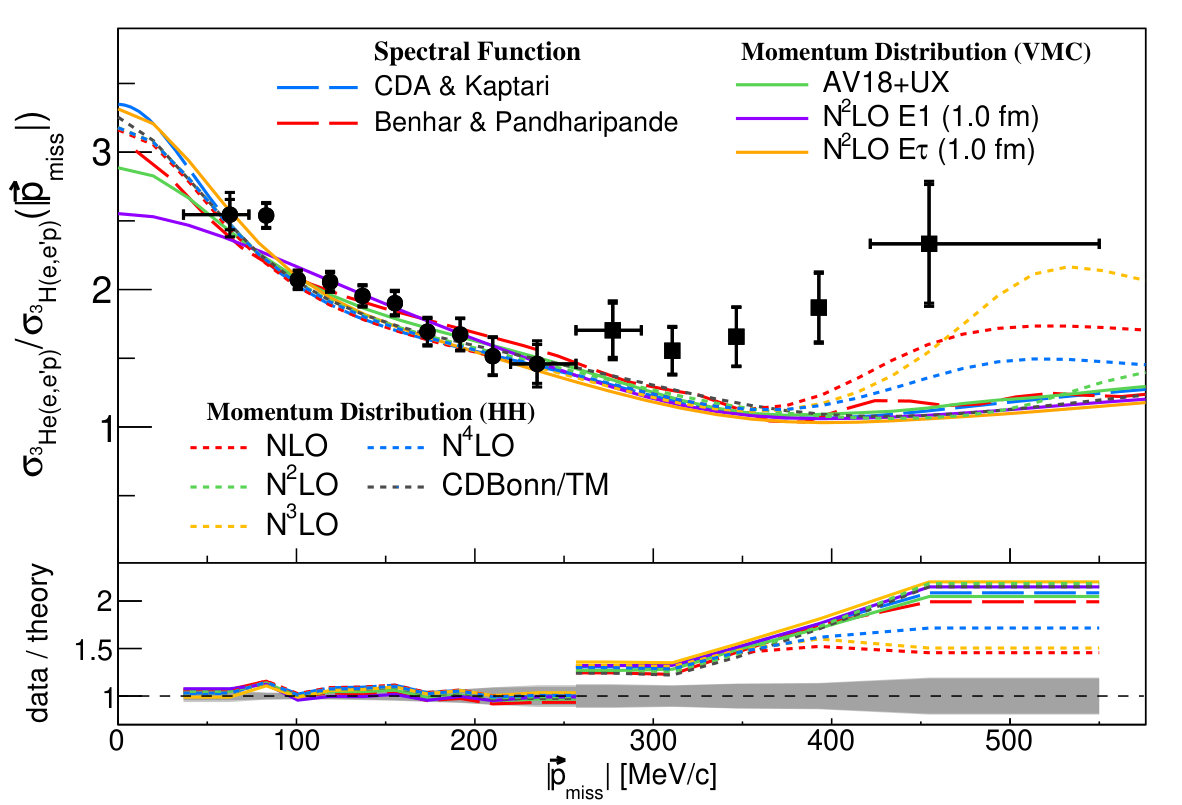 Figure 1
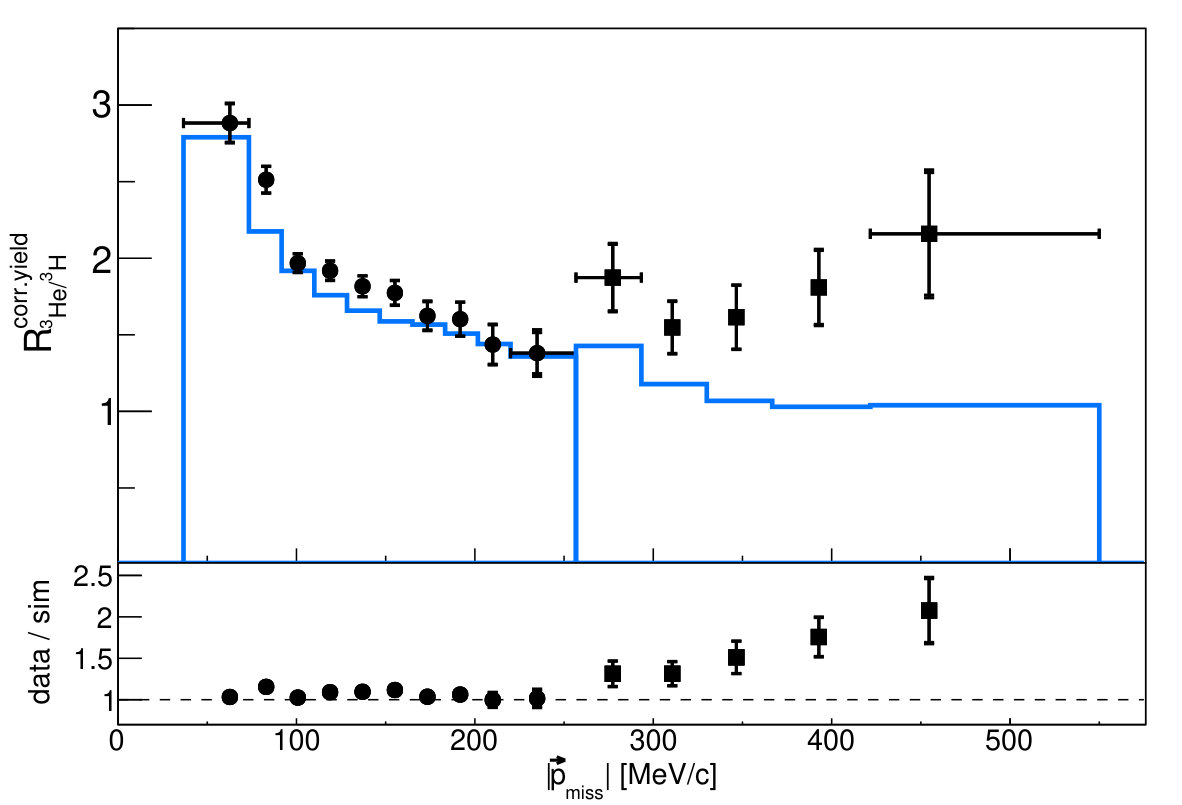 Figure 2
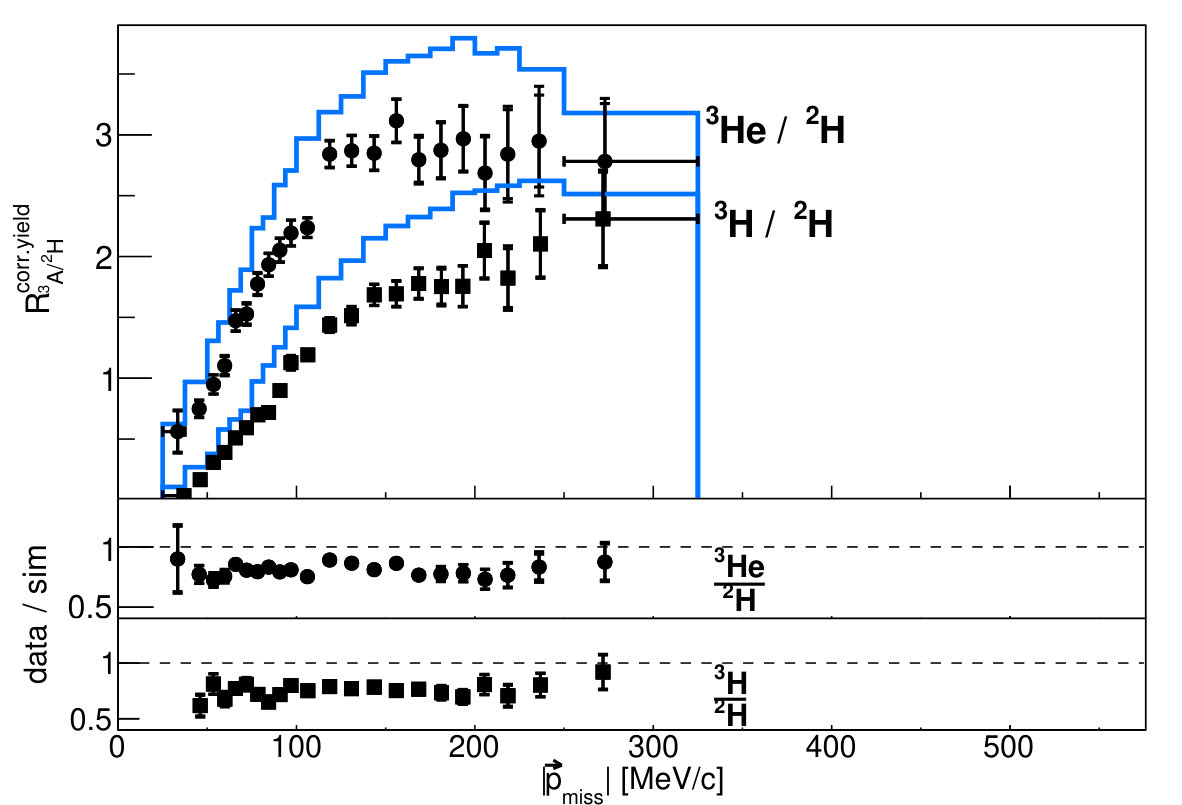 Figure 3
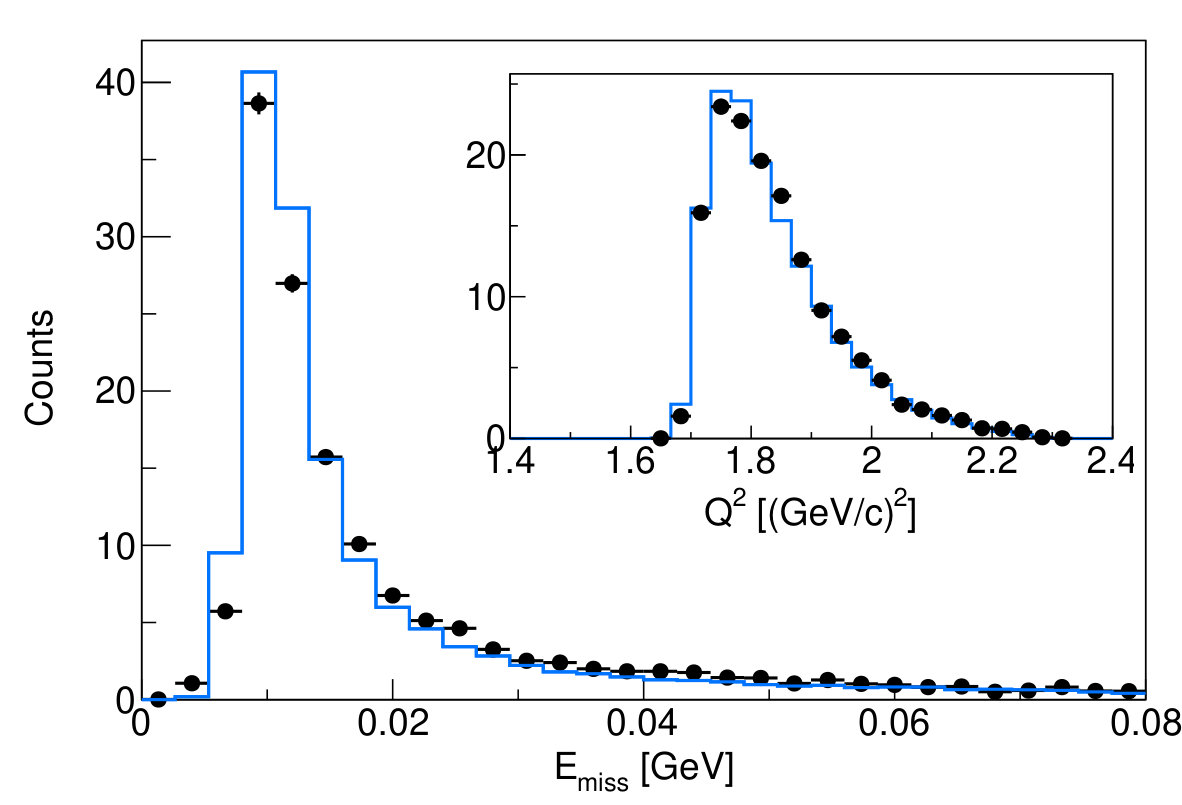 Figure 4
| Overall | Point-to-point | ||||||
| Target Walls | % | ||||||
| Target Density | 1.5% | ||||||
| Beam-Charge and Stability | 1% | ||||||
| Tritium Decay | 0.18% | ||||||
| Cut sensitivity | 1% - 8% | ||||||
|
1% - 2% |
Peer Reviews
No public reviews on file for this paper yet. If you reviewed it on a platform where reviews are public (OpenReview, ICLR, NeurIPS, ICML), you can paste yours below so the community can read it here.
Videos
No videos yet. Explain this paper in a talk, walkthrough, or lecture? Add one.
Jefferson Lab Hall A Tritium Collaboration
Comparing proton momentum distributions in and nuclei via 2H 3H and 3He measurements
R. Cruz-Torres
Massachusetts Institute of Technology, Cambridge, MA
S. Li
University of New Hampshire, Durham, NH
F. Hauenstein
Old Dominion University, Norfolk, VA
A. Schmidt
Massachusetts Institute of Technology, Cambridge, MA
D. Nguyen
University of Virginia, Charlottesville, VA
D. Abrams
University of Virginia, Charlottesville, VA
H. Albataineh
Texas A & M University, Kingsville, TX
S. Alsalmi
Kent State University, Kent, OH
D. Androic
University of Zagreb, Zagreb, Croatia
K. Aniol
California State University , Los Angeles, CA
W. Armstrong
Physics Division, Argonne National Laboratory, Lemont, IL
J. Arrington
Physics Division, Argonne National Laboratory, Lemont, IL
H. Atac
Temple University, Philadelphia, PA
T. Averett
The College of William and Mary, Williamsburg, VA
C. Ayerbe Gayoso
The College of William and Mary, Williamsburg, VA
X. Bai
University of Virginia, Charlottesville, VA
J. Bane
University of Tennessee, Knoxville, TN
S. Barcus
The College of William and Mary, Williamsburg, VA
A. Beck
Massachusetts Institute of Technology, Cambridge, MA
V. Bellini
INFN Sezione di Catania, Italy
H. Bhatt
Mississippi State University, Miss. State, MS
D. Bhetuwal
Mississippi State University, Miss. State, MS
D. Biswas
Hampton University , Hampton, VA
D. Blyth
Physics Division, Argonne National Laboratory, Lemont, IL
W. Boeglin
Florida International University, Miami, FL
D. Bulumulla
Old Dominion University, Norfolk, VA
A. Camsonne
Jefferson Lab, Newport News, VA
J. Castellanos
Florida International University, Miami, FL
J-P. Chen
Jefferson Lab, Newport News, VA
E. O. Cohen
School of Physics and Astronomy, Tel Aviv University, Tel Aviv 69978, Israel
S. Covrig
Jefferson Lab, Newport News, VA
K. Craycraft
University of Tennessee, Knoxville, TN
B. Dongwi
Hampton University , Hampton, VA
M. Duer
School of Physics and Astronomy, Tel Aviv University, Tel Aviv 69978, Israel
B. Duran
Temple University, Philadelphia, PA
D. Dutta
Mississippi State University, Miss. State, MS
E. Fuchey
University of Connecticut, Storrs, CT
C. Gal
University of Virginia, Charlottesville, VA
T. N. Gautam
Hampton University , Hampton, VA
S. Gilad
Massachusetts Institute of Technology, Cambridge, MA
K. Gnanvo
University of Virginia, Charlottesville, VA
T. Gogami
Tohoku University, Sendai, Japan
J. Gomez
Jefferson Lab, Newport News, VA
C. Gu
University of Virginia, Charlottesville, VA
A. Habarakada
Hampton University , Hampton, VA
T. Hague
Kent State University, Kent, OH
O. Hansen
Jefferson Lab, Newport News, VA
M. Hattawy
Physics Division, Argonne National Laboratory, Lemont, IL
O. Hen
Massachusetts Institute of Technology, Cambridge, MA
D. W. Higinbotham
Jefferson Lab, Newport News, VA
E. Hughes
Columbia University, New York, NY
C. Hyde
Old Dominion University, Norfolk, VA
H. Ibrahim
Cairo University, Cairo, Egypt
S. Jian
University of Virginia, Charlottesville, VA
S. Joosten
Temple University, Philadelphia, PA
A. Karki
Mississippi State University, Miss. State, MS
B. Karki
Ohio University, Athens, OH
A. T. Katramatou
Kent State University, Kent, OH
C. Keppel
Jefferson Lab, Newport News, VA
M. Khachatryan
Old Dominion University, Norfolk, VA
V. Khachatryan
Stony Brook, State University of New York, NY
A. Khanal
Florida International University, Miami, FL
D. King
Syracuse University, Syracuse, NY
P. King
Ohio University, Athens, OH
I. Korover
Nuclear Research Center -Negev, Beer-Sheva, Israel
T. Kutz
Stony Brook, State University of New York, NY
N. Lashley-Colthirst
Hampton University , Hampton, VA
G. Laskaris
Massachusetts Institute of Technology, Cambridge, MA
W. Li
University of Regina, Regina, SK , Canada
H. Liu
Columbia University ,New York, NY
N. Liyanage
University of Virginia, Charlottesville, VA
D. Lonardoni
Facility for Rare Isotope Beams, Michigan State University, East Lansing, Michigan 48824, USA
Theoretical Di vision, Los Alamos National Laboratory, Los Alamos, New Mexico 87545, USA
R. Machleidt
Department of Physics, University of Idaho, Moscow, ID 83844, USA
L.E. Marcucci
Department of Physics “E. Fermi”, University of Pisa, Italy
INFN, Pisa, Italy
P. Markowitz
Florida International University, Miami, FL
R. E. McClellan
Jefferson Lab, Newport News, VA
D. Meekins
Jefferson Lab, Newport News, VA
S. Mey-Tal Beck
Massachusetts Institute of Technology, Cambridge, MA
Z-E. Meziani
Temple University, Philadelphia, PA
R. Michaels
Jefferson Lab, Newport News, VA
M. Mihovilovič
University of Ljubljana, Ljubljana, Slovenia
Faculty of Mathematics and Physics, Jožef Stefan Inst itute, Ljubljana, Slovenia
Institut für Kernphysik, Johannes Gutenberg-Universität Mainz, DE-55128 Mainz, Germany
V. Nelyubin
University of Virginia, Charlottesville, VA
N. Nuruzzaman
Hampton University , Hampton, VA
M. Nycz
Kent State University, Kent, OH
R. Obrecht
University of Connecticut, Storrs, CT
M. Olson
Saint Norbert College, De Pere, WI
L. Ou
Massachusetts Institute of Technology, Cambridge, MA
V. Owen
The College of William and Mary, Williamsburg, VA
B. Pandey
Hampton University , Hampton, VA
V. Pandey
Center for Neutrino Physics, Virginia Tech, Blacksburg, Virginia 24061, USA
A. Papadopoulou
Massachusetts Institute of Technology, Cambridge, MA
S. Park
Stony Brook, State University of New York, NY
M. Patsyuk
Massachusetts Institute of Technology, Cambridge, MA
S. Paul
The College of William and Mary, Williamsburg, VA
G. G. Petratos
Kent State University, Kent, OH
E. Piasetzky
School of Physics and Astronomy, Tel Aviv University, Tel Aviv 69978, Israel
R. Pomatsalyuk
Institute of Physics and Technology, Kharkov, Ukraine
S. Premathilake
University of Virginia, Charlottesville, VA
A. J. R. Puckett
University of Connecticut, Storrs, CT
V. Punjabi
Norfolk State University, Norfolk, VA
R. Ransome
Rutgers University, New Brunswick, NJ
M. N. H. Rashad
Old Dominion University, Norfolk, VA
P. E. Reimer
Physics Division, Argonne National Laboratory, Lemont, IL
S. Riordan
Physics Division, Argonne National Laboratory, Lemont, IL
J. Roche
Ohio University, Athens, OH
F. Sammarruca
Department of Physics, University of Idaho, Moscow, ID 83844, USA
N. Santiesteban
University of New Hampshire, Durham, NH
B. Sawatzky
Jefferson Lab, Newport News, VA
E. P. Segarra
Massachusetts Institute of Technology, Cambridge, MA
B. Schmookler
Massachusetts Institute of Technology, Cambridge, MA
A. Shahinyan
Yerevan Physics Institute, Yerevan, Armenia
S. Širca
University of Ljubljana, Ljubljana, Slovenia
Faculty of Mathematics and Physics, Jožef Stefan Institute, Ljubljana, Slovenia
N. Sparveris
Temple University, Philadelphia, PA
T. Su
Kent State University, Kent, OH
R. Suleiman
Jefferson Lab, Newport News, VA
H. Szumila-Vance
Jefferson Lab, Newport News, VA
A. S. Tadepalli
Rutgers University, New Brunswick, NJ
L. Tang
Jefferson Lab, Newport News, VA
W. Tireman
Northern Michigan University, Marquette, MI
F. Tortorici
INFN Sezione di Catania, Italy
G. Urciuoli
INFN, Rome, Italy
M. Viviani
INFN, Pisa, Italy
L. B. Weinstein
Old Dominion University, Norfolk, VA
B. Wojtsekhowski
Jefferson Lab, Newport News, VA
S. Wood
Jefferson Lab, Newport News, VA
Z. H. Ye
Physics Division, Argonne National Laboratory, Lemont, IL
Z. Y. Ye
University of Illinois-Chicago, IL
J. Zhang
Stony Brook, State University of New York, NY
(August 21, 2019)
Abstract
We report the first measurement of the reaction cross-section ratios for Helium-3 (3He), Tritium (3H), and Deuterium (). The measurement covered a missing momentum range of 550\text{,}\mathrm{MeV}\text{/}\mathrm{\text{ }}$$, at large momentum transfer ( (GeV/c)2) and , which minimized contributions from non quasi-elastic (QE) reaction mechanisms. The data is compared with plane-wave impulse approximation (PWIA) calculations using realistic spectral functions and momentum distributions. The measured and PWIA-calculated cross-section ratios for 3He/ and 3H/ extend to just above the typical nucleon Fermi-momentum ( MeV/c) and differ from each other by , while for 3He/3H they agree within the measurement accuracy of about 3%. At momenta above , the measured 3He/3H ratios differ from the calculation by . Final state interaction (FSI) calculations using the generalized Eikonal Approximation indicate that FSI should change the 3He/3H cross-section ratio for this measurement by less than 5%. If these calculations are correct, then the differences at large missing momenta between the 3He/3H experimental and calculated ratios could be due to the underlying interaction, and thus could provide new constraints on the previously loosely-constrained short-distance parts of the interaction.
Nuclear interaction models are a crucial starting point for modern calculations of nuclear structure and reactions, as well as the properties of dense astrophysical objects such as neutron stars. Phenomenological or meson-theoretic two-body potentials, such as Argonne-V18 (AV18) and CD-Bonn, were developed in the 1990s using constraints primarily from nucleon-nucleon () scattering data Machleidt et al. (1987); Wiringa et al. (1995). More recently, chiral effective field theory (EFT) has led to the development of potentials with systematic and controlled approximations Machleidt and Entem (2011); Epelbaum et al. (2009). Light atomic nuclei have played a crucial role in constraining modern nuclear interaction models, including many-body forces, as many of their properties (e.g., charge distributions and radii, ground- and excited-state energies) can be both precisely measured and exactly calculated for a given two- and three-nucleon interaction model Carlson and Schiavilla (1998); Carlson et al. (2015); Piarulli et al. (2016); Hagen et al. (2014); Barrett et al. (2013); Lonardoni et al. (2018a).
While the combination of scattering and light-nuclei data allows one to constrain the two- and three-nucleon interaction at large distances, its short-ranged behavior is still largely unconstrained. The latter is important for understanding nucleon-nucleon short-range correlations (SRC) in nuclei Hen et al. (2017); Ciofi degli Atti (2015), their relation to the partonic structure of bound nucleons Schmookler et al. (2019); Chen et al. (2017); Weinstein et al. (2011); Hen et al. (2012, 2013), and the structure of neutron stars Frankfurt et al. (2008); Li et al. (2018).
Constraining the short-ranged part of the nuclear interaction requires studying nucleon momentum distributions at high-momentum. However, previous attempts to extract these were largely unsuccessful, due to the fact that nucleon momentum distributions are not direct observables, and typical experimental extractions suffer from large reaction mechanism effects. These introduce significant model-dependent corrections that mask the underlying characteristics of the momentum distribution, especially at high-momentum Bussiere et al. (1981); Benmokhtar et al. (2005); Rvachev et al. (2005); Egiyan et al. (2007).
Advances in nuclear reaction theory now allow us to identify observables with increased sensitivity to nucleon momentum densities at high-momentum Ciofi degli Atti and Kaptari (2005a); Laget (2005); Alvioli et al. (2010); Frankfurt et al. (2008); Boeglin et al. (2011). In light of these advances, we report on a new study of the momentum distribution of nucleons in Helium-3 relative to Tritium over a broad momentum range.
We study nucleon momentum distributions using Quasi-Elastic (QE) electron scattering. In these experiments, an electron with momentum is scattered from the nucleus, transferring energy and momentum to the nucleus. We choose and to be appropriate for elastic scattering from a moving bound nucleon. By detecting the knocked-out proton () in coincidence with the scattered electron (), we can measure the missing energy and missing momentum of the reaction:
[TABLE]
where is the momentum transfer, is the reconstructed kinetic energy of the residual system, and and are the measured kinetic and total energies of the outgoing proton.
In the Plane-Wave Impulse Approximation (PWIA) for QE scattering, where a single exchanged photon is absorbed on a single proton and the knocked-out proton does not re-interact as it leaves the nucleus, the cross-section for , electron-induced proton knockout from nucleus , can be written as Kelly (1996); De Forest (1983):
[TABLE]
where is the cross-section for scattering an electron from a bound proton De Forest (1983), is a kinematical factor, and are the electron and proton solid angles respectively, and is the spectral function, which defines the probability to find a proton in the nucleus with momentum and separation energy . The nucleon momentum distribution is the integral of the spectral function over the separation energy: .
In PWIA, the missing momentum and energy equal the initial momentum and separation energy of the knocked-out nucleon: , . However, there are other, non-QE, reaction mechanisms, including final state interactions (the rescattering of the knocked-out proton, FSI), meson-exchange currents (MEC), and exciting isobar configurations (IC) that can lead to the same measured final state. These also contribute to the cross section, complicating this simple picture. In addition, relativistic effects can be significant Gao et al. (2000); Udias et al. (1999); Alvarez-Rodriguez et al. (2011).
Previous measurements of the 3He two- and three-body breakup cross-sections were done at (GeV/c)2 and where is the proton mass Benmokhtar et al. (2005); Rvachev et al. (2005), near the expected maximum of the proton rescattering. The measured cross-sections disagreed by up to a factor of five with PWIA calculations for MeV/c. These deviations were described to good accuracy by calculations which included the contribution of non-QE reaction mechanisms, primarily FSI Ciofi degli Atti and Kaptari (2005a); Laget (2005); Frankfurt et al. (2008); Alvioli et al. (2010). The large contribution of such non-QE reaction mechanisms to the measured cross-sections limited their ability to constrain the nucleon momentum distribution at high momenta.
Guided by reaction mechanism calculations, which agree with previous measurements, we can reduce the effect of FSI in two ways Boeglin et al. (2011); Sargsian (2001); Frankfurt et al. (1997); Jeschonnek and Van Orden (2008); Laget (2005); Sargsian (2010); Hen et al. (2014a) by: (A) constraining the angle between and to be and (B) taking the ratio of cross-sections for same-mass nuclei. The effect of FSI should be similar in both nuclei because knocked-out protons in both nuclei can rescatter from the same number of nucleons and FSI should therefore largely cancel in the ratio.
Additional non-QE reaction mechanisms such as MEC and IC were shown to be suppressed for (GeV/c)2 and Sargsian (2001); Sargsian et al. (2003). Thus, the ratio of 3He to 3H cross-sections in QE kinematics at (GeV/c)2, and should have increased sensitivity to the ratio of their spectral functions.
We measured the ratios of , 3He, and 3H cross-sections in Hall A of the Thomas Jefferson National Accelerator Facility (JLab) using the two high-resolution spectrometers (HRS) and a 20 4.326 GeV electron beam incident on one of four 25-cm long gas target cells Meekins (2017). The four identical cells were filled with Hydrogen ( mg/cm2), Deuterium ( mg/cm2), 3He ( mg/cm2) and Tritium ( mg/cm2) gas Santiesteban et al. (2018). We detected the scattered electrons in the left HRS at a central angle and momentum GeV/c, corresponding to a central four-momentum transfer (GeV/c)2, energy transfer GeV, and . We detected the knocked-out protons in the right HRS at two different kinematical settings, = (, 1.481 GeV/c), and (, 1.246 GeV/c), referred to here as “low ” and “high ” respectively. These two settings cover a combined missing momentum range of MeV/c. Deuterium measurements were only done in the “low ” kinematics and thus extended only up to MeV/c.
Each HRS consisted of three quadrupole magnets for focusing and one dipole magnet for momentum analysis Alcorn et al. (2004); HRS . These magnets were followed by a detector package, slightly updated with respect to the one in Ref Alcorn et al. (2004), consisting of a pair of vertical drift chambers used for tracking, and two scintillation counter planes that provide timing and trigger signals. A CO2 Cherenkov detector placed between the scintillators and a lead-glass calorimeter placed after them were used for particle identification.
Electrons were selected by requiring that the particle deposits more than half of its energy in the calorimeter: . coincidence events were selected by placing a cut around the relative electron and proton event times. Due to the low experimental luminosity, the random coincidence event rate was negligible. We discarded a small number of runs with anomalous numbers of events normalized to the beam charge.
Measured electrons were required to originate within the central cm of the gas target to exclude events originating from the target walls. The electron and proton reconstructed target vertices were required to be within cm of each other, which corresponds to of the vertex reconstruction resolution. By measuring scattering from an empty-cell-like target we determined that the target cell wall contribution to the measured event yield was negligible ().
To avoid the acceptance edges of the spectrometer, we restricted the analysis to events that are detected within of the central spectrometer momentum, and 27.5\text{,}\mathrm{mrad}\text{/} in in-plane angle and $\pm$55.0\text{\,}\mathrm{mrad}\text{/} in out-of-plane angle relative to the center of the spectrometer acceptance. In addition, we further restricted the measurement phase-space by requiring to minimize the effect of FSI and, in the high kinematics, to further suppress non-QE events.
The spectrometers were calibrated using sieve slit measurements to define scattering angles and by measuring the kinematically over-constrained exclusive H and 2H reactions. The H reaction resolution was better than 9 MeV/c. We verified the absolute luminosity normalization by comparing the measured elastic H yield to a parametrization of the world data Lomon (2006). We also found excellent agreement between the elastic H and H rates, confirming that the coincidence trigger performed efficiently.
Figure 1 shows the number of measured 3H events as a function of and of for the low setting as well as the same distributions calculated using the Monte Carlo code SIMC Sim and normalized to give the same integrated number of events as the data. SIMC generated events using Eq. (3), with the addition of radiation effects, that were then propagated through the spectrometer model to account for acceptance and resolution effects, and subsequently analyzed as the data. The SIMC calculations used a 3He spectral function calculated by C. Ciofi degli Atti and L. P. Kaptari using the AV18 potential Ciofi degli Atti and Kaptari (2005b). Due to the lack of 3H proton spectral functions, we assumed isospin symmetry and used the 3He neutron spectral function for the 3H simulation. The difference between the calculated momentum distributions of neutrons in 3He and protons in 3H is small and contributes a uncertainty to the 3H calculations and to the spectral-function ratio calculations Wiringa et al. (2014). The spectral function calculation appears to describe the measured and distributions well. See online supplementary materials for details and additional comparisons (including 3He spectra).
For each measured nucleus, we calculated the normalized event yield as:
[TABLE]
where is the target atomic weight, is the number of counts for that target in a given bin of integrated over the experimental acceptance, is the total accumulated beam charge, is the live time fraction in which the detectors are able to collect data, is the nominal areal density of the gas in the target cell, and is a correction factor to account for changes in the target density caused by local beam heating. was determined by measuring the beam current dependence of the inclusive event yield Santiesteban et al. (2018). We formed three yield ratios, 3He/, 3H/, and 3He/3H.
We corrected the measured ratio of the normalized yields for the radioactive decay of of the target 3H nuclei to 3He in the six months since the target was filled, and denote the corrected yield ratio by .
The point-to-point systematical uncertainties on this ratio due to the event selection criteria (momentum and angular acceptances, and and limits) were determined by repeating the analysis 5000 times, selecting each criterion randomly within reasonable limits for each iteration. The systematic uncertainty was taken to be the standard deviation of the resulting distribution of ratios. They range from 1% to 8% and are typically much smaller than the statistical uncertainties. There is an overall normalization uncertainty of , predominantly due to the target density uncertainty. Other normalization uncertainties due to beam-charge measurement and run-by-run stability are at the level or lower, see Table 1. See online supplementary materials for details.
Figure 2 shows the missing momentum dependence of the corrected event yield ratios , , and for each kinematical setting. The ratios of 3He and 3H to deuterium are very small at low , due to the much narrower deuterium momentum distribution, and increase to a constant value of about two for 3H/ and about three for 3He/ at the largest measured of about 270 MeV/c. By contrast, the 3He/3H ratio is about three at the smallest measured and decreases to about 1.5 at MeV/c, with a possible rise after that. This is consistent with the low-expectation of 2.5 to 3 and slightly higher than the SRC-based high- expectation of one. The change in the ratios is much smaller than the four order-of-magnitude decrease in the calculated momentum distributions (see online supplementary information).
Both measured 3He/ and 3H/ ratios are about larger than the PWIA spectral-function based SIMC calculation. This indicates that FSI effects are the same for both ratios. For the same missing momentum range, the measured and calculated 3He/3H ratios agree within the measurement accuracy of about 3%. This is a clear indication for cancellation of FSI effect in the 3He/3H ratio. At higher missing-momentum ( MeV/c), the measured 3He/3H ratios are about larger than the calculation.
To extract the experimental cross-section ratio, , we corrected the measured yield ratios using SIMC for radiative and bin-migration effects as well as for the finite acceptance of the spectrometers. The finite correction equals the calculated momentum distribution ratio divided by the calculated ratio of spectral functions integrated over the missing energy acceptance. The individual and total corrections were all less than 10% for all values. We apply a point-to-point systematic uncertainty of 20% of the resulting correction factors. See Table 1 and online supplementary material for details.
We also calculated the final state interaction effects of single rescattering of the knocked-out proton with either of the two other nucleons in the three-body-breakup reaction in the generalized Eikonal approximation Sargsian et al. (2005a, b) using a computer code developed by M. Sargsian Sar . For each bin we calculated both the PWIA and FSI cross section and integrated over the experimental acceptance. FSI changed the individual 3He and 3H cross-sections by between 10% and 30%. However, they largely cancelled in the double ratio
[TABLE]
producing at most a 5% effect at the highest . This reinforces the claim that FSI effects are very small in the cross-section ratio. We did not correct the data for FSI. See online supplementary materials for more information.
We tested the cross section factorization approximation by comparing the factorized spectral function approach used in SIMC with an unfactorized calculation by J. Golak Carasco et al. (2003); Bermuth et al. (2003); Golak et al. (2005). The difference between the factorized and non-factorized calculations was about , which is not enough to explain the data-calculation discrepancy at high .
Figure 3 shows the dependence of the extracted 3He/3H cross-section ratio. In the simplest model, this ratio should equal two, the relative number of protons in 3He and 3H. However, at large the ratio should equal one, the relative number of SRC pairs in 3He and 3H Weiss et al. (2018); Piasetzky et al. (2006); Tang et al. (2003); Shneor et al. (2007); Subedi et al. (2008); Korover et al. (2014); Hen et al. (2014b); Duer et al. (2018, 2019). These SRC pairs will shift equal amounts of cross-section strength from low to high in both nuclei, increasing the 3He to 3H ratio at low to more than two. The measured ratio follows this simple model of a transition from independent nucleons at the lowest to -SRC pairs at higher , decreasing from almost three at low towards about 1.5 at MeV/c. At larger the measured ratio is approximately flat, with a possible rise at the largest .
With the missing-energy acceptance correction for 3He/3H and the small expected FSI effects, the resulting cross-section ratios should be sensitive to the ratio of momentum distributions. We therefore compare in Fig. 3 the measured cross-section ratios directly with the ratio of various single-nucleon momentum distributions. The momentum distribution calculations are obtained using either the variational Monte Carlo (VMC) technique with local interactions Wiringa et al. (2014); Lonardoni et al. (2018b) or the Hyperspherical Harmonics (HH) method Kievsky et al. (2008); Marcucci et al. (2018) with non-local interactions.
The local interactions used include the phenomenological AV18 Wiringa et al. (1995) two-nucleon potential augmented by the Urbana X (UX) Wiringa (2018) three-nucleon force and the chiral EFT potentials at N2LO (including two- and three-body contributions), using a coordinate-space cutoff of fm and different parametrizations of the three-body contact term and Gezerlis et al. (2014); Lynn et al. (2016, 2017); Lonardoni et al. (2018c, a). Non-local interactions include the meson-theoretic CD-Bonn Machleidt (2001) two-nucleon potential, together with the Tucson-Melbourne Coon and Han (2001) (TM) three-nucleon potential, or the latest chiral two-body potentials from NLO to N4LO Entem et al. (2017), including three-nucleon interactions. The main contribution to the latter, namely the one arising from two-pion exchange, is effectively included at the same chiral order as the two-nucleon interaction, as explained in Refs. Entem et al. (2017); Marcucci et al. (2018). In these calculations, the momentum-space cutoff is kept fixed at 500 MeV. The VMC calculations using the AV18 and UX interactions produce equivalent results as the HH calculations using the AV18 plus Urbana IX Pudliner et al. (1995) interactions.
For completeness, Fig. 3 also shows the momentum-distribution ratio calculated by integrating over the missing energy in the spectral functions of Ref. Ciofi degli Atti and Kaptari (2005b) and Ref. Benhar and Pandharipande (1993), obtained using the AV18 two-nucleon only and the AV14 Wiringa et al. (1984) two- and the Urbana VIII Carlson et al. (1983) (UVIII) three-nucleon interactions, respectively.
All calculated momentum-distribution ratios shown agree with the data up to MeV/c. At larger , the theoretical predictions obtained by integrating the spectral functions or by calculating the momentum distribution ratio with local potentials or with the CD-Bonn/TM model disagree with the data by 20–50%. In the case of the non-local chiral potential models, the calculations show significant order dependence.
Note that, while momentum distributions calculated with local chiral-interactions depend strongly on the cutoff parameter, these effects appear to mostly cancel in the ratio of the momentum distributions Lonardoni et al. (2018d).
Finally, although FSI calculated in the generalized Eikonal approximation are small, more complete calculations are needed, including two- and three-body interaction operators More et al. (2017), to determine if the discrepancy between data and calculation is due to the reaction mechanism or to the validity of the underlying potentials at short-distances. In addition, fully relativistic calculations are needed to see if there are any significant corrections due to longitudinal-transverse interference effects Gao et al. (2000); Udias et al. (1999); Alvarez-Rodriguez et al. (2011).
One possible explanation for the discrepancy could be single-charge exchange FSI, where a struck neutron from an SRC rescatters at almost 180∘ from a proton, and the proton is detected ( SCX), or a struck proton from an SRC rescatters at almost 180∘ from a neutron ( SCX). A struck proton in an SRC rescattering from its partner neutron will decrease the number of observed proton events and a struck neutron in an SRC rescattering from its partner proton will increase the number of observed proton events. These two effects will largely cancel in both 3He and 3H. However, in 3He the struck neutron in an SRC can rescatter from the uncorrelated proton, increasing the number of observed proton events but in 3H it cannot. This can increase the observed 3He/3H ratio. In addition, if the SCX occurs at , then events at small will be observed at larger , amplifying the effects of SCX at large .
To summarize, we presented the first simultaneous measurement of the 3He, 3H and d$$(e,e^{\prime}p) reactions in kinematics where the cross-sections are expected to be sensitive to the proton momentum distribution, i.e., at large , , and that minimize two-body currents and the effects of FSI. We further enhanced the sensitivity to the momentum distribution by extracting the ratio of the cross-sections, so that most of the remaining FSI effects cancel, as confirmed by a generalized Eikonal approximation calculation of leading proton rescattering.
The measured 3He/ and 3H/ corrected yield ratios are small at low and increase to three and two respectively at MeV/c. Both are about 20% lower than PWIA calculated yield ratios, indicating that FSI effects are about the same in both pairs of reactions.
While the measured corrected cross-section ratio is well described by PWIA calculations up to MeV/c, they disagree by only 20 - 50% at high , despite a four order of magnitude decrease of the momentum distribution in this range (see Fig. 2 of the online supplementary information). This is a vast improvement over previous measurements at lower and , which disagreed with PWIA calculations by factors of several at large Benmokhtar et al. (2005); Rvachev et al. (2005). This, together with FSI calculations, strongly supports the reduced contribution of non-QE reaction mechanisms in our kinematics.
The data overall supports the transition from single-nucleon dominance at low , towards an -SRC pair dominant region at high Weiss et al. (2018); Piasetzky et al. (2006); Tang et al. (2003); Shneor et al. (2007); Subedi et al. (2008); Korover et al. (2014); Duer et al. (2018, 2019); Hen et al. (2014b). However, more complete calculations are needed to assess the implications of the observed 20–50% deviation of the data from the PWIA calculation in the expected -SRC pair dominance region, including the effects of single charge exchange. If the observed difference between the 3He/3H experimental ratio and momentum distribution ratios at large missing momenta is due to the underlying interaction, then it can provide significant new constraints on the previously loosely-constrained short-distance parts of the interaction.
We acknowledge the contribution of the Jefferson-Lab target group and technical staff for design and construction of the Tritium target and their support running this experiment. We thank C. Ciofi degli Atti and L. Kaptari for the 3He spectral function calculations and M. Sargsian, M. Strikman, J. Carlson, S. Gandolfi, and R. B. Wiringa for many valuable discussions. This work was supported by the U.S. Department of Energy (DOE) grant DE-AC05-06OR23177 under which Jefferson Science Associates, LLC, operates the Thomas Jefferson National Accelerator Facility, the U.S. National Science Foundation, the Pazi foundation, the Israel Science Foundation, and the NUCLEI SciDAC program. Computational resources for the calculation of the N2LO momentum distributions have been provided by Los Alamos Open Supercomputing via the Institutional Computing (IC) program and by the National Energy Research Scientific Computing Center (NERSC), which is supported by the U.S. Department of Energy, Office of Science, under Contract No. DE-AC02-05CH11231. The Kent State University contribution is supported under the PHY-1714809 grant from the U.S. National Science Foundation. The University of Tennessee contribution is supported by the DE-SC0013615 grant. The work of ANL group members is supported by DOE grant DE-AC02-06CH11357.
The reference list from the paper itself. Each links out to its DOI / PubMed record.
- 1Machleidt et al. (1987) R. Machleidt, K. Holinde, and C. Elster, Phys. Rept. 149 , 1 (1987) . · doi ↗
- 2Wiringa et al. (1995) R. B. Wiringa, V. G. J. Stoks, and R. Schiavilla, Phys. Rev. C 51 , 38 (1995) , ar Xiv:nucl-th/9408016 [nucl-th] . · doi ↗
- 3Machleidt and Entem (2011) R. Machleidt and D. R. Entem, Phys. Rep. 503 , 1 (2011) . · doi ↗
- 4Epelbaum et al. (2009) E. Epelbaum, H.-W. Hammer, and U.-G. Meissner, Rev. Mod. Phys. 81 , 1773 (2009) , ar Xiv:0811.1338 [nucl-th] . · doi ↗
- 5Carlson and Schiavilla (1998) J. Carlson and R. Schiavilla, Rev. Mod. Phys. 70 , 743 (1998) . · doi ↗
- 6Carlson et al. (2015) J. Carlson, S. Gandolfi, F. Pederiva, S. C. Pieper, R. Schiavilla, K. E. Schmidt, and R. B. Wiringa, Rev. Mod. Phys. 87 , 1067 (2015) , ar Xiv:1412.3081 [nucl-th] . · doi ↗
- 7Piarulli et al. (2016) M. Piarulli, L. Girlanda, R. Schiavilla, A. Kievsky, A. Lovato, L. E. Marcucci, S. C. Pieper, M. Viviani, and R. B. Wiringa, Phys. Rev. C 94 , 054007 (2016) . · doi ↗
- 8Hagen et al. (2014) G. Hagen, T. Papenbrock, M. Hjorth-Jensen, and D. J. Dean, Reports on Progress in Physics 77 , 096302 (2014) . · doi ↗