Phonon polaritonics in two-dimensional materials
Nicholas Rivera, Thomas Christensen, Prineha Narang

TL;DR
This paper derives a first-principles model for phonon polaritons in 2D materials, revealing their properties, confinement, and interaction with emitters, with implications for nanoscale control and hybrid states.
Contribution
It provides a universal conductivity expression for 2D phonon polaritons and analyzes their confinement, losses, and strong coupling with emitters in monolayer materials.
Findings
Phonon polaritons in 2D are simply the LO phonons of the system.
High confinement and reasonable propagation quality factors can coexist.
External emitters can strongly couple with 2D phonon polaritons, enabling hybrid states.
Abstract
Extreme confinement of electromagnetic energy by phonon polaritons holds the promise of strong and new forms of control over the dynamics of matter. To bring such control to the atomic-scale limit, it is important to consider phonon polaritons in two-dimensional (2D) systems. Recent studies have pointed out that in 2D, splitting between longitudinal and transverse optical (LO and TO) phonons is absent at the point, even for polar materials. Does this lack of LO--TO splitting imply the absence of a phonon polariton in polar monolayers? Here, we derive a first-principles expression for the conductivity of a polar monolayer specified by the wavevector-dependent LO and TO phonon dispersions. In the long-wavelength (local) limit, we find a universal form for the conductivity in terms of the LO phonon frequency at the point, its lifetime, and the group velocity of the LO…
Click any figure to enlarge with its caption.
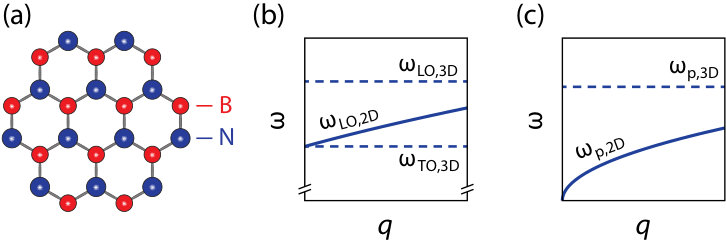 Figure 1
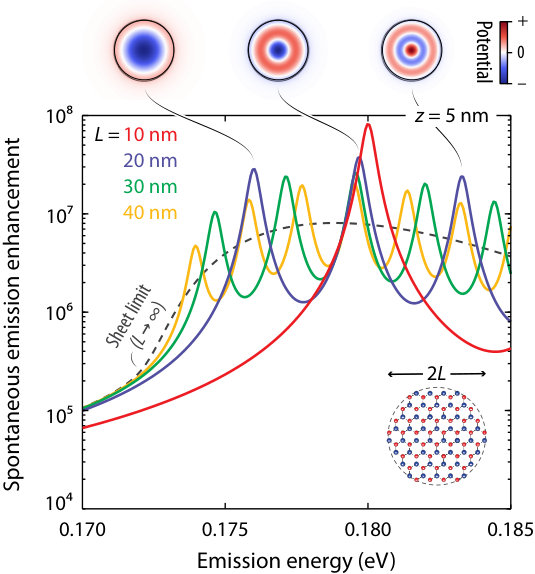 Figure 3
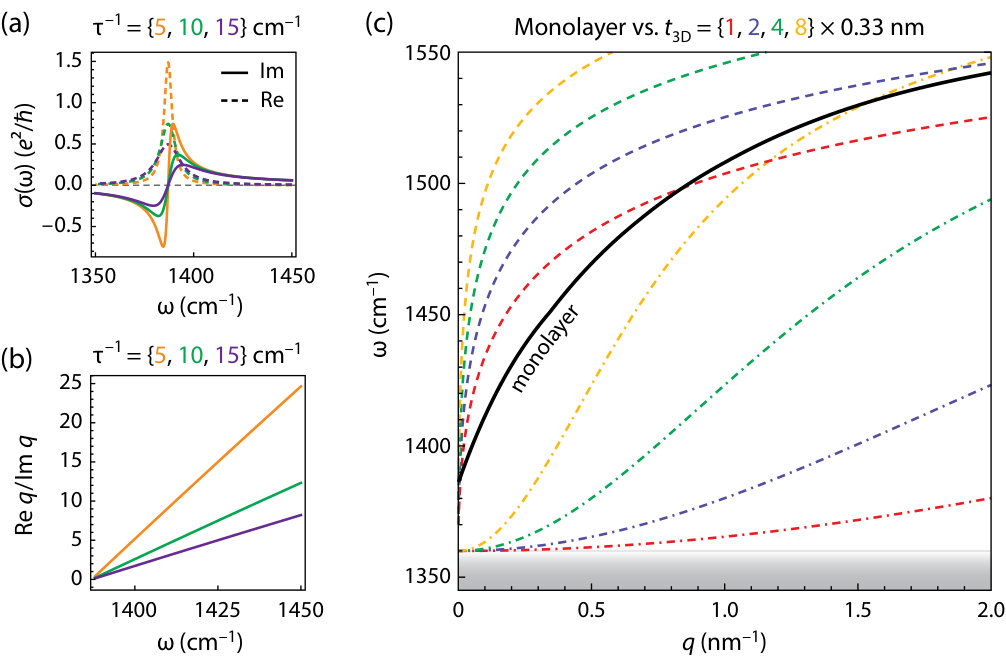 Figure 2
Peer Reviews
No public reviews on file for this paper yet. If you reviewed it on a platform where reviews are public (OpenReview, ICLR, NeurIPS, ICML), you can paste yours below so the community can read it here.
Videos
No videos yet. Explain this paper in a talk, walkthrough, or lecture? Add one.
Phonon polaritonics in two-dimensional materials
Nicholas Rivera
John A. Paulson School of Engineering and Applied Sciences, Harvard University, Cambridge, MA, USA
Department of Physics, Massachusetts Institute of Technology, Cambridge, MA, USA
Thomas Christensen
John A. Paulson School of Engineering and Applied Sciences, Harvard University, Cambridge, MA, USA
Department of Physics, Massachusetts Institute of Technology, Cambridge, MA, USA
Prineha Narang
John A. Paulson School of Engineering and Applied Sciences, Harvard University, Cambridge, MA, USA
Abstract
Extreme confinement of electromagnetic energy by phonon polaritons holds the promise of strong and new forms of control over the dynamics of matter. To bring such control to the atomic-scale limit, it is important to consider phonon polaritons in two-dimensional (2D) systems. Recent studies have pointed out that in 2D, splitting between longitudinal and transverse optical (LO and TO) phonons is absent at the point, even for polar materials. Does this lack of LO–TO splitting imply the absence of a phonon polariton in polar monolayers? Here, we derive a first-principles expression for the conductivity of a polar monolayer specified by the wavevector-dependent LO and TO phonon dispersions. In the long-wavelength (local) limit, we find a universal form for the conductivity in terms of the LO phonon frequency at the point, its lifetime, and the group velocity of the LO phonon. Our analysis reveals that the phonon polariton of 2D is simply the LO phonon of the 2D system. For the specific example of hexagonal boron nitride (hBN), we estimate the confinement and propagation losses of the LO phonons, finding that high confinement and reasonable propagation quality factors coincide in regions which may be difficult to detect with current near-field optical microscopy techniques. Finally, we study the interaction of external emitters with two-dimensional hBN nanostructures, finding extreme enhancement of spontaneous emission due to coupling with localized 2D phonon polaritons, and the possibility of multi-mode strong and ultra-strong coupling between an external emitter and hBN phonons. This may lead to the design of new hybrid states of electrons and phonons based on strong coupling.
Phonon polaritons, hybrid quasiparticles of photons and optical phonons supported in polar materials, hold promise for nanoscale control of electromagnetic fields at mid-infrared and terahertz frequencies. Qualitatively, phonon polaritons share many features with plasmon polaritons in conductors. Recently, it has been shown that phonon polaritons enable confinement of light to volumes times smaller than that of a diffraction-limited photon in free-space Caldwell et al. (2013); Xu et al. (2014); Caldwell et al. (2014); Dai et al. (2014); Tomadin et al. (2015); Yoxall et al. (2015); Li et al. (2015); Dai et al. (2015a, b); Caldwell et al. (2015); Li et al. (2016); Basov et al. (2016, 2017); Low et al. (2017); Giles et al. (2018); Li et al. (2018); Ma et al. (2018). Due to this remarkable confinement and their relatively high lifetimes—around picoseconds—phonon polaritons open new opportunities for vibrational spectroscopy Autore et al. (2018), radiative heat transfer Hillenbrand et al. (2002), and control of dynamics in quantum emitters Kumar et al. (2015); Rivera et al. (2017); Kurman et al. (2018); Flick et al. (2018).
Thus far, extreme confinement of phonon polaritons has been achieved by the use of thin-films (or nanostructuring), which shrink the in- and out-of-plane wavelength of polaritons with decreasing feature size (such as the film thickness) Dai et al. (2014); Dubrovkin et al. (2018). A monolayer is the ultimate limit of this effect, making it critical to have a fundamental understanding of the optical response of 2D polar materials Thygesen (2017). Concerning the optical response, the transition from three-dimensional (3D) to two-dimensional (2D) polar materials is nontrivial, however, since in a polar monolayer, the LO–TO splitting that gives rise to phonon polaritons in 3D is absent at the point Sánchez-Portal and Hernandez (2002); Mele and Král (2002); Serrano et al. (2007); Sohier et al. (2017). This raises a fundamental question about the nature of electromagnetic modes in polar monolayers.
We now develop a framework with quantitative, concrete examples that enables a first-principles understanding of phonon polaritons in 2D materials. We do so by deriving a universal form for the conductivity of a polar monolayer, which depends solely on the LO and TO phonon frequencies—and their dispersion with momentum—in the 2D system. Using parameters from Ref. 29 for the canonical 2D polar monolayer—hexagonal boron nitride (hBN)—we present the confinement and propagation losses of the 2D phonon polariton modes, identifying the frequency region where they should be most easily detected. Finally, we find that these modes enable extreme light-matter interaction between emitters and polar materials, showing that for atom-like emitters, their spontaneous decay can be enhanced by up to eight orders of magnitude through the emitter–LO phonon coupling. For an infrared emitter with a sufficiently high free-space radiative decay rate (1\text{\times}{10}^{6}\text{,}{\mathrm{s}}^{-1}$$), we find that the associated linewidth of the emitter is comparable to the spacing between different phonon polaritonic resonances of an hBN nanostructure. This suggests the possibility of realizing the multi-mode strong coupling and ultra-strong coupling regimes of quantum electrodynamics in a 2D hBN platform. Our results for hBN are particularly relevant due its widespread use in 2D van der Waals heterostructures. In addition to providing functionality as a layer which improves the electrical and optical properties of other 2D materials, e.g. graphene, our results suggest that in these heterostructures, hBN layers could provide a mid-infrared platform for nanophotonics and quantum optics. While we focus on hBN in this manuscript, the salient features of our findings apply to other polar monolayers as well.
I Optical response of optical phonons in two-dimensions
In this section, we develop a theory of electromagnetic response due to optical phonons in 2D systems. The key response function of interest is the conductivity of the monolayer. To that end, we consider the response of the ions of the monolayer due to an electric potential . For that case, the interaction Hamiltonian is
[TABLE]
with the induced charge density and the induced polarization density associated with the ionic motion. Note that boldfaced quantities refer to vectors or tensors as appropriate. Within linear response theory, the polarization density can be straightforwardly evaluated from the displacement of every atom within the unit cell. Specifically, to first order, the polarization density is
[TABLE]
where is the Born effective charge tensor of ion and is the unit cell area. is the equilibrium polarization in the absence of displacements, which is zero here. With this relation between polarization and ionic displacements, the interaction Hamiltonian in Equation (1) couples the scalar potential and the ionic displacements. We consider the response of the monolayer to a potential of the form , where is a 2D wavevector in the plane of the monolayer. Such a potential corresponds to a longitudinal electric field .
In what follows, we assume the validity of the random-phase approximation (RPA) in calculating Coulombic interactions between ions in the polar lattice. Within the RPA, these Coulombic interactions are accounted for by taking the induced polarization to be proportional total electric field, , defined to be the sum of the externally applied electric field and the electric field created by the induced polarization. The polarization and total field are connected by the polarization-polarization response (tensor) function via
[TABLE]
The polarization-polarization response function is related to the conductivity via the relation . From the Kubo formula, it follows that the conductivity is
[TABLE]
where are eigenstates in the phononic Fock space of the monolayer, are matrix elements of the polarization associated with phonon modes (where is the Fourier transform of the phonon displacement operator), () is the energy of state (), is the inverse temperature, and is the grand partition function. We now evaluate the contribution of optical phonons to the polarization-polarization response in the low-temperature limit with a characteristic optical phonon frequency. Considering the long-wavelength (small wavevector) limit, and taking a material with long-wavelength isotropy, such as hBN, we only have to consider the -component in the response tensor, where denotes a pair of directions parallel to the wavevector. Denoting as simply , we find that the conductivity is given by Rivera et al. (2018):
[TABLE]
where L-subscripts denote longitudinal polarization, () denotes a state with no (one) longitudinal phonon of wavevector , and denotes a unit vector in the direction of . We have also phenomenologically included the phonon dissipation rate , consistently with a relaxation-time prescription. The frequency in the denominator, as in the case of bulk phonons, is the frequency of the longitudinal phonon of wavevector prior to considering LO–TO splitting Born and Huang (1954) (and near the point is approximately equal to the TO phonon frequency). This is consistent with the fact that LO–TO splitting is a collective effect arising from Coulomb interactions and the fact that the equation above represents a single-particle susceptibility. Coulomb interactions are accounted for in the random phase approximation, and to include them in the single-particle response amounts to an uncontrolled double-counting.
Next, we express the polarization matrix element in Equation (5) in terms of the Born effective charges of the monolayer and the phonon displacement eigenvectors. Considering the longitudinal phonon contribution to the second-quantized ionic displacement, as in Ref. 32, we find that the conductivity within the RPA is given by
[TABLE]
We have defined scaled eigendisplacements , where is the unit-normalized polarization vector of atom in the unit cell oscillating according to a longitudinal phonon of wavevector and is the mass of atom .
While the conductivity is the main electromagnetic quantity of interest for electrodynamics applications, we briefly state the form of the (2D) permittivity, as its zeros immediately yield the longitudinal modes of the system, which are the LO phonons. The permittivity within the RPA, denoted is related to the polarization-polarization response function via Jablan et al. (2009) and the conductivity via . Here, is the average permittivity of the bulk above and below the monolayer, and is added to take into account the polarization arising from these bulk materials. Note that we have neglected any intrinsic high-frequency screening in the monolayer itself, which is only relevant for wavevectors comparable to the inverse layer spacing between monolayers. When considering non-local corrections to the conductivity at these large wavevectors, these must be taken into account Sohier et al. (2016); Thygesen (2017); Sohier et al. (2017). Based on Equation (6), the zeros of the RPA dielectric function satisfy:
[TABLE]
where is the Coulomb interaction in Fourier space, which in two dimensions, is given by . Given that the zeros of the dielectric function are associated with longitudinal modes, one expects that is in fact the frequency of the LO phonon mode. This is consistent with the result of Ref. 29, in which Sohier et al. show that in 2D polar materials, the extra restoring forces on LO phonons relative to TO phonons, due to the Coulomb interaction, lead to a wavevector-dependent LO–TO splitting and zero LO–TO splitting at the point of the Brillouin zone.
Given these results, we now re-express the conductivity explicitly in terms of the 2D phonon dispersion, and derive a universal form for the conductivity in the local () limit specified in terms of three parameters: the LO phonon frequency at the point (i.e., ), the group velocity of the LO phonon at the point, and the damping rate. From Equation (7), we can immediately write the conductivity as
[TABLE]
In this expression, , the LO phonon frequency prior to LO-TO splitting, has been re-named as , the transverse optical phonon frequency, because in the absence of LO–TO splitting, they are degenerate. The RPA zeros have also been renamed as . This is done in order to make the form of the final results more closely resemble their 3D counterparts, in which the dielectric function is expressed in terms of the TO frequency (see for example Eq. (13)).
For small , the Born charges are (to lowest-order) constant, and so the LO phonon dispersion takes the form , where , the LO phonon group velocity, is defined from microscopic parameters through the relation
[TABLE]
Thus, in the long wavelength limit, we have the following universal parameterization of the conductivity of a polar monolayer:
[TABLE]
We note that despite its appearance, does not depend on , as has an opposite dependence on . From this relation, it follows that given the properties of the 2D phonons (from experiments or from ab initio calculations), one can immediately specify the conductivity. Alternatively, from optical measurements (including far-field measurements) which allow one to extract the conductivity, it becomes possible to extract the group velocity of 2D LO phonons and thus the small-wavevector dispersion of those phonons.
Before moving on to analyze the electrodynamics of 2D phonon polaritons, we make two comments on lack of LO–TO splitting in 2D polar materials. The first is that this situation is in stark contrast to the situation of polar materials in 3D, which have a finite LO–TO splitting at the point. In the absence of such LO–TO splitting in 3D, there would be no frequency compatible with the existence of a phonon polariton. On the contrary, we will show that in 2D, despite the absence of LO–TO splitting at the point, there persists a strongly confined evanescent electromagnetic mode with a high local density of states which in all respects is similar to a phonon polariton of a thin film, but is in fact the 2D LO phonon of the polar monolayer (thus the phrases “phonon polariton” and “2D LO phonon” may be used somewhat interchangeably as is the case in plasmonics where the terms “plasmon polariton” and “2D plasmon” are often used interchangeably).
The second comment is that much of what has been discussed here has a strong analogy with the theory of optical response in electron gases in 2D, and particularly the relation between plasmons in 2D and 3D. To elaborate on this analogy, we take Equation (7) in the case of a two-atom unit cell (such as hBN), and note that the term in the sum over Born charges can be written as \Big{|}\hat{\mathbf{q}}\cdot\sum_{\kappa}\mathbf{Z}_{\kappa}\boldsymbol{\eta}_{\kappa}\Big{|}^{2}\equiv\frac{Q_{*}^{2}}{M_{*}}, with being an effective charge and being an effective mass. Then, the LO–TO splitting can be written as . Now we note that the RHS is exactly the squared-frequency for a plasma oscillation in a 2D gas of charged particles with charge and mass . To connect to LO-TO splitting in phonons, this squared frequency can be thought of as the “LP–TP” splitting between longitudinal and transverse plasma oscillations. Of course, there are no transverse plasma oscillations due to the structure-less nature of the electron, and so “” should be considered equal to zero. In the three-dimensional plasmon case, “”, but the difference between the squared longitudinal and transverse plasma oscillation frequencies at zero-wavevector is non-zero and given by . In other words, the plasma frequency in electron gases is analogous to the LO–TO splitting in polar materials. The change in the dispersion of 3D versus 2D plasmons, like 3D versus 2D LO phonons, arises from the change in dimensionality of the Coulomb interaction from 3D to 2D. This analogy between phononic and plasmonic behavior as a function of dimension is illustrated schematically in Figures 1(b,c) in order to help unify the understanding of 2D plasmonics and phononics. These considerations should also extend to the one-dimensional case.
II Electrodynamics of optical phonons in two-dimensions
To relate the conductivity function to the electromagnetic modes supported by a polar monolayer, we solve Maxwell’s equations for an evanescent electromagnetic mode supported by a surface with conductivity . We consider the monolayer to be sandwiched by a superstrate of permittivity and a substrate of permittivity . To strip the analysis to its bare essentials, we consider optical phonon response with in-plane isotropy in the long-wavelength limit arising from in-plane LO oscillations. A relevant example of a system where these conditions are satisfied is in a hexagonal boron nitride monolayer (see Figure 1(a) for schematic atomic structure). In a monolayer geometry with translation invariance and in-plane isotropy, the solutions of Maxwell’s equations can be decomposed into transverse magnetic (TM) and transverse electric (TE) parts, where the magnetic or electric field respectively is transverse to the in-plane wavevector of the mode. In practice, it is the TM mode which is associated with highly confined electromagnetic waves. We consider without loss of generality a TM mode with wavenumber along the -direction in the monolayer and magnetic field along the -direction of the monolayer. The direction transverse to the monolayer is denoted as . With these definitions in place, the Maxwell equation satisfied by the magnetic field is
[TABLE]
where applies for and applies for . We consider a solution of the form with with corresponding to respectively. The boundary condition on the magnetic field is where is the surface current density, and is the electric field. This condition enforces . Continuity of the electric field in the direction enforces . Combining the two conditions, we obtain the usual dispersion equation for the TM mode of a polarizable 2D monolayer, namely . Given the deeply subwavelength nature of 2D phonon polaritons, i.e. since such that , the dispersion equation can be reduced to its quasistatic limit without consequential loss of accuracy:
[TABLE]
with . This condition, as can be seen from the relation between and , is equivalent to . Thus, the condition for phonon polaritons coincides precisely with the condition for longitudinal optical phonons. One of the main results of our manuscript is that despite the lack of LO–TO splitting at the point, there nevertheless exists a strongly confined evanescent mode in many respects similar to the phonon polaritons of thin films. We now analyze the dispersion relation of phonon polaritons in a specific material, hexagonal boron nitride, in more detail, showing the possibility of highly confined electromagnetic modes with a large local density of states.
In Figure 2(a), we present the conductivity of 2D hBN of Equation 10, using parameters from Ref. 29 calculated from density functional theory within the local density approximation. In this plot and , with the speed of light in vacuum.
From the conductivity, the dispersion relation of phonon polaritons on an infinite sheet is given by . The dispersion, assuming and , is shown in Figure 2(c) (black line). A key figure of merit for applications involving the propagation of phonon polaritons, is the propagation quality factor, defined by , which is shown in Figure 2(b).
For monolayer hBN, the wavevector grows very rapidly with frequency, due to the extremely low group velocity of 2D LO phonons, which is a remarkable four orders of magnitude slower than the speed of light. In particular, at frequencies of , the phonon polariton has a wavelength of about , significantly shorter than any phonon polariton measured so far, and, similarly shorter than any plasmonic wavelength, even in graphene. In fact, this short a wavelength well-below that of any polariton in current scattering near-field microscopy (SNOM) measurements. The 2D phonon polariton could in principle be measured by SNOM closer to the TO frequency, where confinement is smaller; unfortunately, as shown in Figure 2(b), near the TO frequency, dissipation is far higher (and corresponding propagation quality factors far lower) due to large (or, equivalently, large ).
These considerations imply that access to the lower-loss and higher-confined portions of the dispersion relation of phonon polaritons, in the absence of a sharper tip, requires a near-field probe such as a free electron probe, as used in electron energy loss spectroscopy (EELS), where slow electrons can be used to probe plasmon wavelengths of just a few nanometers in monolayer metals, as well as the nonlocal bulk plasmon dispersion in metals Nagao et al. (2001); García de Abajo (2010); Diaconescu et al. (2007). EELS has been recently employed to measure phonon polaritons in ultrathin films of hBN Govyadinov et al. (2017). Another interesting class of near-field probes, with relevance to fundamental physics and quantum optics applications, is a quantum emitter such as an atom, molecule, or artificial atom such as a quantum dot, quantum well, or vacancy center. Recently, it was demonstrated using nanostructures of bulk hBN that the interaction of vibrational emitters with phonon polaritons is on the border of the strong coupling regime Autore et al. (2018).
In the rest of this section, we discuss the relation between the dispersion of an hBN monolayer versus the atomically-thick limit of a thin film of a material with hBN’s bulk dielectric function. To aid this discussion, in Figure 2(c), we show the dispersion relation of thin films of bulk hBN with film thicknesses of 1, 2, 4, and 8 times the interlayer spacing of bulk hBN, which is roughly . For these plots, we take hBN to be cleaved such that the optical axis is perpendicular to the plane of the film. The components of the bulk permittivity perpendicular and parallel to the c-axis ( and , respectively; indexed by below) are then given by
[TABLE]
with 2.95, $\omega_{\mathrm{TO},\parallel}=$760\text{\,}{\mathrm{cm}}^{-1}, and 830\text{,}{\mathrm{cm}}^{-1}; and $\epsilon_{\infty,\perp}=$4.87, 1360\text{,}{\mathrm{cm}}^{-1}, and $\omega_{\mathrm{LO},\perp}=$1614\text{\,}{\mathrm{cm}}^{-1}Caldwell et al. (2014); Dai et al. (2014). Losses are ignored in this discussion altogether. In the range between and , the corresponding component of the permittivity is negative, while the other component is positive. This hyperbolicity leads to a dispersion for hBN thin films that have multiple branches at a given frequency, as can be seen in Figure 2(c). This trend persists even when the thickness of the bulk is taken down to a single layer, albeit being pushed to high wavevectors. This is in contrast with the true monolayer, in which there is only one LO phonon mode. Given that the phonon polariton of 2D is the LO phonon, there can be only one branch of the dispersion. Another anomaly between 2D and 3D is that the dispersion relation of the 2D LO phonon is non-monotonic, and the frequency starts to decrease for sufficiently large wavevector. This can never happen by extrapolating to a monolayer a dielectric function which has finite LO–TO splitting. This turn-back point corresponds to a frequency of around and a phonon wavelength of less than . Thus, this deviation is challenging to probe in typical optical experiments. However it means that for the monolayer, the range of accessible phonon polaritonic frequencies for optical applications is reduced compared to thick films. Finally, while we have focused on anomalies between the atomically-thin limit of bulk and a true monolayer, a comparison of the monolayer with the fundamental phonon polariton mode of the one-atom-thick thin film suggests that we have a reasonable qualitative understanding of the monolayer dispersion from this limit.
III Strong light-matter interactions enabled by 2D optical phonons
The extreme confinement of electromagnetic fields offered by the 2D phonon polariton presents an opportunity for quantum optical applications in which one seeks to couple an external emitter such as an atom, molecule, defect, or artificial atomic system to electromagnetic fields. Applications of these couplings are ultra-bright single- or two-photon sources, realizing the strong-coupling regime and the associated phenomenology of Rabi oscillations and polaritons, or resolving spectroscopically “forbidden” transitions Koppens et al. (2011); Autore et al. (2018); Rivera et al. (2016, 2017); Kurman et al. (2018) to achieve near-field spectroscopies with momentum and angular momentum resolution not accessible in far-field spectroscopies.
In Figure 3, we consider the coupling of a dipole emitter to localized phonon polaritons of nanostructured monolayer hBN. For simplicity, we consider hBN nanostructured as a disk, which leads to the formation of sharp resonances quantized along the azimuthal and radial directions. The disk is taken to have a radii varying from to and a loss rate 0.5\text{,}\mathrm{meV}$$, which is of the order of the loss rate in bulk hBN Caldwell et al. (2014); Dai et al. (2014). We also show (dashed line) the results for a disk of infinite radius, i.e., a flat sheet of monolayer hBN. We parameterize the coupling between the dipole and phonon polaritons through the rate of spontaneous emission of phonon polaritons by the dipole, normalized to the rate of spontaneous emission in free space . It is related to the dyadic Green function of the Maxwell equations for the nanostructure via the expression Novotny and Hecht (2012):
[TABLE]
where is the orientation of the dipole, is its position, and is its frequency.
The dyadic Green function is computed using a quasi-electrostatic boundary element method (as in Ref. 42). In Figure 3, we plot the enhancement of the spontaneous emission rate for an external emitter polarized perpendicularly to the plane of the disk and placed away from the center of the disk. Due to the orientation and position of the dipole , which maintains the axial symmetry of the disk, the emitter only couples to axially symmetric () modes with zero orbital angular momentum. We find that the rate of spontaneous emission of 2D optical phonons is approximately 8 orders of magnitude larger than the rate of spontaneous emission of photons in the far field at frequencies corresponding to resonant modes of the hBN disk. Such enhancement is much larger than the enhancement presented by an unstructured, infinite sheet at the same frequency, due to the concentration of electromagnetic local density of states around the resonances. Nevertheless, the average spontaneous emission enhancement, defined by the integral of the enhancement over frequencies, is comparable to that of the flat sheet, in keeping with sum rules for spontaneous emission enhancement Scheel and Buhmann (2008). We note that in this approach, the coupling of the dipole to phonon polaritons is manifested through the phonon contribution to the dielectric function of the disk. This should be equivalent to an approach that considers the coupling of a bound electron in an emitter to LO phonons in the disk through a 2D Fröhlich coupling—i.e. a coupling of the atomic electron to the electric potential resulting from the polarization associated with an LO phonon mode Sohier et al. (2016).
In Figure 3, we show that for an infrared emitter at a transition wavelength of with a free-space radiative lifetime of , away from an hBN disk, the coupling rate to 2D optical phonons (about ) would be on the same scale as the optical phonon frequency itself (about ). This rate thus implies coupling between an emitter and the field in the regime of ultra-strong coupling. Moreover, the coupling rate for the disk (purple), for an emitter with a far field decay rate of 3\text{\times}{10}^{14}\text{,}{\mathrm{s}}^{-1}$$ would have a sufficient coupling strength to the distinct, radially-quantized resonances in purple for its linewidth to span multiple resonances and thus be in a multi-mode ultra-strong coupling regime. Thus, the extreme confinement of electromagnetic energy associated with LO phonons in two dimensions enables the possibility of realizing ultra-strong coupling of an atom or molecule with optical phonons in a polar material, allowing the potential realization of new coupled states of quantum emitters and phonons such as atom–phonon polariton bound states.
The ability to probe low-loss and highly confined electromagnetic modes associated with optical phonons in 2D polar materials provides a new platform for nanophotonics in the mid- and far-infrared spectral range. The identification of the phonon polariton of bulk and thin-film geometries with the 2D LO phonon made in this manuscript would extend the rich phenomenology of optical phonons to nanophotonic applications. This work also points the way to useful new approaches to study LO phonons, arising from the fact that 2D LO phonons, unlike their 3D counterparts, have their electromagnetic energy extend a considerable distance from the material boundary. Due to the strong electromagnetic interactions between emitters and 2D phonon polaritons shown here, it is now possible to design interesting new hybrid states of matter and phonons based on quantum electrodynamical strong coupling. The highly confined phonon polaritons in polar monolayers may also provide interesting new opportunities in near-field radiative heat transfer, in which it has been long known that thin-film surface phonon polaritons play a critical role. Additional opportunities come from considering the near- and far-field optical properties of periodically structured layers involving hBN and other materials such as graphene Papadakis et al. (2017). An important avenue of future study would be the ab initio calculation of lifetimes of 2D LO phonons associated with three-phonon processes Caldwell et al. (2015); Srivastava (1990) and electron-phonon interactions Sundararaman et al. (2014); Sohier et al. (2016); Ciccarino et al. (2018). In further work, it would be of great interest to study the effects of isotopic purification and cryogenic temperatures on reducing the decay rate of these 2D LO phonons Giles et al. (2018).
IV Acknowledgments
The authors thank Ido Kaminer, Siyuan Dai, Samuel Moore, Jennifer Coulter, and Christopher Ciccarino for helpful discussions. N. R. recognizes the support of the DOE Computational Science Graduate Fellowship (CSGF) fellowship no. DE-FG02-97ER25308. T. C. acknowledges support from the Danish Council for Independent Research (Grant No. DFF–6108-00667). This work was supported by the DOE Photonics at Thermodynamic Limits Energy Frontier Research Center under grant number DE-SC0019140.
The reference list from the paper itself. Each links out to its DOI / PubMed record.
- 1Caldwell et al. (2013) J. D. Caldwell et al. , Nano Lett. 13 , 3690 (2013) . · doi ↗
- 2Xu et al. (2014) X. G. Xu, J.-H. Jiang, L. Gilburd, R. G. Rensing, K. S. Burch, C. Zhi, Y. Bando, D. Golberg, and G. C. Walker, ACS Nano 8 , 11305 (2014) . · doi ↗
- 3Caldwell et al. (2014) J. D. Caldwell et al. , Nat. Commun. 5 , 5221 (2014) . · doi ↗
- 4Dai et al. (2014) S. Dai et al. , Science 343 , 1125 (2014) . · doi ↗
- 5Tomadin et al. (2015) A. Tomadin, A. Principi, J. C. Song, L. S. Levitov, and M. Polini, Phys. Rev. Lett. 115 , 087401 (2015) . · doi ↗
- 6Yoxall et al. (2015) E. Yoxall, M. Schnell, A. Y. Nikitin, O. Txoperena, A. Woessner, M. B. Lundeberg, F. Casanova, L. E. Hueso, F. H. Koppens, and R. Hillenbrand, Nat. Photonics 9 , 674 (2015) . · doi ↗
- 7Li et al. (2015) P. Li, M. Lewin, A. V. Kretinin, J. D. Caldwell, K. S. Novoselov, T. Taniguchi, K. Watanabe, F. Gaussmann, and T. Taubner, Nat. Commun. 6 , 7507 (2015) . · doi ↗
- 8Dai et al. (2015 a) S. Dai et al. , Nat. Commun. 6 , 6963 (2015 a) . · doi ↗