Statistical Timing Analysis for Latch-Controlled Circuits with Reduced Iterations and Graph Transformations
Bing Li, Ning Chen, Ulf Schlichtmann

TL;DR
This paper introduces an efficient statistical timing analysis method for latch-controlled circuits that reduces computational effort by combining reduced iterations and graph transformations, enabling faster yield estimation.
Contribution
It proposes a novel combination of reduced iterations and graph transformations to significantly improve the efficiency of statistical timing analysis for latch circuits.
Findings
Over 10 times faster than existing methods
Provides parametric minimum clock period for yield calculation
Handles nonpositive loops effectively
Abstract
Level-sensitive latches are widely used in high- performance designs. For such circuits efficient statistical timing analysis algorithms are needed to take increasing process vari- ations into account. But existing methods solving this problem are still computationally expensive and can only provide the yield at a given clock period. In this paper we propose a method combining reduced iterations and graph transformations. The reduced iterations extract setup time constraints and identify a subgraph for the following graph transformations handling the constraints from nonpositive loops. The combined algorithms are very efficient, more than 10 times faster than other existing methods, and result in a parametric minimum clock period, which together with the hold time constraints can be used to compute the yield at any given clock period very easily.
Click any figure to enlarge with its caption.
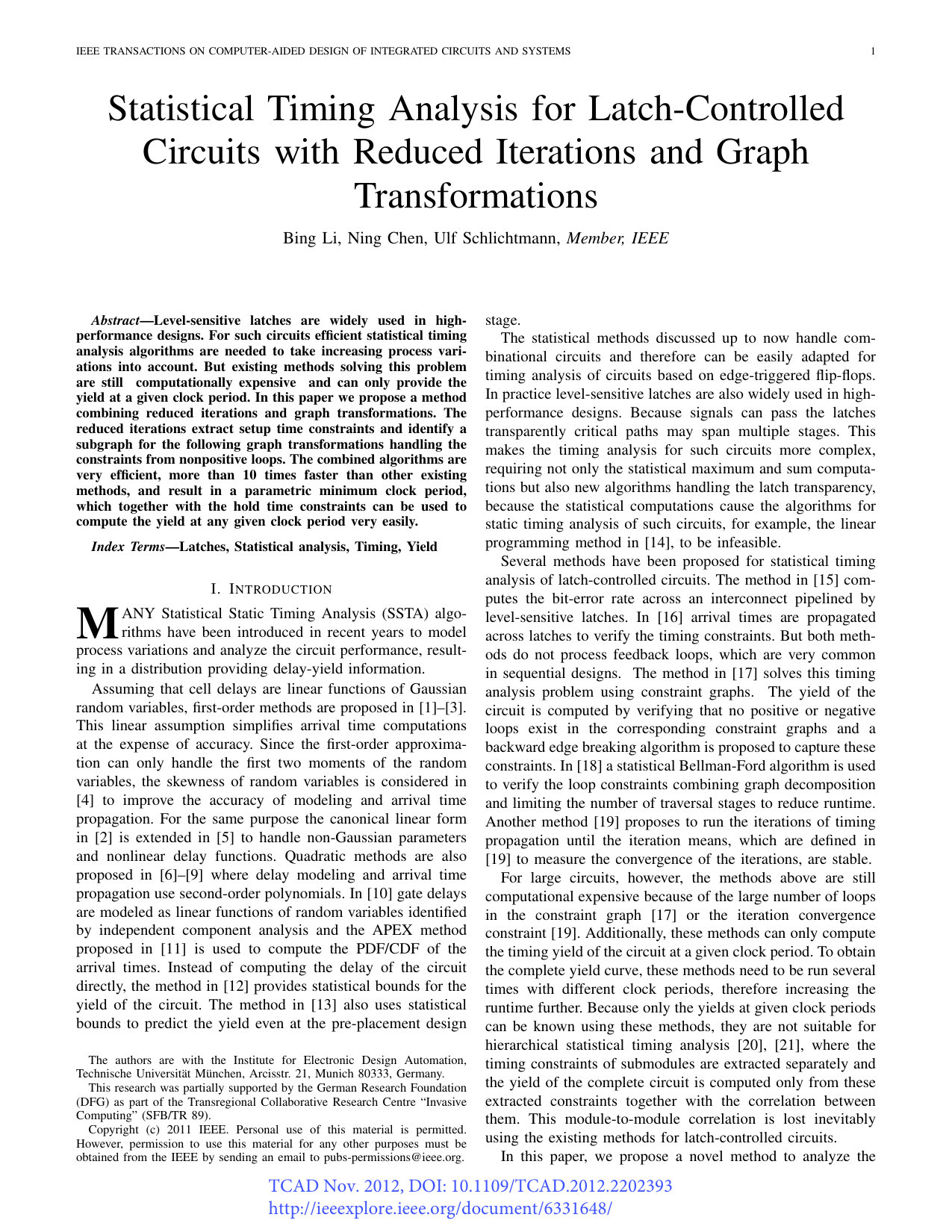 Figure 1
Peer Reviews
No public reviews on file for this paper yet. If you reviewed it on a platform where reviews are public (OpenReview, ICLR, NeurIPS, ICML), you can paste yours below so the community can read it here.
Videos
No videos yet. Explain this paper in a talk, walkthrough, or lecture? Add one.
See pages 1-last of latch_SSTA_TCAD_2012_11.pdf