Ultrafocused Electromagnetic Field Pulses with a Hollow Cylindrical Waveguide
P. Maurer, J. Prat-Camps, J. I. Cirac, T. W. H\"ansch, O., Romero-Isart

TL;DR
This paper demonstrates theoretically that a dipole inside a hollow cylindrical waveguide can generate a train of ultrashort, ultrafocused electromagnetic pulses through spectral filtering and mode excitation, with potential for outside propagation.
Contribution
It introduces a method to produce trains of ultrashort, focused electromagnetic pulses using a dipole in a cylindrical waveguide, exploiting spectral filtering and mode coherence.
Findings
Ultrashort pulses can be generated inside the waveguide.
Focused pulses persist outside at distances comparable to the waveguide radius.
The method allows for arbitrary shortness of the pulses.
Abstract
We theoretically show that an externally driven dipole placed inside a cylindrical hollow waveguide can generate a train of ultrashort and ultrafocused electromagnetic pulses. The waveguide encloses vacuum with perfect electric conducting walls. A dipole driven by a single short pulse, which is properly engineered to exploit the linear spectral filtering of the cylindrical hollow waveguide, excites longitudinal waveguide modes that are coherently re-focused at some particular instances of time. A dipole driven by a pulse with a lower-bounded temporal width can thus generate, in principle, a finite train of arbitrarily short and focused electromagnetic pulses. We numerically show that such ultrafocused pulses persist outside the cylindrical waveguide at distances comparable to its radius.
Click any figure to enlarge with its caption.
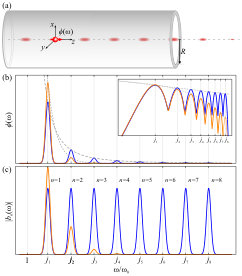 Figure 1
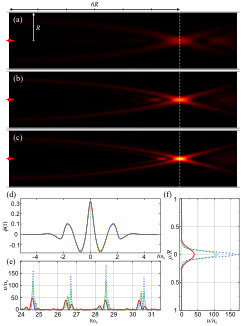 Figure 2
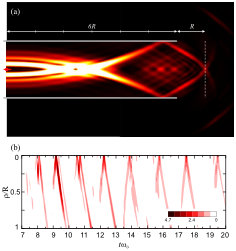 Figure 3
Peer Reviews
No public reviews on file for this paper yet. If you reviewed it on a platform where reviews are public (OpenReview, ICLR, NeurIPS, ICML), you can paste yours below so the community can read it here.
Videos
No videos yet. Explain this paper in a talk, walkthrough, or lecture? Add one.
Ultrafocused Electromagnetic Field Pulses with a Hollow Cylindrical Waveguide
P. Maurer
Institute for Quantum Optics and Quantum Information of the Austrian Academy of Sciences, A-6020 Innsbruck, Austria.
Institute for Theoretical Physics, University of Innsbruck, A-6020 Innsbruck, Austria.
J. Prat-Camps
Institute for Quantum Optics and Quantum Information of the Austrian Academy of Sciences, A-6020 Innsbruck, Austria.
Institute for Theoretical Physics, University of Innsbruck, A-6020 Innsbruck, Austria.
J. I. Cirac
Max-Planck-Institut für Quantenoptik, Hans-Kopfermann-Strasse 1, D-85748, Garching, Germany
T. W. Hänsch
Ludwig-Maximilians-Universität München, Fakultät für Physik, Schellingstrasse 4/III, 80799 München, Germany
Max-Planck-Institut für Quantenoptik, Hans-Kopfermann-Strasse 1, D-85748, Garching, Germany
O. Romero-Isart
Institute for Quantum Optics and Quantum Information of the Austrian Academy of Sciences, A-6020 Innsbruck, Austria.
Institute for Theoretical Physics, University of Innsbruck, A-6020 Innsbruck, Austria.
Abstract
We theoretically show that an externally driven dipole placed inside a cylindrical hollow waveguide can generate a train of ultrashort and ultrafocused electromagnetic pulses. The waveguide encloses vacuum with perfect electric conducting walls. A dipole driven by a single short pulse, which is properly engineered to exploit the linear spectral filtering of the cylindrical hollow waveguide, excites longitudinal waveguide modes that are coherently re-focused at some particular instances of time. A dipole driven by a pulse with a lower-bounded temporal width can thus generate, in principle, a finite train of arbitrarily short and focused electromagnetic pulses. We numerically show that such ultrafocused pulses persist outside the cylindrical waveguide at distances comparable to its radius.
The precise generation and control of spatiotemporal properties of electromagnetic (EM) fields is an enabling tool for science and technology. Spatial distributions in the far field can be controlled by tailoring the EM properties of media Leonhardt2006 ; Pendry2006 . These so-called metamaterials have been proposed for perfect imaging by either using a negative refractive index to amplify evanescent waves Pendry2000 , or an ordinary optical medium whose positive refractive index is continuously varied Leonhardt2009 . Regarding temporal properties, the generation of frequency combs, namely a train of coherent ultrashort pulses, has lead to a myriad of applications in precision spectroscopy, optical clocks, astronomical observation, precision ranging, and gas sensing, to mention a few Newbury2011 ; Udem1999 ; Diddams2001 ; Steinmetz2008 ; Schuhler2006 ; Rieker2014 . Frequency combs are typically generated by using non-linear EM media, such as by mode-locking lasing longitudinal modes by means of a saturable absorber Holzwarth2000 ; Cundiff2003 or by parametric frequency conversion in optical microresonators Kippenberg2011 .
In this Letter, we propose an alternative tool, based neither on spatially structured nor on non-linear EM media, to generate tiny spatiotemporal features of EM fields. In particular, we devise a scheme to generate a train of ultrashort pulses that are ultrafocused in space. This is achieved by placing a driven point dipole inside an otherwise empty hollow cylindrical waveguide of radius with perfect electric conducting walls, see Fig. 1a. The oscillating dipole has a mean frequency , where is the speed of light in vacuum. By properly engineering the temporal dependence of the driven dipole, and in particular, by fine-tuning its spectral tail at high frequencies, we theoretically show that far from the dipole a train of ultrafocused EM pulses is generated. Each pulse has a temporal width and its EM energy near the axis is mostly carried by the longitudinal components that exhibit a transverse spot size given by . Here, is the number of waveguide modes that the high frequency tail of the driven dipole’s spectrum excites. This effect is thus solely based on the geometric properties of the hollow cylindrical waveguide, which acts as a linear spectral filter, and the fine-tuning of the spectral distribution of the driven dipole. These analytical results are corroborated by numerical simulations. We further show that for a finite waveguide, these ultrashort and ultrafocused EM pulses persist at a distance outside the cylindrical waveguide. We remark that the discussed mechanism to generate EM hot-spots is different from superoscillatory fields Berry2006 ; Rogers2013 , which are often realized by illuminating carefully designed optical masks with coherent monochromatic light. These can also focus EM energy in a sub-wavelength spot size far from the source, but only a small fraction of the total energy.
To be more precise, let us consider a point dipole inside an infinite hollow cylinder of radius , whose symmetry axis is aligned with the -axis. The border of the cylinder, which encloses vacuum, consists of a perfect electric conductor. This sets the boundary condition for the electric field in cylindrical coordinates, where and is the radial unit vector. The dipole moment is aligned with the symmetry axis, see Fig. 1a. Hereafter, we concentrate on a magnetic dipole but the results hold analogously for an electric dipole, see SM . The magnetic dipole moment is given by , where and is a dimensionless real scalar function that parametrizes the temporal dependence of . The temporal dependence of the point dipole is assumed to be induced by external driving. The magnetization associated to the magnetic dipole, , corresponds to a current density given by . Our goal is to derive the EM field generated by the dipole in the far field and analyze its spatiotemporal features.
To this end, we analytically solve Maxwell’s equations in the spectral domain. In the following, we sketch the derivation and refer to SM for further details. First, let us define the dipole spectrum , which (as discussed below) is crucially chosen to be real. We normalize it as . In the framework of vector polarization potentials Stratton2007 , the problem is reduced to find the solution of the inhomogeneous scalar Helmholtz equation
[TABLE]
with the boundary condition . Here, is the vacuum permeability and . From the solutions of the Helmholtz equation, one can then readily obtain the magnetic field and SM . The symmetry of the problem allows to expand the solutions in a complete set of orthogonal functions that fulfill the boundary condition. That is,
[TABLE]
where denotes the th order Bessel function of the first kind and is the th non-zero root of , namely . The expansion coefficients can be obtained using the orthogonality relations and the integral can be performed using complex analysis SM . One then analytically obtains that the propagating electric and magnetic fields are given by
[TABLE]
This corresponds to a magnetic (electric) field with longitudinal and radial (azimuthal) components. These components can be written as an infinite sum of discrete modes
[TABLE]
where . The modes are determined by the phase and amplitude functions
[TABLE]
Here, is the Heaviside function and we defined dimensionless frequencies as and spatial coordinates as and .
The analytical solution in the spectral domain unveils some key features of the generated EM fields: (i) the cylinder acts as a high-pass filter since the field components vanish for ; (ii) the phase at the resonance frequencies vanishes, namely (thanks to the fact that is chosen to be real, namely that the driven dipole has the same spectral phase at all ); (iii) the resonance frequencies are quasi-equidistant, namely Olver1974 ; (iv) the amplitude diverges at as , a peak that is equal for all modes; (v) on the -axis (), the EM field is purely longitudinal and magnetic since ; (vi) the peaks of the longitudinal component of the magnetic field at for are given by , where has been used.
In summary, the EM field near axis has predominantly a longitudinal magnetic field component whose spectrum has the form of quasi-equidistant teeth, all with the same phase, but, in general, with different amplitudes. This is the result of the linear spectral filtering of the hollow cylindrical waveguide. According to feature (vi), all modes can equally contribute by tuning the spectrum of the driven dipole such that for all modes. This leads to , such that each tooth in the frequency spectrum has the same height and phase. This is illustrated in Fig. 1(b,c), where dipole spectra given by with
[TABLE]
() are plotted. Here is the normalization constant and the peak function. An EM field with a spectrum of quasi-equidistant coherent peaks is thus generated by fine tuning [blue line in Fig. 1(b,c)]. See the difference with the non-tuned spectrum [orange line in Fig. 1(b,c)].
Therefore, one expects that by engineering a time-dependent dipole such that its spectrum is given by Eq. (11) with , one generates an EM field where on the axis consists of a train of pulses, each of duration , temporally separated by . Remarkably, each pulse is given by a coherent superposition of the first zeroth-order Bessel functions, see Eq. (5), which thus should lead to a transverse spot size given by Maurer2016 . Off-axis, where is non-zero, one expects these spatiotemporal features to disappear since neither nor can be made constant for all . Thus, the energy density should show similar spatiotemporal features as those shown by the longitudinal component of the magnetic field. The larger the number of excited modes is, the more dominant these features are. Note, however, that the mean frequency , calculated using Eq. (11) with and , can be numerically upper bounded by . Hence, barely increases with . In essence, the fine-tuned spectrum optimally exploits the linear spectral filtering provided by the hollow cylinder, as given by Eq. (9).
Let us confirm these results by numerically solving, using COMSOL Multiphysics, the Maxwell equations in the temporal domain. We consider a hollow cylinder of a certain length with perfect electric conducting walls. At the two ends, perfectly absorbing transverse walls emulate the infinite length of the cylinder. Regarding the magnetic dipole, we use the spectrum given by Eq. (11), see Fig. 1a, spanning over resonance frequencies and with the fine-tuned decay . The strength of the magnetic moment is normalized such that the energy radiated by the dipole in free space, , does not depend on . Electric and magnetic fields solutions are numerically calculated as a function of space and time. The energy density is then computed. In Fig. 2(a,b,c), we show snapshots of these simulations for modes at similar times. It can be seen that the larger the number of modes, the shorter the duration of the pulses [see Fig. 2(e)]. The spatial distribution of energy also becomes more focused with increasing , as shown in Fig. 2(f). In SM , we provide the videos showing the temporal evolution of the energy density for these three cases as well as for a non-tuned spectrum. As discussed above, the mean frequency of the dipole barely depends on and hence, so does [Fig. 2(d)]. Nevertheless, the high frequency tail of the spectrum has a significant impact on the spatiotemporal features of the generated EM field. We remark that in order to understand the on-axis trajectory of each pulse emitted, it is very enlightening to solve the similar problem of a dipole placed between two infinite planes made of perfect electric conducting material. By using the method of images, one readily obtains that the trajectory of the th pulse () is given by the equation , which indicates that the group velocity of the th pulse is superluminal after being generated, namely for . This can be neatly corroborated in the videos given in SM .
Motivated by the potential applications, we also numerically study a cylindrical waveguide of finite length. In particular, we consider a magnetic dipole at the origin of coordinates and a hollow perfect electric conducting cylinder extending from . We analyze the spatiotemporal distribution of the energy density outside the cylinder. As can be seen in Fig. 3(a), the magnitude of the energy density at distance outside the cylinder is still comparable to the energy density inside. Furthermore, the main features such as equidistant pulsing and spatial focusing are approximately preserved at a distance outside the cylinder, see Fig. 3(b).
Let us now discuss a particular case study. Consider a cylinder of radius and a magnetic dipole moment generated with a coil of radius . The coil is driven by a time-dependent current with a peak intensity of and spectrum given by Eq. (11) with and . The characteristic frequency is then . Inside the cylinder, the temporal duration of an EM pulse is , the repetition period , and the spot size is given by . The peak energy density inside the cylinder is with a longitudinal magnetic field component given by T. At outside the cylinder, the peak energy density is and the magnetic field T.
Thorough the Letter we assume that the hollow cylinder consists of a perfect electric conductor. In practice, one should find a material that provides the appropriate boundary conditions over a frequency window that includes several resonance frequencies. Since frequencies depend inversely on the radius of the cylinder, the operating frequency window will strongly depend on . For a cm-sized cylinder, where is at the GHz regime, one could use a good conductive metal, such as copper or gold, to obtain the approximate boundary conditions up to frequencies in the terahertz regime Pendry2004 . These materials would also introduce some losses, which could be taken into account numerically. Their effect would increase with frequency, ultimately limiting the useful frequency window. Resonant frequencies also depend linearly on the speed of light . Thus, one could fill the cylinder with a non-structured and non-absorptive medium with a given refractive index to reduce , thereby decreasing the resonance frequencies and effectively increasing the number of modes that could be perfectly reflected in the waveguide. Another challenge is the fine-tuning of the driven dipole spectrum at high frequencies, namely the precision with which the time-dependent variation of the dipole moment has to be implemented. This precision is then translated into the tiny spatiotemporal features of the emitted EM field. Note that for a sustained generation of ultrafocused EM pulses, one could use a frequency comb to drive the dipole. Interestingly, one could explore if a suitable quantum emitter inside the cylinder can naturally emit radiation with the required optimal tail at high-frequencies, a question we leave for further research.
In summary, we have discussed an alternative scheme to generate tiny spatiotemporal features of EM fields that is neither based on spatially-structured nor on non-linear EM media. It is solely based on the geometry of a hollow cylindrical waveguide and the fine-tuning of the high-frequency tail of a time-dependent point dipole placed in its interior. The temporal features of the generated EM fields could be used for precise sensing, as similarly done with frequency combs, and the spatial features for imaging and focusing of either magnetic or electric longitudinal fields.
We acknowledge useful discussions with A. Rauschenbeutel. This work is supported by the European Research Council (ERC-2013-StG 335489 QSuperMag) and the Austrian Federal Ministry of Science, Research, and Economy (BMWFW).
References
- (1)
O. Keller, Quantum Theory of Near-Field Electrodynamics (Springer, Berlin Heidelberg, 2012).
The reference list from the paper itself. Each links out to its DOI / PubMed record.
- 1(1) J. B. Pendry, D. Schurig, and D. R. Smith, Science 312 , 1780 (2006) .
- 2(2) U. Leonhradt, Science 312 , 1777 (2006) .
- 3(3) J. B. Pendry, Phys. Rev. Lett. 85 , 3966 (2000) .
- 4(4) U. Leonhardt, New J. Phys. 11 , 093040 (2009) .
- 5(5) N. R. Newbury, Nature Photon. 5 , 186 (2011) .
- 6(6) Th. Udem, J. Reichert, R. Holzwarth, and T. W. Hänsch, Phys. Rev. Lett. 82 , 3568 (1999) .
- 7(7) S. A. Diddams, Th. Udem, J. C. Bergquist, E. A. Curtis, R. E. Drullinger, L. Hollberg, W. M. Itano, W. D. Lee, C. W. Oates, K. R. Vogel, and D. J. Wineland, Science 293 , 825 (2001) .
- 8(8) T. Steinmetz, T. Wilken, C. Araujo-Hauck, R. Holzwarth, T. W. Hänsch, L. Pasquini, A. Manescau, S. D’Odorico, M. T. Murphy, T. Kentischer, W. Schmidt, and T. Udem, Science 321 , 1335 (2008) .