(p,q)-webs of DIM representations, 5d N=1 instanton partition functions and qq-characters
Jean-Emile Bourgine, Masayuki Fukuda, Koichi Harada, Yutaka Matsuo and, Rui-Dong Zhu

TL;DR
This paper develops a new mathematical framework using (p,q)-webs and DIM algebra representations to compute 5d N=1 instanton partition functions and qq-characters, simplifying calculations and extending previous operator relations.
Contribution
It introduces a new intertwiner for higher rank representations, enabling the use of folded web diagrams and advancing the construction of qq-characters for linear quivers.
Findings
New intertwiner for levels (1,n)⊗(0,m)→(1,n+m) representations.
Simplified computations via folded (p,q)-web diagrams.
Method to construct qq-characters using DIM algebra actions and Weyl reflections.
Abstract
Instanton partition functions of 5d Super Yang-Mills reduced on can be engineered in type IIB string theory from the -branes web diagram. To this diagram is superimposed a web of representations of the Ding-Iohara-Miki (DIM) algebra that acts on the partition function. In this correspondence, each segment is associated to a representation, and the (topological string) vertex is identified with the intertwiner operator constructed by Awata, Feigin and Shiraishi. We define a new intertwiner acting on the representation spaces of levels , thereby generalizing to higher rank the original construction. It allows us to use a folded version of the usual -web diagram, bringing great simplifications to actual computations. As a result, the characterization of Gaiotto states and vertical intertwiners, previously obtained by some…
Click any figure to enlarge with its caption.
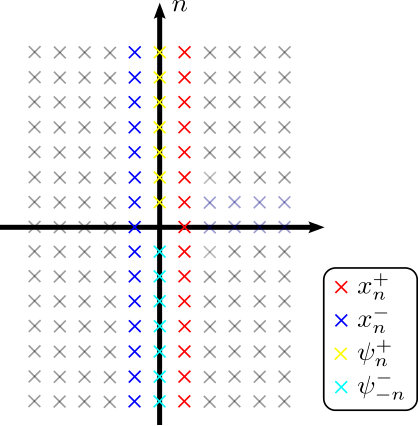 Figure 1
Peer Reviews
No public reviews on file for this paper yet. If you reviewed it on a platform where reviews are public (OpenReview, ICLR, NeurIPS, ICML), you can paste yours below so the community can read it here.
Videos
No videos yet. Explain this paper in a talk, walkthrough, or lecture? Add one.