Comment on "Spreading widths of giant resonances in spherical nuclei: damped transient response" by Severyukhin et al. [arXiv:1703.05710]
V.Yu. Ponomarev

TL;DR
This paper critically examines the universal approach proposed by Severyukhin et al. for describing spreading widths of giant resonances in spherical nuclei, questioning its validity and applicability.
Contribution
It provides a critical analysis of the universality claim and assesses the approach's effectiveness in nuclear resonance modeling.
Findings
Questions the validity of the universal approach
Highlights limitations in the applicability of the method
Suggests need for further validation and refinement
Abstract
We argue whether physics of universal approach of Severyukhin et al. [arXiv:1703.05710] is approved.
Click any figure to enlarge with its caption.
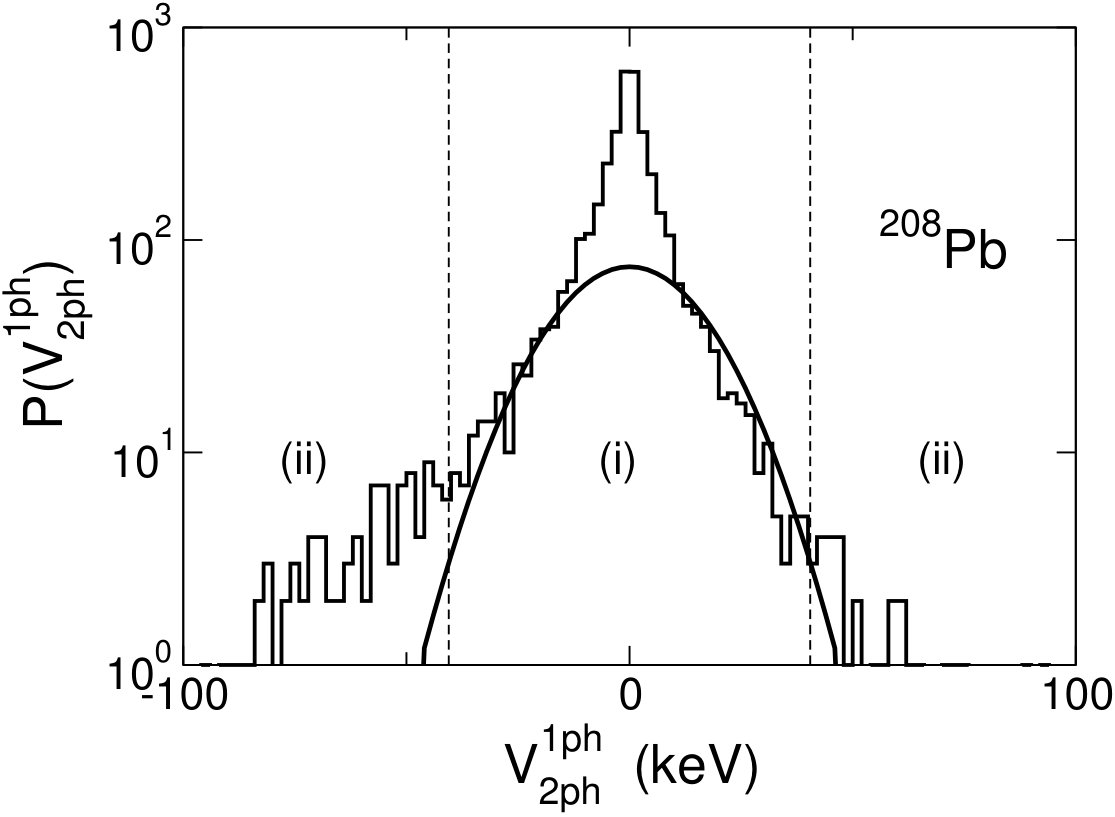 Figure 1
Peer Reviews
No public reviews on file for this paper yet. If you reviewed it on a platform where reviews are public (OpenReview, ICLR, NeurIPS, ICML), you can paste yours below so the community can read it here.
Videos
No videos yet. Explain this paper in a talk, walkthrough, or lecture? Add one.
Comment on “Spreading widths of giant resonances in
spherical nuclei: damped transient response” by Severyukhin et al. [arXiv:1703.05710].
V.Yu. Ponomarev
Institute of Nuclear Physics, Technical University of Darmstadt, 64289 Darmstadt, Germany
(March 29, 2017)
Abstract
We argue whether physics of universal approach of Severyukhin et al. [arXiv:1703.05710] is approved.
A universal approach (UA) to describe spreading width of giant resonances in atomic nuclei has been offered recently in Ref. Sev . We discuss below its physical content.
One reads in Summary that the authors “suggest the way to describe spreading widths of GRs by including the coupling between one-phonon and two-phonon states.”Sev . This idea already belongs to well-established knowledge; it is employed by many nuclear models during almost half a century. Accordingly, the above-mentioned suggestion does not sound timely as original one.
An original suggestion of Severyukhin et al. is to generate the coupling matrix elements V between one-phonon (1ph) and two-phonon (2ph) states “by means of the random distribution”Sev in Gaussian form.
The matrix elements V have been already analysed, e.g., in Refs. Shev ; Shev2 within the quasiparticle phonon model (QPM) Sol : They have been “divided into two subspaces: (i) a large subspace with V following the Gaussian distribution (plus overshoot small matrix elements) and (ii) a small subspace with large V values above the Gaussian tails.”Shev (see Fig. 1 taken from Ref. Shev ). It has been demonstrated that “the fragmentation is dominated by the collective mechanism”Shev , i.e. determined by the matrix elements from the group (ii).
The UA suggests to neglect the most important matrix elements from the group (ii) in favour of less important ones from the group (i) (without overshooting small matrix elements). As a result, calculations in Ref. Sev confirm* observation in Ref. Shev and at the same time, are in obvious conflict with conclusion in Ref. Sev that the UA “enables to describe gross structure of the spreading widths of the considered giant resonances.”Sev .
To conclude: Any interaction between doorway and background states yields fragmentation pattern; any distribution has its width. But this alone is not sufficient to claim that the width predicted by the UA describes the physical width of giant resonances. The UA appears to miss the main contribution to the width formation.
Support by the DFG (Contract No. SFB 1245) is acknowledged.+
The reference list from the paper itself. Each links out to its DOI / PubMed record.
- 1(1) A.P. Severyukhin et al., ar Xiv:1703.05710.
- 2(2) A. Shevchenko et al., Phys. Rev. Lett. 93 , 122501 (2004).
- 3(3) A. Shevchenko et al., Phys. Rev. C 79 , 044305 (2009).
- 4(4) V.G. Soloviev, Theory of Atomic Nuclei: Quasiparticles and Phonons (Institute of Physics, Bristol and Philadelphia, 1992).
- 5(5) The widths in Random are substantially smaller as compared to the ones of PPC for the ISGMR and ISGQR (see Table I in Ref. Sev ). **
- 6(6) The IVGDR width in Ref. Sev is determined by the Landau damping (compare to RPA in the same Table I).
- 7(7) Having no discussions on the topic with the authors of Sev , I cannot accept their thanks “for useful discussions”.