Intensity autocorrelation measurements of quantum cascade laser frequency combs in the Terahertz range
Ileana-Cristina Benea-Chelmus, Markus R\"osch, Giacomo Scalari,, Mattias Beck, J\'er\^ome Faist

TL;DR
This paper presents the first direct intensity autocorrelation measurements of quantum cascade laser frequency combs in the Terahertz range, revealing amplitude and frequency modulation characteristics with high temporal resolution.
Contribution
It introduces a novel electro-optic sampling technique for direct measurement of quantum cascade laser combs' emission properties in the Terahertz spectrum.
Findings
Laser emission is amplitude and frequency modulated simultaneously.
Intensity modulation depth reaches up to 90%.
No significant difference observed between comb and dispersed regimes.
Abstract
We report on the first direct measurement of the emission character of quantum cascade laser based frequency combs, using intensity autocorrelation. The correlation technique is based on fast electro-optic sampling, with a bandwidth optimized to match the emission spectra of the comb laser, centered around 2.5~THz. We find the output light to be amplitude and frequency modulated at the same time, with intensity modulation depth as high as 90\%, occuring on timescales as short as few picoseconds. We compare these findings with intensity autocorrelation measurements of pulsed Terahertz light originating from a photoconductive antenna and find very different results. We observe no significant difference for the comb and dispersed regime. The technique will be of significant importance in future for the measurement of ultra-short pulses from quantum cascade lasers.
Click any figure to enlarge with its caption.
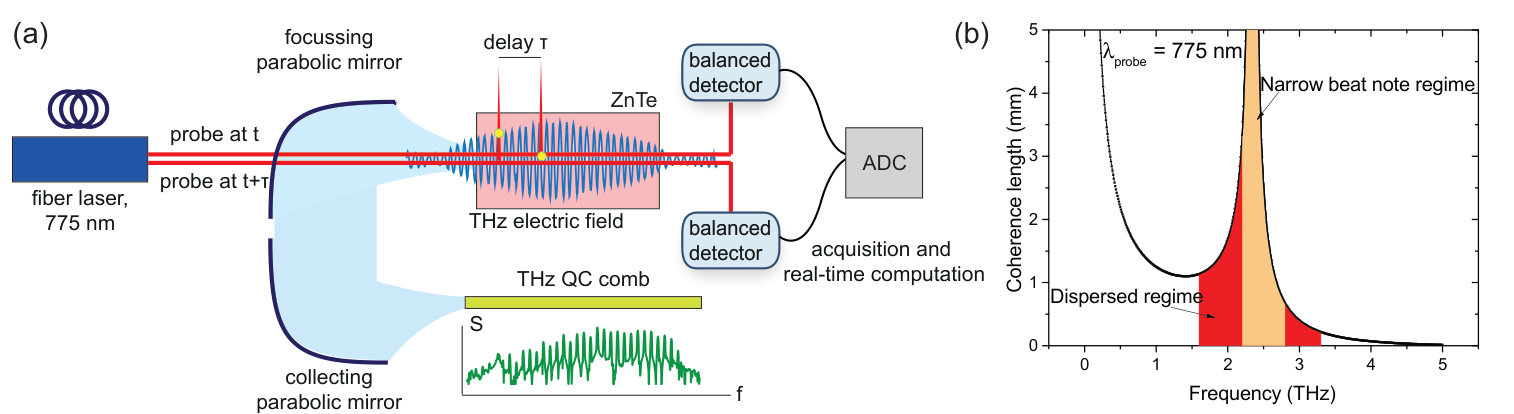 Figure 1
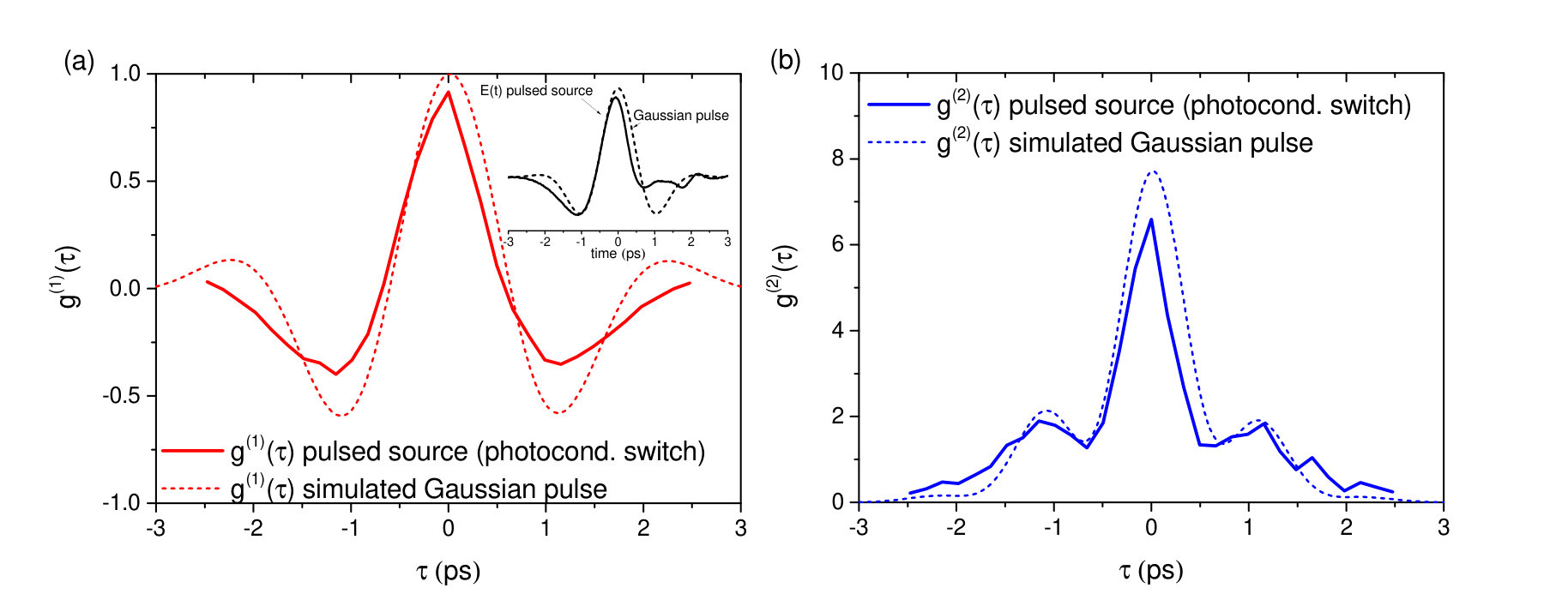 Figure 2
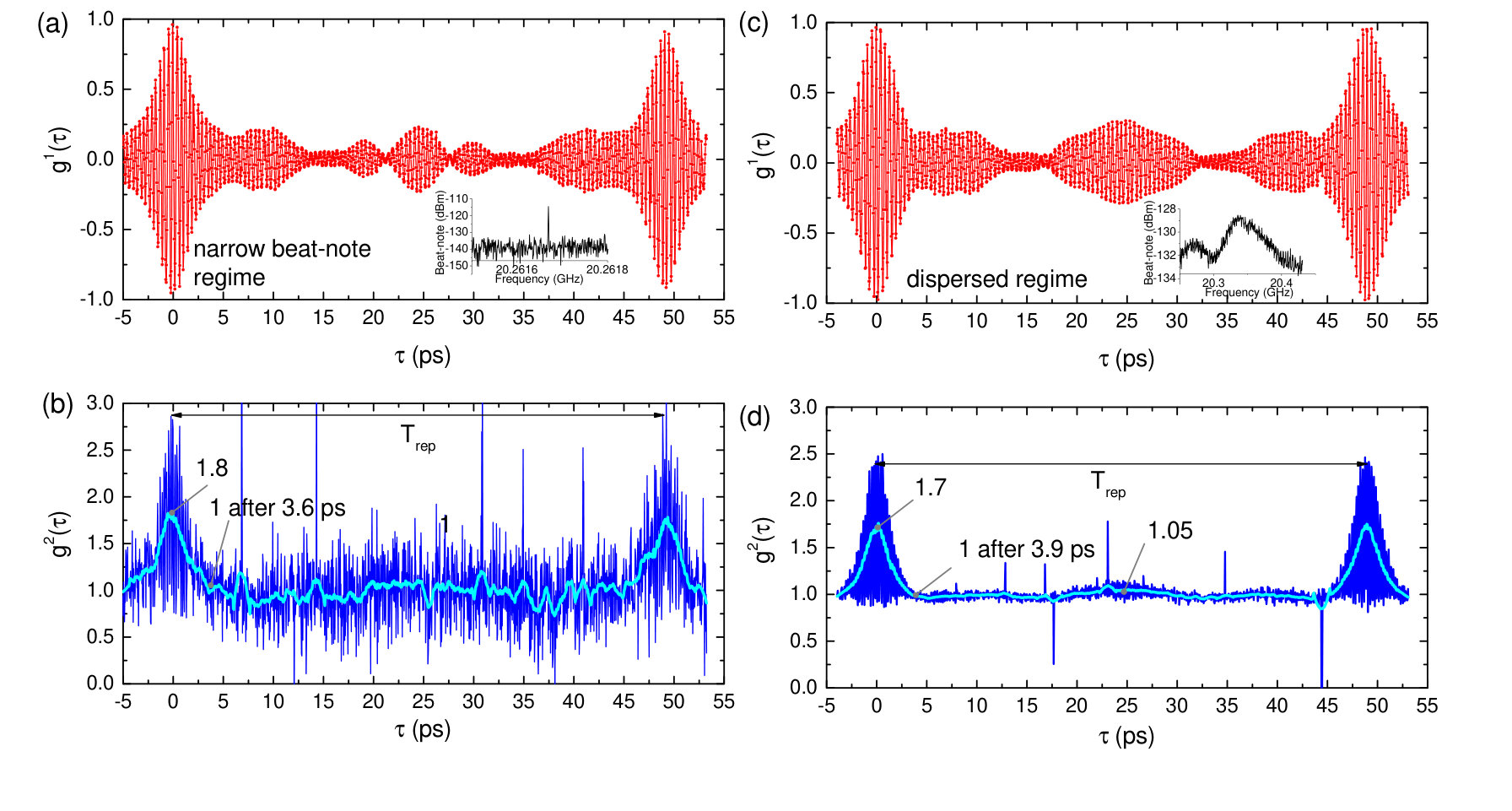 Figure 3
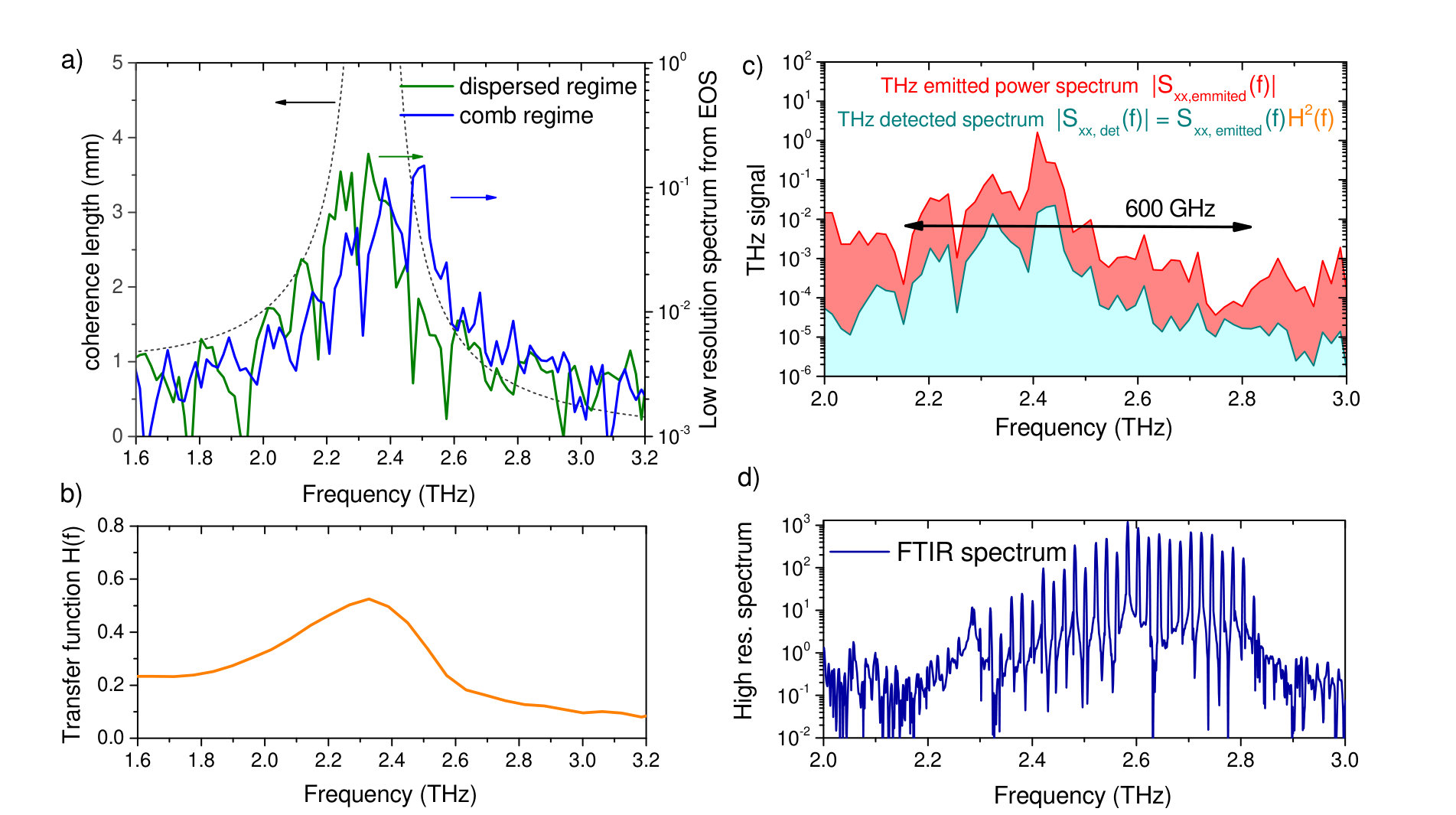 Figure 4
Peer Reviews
No public reviews on file for this paper yet. If you reviewed it on a platform where reviews are public (OpenReview, ICLR, NeurIPS, ICML), you can paste yours below so the community can read it here.
Videos
No videos yet. Explain this paper in a talk, walkthrough, or lecture? Add one.
Intensity autocorrelation measurements of quantum cascade laser frequency combs in the Terahertz range
Ileana-Cristina Benea-Chelmus
Markus Rösch
Giacomo Scalari
Mattias Beck
Jérôme Faist
ETH Zurich, Institute of Quantum Electronics, Auguste-Piccard-Hof 1, Zurich 8093, Switzerland [
Abstract
We report on the first direct measurement of the emission character of quantum cascade laser based frequency combs, using intensity autocorrelation. The correlation technique is based on fast electro-optic sampling, with a bandwidth optimized to match the emission spectra of the comb laser, centered around 2.5 THz. We find the output light to be amplitude and frequency modulated at the same time, with intensity modulation depth as high as 90%, occuring on timescales as short as few picoseconds. We compare these findings with intensity autocorrelation measurements of pulsed Terahertz light originating from a photoconductive antenna and find very different results. We observe no significant difference for the comb and dispersed regime. The technique will be of significant importance in future for the measurement of ultra-short pulses from quantum cascade lasers.
pacs:
I Introduction
Frequency combs Delhaye:2007p1571 are sources of electromagnetic radiation, which have the intriguing property that their frequency components are equidistantly placed in frequency domain. This property qualifies them as highly precise spectral rulers, a merit which has promoted their use for high-resolution metrology Udem:1999vw , in the telecommunication domain Pfeifle:2014cm , as well as for spectroscopy Holzwarth:2000p2058 ; Villares:2014gl ; Roesch2016Dual . The traditional way to realize frequency combs was from mode-locked lasers Udem:2002p2021 , and their output ideally represented a Fourier-limited train of pulses Cundiff:2003um . Nowadays, numerous alternative means have been demonstrated, with notable results based on phase-locked lasers in the optical and near infrared (NIR) domain Jones:2000p2050 , Kerr-effect in microresonators for the NIR Delhaye:2007p1571 and mid infrared (MIR) Griffith:2015gd ; Wang:2013db .
In the MIR Hugi:2012ep and the Terahertz (THz) region of the electromagnetic spectrum Rosch:2014ft ; Burghoff:2014hpa , up to date the most compact and efficient frequency combs are from electrically injected quantum cascade lasers (QCL) Faist2016 . They have been shown to produce high-power, high bandwidth frequency combs, with Shawlow-Townes limited spectral purity Bartalini:2010p1511 ; Cappelli2015 . The frequency comb is formed by Four Wave Mixing Khurgin:2014hy , a nonlinear process, where, in the frequency domain, the non-linear mixing of equidistant frequency components, is parametrically enhanced by energy conservation. In the time-domain, the underlying dynamics differ significantly from traditional frequency combs, being dominated by the very short upper state lifetime of intersubband transitions in comparison to the cavity roundtrip time Faist:2013td .
Recently reported theroretical work attests that passive pulse formation is not possible in QCL combs even in the case of zero dispersion, and that their output resembles the one of continueous wave lasers Khurgin:2014hy ; Villares:2015ho . Theoretically, the phase relation of the individual comb modes is fixed, but can have more realizations than the one required for Fourier-limited pulses. In the time-domain, this can result in full frequency modulation or a mixture between amplitude and frequency modulation. Experimentally, the only successful approaches to generate pulses from QCLs are indirect, based on injection seeding the active medium with picosecond short pulses from a photoconductive antenna Bachmann:16 ; Soibel:2004p1534 , or on active mode-locking Barbieri:2011p1986 . In these particular cases, the emitted terahertz light is phase-locked to a reference femtosecond oscillator, and its output profile could be measured by coherent electro-optic sampling Kroell:2007p211 ; Oustinov2010 . For the case of free-running QC combs, coherent electr-optic sampling is not feasible and the method of choice for the characterization of their peculiar properties has long been beat-note analysis on a sufficiently fast detector, in the absence of intensity autocorrelation techniques at Terahertz frequencies Burghoff:2015jf .
In conventional NIR frequency combs, the coherence properties are routinely assessed by intensity autocorrelation, which is based on second harmonic generation of the lightwave with a delayed replica using a medium Armstrong1967 ; Hirayama2002 . A simmilar technique would be of great help for the characterization of combs in the Terahertz range, however, any nonlinear scheme is suited in particular for the characterization of high peak power pulsed radiation, since the signal is scaling like . So far, Quantum cascade laser based frequency combs are expected to emmit continuously Burghoff:2015jf , and would have a weak non-linear signal because they are diluted in time. In addition, the THz frequency range has long been completely lacking such tool to measure intensity autocorrelations. Recently, a novel technique has been reported to measure electric field and intensity correlations at THz frequencies by electro-optic sampling with a very short temporal resolution of 146 fs Benea-Chelmus2016 . This technique is optimally suited for the investigation of long- and short-scale correlations of QCL based frequency combs, since the temporal resolution of this technique is high enough to resolve temporal dynamics as fast as the gain recovery time, typically only few picoseconds Choi:2008p303 . In addition, even cavity roundtrip times of such lasers are as short as few tens of picoseconds, and correspond to cavity lengths of few millimiters.
In the present work, we exploit autocorrelation to get insight into the ouput dynamics of THz QCL frequency combs. Several devices have been tested and show qualitatively similar behaviour. From them, one will be presented in the paper and another one can be found in the supplementary material. The laser is operating as a low-noise frequency comb at low input current where it spans the spectral range from 2.2-2.8 THz, and in the dispersed regime at high input current, where the emission is more broadband, reaching a maximum from 1.6-3.3 THz. The detailed performance and spectral characteristics of the investigated device have been reported in reference Rosch:2014ft ; Faist2016 . We compare the results with the emission profile of a pulsed frequency comb in the Terahertz based on optical rectification in a photoconductive antenna.
A schematics of the correlation measurement method is shown in figure 1 (a). The operation principle relies on the non-linear interaction (Pockels) between the THz wave and two mutually delayed () ultra-short near-infrared (NIR) probing pulses Benea-Chelmus2016 . They are in essence sampling the electric field of the THz wave at two distinct points in time (), with the associated measurement results denoted in the following and . A fast two-channel analog-to-digital converter is utilized to record in real-time the electric field value of each pair of pulses, and , at the speed of the repetition rate of the laser, in our case 90 MHz. From this single measurement, and subsequent averaging over the result of such single measurements, the instantaneous intensity is retrieved, as well as electric field and intensity autocorrelations. The instantaneous intensity of the THz light wave is retrieved digitally, by applying the intensity formula on the corresponding electric field values. The electric field and intensity correlations are time averages of products as and . They are retrieved by multiplying each pair of measurements and averaging over a big amount of sample pairs, which in the case of a free running source is equivalent to time-averaging over laboratory time-scales. Finally, we normalize these products are retieve the normalized autocorrelation functions, denoted and and defined as follows.
[TABLE]
[TABLE]
and represent averages over time.
A detailed description of the setup and measurement algorithm can be found in reference Benea-Chelmus2016 .
Each of these quantities will be utilized to infer complementary information about the operation mode of the comb lasers. The first order coherence function will give us, similarily like a Fourier Transform Infrared Spectrometer the power spectrum of emission, through the Wiener Khinchin theorem Vetterli2014 . The frequency resolution is determined by the temporal delay, which in our case is roughly 60 ps, corresponding to 17 GHz. The value at is , as is evident from the definition. The second order coherence function will be used to infer information about the output pattern of the laser, since it represents the normalized time-dependent autocorrelation of the intensity. The quantity is 1 when the intensity and are fully uncorrelated and can be factorized:
[TABLE]
More importantly for our analysis about the output profile of comb lasers, for classical radiation, the value of gives particular insight into the intensity modulation depth, since it can be rewritten as:
[TABLE]
where represents the variance of the intensity. From here, we define the amplitude modulation depth in the following way:
[TABLE]
The double beam technique is self-referenced. In comparison to coherent sampling, it brings the advantage that free-running sources can be investigated herewith. Also, even incoherent radiation which is otherwise averaged out by coherent sampling techniques, is measured together with the coherent part of the signal. All these essential properties make this technique perfectly suited for the investigation of temporal dynamics in THz comb lasers.
For enhanced sensitivity, we match the emission bandwidth of the laser with the detection bandwidth of the nonlinear effect by choosing a 3 mm long Zinc Telluride (ZnTe, (110)) crystal as detection medium. In this configuration, it exhibits a coherence window in the spectral region around 2.4 THz where the laser is operating, if combined with a probe central wavelength of 775 nm. In addition, the detection bandwidth is several hundrets of GHz. Figure 1 b represents the computed coherence length in this configuration, using , with marked spectral regions where the laser is emitting in the comb (2.2-2.8 THz) and dispersed regime (1.6-3.3 THz).
II Current-dependent correlations
We were interested in the dynamics of the QCL based laser comb when operated in the narrow-beatnote regime, at 906 mA, and dispersed regime, at 1010 mA. The QCL based frequency comb was operated in quasi continuous-wave (CW) mode with a very slow modulation frequency of 2.5 kHz. The CW output power of the laser at these two operating points was 1.05 mW and 2.96 mW, respectively, as measured with a Thomas Keithling power meter.
The laser is 2 mm long and 150 m wide, corresponding to a repetition rate of 20.3 GHz. The cavity of the laser is constituted of a double metal cavity for good temperature and dispersion performance and cryocooled to 23 K. The beat-notes of the comb lasers were measured when operated in continuous wave.
The measured first and second order coherence functions are reported in figure 2 as a function of time delay , which covers more than the full round-trip time of the laser cavity, 49.5 ps. The electric field interferogram , is reported at the two operation points in figure 2(a)&(c), and exhibits a repetition period of 49.5 ps, corresponding to the expected repetition rate of 20.3 GHz. At , at both operating points, approximating well the theoretically expected value of 1.
The intensity autocorrelation is reported in figure 2(b)&(d). As elaborated in the introduction, the rather unusual property of electro-optic correlations is the temporal resolution, meaning that we resolve the instantaneous intensity of the laser. The intensity autocorrelation is therefore also periodic, with a characteristic frequency of double the emission frequency. In principle, correlated intensity fluctuations occuring at sub-cycle timescales can be seen in this way. To retrieve long-range behaviour, we performed a running average filtering (window width of 1.66 ps) to filter out these oscillations, and the result is reported by the cyan-colored line. In the comb regime, the intensity autocorrelation function takes a value of 1.8 at . Using the above formula, this suggests that , and consequently, that the intensity modulation depth as defined presviously is roughly 90%. In addition, decreases to a value of 1 after roughly 3.6 ps, showing that correlated intensity modulations take place on timescales as short as 3.9 ps. At longer time-scales, the intensity autocorrelation function is roughly constant to 1, which suggests the peculiar continuous wave-like output. Clearly, in this case, even if the field is coherent, suggested by the interference fringes, the intensity itself has no predetermined correlations. These characteristics can therefore be sumed-up to the conclusion that the laser is both frequency and amplitude modulated. In the dispersed regime, decreases to 1 after 3.9 ps, and decays from a value of 1.7 at . Similarly, this suggests that , and consequently, that the intensity modulation depth is roughly 83%. In addition, this intensity modulation takes place on longer timescales, 3.9 ps. Also in the dispersed regime, the laser is both frequency and amplitude modulated, with slightly smaller modulation depth on faster timescales.
We investigated a second laser, 2.2 mm long, which was also operating in the comb and dispersed regime. We found qualitatively very simmilar results, namely a continuous wave like output with intensity correlations on fast timescales. This stands in high contrast to results that are to be obtained from pulsed sources, which we will discuss in the last section of this paper. The results are presented in the supplementary material.
III Bandwidth of detection
Our technique is spectrally resolving, and gives access also to the spectral information. The direct measurement of electric field auto-correlation has been Fourier-transformed to retrieve the low resolution spectrum of the THz source. The results are reported in figure 3 a, for the comb and dispersed regime, together with the coherence properties of ZnTe. The emission spectra are significantly different in the two regimes. The low-current spectra reveals a spectral bandwidth of roughly 600 GHz centered around 2.6 THz. However, the spectral response function of ZnTe, here denoted , is not flat over the full bandwidth of interest, and therefore, the measured signal is a convolution of the real laser emission and the detection sensitivity of the ZnTe crystal:
[TABLE]
The transfer function of a 3 mm long ZnTe crystal is reported in figure 3b, as measured with standard time domain spectroscopy from comparison with a very thin crystal (200 m), where a flat response was assumed. It includes both the effects of coherence and of THz absorption in ZnTe, which is particularily strong in this region due to phonon resonances. The transfer function is further used to retrieve the power spectrum of the THz source, as reported in figure 3c:
[TABLE]
Finally, we compare the low resolution spectra as obtained by electro-optic sampling with the high-resolution Fourier Transform Infrared Spectroscopy setup. We find qualitatively good agreement.
IV Intensity correlations of pulsed light
We have demonstrated so far, that THz quantum cascade laser based frequency combs are both amplitude and frequency modulated, and have an output simmilar to continuous wave sources. This peculiar properties remain in big contrast to conventional frequency combs, where the emission is typically pulsed. Such pulsed sources have been realized in the Terahertz domain by optical rectification of femtosecond pulses in media.
In the following, we will show that intensity autocorrelation results from pulsed sources are quantitatively very different from results obtained from quantum cascade laser frequency combs. With this goal, we measure the field and intensity autocorrelation functions of the pulsed THz radiation emitted by a photoconductive emitter, by optical rectification of femtosecond laser pulses at 775 nm. The results are shown in figure 4, together with analytical simulations, which assume a simplified scenario of a THz pulse with Gaussian spectrum, no dispersion and a spectral width roughly coinciding with the one of the photoconductive emitter. This simplified example is instructive enough to reproduce the main characteristics.
The electric field of the emission has been measured by coherent electro-optic sampling and is shown in the inset in figure 4a. The autocorrelation functions have been measured by the two beam technique utilized also for the laser comb. They are measured for a time delay as long as the main temporal extent of pulse, roughly 6 ps. The first order coherence function has a symmetric shape around , as expected. The most instructive characteristic is however in the shape and peak value of the second order coherence function . It decays to a value of 0 after roughly 2.5 ps, which suggests the pulsed character of the emission. This is in strong contrast to the emission of quantum cascade laser combs, where the continuous wave-like output results in a which decays to 1. Moreover, at zero path delay is 6.59, when normalized to the average intensity in a time window of 13 ps. From this, we conclude, that in this time window, the intensity modulation depth is 242%, considerably bigger than the value retrieved for mixed frequency and amplitude modulated combs. For completeness, these results can be also compared to measurements of single mode lasers, where is 1, and therefore the intensity modulation depth is 0%. Such results can be found in reference Benea-Chelmus2016 .
V Discussion and conclusion
We have demonstrated the first direct measurement of intensity correlations of a quantum cascade laser based frequency comb, and compared these results to mode-locked THz combs generated by optical rectification in a photoconductive emitter. We found that the laser is both amplitude and frequency modulated with a modulation depth of 90% in the comb regime and 83% in the dispersed regime. Moreover, the continuous-wave like output of the laser shows up in the intensity autocorrelation which decays to 1, in contrast to pulsed sources where it decays to 0.
For this purpose, we utilized a technique which has a temporal resolution of 146 fs, only a fraction of one period of light, and is in addition sensitive to any incoherent components in the lightwave through its selfreferencing character. All these characteristics render the technique unique in its features.
Having the possibility to fastly assess the emission profile of free-running lasers, is an important technological milestone. In future, inherently frequency modulated combs based on quantum cascade lasers, could be transformed into amplitude modulated combs by use of an exernal spatial light modulator which is dynamically shifting the phases which are stable, but do not fulfill the mutual condition for Fourier limited pulses. Our technique will be here of big importance to minimize in real-time the temporal extent and provide feedback to the actuating modulator.
More generally, the technique is perfectly suited to measure flutuations faster than one oscillation period, thus sub-cycle. This allows for many more fundamental experiments to be envisaged.
Funding Information
The authors would like to acknowledge funding from the ERC (Advanced Grant, ‘Quantum Metamaterials in the Ultra Strong Coupling Regime’).
Acknowledgments
We acknowledge the insightful comments of Christopher Bonzon on the data and his expertise with cryogenic measurements. We also acknowledge the work of the mechanical workshop at ETHZ. The sample growth and processing took place in the clean room facility of ETHZ, FIRST center.
Supplemental Documents
See Supplement 1 for supporting content.
The reference list from the paper itself. Each links out to its DOI / PubMed record.
- 1(1) P. Del’Haye, A. Schliesser, O. Arcizet, T. Wilken, R. Holzwarth, and T. J. Kippenberg, “Optical frequency comb generation from a monolithic microresonator,” Nature 450 , 1214–1217 (2007).
- 2(2) T. Udem, J. Reichert, R. Holzwarth, and T. W. Hänsch, “Absolute optical frequency measurement of the cesium D 1 line with a mode-locked laser,” Physical Review Letters 82 , 3568 (1999).
- 3(3) J. Pfeifle, V. Brasch, M. Lauermann, Y. Yu, D. Wegner, T. Herr, K. Hartinger, P. Schindler, J. Li, D. Hillerkuss, R. Schmogrow, C. Weimann, R. Holzwarth, W. Freude, J. Leuthold, T. J. Kippenberg, and C. Koos, “Coherent terabit communications withmicroresonator Kerr frequency combs,” pp. 1–6 (2014).
- 4(4) R. Holzwarth, T. Udem, T. Hansch, J. Knight, W. Wadsworth, and P. Russell, “Optical frequency synthesizer for precision spectroscopy,” Physical Review Letters 85 , 2264–2267 (2000).
- 5(5) G. Villares, A. Hugi, S. Blaser, and J. Faist, “Dual-comb spectroscopy based on quantum-cascade-laser frequency combs,” Nature Communications 5 , 1–9 (2014).
- 6(6) M. Rösch, G. Scalari, G. Villares, L. Bosco, M. Beck, and J. Faist, “On-chip, self-detected terahertz dual-comb source,” Applied Physics Letters 108 , 171104 (2016).
- 7(7) T. Udem, R. Holzwarth, and T. Hansch, “Optical frequency metrology,” Nature 416 , 233–237 (2002).
- 8(8) S. T. Cundiff and J. Ye, “Colloquium: Femtosecond optical frequency combs,” Reviews Of Modern Physics 75 , 325–342 (2003).