Quartified Leptonic Color, Bound States, and Future Electron-Positron Collider
Corey Kownacki, Ernest Ma, Nicholas Pollard, Oleg Popov, and, Mohammadreza Zakeri

TL;DR
This paper discusses a theoretical model predicting new leptonic bound states called hemionium, which could be detected as sharp resonances at future electron-positron colliders, expanding our understanding of leptonic color confinement.
Contribution
It explores the phenomenology of quartified leptonic color and predicts observable hemionium resonances at future colliders, extending previous models with potential experimental signatures.
Findings
Hemionium states are expected as sharp resonances.
Leptonic color $SU(2)$ becomes strong at keV scale.
Bound states of hemions are challenging to detect at LHC.
Abstract
The quartification model of Babu, Ma, and Willenbrock (BMW), proposed in 2003, predicts a confining leptonic color gauge symmetry, which becomes strong at the keV scale. It also predicts the existence of three families of half-charged leptons (hemions) below the TeV scale. These hemions are confined to form bound states which are not so easy to discover at the Large Hadron Collider (LHC). However, just as and appeared as sharp resonances in colliders of the 20th century, the corresponding 'hemionium' states are expected at a future collider of the 21st century.
Click any figure to enlarge with its caption.
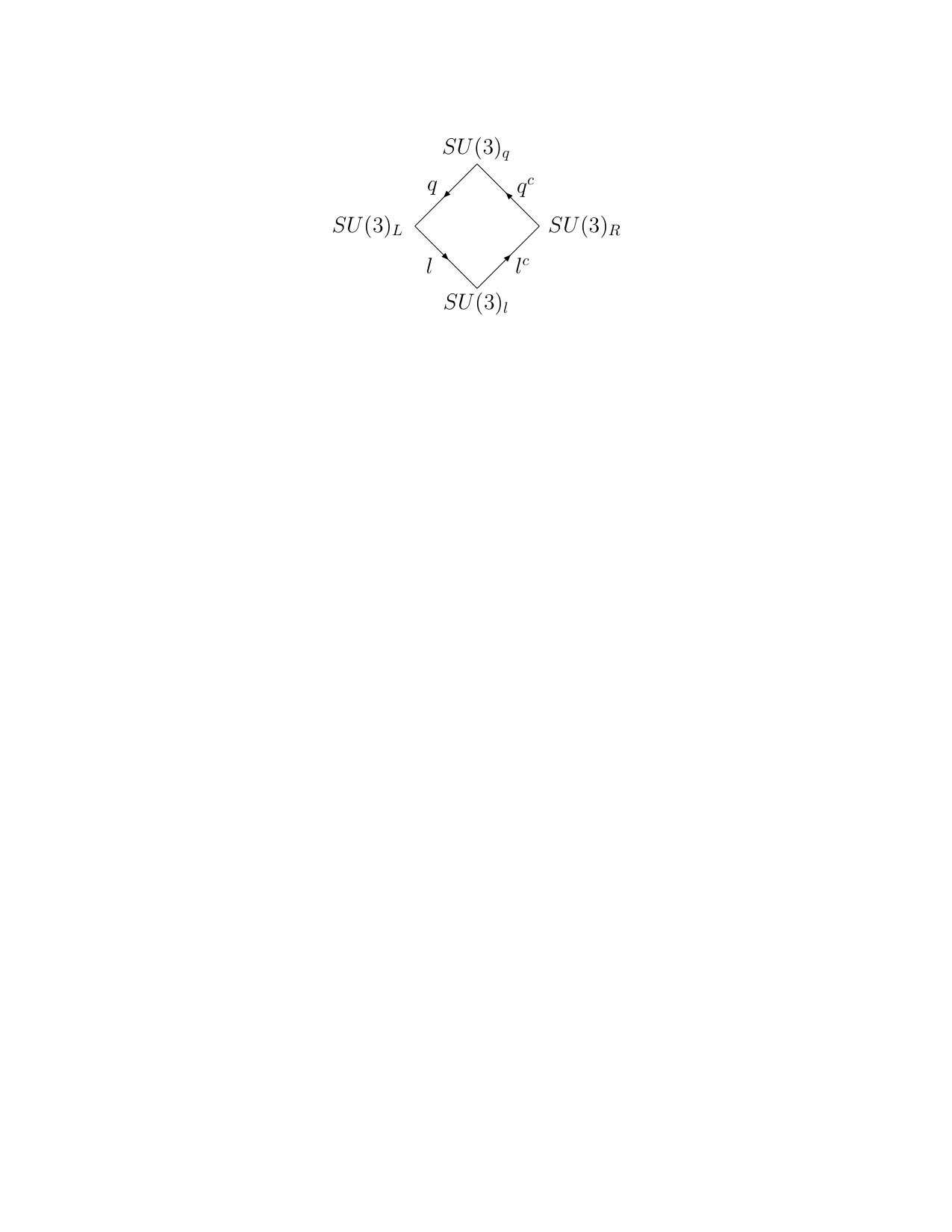 Figure 1
| particles | ||||
| 3 | 1 | 2 | 1/6 | |
| 1 | 1 | 2/3 | ||
| 1 | 1 | |||
| 1 | 2 | 2 | 0 | |
| 1 | 2 | 1 | 1/2 | |
| 1 | 2 | 1 | ||
| 1 | 1 | 2 | ||
| 1 | 1 | 1 | 0 | |
| 1 | 1 | 1 | ||
| 1 | 1 | 2 |
| Channel | Width (A) | Width (B) |
|---|---|---|
| 11 eV | 123 eV | |
| 43 eV | 69 eV | |
| 43 eV | 69 eV | |
| 43 eV | 69 eV | |
| 50 eV | 175 eV | |
| 50 eV | 175 eV | |
| 10 eV | 147 eV | |
| 10 eV | 147 eV | |
| 10 eV | 147 eV | |
| 3.2 eV | 190 eV | |
| 0.02 eV | 2.5 eV | |
| 4.5 eV | 4.5 eV | |
| 1.1 eV | 1.1 eV | |
| sum | 279 eV | 1319 eV |
Peer Reviews
No public reviews on file for this paper yet. If you reviewed it on a platform where reviews are public (OpenReview, ICLR, NeurIPS, ICML), you can paste yours below so the community can read it here.
Videos
No videos yet. Explain this paper in a talk, walkthrough, or lecture? Add one.
UCRHEP-T574
January 2017
**Quartified Leptonic Color, Bound States,
and Future Electron-Positron Collider
**
**Corey Kownacki, Ernest Ma, Nicholas Pollard, Oleg Popov, and Mohammadreza Zakeri
**
Physics and Astronomy Department,
University of California, Riverside, California 92521, USA
Abstract
The quartification model of Babu, Ma, and Willenbrock (BMW), proposed in 2003, predicts a confining leptonic color gauge symmetry, which becomes strong at the keV scale. It also predicts the existence of three families of half-charged leptons (hemions) below the TeV scale. These hemions are confined to form bound states which are not so easy to discover at the Large Hadron Collider (LHC). However, just as and appeared as sharp resonances in colliders of the 20th centrury, the corresponding ’hemionium’ states are expected at a future collider of the 21st century.
Introduction* : Fundamental matter consists of quarks and leptons, but why are they so different? Both interact through the electroweak gauge bosons and the photon , but only quarks interact through the strong force as mediated by the gluons of the unbroken (and confining) color gauge symmetry, called quantum chromodynamics (QCD). Suppose this is only true of the effective low-energy theory. At high energy, there may in fact be three ’colors’ of leptons transforming as a triplet under a leptonic color gauge symmetry. Unlike QCD, only its subgroup remains exact, thus confining only two of the three ’colored’ leptons, called ’hemions’ in Ref. [1] because they have electric charges, leaving the third ones free as the known leptons.*
The notion of leptonic color was already discussed many years ago [2, 3], and its incorporation into appeared in Ref. [4], but without full unification. Its relevance today is threefold. (1) The quartification model [1] of Babu, Ma, and Willenbrock (BMW) is non-supersymmetric, and yet achieves gauge-coupling unification at GeV without endangering proton decay. This unification of gauge couplings is only possible if the three families of hemions have masses below the TeV scale. Given the absence of experimental evidence for supersymmetry at the Large Hadron Collider (LHC) to date, this alternative scenario deserves a closer look. (2) The quartification scale determines the common gauge coupling for the symmetry. Its extrapolation to low energy predicts that it becomes strong at the keV scale, in analogy to that of QCD becoming strong at somewhat below the GeV scale. This may alter the thermal history of the Universe and allows the formation of gauge-boson bound states, the lightest of which is a potential warm dark-matter candidate [5]. (3) The hemions (called ’liptons’ previously [3]) have electric charges and are confined to form bound states by the ’stickons’ in analogy to quarks forming hadrons through the gluons. They have been considered previously [6] as technifermions responsible for electroweak symmetry breaking. Their electroweak production at the LHC is possible [7] but the background is large. However, in a future collider (ILC, CEPC, FCC-ee), neutral vector resonances of their bound states (hemionia) would easily appear, in analogy to the observations of quarkonia (, ) at past colliders.
The BMW model* : Under the quartification gauge symmetry, quarks and leptons transform as in a moose chain linking to to to back to as depicted in Fig. 1.*
Specifically,
[TABLE]
Below the TeV energy scale, the gauge symmetry is reduced **[1]** to with the particle content given in Table 1.
The electric charge is given by as usual. The exotic doublets have charges, hence the name hemions. Whereas the quarks and charged leptons must obtain masses through electroweak symmetry breaking, the hemions have invariant mass terms, i.e. and . This is important because they are then allowed to be heavy without disturbing the electroweak oblique parameters which are highly constrained experimentally. In the following, the mass terms from electroweak symmetry breaking, i.e. and , will be assumed negligible.
Gauge coupling unification and the leptonic color confinement scale* : The renormalization-group evolution of the gauge couplings is dictated at leading order by*
[TABLE]
where are the one-loop beta-function coefficients,
[TABLE]
The number of families is set to three, and the number of Higgs doublets is set to two, as in the original BMW model. Here we make a small adjustment by separating the three hemion families into two light ones at the electroweak scale and one at a somewhat higher scale . We then input the values **[8]**
[TABLE]
where has been normalized by a factor of 2 (and by a factor of 1/2) to conform to quartification. We find
[TABLE]
We then use to extrapolate back to and obtain . Below the electroweak scale, the evolution of comes only from the stickons and it becomes strong at about 1 keV. Hence ’stickballs’ are expected at this confinement mass scale. Unlike QCD where glueballs are heavier than the mesons so that they decay quickly, the stickballs are so light that they could decay only to lighter stickballs or to photon pairs through their interactions with hemions.
Thermal history of stickons* : At temperatures above the electroweak symmetry scale, the hemions are active and the stickons () are in thermal equilibrium with the standard-model particles. Below the hemion mass scale, the stickon interacts with photons through scattering with a cross section*
[TABLE]
The decoupling temperature of is then obtained by matching the Hubble expansion rate
[TABLE]
to . Hence
[TABLE]
where . For GeV and which includes all particles with masses up to a few GeV, GeV. Hence the contribution of stickons to the effective number of neutrinos at the time of big bang nucleosynthesis (BBN) is given by **[9]**
[TABLE]
compared to the value from a recent analysis **[10]**. The most recent PLANCK measurement **[11]** coming from the cosmic microwave background (CMB) is
[TABLE]
However, at the time of photon decoupling, the stickons have disappeared, hence as in the SM. This is discussed in more detail below.
Formation and decay of stickballs* : As the Universe further cools below a few keV, leptonic color goes through a phase transition and stickballs are formed. If the lightest stickball is stable, it may be a candidate for warm dark matter. It has strong self-interactions and the process determines its relic abundance. Following Ref. [12] and using Ref. [5], we estimate that it is overproduced by a factor of about 3. However, is not absolutely stable. It is allowed to mix with a scalar bound state of two hemions which would decay to two photons. We assume this mixing to be , so that its decay rate is given by*
[TABLE]
where is now defined by . Setting keV to be above the astrophysical bound of 4 keV from Lyman forest observations **[13]** and GeV, its lifetime is estimated to be for . This is exactly the age of the Universe, and it appears that may be a candidate for dark matter after all. However, CMB measurements constrain **[14]** a would-be dark-matter lifetime to be greater than about , and -ray line measurements in this mass range constrain **[15]** it to be greater than , so this scenario is ruled out. On the other hand, if keV, then the lifetime is , which translates to a fraction of of the initial abundance of to remain at the present Universe. Compared to the upper bound of for a lifetime of given in Ref. **[14]**, this is easily satisfied, even though is overproduced at the leptonic color phase transition by a factor of 3.
At the time of photon decoupling, the sector contributes no additional relativistic degrees of freedom, hence remains the same as in the SM, i.e. 3.046, coming only from neutrinos. In this scenario, is not dark matter. However, there are many neutral scalars and fermions in the BMW model which are not being considered here. They are naturally very heavy, but some may be light enough and stable, and be suitable as dark matter.
Revelation of leptonic color at future colliders* : Unlike quarks, all hemions are heavy. Hence the lightest bound state is likely to be at least 200 GeV. Its cross section through electroweak production at the LHC is probably too small for it to be discovered. On the other hand, in analogy to the observations of and at colliders of the last century, the resonance production of the corresponding neutral vector bound states (hemionia) of these hemions is expected at a future collider (ILC, CEPC, FCC-ee) with sufficient reach in total center-of-mass energy. Their decays will be distinguishable from heavy quarkonia (such as toponia) experimentally.*
The formation of hemion bound states is analogous to that of QCD. Instead of one-gluon exchange, the Coulomb potential binding a hemion-antihemion pair comes from one-stickon exchange. The difference is just the change in an SU(3) color factor of 4/3 to an SU(2) color factor of 3/4. The Bohr radius is then , and the effective is defined by
[TABLE]
Using Eqs. (3) and (5), and with GeV, we obtain and GeV. Consider the lowest-energy vector bound state of the lightest hemion of mass GeV. In analogy to the hydrogen atom, its binding energy is given by
[TABLE]
and its wavefunction at the origin is
[TABLE]
Since will appear as a narrow resonance at a future collider, its observation depends on the integrated cross section over the energy range around :
[TABLE]
where is the total decay width of , and , are the respective partial widths.
Since is a vector meson, it couples to both the photon and boson through its constituent hemions. Hence it will decay to , , , and . Using
[TABLE]
the decay rate is given by
[TABLE]
where
[TABLE]
In the above, is assumed to be composed of the singlet hemions and with invariant mass term (case A). Hence eV. If comes instead from and with invariant mass term (case B), then the factor in and is replaced with and eV. Similar expressions hold for the other fermions of the Standard Model (SM).
For , the triple and vertices have the same structure. The decay rate is calculated to be
[TABLE]
where and
[TABLE]
in case A. Because of the accidental cancellation of the two terms in the above, turns out to be very small. Hence eV. In addition to the channel decay of to through and , there is also a channel electroweak contribution in case B because and form an electroweak doublet. Replacing with in , and adding this contribution, we obtain
[TABLE]
where
[TABLE]
Thus a much larger eV is obtained. For , there is only the channel contribution, i.e.
[TABLE]
where and in case A, with replaced by in case B. Hence is negligible in case A and only 2.5 eV in case B.
The decay to two stickons is forbidden by charge conjugation. Its decay to three stickons is analogous to that of quarkonium to three gluons. Whereas the latter forms a singlet which is symmetric in , the former forms a singlet which is antisymmetric in . However, the two amplitudes are identical because the latter is symmetrized with respect to the exchange of the three gluons and the former is antisymmetrized with respect to the exchange of the three stickons. Taking into account the different color factors of versus , the decay rate of to three stickons and to two stickons plus a photon are given by
[TABLE]
Hence eV and eV. The integrated cross section of Eq. (21) for is then cm2-keV in case A and cm2-keV in case B. For comparison, this number is cm2-keV for the . At a high-luminosity collider, it should be feasible to make this observation. Table 2 summarizes all the partial decay widths.
Discussion and outlook* : There are important differences between QCD and QHD (quantum hemiodynamics). In the former, because of the existence of light and quarks, it is easy to pop up and pairs from the QCD vacuum. Hence the production of open charm in an collider is described well by the fundamental process . In the latter, there are no light hemions. Instead it is easy to pop up the light stickballs from the QHD vacuum. As a result, just above the threshold of making the resonance, the many-body production of + stickballs becomes possible. This cross section is presumably also well described by the fundamental process . In case A, the cross section is given by*
[TABLE]
where and is the square of the center-of-mass energy. In case B, it is
[TABLE]
Using GeV and as an example, we find these cross sections to be 0.79 and 0.44 pb respectively.
In QCD, there are bound states which are bosons, and bound states which are fermions. In QHD, there are only bound-state bosons, because the confining symmetry is . Also, unlike baryon (or quark) number in QCD, there is no such thing as hemion number in QHD, because is effectively . This explains why there are no stable analog fermion in QHD such as the proton in QCD.
The SM Higgs boson couples to the hemions, but these Yukawa couplings could be small, because hemions have invariant masses themselves as already explained. So far we have assumed these couplings to be negligible. If not, then may decay to two photons and two stickons through a loop of hemions. This may show up in precision Higgs studies as a deviation of from the SM prediction. It will also imply a partial invisible width of proportional to this deviation. Neither would be large effects and that is perfectly consistent with present data.
The absence of observations of new physics at the LHC is a possible indication that fundamental new physics may not be accessible using the strong interaction, i.e. quarks and gluons. It is then natural to think about future colliders. But is there some fundamental issue of theoretical physics which may only reveal itself there? and not at hadron colliders? The BMW model is one possible answer. It assumes a quartification symmetry based on . It has gauge-coupling unification without supersymmetry, but requires the existence of new half-charged fermions (hemions) under a confining leptonic color symmetry, with masses below the TeV scale. It also predicts the confining scale to be keV, so that stickball bound states of the vector gauge stickons are formed. These new particles have no QCD interactions, but hemions have electroweak couplings, so they are accessible in a future collider, as described in this paper.
Acknowledgement* : This work was supported in part by the U. S. Department of Energy Grant No. DE-SC0008541.*
The reference list from the paper itself. Each links out to its DOI / PubMed record.
- 1[1] K. S. Babu, E. Ma, and S. Willenbrock, Phys. Rev. D 69 , 051301(R) (2004).
- 2[2] R. Foot and H. Lew, Phys. Rev. D 41 , 3502 (1990).
- 3[3] R. Foot, H. Lew, and R. R. Volkas, Phys. Rev. D 44 , 1531 (1991).
- 4[4] G. C. Joshi and R. R. Volkas, Phys. Rev. D 45 , 1711 (1992).
- 5[5] A. Soni and Y. Zhang, Phys. Rev. D 93 , 115025 (2016).
- 6[6] R. Foot, H. Lew, and R. R. Volkas, Phys. Rev. D 42 , 1851 (1991).
- 7[7] J. D. Clarke, R. Foot, and R. R. Volkas, Phys. Rev. D 85 , 074012 (2012).
- 8[8] C. Patrignani et al. (Particle Data Group), Chin. Phys. C 40 , 100001 (2016).