Probing sub-GeV dark sectors via high energy proton beams at LBNF/DUNE and MiniBooNE
Claudia Frugiuele

TL;DR
This paper investigates how high-energy proton fixed target experiments like LBNF and MiniBooNE can detect sub-GeV dark sectors, especially leptophobic dark forces, by analyzing off-axis detector sensitivities and existing data.
Contribution
It demonstrates MiniBooNE's potential to explore new parameter space for leptophobic dark forces in the 1 MeV to 10 GeV mass range using existing and future data.
Findings
MiniBooNE can probe new regions of leptophobic dark force parameter space.
Existing MiniBooNE data already constrains certain dark sector models.
A dedicated beam dump run would significantly enhance sensitivity to lighter dark sector particles.
Abstract
We study the sensitivity to sub-GeV dark sectors of high energy ( GeV) proton fixed target experiments such as the Main Injector and the future Long-Baseline Neutrino Facility (LBNF). We focus on off-axis detectors since they have been shown to be the ideal location to reduce the neutrino background. We consider MiniBooNE as an off-axis detector for the NuMI facility and a hypotetical detector for LBNF located 200 m away from the target and 6.5 degrees off-axis. We find that with the existing data, MiniBoone can explore new regions of the parameter space for leptophobic dark forces in the 100 MeV- few GeV mass range. The dedicated MiniBooNE run in beam dump mode would further improve the reach for even lighter masses. Therefore, MiniBooNE has the potential to be one of the most sensitive probe of leptophobic dark forces for masses between 1 MeV-10 GeV.
Click any figure to enlarge with its caption.
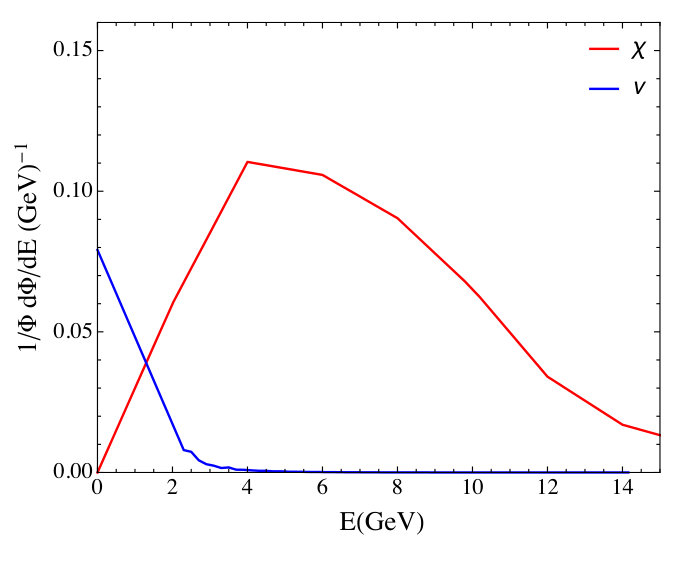 Figure 1
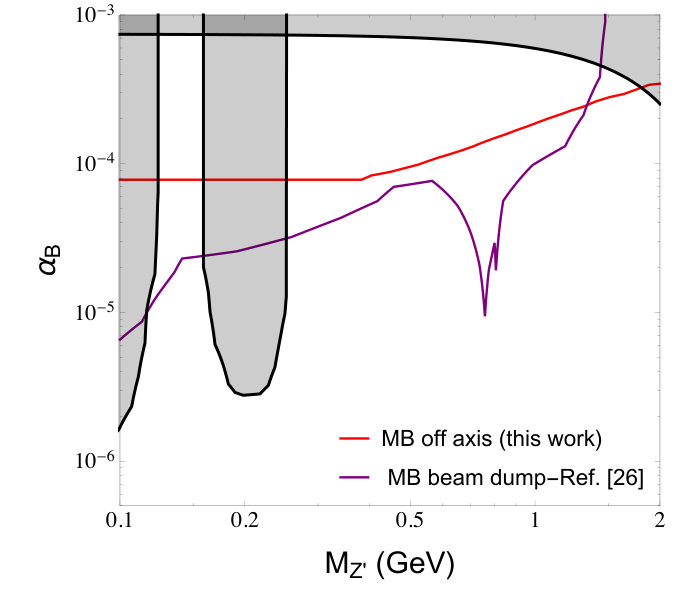 Figure 2
Peer Reviews
No public reviews on file for this paper yet. If you reviewed it on a platform where reviews are public (OpenReview, ICLR, NeurIPS, ICML), you can paste yours below so the community can read it here.
Videos
No videos yet. Explain this paper in a talk, walkthrough, or lecture? Add one.
Probing sub-GeV dark sectors via high energy proton beams at LBNF/DUNE and MiniBooNE
**Claudia Frugiuele **
Department of Particle Physics and Astrophysics, Weizmann Institute of Science, Rehovot, Israel
Abstract
We study the sensitivity to sub-GeV dark sectors of high energy ( GeV) proton fixed target experiments such as the Main Injector and the future Long-Baseline Neutrino Facility (LBNF). We focus on off-axis detectors since they have been shown to be the ideal location to reduce the neutrino background. We consider MiniBooNE as an off-axis detector for the NuMI facility and a hypotetical detector for LBNF located 200 m away from the target and 6.5 degrees off-axis. We find that with the existing data, MiniBoone can explore new regions of the parameter space for leptophobic dark forces in the 100 MeV- few GeV mass range. The dedicated MiniBooNE run in beam dump mode would further improve the reach for even lighter masses. Therefore, MiniBooNE has the potential to be one of the most sensitive probe of leptophobic dark forces for masses between 1 MeV-10 GeV.
Introduction
The existence of dark matter (DM) is one of the most solid pieces of evidence for physics beyond the Standard Model (SM). We do not, however, know DM properties or if it interacts with the SM through other forces beyond gravity. Therefore, it is essential to keep an open attitude towards its investigation both from an experimental and a theoretical point of view. In the past decade a solid experimental program for DM searches has been carried out on different levels without finding any positive signal. In particular direct detection experiments Cushman:2013zza investigated the GeV-TeV scale setting impressive bounds on the quark-DM coupling. Furthermore, the LHC is playing an important role inspecting this region of the parameter space through monojet searches Goodman:2010yf ; Goodman:2010ku ; Bai:2010hh ; Fox:2011pm ; Aaltonen:2012jb ; Khachatryan:2014rra . Both high energy colliders and direct detection experiments lose sensitivity for sub-GeV DM mass. Therefore, the question of how to look for light DM is a pressing one.
Low energy experiments can help close this experimental loophole and a lot of effort has recently been spent studying their sensitivity Reece:2009un ; Bjorken:2009mm ; Essig:2010xa ; Essig:2010gu ; Izaguirre:2013uxa ; Morrissey:2014yma ; Izaguirre:2014dua ; Kahn:2014sra ; Gardner:2015wea ; Alekhin:2015byh ; Batell:2009di ; deNiverville:2011it ; deNiverville:2012ij ; Dharmapalan:2012xp ; Batell:2014yra ; Soper:2014ska ; Dobrescu:2014ita ; Coloma:2015pih . In particular, neutrino fixed target experiments offer a way to probe light DM/quark couplings Batell:2009di ; deNiverville:2011it ; deNiverville:2012ij ; Dharmapalan:2012xp ; Batell:2014yra ; Soper:2014ska ; Dobrescu:2014ita ; Coloma:2015pih . These experiments, aiming to investigate neutrino masses and oscillations, consist of a high-intensity proton beam impinging on a target and thus producing a large number of neutrinos via leptonic meson decays. The produced neutrino beam is then studied via its interaction with electrons and nucleons both in a near detector, located near the target, and in a far detector, located hundreds of km away. The possibility of investigating light DM/quark interaction via this class of experiments is particularly interesting given the variety of present and future neutrino facilities. The idea, first proposed in Batell:2009di , goes as follows: if we assume that the dark sector consist of a DM particle and a light mediator which also interacts with quarks, a dark matter beam is produced along the aforementioned neutrino beam. As it happens for neutrinos, these dark particles will enter the near detector and scatter with the nucleons inside. This represents the positive and at the same time the negative side of this proposal: on one hand these experiments are accidentally designed to look also for DM signals, but on the other hand neutrinos represent a large background. The challenge of this program is then to suppress the neutrino background. In order to circumvent this problem, it was proposed in Ref. Dharmapalan:2012xp to have a dedicated run in proton beam dump mode for MiniBooNE detector, located at Fermilab 500m away from the target striked by 8 GeV proton from the Fermilab Booster, with the aim of suppressing the neutrino background and thus looking for light DM . This run is now complete and limits for the quark/DM mediator masses in MeV-GeV range will soon be available ( see wc for preliminary results). Higher energy proton beam ( GeV) experiments allow to probe heavier mediator masses. In this regard, Ref. Coloma:2015pih studied the projected sensitivity to few GeV mass mediators for Fermilab based experiments facilities such as the ones at the Fermilab Main Injector and the future Long-Baseline Neutrino Facility (LBNF) lbnf . This study pointed out the necessity of having an off-axis detector in order to efficiently suppress the neutrino background produced by high energy proton beams. In particular, an interesting finding is that MiniBooNE is in a perfect location as an off-axis detector for the NuMI beam. Therefore, MiniBooNE could not only explore the light dark matter region in the dedicated beam dump mode, but could also explore the few GeV region (2 GeV-8 GeV) using existing data from the Main Injector.
In this paper we investigate whether an off-axis detector could have sensitivity also to the sub-GeV region of the mediator masses. In particular, we want to compare the reach of MiniBooNE as the off axis detector for the NuMI beam with the one achievable by the dedicated run in beam dump mode. This means evaluating whether a dedicated run for light DM is necessary or if the DM program can run symbiotically to the neutrino program. Furthermore, our study provides the necessary information to assess and complete the physics case for possible future off-axis detectors for LBNF/DUNE. The paper is organized as follows: we first give a brief overview of the existing constraints on our benchmark model, a leptophobic , with a mass in the 100 MeV-2 GeV window, which decays into DM particles and then we explain how an off-axis detector could probe this region of parameter space. The production process considered for the is different from the one previously studied in the literature and the key idea is to produce DM particles from an uncollimated beam. After explaining this crucial point we proceed with showing the energy spectrum of DM versus the neutrino one and finally we show the sensitivity plot, where we will compare our projection to the existing constraints and to the projection for the MiniBooNE beam dump run.
Probing the quark/dark sector portal in the MeV-GeV region
As a benchmark model we consider a sub-GeV dark matter particle, either a scalar or a fermion, charged under a new abelian gauge group , that is:
[TABLE]
where is a Dirac fermion and is a complex scalar. The distinction between scalar or fermion is marginally relevant for our purpose, thus in the following we refer to the DM particle with the symbol . We further assume the quarks to be charged under (the simplest case is ), while the leptons are neutral under it. Models where also the leptons are charged under the new gauge group like or models with kinetic mixing are typically more constrained due to the easier detectability of new degrees of freedom coupled with the electrons. Therefore, our benchmark model is a lepto-phobic . In this paper we are interested in exploring the MeV-GeV range for an invisibly decaying . For this reason we consider the hierarchy and throughout the paper we fix the DM charge to be 3 in order to enforce . The present constraints on an invisibly decaying leptophobic in the 100 MeV- 2 GeV range are discussed in Batell:2014yra and Dobrescu:2014ita . Kaon invisible rare decays provide the strongest bound in the 100 MeV-500 MeV range. For heavier the Tevatron-monojet searches Shoemaker:2011vi give a very mild bound constraining couplings to be . A slightly stronger constraint is provided instead by invisible decay. If is stable it provides a form of DM, see Dobrescu:2014ita for the discussion of cosmological bounds and relic density computation. It is worth mentioning that recently one of the direct detection experiments, CDMS lite Agnese:2015nto , extended its analysis in the light DM region setting bounds for MeV. This bound is an impressive achievement, but depends crucially on the assumption that is the dominant dark matter particle, while the laboratory bounds have the advantage to probe a larger region of the parameter space where could be either a subdominant form of DM or an unstable particle decaying into lighter members of an extended dark sector. Other strong bounds could arise from collider limits on additional fermions necessary to cancel the gauge anomalies of the group (see Dobrescu:2014fca ). In our sensitivity plot, which we discuss in the next section, we do not present these bounds since they are somewhat model dependent.
Therefore, we see that there is an ample region of the parameter space where order one couplings are still allowed. In the present paper we want to explore whether MiniBooNE can explore it via the analysis of the existing data of neutrinos coming from the NuMI beam.
In Ref.Coloma:2015pih high energy proton beams facilities, such as LBNF and the NuMI experiments, were studied investigating the 2 GeV-8 GeV mass range. It was shown that an off-axis location of the detectors efficiently suppresses the background and hence sets competitive limits on masses in the few GeV range. This leads to the proposal of an off-axis location for a light dark matter detector and to identify the MiniBooNE’s location as the ideal location to probe light dark matter with proton beams produced by the Fermilab Main Injector. NOvA and MINOS, instead, were shown to suffer too much from the large neutrino background due to their on-axis position.
Detecting sub-GeV via off-axis detectors
In the present paper we want to estimate the sensitivity of off-axis detectors to sub-GeV mediator masses. With this purpose, let us first summarize the key points of Ref. Coloma:2015pih . In high energy proton beam experiments, like the one investigated, both the main neutrino and DM signal consist of neutral-current deep inelastic scattering (DIS) events, since the energy of these particles is typically a few GeV or higher. The challenge is finding a difference between the DM and the neutrino events. DM particles are produced by the decay of a mediator with mass in the 2 GeV-8 GeV range produced via , while neutrinos are produced via mesons (pion and kaon) decays. The mass difference of the parent particles is important since the energy of the emitted particle goes like:
[TABLE]
where is the angle between the and the direction, which for the production channel corresponds to the beam direction. Therefore, DM particles are more energetic than neutrinos. The quantitive study of signal and background carried in Coloma:2015pih shows that this difference helps in sufficiently suppressing the number of neutrino DIS events only if the detector is placed at a large angle from the target. Therefore, the location of MiniBooNE ( and 700 m away) with respect to the NuMI target is close to the ideal location, estimated to be 200 m away from the target and off axis. For sub-GeV mediators this mass difference does not exist anymore and thus we expect the DM energy profile to be more similar to the neutrino one. Therefore, one could conclude that what suppresses the neutrino background would also suppress the signal, discarding the possibility of using off-axis detectors to constraint sub GeV mediators. However, this is true only if DM particles are produced via the decay of a emitted parallel to the beam line. Hence, in order to put to good use an off-axis detector to probe sub GeV , it is necessary to consider emitted off-axis with respect to the beam line. In this way the DM particles, reaching the MiniBooNE detector, are emitted at a smaller angle in respect to the direction and therefore they are more energetic, as is clearly shown by Eq. 2. An uncollimated beam is emitted either from uncollimated neutral mesons decays or via direct production of the together with a high jet, that is via:
[TABLE]
where the cut GeV guarantees the consistency of our calculation within perturbative QCD (pQCD). We will consider only this contribution, though it would also be interesting to evaluate the one coming from meson decays. We then simulate the process with using Madgraph Alwall:2014hca . For and the number of produced is of order .
Having established the production mechanism, the following step is studying the energy profile inside the detector of the DM particles emitted by the uncollimated beam. We consider the location for the MiniBooNE detector ( off-axis and 750 m away from the target), but our conclusion does not change for the proposed dark matter LBNF ideal detector located 200 m away from the target and off-axis. We choose as a benchmark a with mass MeV and a scalar dark matter particle with mass 10 MeV. However, the mass of the DM particle does not play a relevant role so long as it is light enough, nor its spin. The energy profile for DM in this benchmark point is presented in Fig. 1 together with the energy distribution for the neutrinos. We notice that the DM particles entering MiniBooNE are energetic enough to give rise to deep inelastic scattering events. Furthermore, they are significantly more energetic than neutrinos since the beam is less collimated than the meson beam due to the focusing horns. Therefore, in order to reach the off-axis detector neutrinos need to pay the price of the large angle suppression of their energy, while DM particles are emitted at a smaller angle with respect to the off-axis direction of the .
Having determined the energy profile of the DM beam we compute the total number of neutral current deep inelastic scattering inside MiniBooNE. The cross section for DM interacting with nucleons is much larger than the neutrino one since it is mediated by a lighter boson; for sub-GeV and order one coupling it is 1000 times bigger. We find that the number of events is an order of magnitude bigger than the number for heavier mediators, GeV, due to the larger scattering cross section for the lighter mediators, which is an order of magnitude bigger than the one for few GeV . This difference is however tempered by the softer energy spectrum for the lighter case. Therefore, we do not expect a much stronger bound on the one obtained for heavier mediators.
Expected sensitivity
Fig. 2 presents the expected sensitivity in the plane (where ) for the MiniBooNE detector computed estimating the number of the neutrino background events coming from the Main Injector as described in Coloma:2015pih . We do not present the projection for the LBNF ideal detector, which will be only slightly stronger due to the smaller distance from the target. As already noticed, our bound is independent from the spin and mass as long as . We compare our projections both with the existing bounds discussed in the previous section and with the projected sensitivity of the MiniBooNE run in beam dump mode. Fig. 2 shows that MiniBooNE analyzing the existing events coming from the Main Injector proton beam can already set the strongest bounds for masses in a large region of the 500 MeV-2 GeV parameter space. Therefore, combining this result with the one of Coloma:2015pih MiniBooNE can set the strongest limits available on a leptophobic decaying into invisible particles in the region 500 MeV- 8 GeV. However, based on the preliminary results presented in wc , the beam dump mode could obtain an even better sensitivity in most of the region below 2 GeV.
Let us explain the difference between our proposal and the one of Ref. Dharmapalan:2012xp . Our background consists of order 1000 deep inelastic neutrino events, while for the beam dump run of Dharmapalan:2012xp (which uses the Booster beam line as the proton source, so an 8 GeV beam) the estimation is at most order of 100 neutron-neutrino elastic scattering events. It might also be that in our case a dedicated experimental analysis could further reduce our background. However, this would require different techniques than the one applied in the beam dump run since the difference in time of flight does not hold anymore for relativistic neutrinos and dark matter particles. Furthermore, the beam dump running by itself helps in lowering the background. This disadvantage is partially compensated by the fact that we have higher luminosity since our proposal is symbiotic to the neutrino program. Finally, an important difference is played by the production mode. In our case we consider direct production of via pQCD processes, while in Dharmapalan:2012xp the are produced via rare meson decays.
Conclusions
Several fixed target experiments such as LBNF and SHIP will be running in the coming years and many other experiments are currently in full action. It is therefore important to try to find ways to use the potential of these experimental devices. In the present paper we investigated the sensitivity to sub-GeV dark/visible sector mediators of MiniBooNE as off-axis detectors for the NuMI beam finding that:
- •
Combining our result together with the finding of Ref.Coloma:2015pih we conclude that MiniBooNE is the most sensitive probe of the 500 MeV-8 GeV region for a leptophobic which decays invisibly. This will be possible already using existing data and does not require an additional run. This is symbiotic to the neutrino program.
- •
In a large part of the sub GeV region our limits are almost comparable, but somewhat weaker than the projected limits for the dedicated run in beam dump mode. For lighter mediators mass this additional run provides limits significantly stronger than our sensitivity. Therefore, our analysis is complementary to Dharmapalan:2012xp and performing it would allow MiniBooNE to set the strongest available bounds on dark leptophobic forces in most of the 1 MeV-10 GeV region.
- •
Our analysis offers interesting and general perspectives for high energy proton fixed target experiments. It would be interesting to do a similar study for SHIP since a new background analysis would be necessary, but this we postpone to a later publication.
Acknowledgements
I would like to thank Pilar Coloma for collaboration in the early stage of the project and Tim Tait for insightful discussions. I am grateful to Kfir Blum, Marco Farina, Roni Harnik, Yossi Nir and Lorenzo Ubaldi for interesting comments and careful reading of the manuscript.
The reference list from the paper itself. Each links out to its DOI / PubMed record.
- 1(1) P. Cushman, C. Galbiati, D. Mc Kinsey, H. Robertson, T. Tait, et. al. , Working Group Report: WIMP Dark Matter Direct Detection , ar Xiv:1310.8327 .
- 2(2) J. Goodman, M. Ibe, A. Rajaraman, W. Shepherd, T. M. Tait, et. al. , Constraints on Light Majorana dark Matter from Colliders , Phys.Lett. B 695 (2011) 185–188, [ ar Xiv:1005.1286 ].
- 3(3) J. Goodman, M. Ibe, A. Rajaraman, W. Shepherd, T. M. Tait, et. al. , Constraints on Dark Matter from Colliders , Phys.Rev. D 82 (2010) 116010, [ ar Xiv:1008.1783 ].
- 4(4) Y. Bai, P. J. Fox, and R. Harnik, The Tevatron at the Frontier of Dark Matter Direct Detection , JHEP 1012 (2010) 048, [ ar Xiv:1005.3797 ].
- 5(5) P. J. Fox, R. Harnik, J. Kopp, and Y. Tsai, Missing Energy Signatures of Dark Matter at the LHC , Phys.Rev. D 85 (2012) 056011, [ ar Xiv:1109.4398 ].
- 6(6) CDF Collaboration, T. Aaltonen et. al. , A Search for dark matter in events with one jet and missing transverse energy in p p ¯ 𝑝 ¯ 𝑝 p\bar{p} collisions at s = 1.96 𝑠 1.96 \sqrt{s}=1.96 Te V , Phys.Rev.Lett. 108 (2012) 211804, [ ar Xiv:1203.0742 ].
- 7(7) CMS Collaboration, V. Khachatryan et. al. , Search for dark matter, extra dimensions, and unparticles in monojet events in proton-proton collisions at s 𝑠 \sqrt{s} = 8 Te V , ar Xiv:1408.3583 .
- 8(8) M. Reece and L.-T. Wang, Searching for the light dark gauge boson in Ge V-scale experiments , JHEP 0907 (2009) 051, [ ar Xiv:0904.1743 ].