Clustering features of $^9$Be, $^{14}$N, $^7$Be, and $^8$B nuclei in relativistic fragmentation
D. A. Artemenkov, T. V. Shchedrina, R. Stanoeva, and P. I. Zarubin

TL;DR
This paper reviews studies of clustering phenomena in light nuclei at relativistic energies, focusing on fragmentation patterns and excitation spectra, with detailed experimental results on $^9$Be, $^{14}$N, $^8$B, and $^7$Be nuclei.
Contribution
It provides new experimental insights into the fragmentation and clustering behavior of specific light nuclei at relativistic energies using nuclear track emulsion techniques.
Findings
$^9$Be nuclei dissociate mainly through $^8$Be states.
Detailed angular measurements help restore excitation spectra.
Fragmentation patterns of $^{14}$N, $^8$B, and $^7$Be are characterized.
Abstract
Recent studies of clustering in light nuclei with an initial energy above 1 A GeV in nuclear treack emulsion are overviewed. The results of investigations of the relativistic Be nuclei fragmentation in emulsion, which entails the production of He fragments, are presented. It is shown that most precise angular measurements provided by this technique play a crucial role in the restoration of the excitation spectrum of the particle sysytem. In peripheral interactions Be nuclei are dissociated practically totally through the 0 and 2 states of the Be nucleus. The results of investigations of the dissociation of a N nucleus of momentum 2.86 A GeV/c in emulsion are presented as example of more complicated system. The momentum and correlation characteristics of particles for the N channel in the laboratory system and the rest…
Click any figure to enlarge with its caption.
 Figure 1
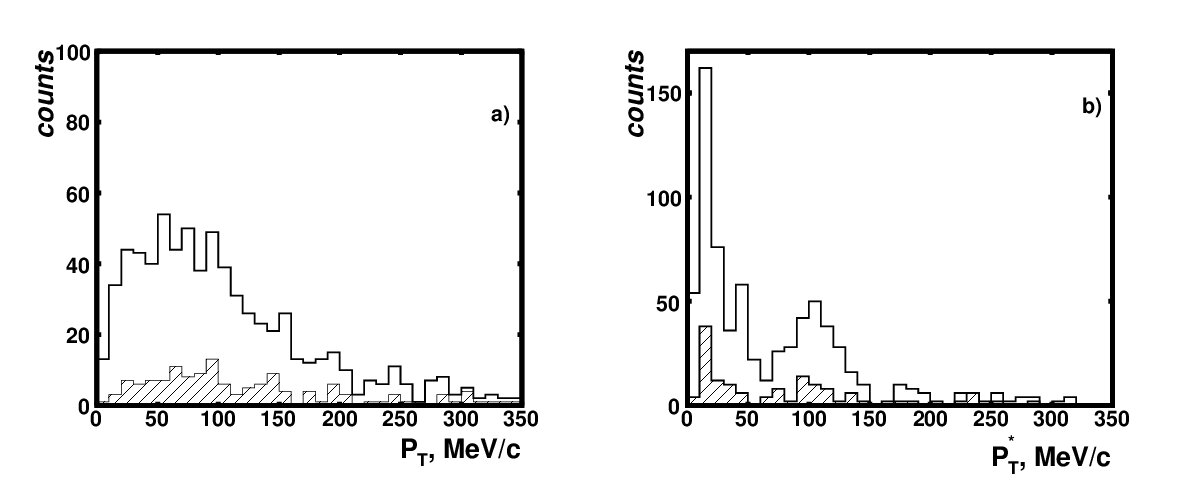 Figure 2
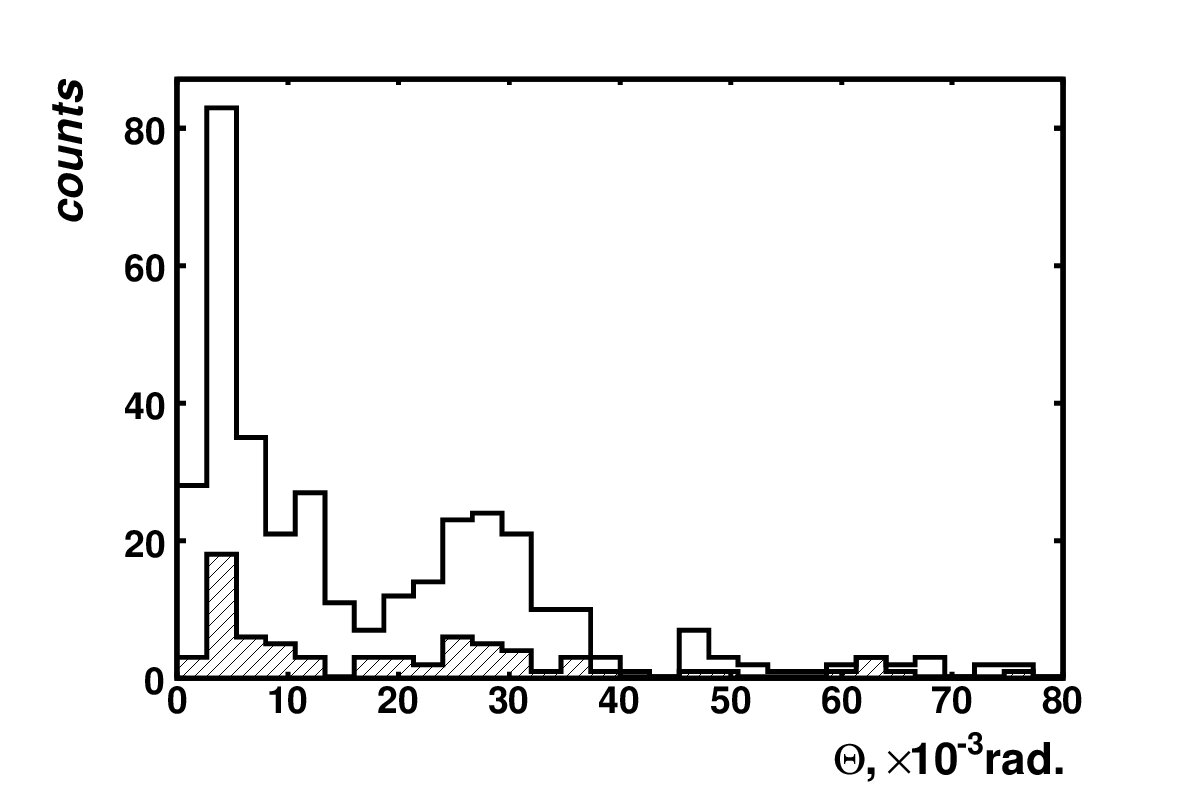 Figure 3
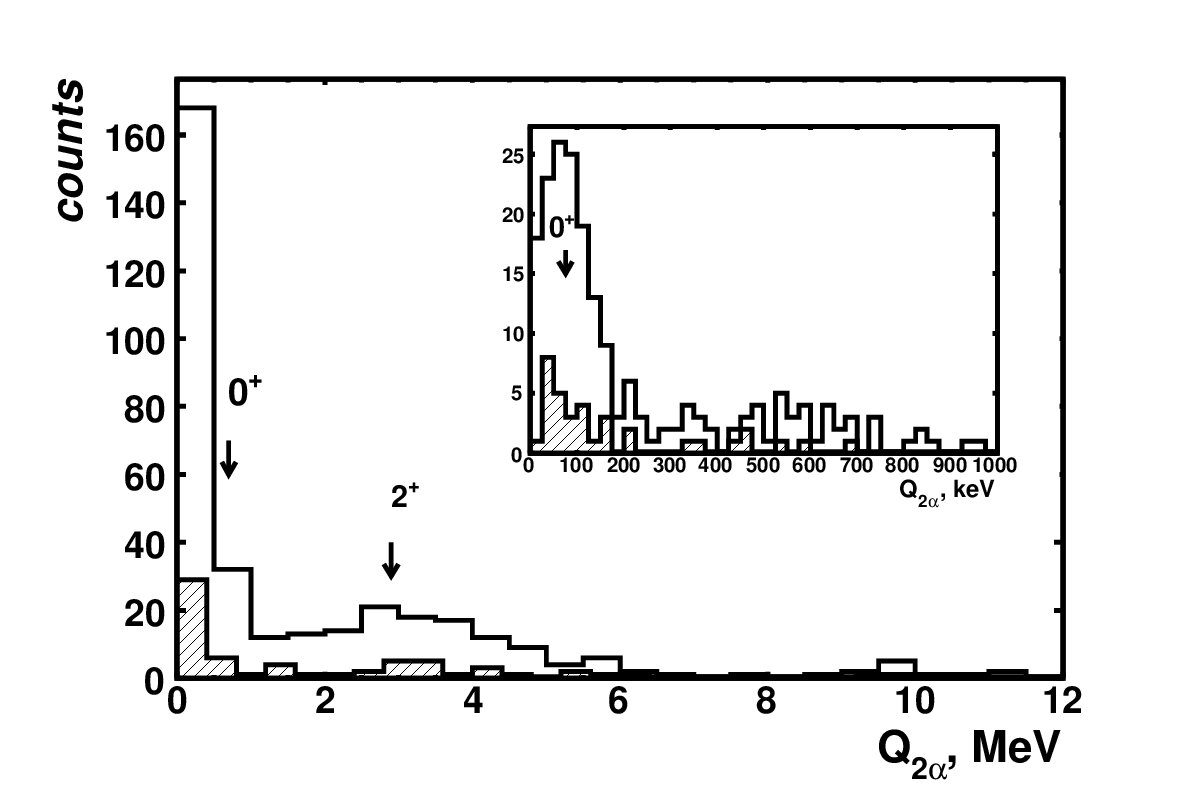 Figure 4
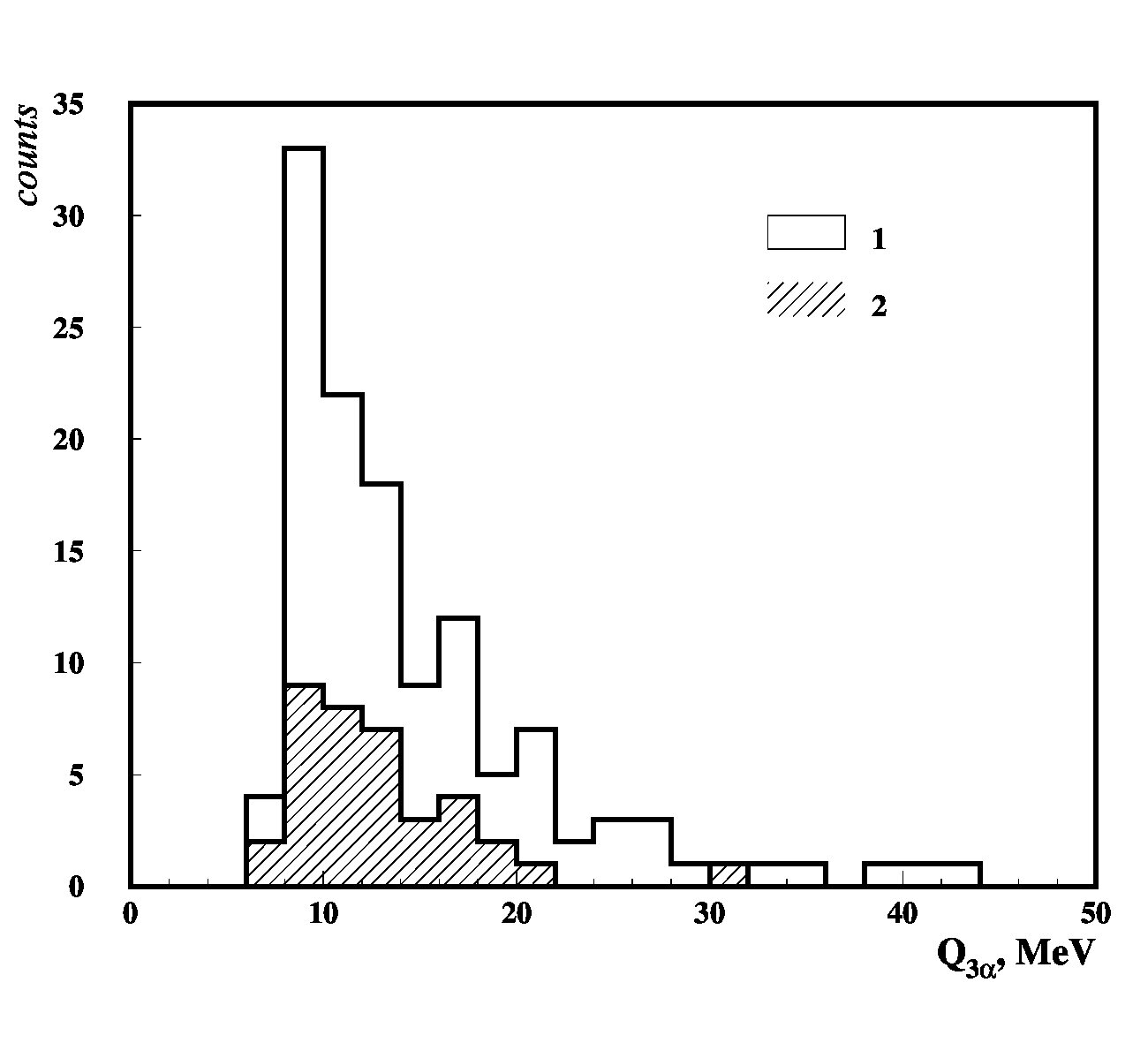 Figure 5
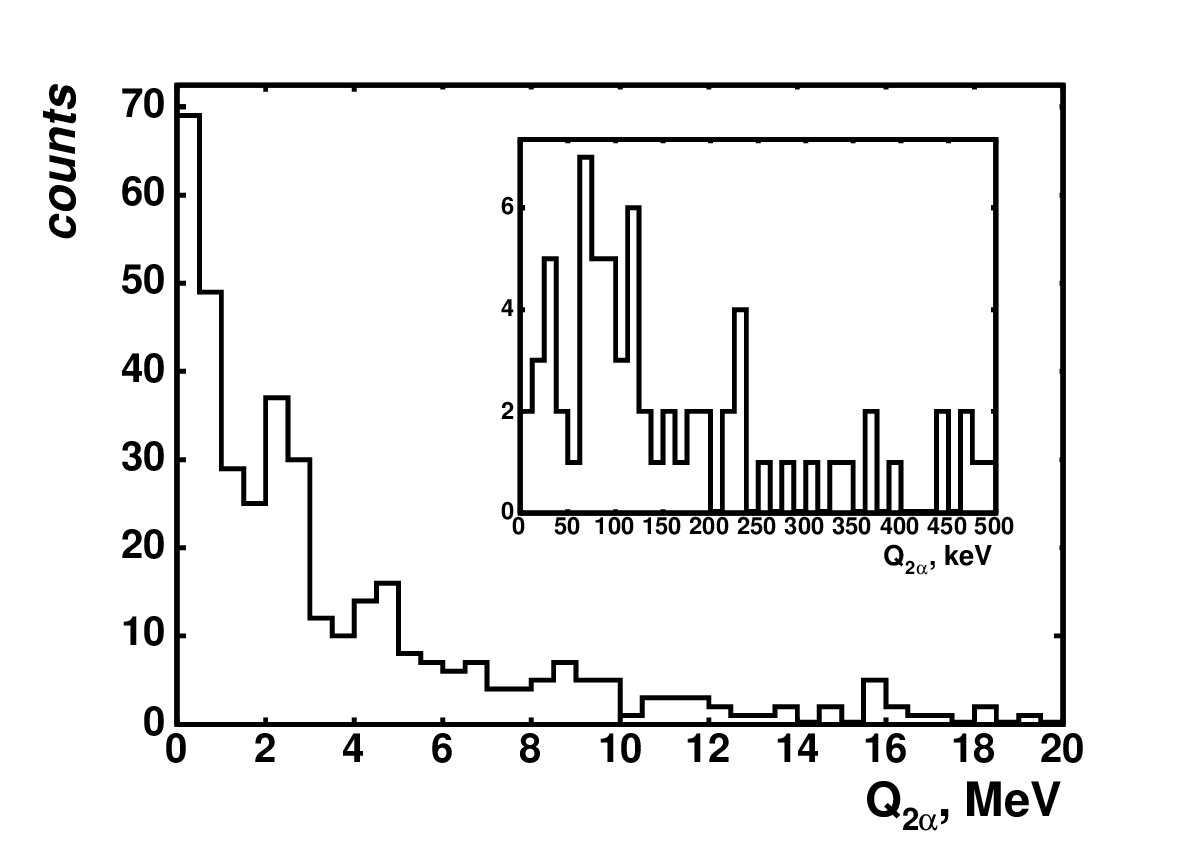 Figure 6
| Zfr | 6 | 5 | 5 | 4 | 3 | 3 | – | – |
|---|---|---|---|---|---|---|---|---|
| NZ=1 | 1 | – | 2 | 1 | 4 | 2 | 3 | 1 |
| NZ=2 | – | 1 | – | 1 | – | 1 | 2 | 3 |
| NW.S. | 13 | 4 | 3 | 1 | 1 | 1 | 6 | 17 |
| Nt.f. | 15 | 1 | 3 | 3 | – | 2 | 5 | 32 |
| N∑ | 28 | 5 | 6 | 4 | 1 | 3 | 11 | 49 |
| N∑,% | 26 | 5 | 5 | 4 | 1 | 3 | 10 | 46 |
| Channel | 2He | 2He | He+2H | He+2H | 4H | 4H | Li+H | Li+H | Sum |
| n0 | n0 | n0 | n0 | n0 | n0 | n0 | n0 | ||
| 3He+4He | 30 | 11 | 41 | ||||||
| 3He+3He | 11 | 7 | 18 | ||||||
| 4He+2p | 13 | 9 | 22 | ||||||
| 4He+d+p | 10 | 5 | 15 | ||||||
| 3He+2p | 9 | 9 | 18 | ||||||
| 3He+d+p | 8 | 10 | 18 | ||||||
| 3He+2d | 1 | 1 | |||||||
| 3He+t+p | 1 | 1 | |||||||
| 3p+d | 2 | 2 | |||||||
| 2p+2d | 1 | 1 | |||||||
| 6Li+p | 9 | 3 | 12 | ||||||
| Sum | 41 | 18 | 42 | 33 | 2 | 1 | 9 | 3 | 149 |
| Zfr | N5 | N4 | N3 | N2 | N1 | Ntf | Nws |
| 7 | - | - | - | 1 | 5 | 1 | - |
| 6 | - | - | - | 2 | 2 | 8 | 2 |
| 6 | - | - | - | 1 | 4 | 6 | 4 |
| 6 | - | - | - | - | 6 | 1 | - |
| 5 | - | - | - | 1 | 3 | 61 | 14 |
| 5 | - | - | - | 2 | 1 | 44 | 12 |
| 5 | - | - | 1 | - | 2 | 8 | - |
| 5 | - | - | 1 | 1 | - | 1 | - |
| 5 | - | 1 | - | - | 1 | 17 | 24 |
| 5 | 1 | - | - | - | - | 17 | 1 |
| 5 | - | - | - | - | 5 | 21 | 4 |
| 4 | - | - | - | - | 4 | 5 | 1 |
| 4 | - | - | - | 2 | - | 24 | 1 |
| 4 | - | - | - | 1 | 2 | 42 | - |
| Zfr=4 | 7Be | % | 8B (+H) | % |
|---|---|---|---|---|
| 2He | 41 | 43 | 12 | 40 |
| He+2H | 42 | 45 | 14 | 47 |
| 4H | 2 | 2 | 4 | 13 |
Peer Reviews
No public reviews on file for this paper yet. If you reviewed it on a platform where reviews are public (OpenReview, ICLR, NeurIPS, ICML), you can paste yours below so the community can read it here.
Videos
No videos yet. Explain this paper in a talk, walkthrough, or lecture? Add one.
Clustering features of 9Be, 14N, 7Be, and 8B nuclei in relativistic
fragmentation
D. A. Artemenkov
Joint Insitute for Nuclear Research, Dubna, Russia
T. V. Shchedrina
Joint Insitute for Nuclear Research, Dubna, Russia
R. Stanoeva
Joint Insitute for Nuclear Research, Dubna, Russia
P. I. Zarubin
[email protected] http://becquerel.lhe.jinr.ru Joint Insitute for Nuclear Research, Dubna, Russia
Abstract
Recent studies of clustering in light nuclei with an initial energy above 1 A GeV in nuclear treack emulsion are overviewed. The results of investigations of the relativistic 9Be nuclei fragmentation in emulsion, which entails the production of He fragments, are presented. It is shown that most precise angular measurements provided by this technique play a crucial role in the restoration of the excitation spectrum of the particle sysytem. In peripheral interactions 9Be nuclei are dissociated practically totally through the 0+ and 2+ states of the 8Be nucleus.
The results of investigations of the dissociation of a 14N nucleus of momentum 2.86 A GeV/c in emulsion are presented as example of more complicated system. The momentum and correlation characteristics of particles for the 14N3 channel in the laboratory system and the rest systems of 3 particles were considered in detail.
Topology of charged fragments produced in peripheral relativistic dissociation of radioactive 8B, 7Be nuclei in emulsion is studied.
pacs:
21.45.+v, 23.60+e, 25.10.+s
I Introduction
The peripheral fragmentation of light relativistic nuclei can serve as a source of information about their exitations above particle decay thresholds including many-body final states. The interactions of this type are provoked either in electromagnetic and diffraction processes, or in nucleon collisions at small overlapping of the colliding nucleus densities. A fragmenting nucleus gains an excitation spectrum near the cluster dissociation thresholds. In the kinetic region of fragmentation of a relativistic nucleus there are produced nuclear fragment systems the total charge of it is close to the parent-nucleus charge. A relative intensity of formation of fragments of various configurations makes it possible to estimate the importance of different cluster modes.
The opening angle of the relativistic fragmentation cone is determined by the Fermi-momenta of the nucleon clusters in a nucleus. Being normalized to the mass numbers they are concentrated with a few percent dispersion near the normalized momentum of the primary nucleus. When selecting events with dissociation of a projectile into a narrow fragmentation cone we see that target-nucleus non-relativistic fragments either are absent (“white”stars in Ref.Andreeva et al. (2005)), or their number is insignificant. The target fragments are easily separated from the fragments of a relativistic projectile since their fraction in the angular relativistic fragmentation cone is small and they possess non-relativistic momentum values.
In the peripheral fragmentation of a relativistic nucleus with charge Z the ionization induced by the fragments can decrease down to a factor Z, while the ionization per one track – down to Z2. Therefore experiment should provide an adequate detection range. In order to reconstruct an event, a complete kinematic information about the particles in the relativistic fragmentation cone is needed which, e.g., allows one to calculate the invariant mass of the system. The accuracy of its estimation decisively depends on the exactness of the track angular resolution. To ensure the best angular resolution, it is necessary that the detection of relativistic fragments should be performed with the best spacial resolution.
The nuclear emulsion technique, which underlies the BECQUEREL project at the JINR Nuclotron Web (2006), well satisfies the above-mentioned requirements. It is aimed at a systematic search for peripheral fragmentation modes with statistical provision at a level of dozens events, their classification and angular metrology. Emulsions provide the best spacial resolution (about 0.5 m) which allows one to separate the charged particle tracks in the three-dimensional image of an event within one-layer thickness (600 m) and ensure a high accuracy of angle measurements. The tracks of relativistic H and He nuclei are separated by sight. As a rule, in the peripheral fragmentation of a light nucleus its charge can be determined by the sum of the charges of relativistic fragments. Multiple-particle scattering measurements on the light fragment tracks enable one to separate the H and He isotopes. The analysis of the products of the relativistic fragmentation of neutron-deficient isotopes has some additional advantages owing to a larger fraction of observable nucleons and minimal Coulomb distortions. Irradiation details and a special analysis of interactions in the BR-2 emulsion are presented in Ref. Adamovich et al. (1999, 2004). In what follows, we give the first results of the study of the 9Be,8B, 7Be 14N nuclei fragmentation with a few A GeV energy which are obtained with the use of a part of the material analyzed.
II Fragmentation of 9Be nuclei
The 9Be nucleus is a loosely bound n++ system. The energy threshold of the 9Ben++ dissociation channel is 1.57 MeV. The study of the 9Be fragmentation at relativistic energies gives the possibility of observing the reaction fragments, which are the decay products of unbound 8Be and 5He nuclei.
The method of nuclear emulsions used in the present paper allows one to observe the charged component of the relativistic 9Be2He+n fragmentation channel. Owing to a good angular resolution of this method it is possible to separate the 9Be fragmentation events, which accompanied by the production of an unstable 8Be nucleus with its subsequent breakup to two a particles. In this case, the absence of a combinatorial background (of three and more particles) for 9Be, which is typical for heavier N nuclei 12C and 16O makes it possible to observe distinctly this picture.
Nuclear emulsions were exposed to relativistic 9Be nuclei at the JINR Nuclotron. A beam of relativistic 9Be nuclei was obtained in the 10BBe fragmentation reaction using a polyethylene target. The 9Be nuclei constituted about 80% of the beam, the remaining 20% fell on Li and He nuclei.Artemenkov (2006)
Events were sought by microscope scanning over the emulsion plates. In total 362 events of the 9Be fragmentation involving the two He fragment production in the forward fragmentation cone within a polar angle of 6*∘(0.1 rad) were found. The requirement of conservation of the fragment charge in the fragmentation cone was fulfilled for the detected events. In event selection 5 - 7 tracks of various types were allowed in a wide (larger than 6∘) cone to increase statistics. An example of the 9Be2He fragmentation event in emulsion is given in Fig. 1 Web (2006). This event belongs to the class of “white”stars as far as it contains neither target nucleus fragments, nor produced mesons. This event sample includes 144 “white ”stars. The angles of the tracks in emulsion for the detected events were obtained using a fine measuring microscope. Angular measurements for the 362 events were carried out with an accuracy not worse then 4.510-3* rad.
In analyzing the data both He fragments observed in the 9Be2He+n channel were supposed to be a particles. This assumption is motivated by the fact that at small angles the 9BeHe+n fragmentation channel with an energy threshold of 1.57 MeV must dominate the 9BeHe+4He+n channel whose energy threshold is 22.15 MeV. The 3He fraction will not exceed a few percent in this energy range Belaga et al. (1996) and all the He fragments in the detected events may be thought of as particles.
In Fig. 2a the PT transverse momentum distribution of particles in the laboratory frame of reference is calculated without the account of particle energy losses in emulsion by the equation
[TABLE]
where p0, A and are the momentum per nucleon, the fragment mass and the polar emission angle, respectively. The outer contour corresponds to all events. The inner histogram is obtained for events accompanied by protons recoil of emulsion target (dashed area). The mean value of the transverse momentum for the total event sample in the laboratory system is equal to 103 MeV/c with FWHM 72 MeV/c. This may be an indication of the fact that the experimental data are not of the same kind which can be pronounced when going over to the c.m.s. of two particles.
The P transverse momentum distribution of particles in the c.m.s. of two particles described by the equation
[TABLE]
where PTi is the transverse momentum of an i-th particle in the laboratory system nα=2 is given in Fig. 2b. There is observed a grouping of events around two peaks with the values 24 MeV/c and 101 MeV/c. In Ref Avetyan et al. (1996) the appropriate mean values of the fragment transverse momenta are 121 MeV/c for 16O4,141 MeV/c Belaga et al. (1995) for 12C3 and 200 MeV/ for 22Ne5 (processing of the available data). There by we clearly see a tendency toward an increase of the mean particle momentum with increasing their multiplicity. This implies a growth of the total Coulomb interaction of alpha clusters arising in nuclei.
In the opening angle distribution (Fig. 3) one can also see two peaks with mean values 4.6rad. and 26.8rad. The ratio of the numbers of the events in the peaks is close to unity.
The distribution entails the invariant energy Q2α distribution, which is calculated as a difference between the effective invariant mass M2α of an fragment pair and the doubled particle mass by the equations
[TABLE]
where Pj is the particle 4-momentum.
In the invariant energy Q2α distribution (Fig. 4) there are two peaks in the ranges 0 to 1 MeV and 2 to 4 MeV. The shape of the distribution does not contradict the suggestion about the 9Be fragmentation involving the production of an unstable 8Be nucleus which decays in the 0+ and 2+ states. The values of the peaks of the invariant energy Q2α and the transverse momenta P in the c.m.s. relate to each other. To the Q2α range from 0 to 1 MeV with a peak at 100 keV there corresponds a peak P with 24 MeV/c , and to the Q2α range from 2 to 4 MeV there corresponds a peak with 101 MeV/c.
III Fragmentation of 14N nuclei
A stack of layers of BR-2 emulsion was exposed to a beam of 14N nuclei accelerated Shchedrina et al. (2006) to a momentum of 2.86 A GeV/c at the Nuclotron of the Laboratory of High Energy Physics (JINR). Already been found amoung 950 inelastic events in which the total fragment charge was equal to the Z0=7 fragment charge and there were no produced particles. Events were sought by viewing over the track length which provided the accumulation of statistics without selection. The selected events are divided in two classes. The events of the type of “white”star and the interactions involving the production of one or a few target-nucleus fragments belong to the first class.
Table 1 shows the charge multi-fragmentation topology which was studied for the events satisfying the above-mentioned conditions. The upper line is the Z2 fragment charge, the second line is the number of single-charged fragments , the third one the number of two-charged fragments, and the fourth and fifth lines are the number of the detected events with a given topology for “white”stars and events with target-nucleus excitation for each channel, respectively. The two last lines present the total number of interactions calculated in absolute values and in percent.
The analysis of the data of Table 1 shows that the number of channels involving Z3 fragments for the “white”stars is larger by about a factor of 1.5 than that for the events accompanied by a target breakup. On the contrary, for the 2+2+2+1 charge configuration channel this number is smaller by about a factor of 1.5. Thus, in the events with target breakup, the projectile fragments more strongly than in the “white”stars. The data of Table 1 points to the predominance of the channel with the 2+2+2+1 charge configuration (49 events) which has been studied in more detail. The obtained results show that the 14N nucleus constitutes a very effective source for the production of 3 system.
In order to estimate the energy scale of production of 3 particle systems in the 14N3+X channel, we present the invariant excitation energy Q3α distribution with respect to the 12C ground state:
[TABLE]
where M() is the mass of the ground state corresponding to the charge and the weight of the system being analyzed, M the invariant mass of the system of fragments. Statistics was increased to 132 events 14N3+X including 50 “white ”stars by scanning over the emulsion plates.
The main part of the events is concentrated in the Q3α area from 10 to 14 MeV, covering the known 12C levels (Fig. 5). Softening of the conditions of the 3He + H selection, for which the target fragment production is allowed, does not result in a shift of the 3 excitation peak. This fact suggests the universality of the 3 state population mechanism.
To estimate the fraction of the events involving the production of an intermediate 8Be nucleus in the reactions 14NBe+X3+X we present the invariant excitation energy distribution for an particle pair with respect to the 8Be ground state (Fig. 6). The first distribution peak relates to the value to be expected for the decay products of an unstable 8Be nucleus in the ground state 0+. The distribution centre is seen to coincide well with the decay energy of the 8Be ground state. The fraction of the particles originating from the 8Be decay is 25-30%.
IV Fragmentation of 7Be, and 8B nuclei
The results of investigations dealing with the charge topology of the fragments produced in peripheral dissociation of relativistic 8B, 7Be nuclei in emulsion are presented in Ref Web (2006); Stanoeva et al. (2006); G.Peresadko et al. (2006); Andreeva et al. (2006).
Table 2 presents the numbers of the events detected in various channels of the 7Be fragmentation. Of them, the 3He+4He channel noticeably dominates, the channels 4He+d+p and 6Li+p constitute 10% each. Two events involving no emission of neutrons in the three-body channels 3He+t+p and 3He+d+d were registered. The reaction of charge-exchange of 7Be nuclei to 7Li nuclei was not detected among the events not accompanied by other secondary charged particles.The events involving no target fragments (nb=0) are separated from the events involving one or a few fragments (n0).
For the first time, nuclear emulsions were exposed to a beam of relativistic 8B nuclei. We have obtained data on the probabilities of the 8B fragmentation channels in peripheral interactions. 55 events of the peripheral 8B dissociation which do not involve the production of the target-nucleus fragments and mesons (“white” stars ) were selected. A leading contribution of the 8BBe+p mode having the lowest energy threshold was revealed on the basis of these events. Information about a relative probability of dissociation modes with larger multiplicity have been obtained. Among the found events there are 320 stars in which the total charge of the relativistic fragments in a 8*∘* fragmentation cone Zfr satisfies the condition Z3. These stars were attributed to the number of peripheral dissociation events Npf. The Npf relativistic fragment distribution of over charges NZ is given in Table 3. There are given the data for 256 events containing the target-nucleus fragments - Ntf, as well as for 64 events which contain no target-nucleus fragments (“white” stars )– Npf. The role of the channels with multiple relativistic fragments N2 is revealed to be dominant for the N“white” stars. Of peripheral events, the “white” stars Nws (Table 3) are of very particular interest. They are not accompanied by the target-nucleus fragment tracks and makes it possible to clarify the role of different cluster degrees of freedom at a minimal excitation of the nuclear structure.
Table 4 gives the relativistic fragment charge distribution in the “white” stars for 7Be and 8B nuclei. The 8B events are presented without one single-charged relativistic fragment, that is a supposed proton halo. The identical fraction of the two main 2He and He+2H dissociation channels is observed for 7Be and 8B nuclei which points out that the 8Be core excitation is independent of the presence of an additional loosely bound proton in the 8B nucleus.
V Conclusions
The degree of the dissociation of the relativistic nuclei in peripheral interactions can reach a total destruction into nucleons and singly and doubly charged fragments. The emulsion technique allows one to observe these systems to the smallest details and gives the possibility of studying them experimentally.
New experimental observations are reported from the emulsion exposures to 14N, 9Be, 8B, 7Be nuclei with energy above 1 A GeV. The main features of 9Be2He relativistic fragmentation are presented. For the particular case of the relativistic 9Be nucleus dissociation it is shown that precise angular measurements play a crucial role in the restoration of the excitation spectrum of the alpha particle fragments. This nucleus is dissociated practically totally through the 0+ and 2+ states of the 8Be nucleus. The data obtained from 9Be angular measurements can be employed for the estimation of the role of 8Be in more complicated N systems.
The results of the study of the dissociation of 14N nuclei of a primary momentum of 2.86 A GeV/c in their interactions with the emulsion nuclei are also presented. The present investigation indicates the leading role of the 2+2+2+1 charge configuration channel. The energy scale of the 3 system production has been estimated. According to the available statistics 80% of interactions are concentrated at 10-14 MeV. The fraction of the 14NBe+X3+X channel involving the production of an intermediate 8Be nucleus is about 25%.
Advantages of emulsion technique are exploited most completely in the study of peripheral fragmentation of light stable and neutron deficient nuclei. The results of investigations dealing with the charge topology of the fragments produced in peripheral dissociation of relativistic 7Be, 8B nuclei in emulsion are presented. Information on the relative probability of dissociation modes with a larger multiplicity was obtained. The dissociation of a 7Be core in 8B indicates an analogy with that of the free 7Be nucleus.
The reference list from the paper itself. Each links out to its DOI / PubMed record.
- 1Andreeva et al. (2005) N. P. Andreeva, et al., Phys. At. Nucl. 68 , 455–465 (2005).
- 2Web (2006) Web site of the BECQUEREL Project: http://becquerel.jinr.ru (2006).
- 3Adamovich et al. (1999) M. I. Adamovich, et al., Phys. At. Nucl. 62 , 1378–1387 (1999).
- 4Adamovich et al. (2004) M. I. Adamovich, et al., Phys. At. Nucl. 62 , 514–517” (2004).
- 5Artemenkov (2006) D. A. Artemenkov, ar Xiv:nucl-ex/0605018 (2006).
- 6Belaga et al. (1996) V. V. Belaga, et al., Phys. At. Nucl. 59 , 869–877 (1996).
- 7Avetyan et al. (1996) F. A. Avetyan, et al., Phys. At. Nucl. 59 , 110–116 (1996).
- 8Belaga et al. (1995) V. V. Belaga, et al., Phys. At. Nucl. 58 , 2014–2020 (1995).