Evaluation of the Recovery Engagement and Coordination for Health–Veterans Enhanced Treatment Suicide Risk Modeling Clinical Program in the Veterans Health Administration
John F. McCarthy, Samantha A. Cooper, Kallisse R. Dent, Aaron E. Eagan, Bridget B. Matarazzo, Claire M. Hannemann, Mark A. Reger, Sara J. Landes, Jodie A. Trafton, Michael Schoenbaum, Ira R. Katz

TL;DR
This study evaluates a program for high-risk veterans and finds it increases treatment engagement and reduces suicide attempts and hospital visits.
Contribution
The study demonstrates the effectiveness of a suicide risk modeling program in improving care and reducing adverse outcomes.
Findings
REACH VET was associated with increased outpatient appointments and safety plan documentation.
The program reduced mental health admissions, emergency visits, and suicide attempts.
No significant differences in suicide or all-cause mortality were found.
Abstract
Is the Veterans Health Administration Recovery Engagement and Coordination for Health–Veterans Enhanced Treatment (REACH VET) program, which facilitates care enhancements for individuals in the top 0.1% suicide risk tier using a validated algorithm, associated with health care utilization, treatment engagement, suicide attempts, suicide safety plan documentation, and suicide mortality? In this cohort study including 173 313 individuals before and after implementation of the REACH VET program using triple differences, inclusion in the REACH VET program was associated with having more outpatient encounters, increased documentation of new suicide prevention safety plans, and fewer inpatient mental health admissions, emergency department visits, and documented suicide attempts. These findings suggest that clinical programs using predictive modeling can support care enhancements and risk…
Genes, proteins, chemicals, diseases, species, mutations and cell lines named across the full text — each resolved to its canonical identifier and authoritative record.
Click any figure to enlarge with its caption.
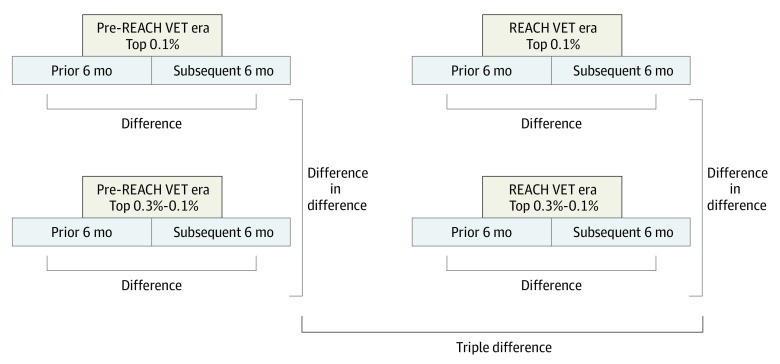 Figure 1
Peer Reviews
No public reviews on file for this paper yet. If you reviewed it on a platform where reviews are public (OpenReview, ICLR, NeurIPS, ICML), you can paste yours below so the community can read it here.
Videos
No videos yet. Explain this paper in a talk, walkthrough, or lecture? Add one.
Taxonomy
TopicsSuicide and Self-Harm Studies · Mental Health Treatment and Access · Posttraumatic Stress Disorder Research