Pilot Investigation of SARS-CoV-2 Secondary Transmission in Kindergarten Through Grade 12 Schools Implementing Mitigation Strategies — St. Louis County and City of Springfield, Missouri, December 2020
Patrick Dawson, Mary Claire Worrell, Sara Malone, Sarah C. Tinker, Stephanie Fritz, Brett Maricque, Sadaf Junaidi, Gemille Purnell, Albert M. Lai, Julie A. Neidich, Justin S. Lee, Rachel C. Orscheln, Rachel Charney, Terri Rebmann, Jon Mooney, Nancy Yoon, Machelle Petit

Abstract
Genes, proteins, chemicals, diseases, species, mutations and cell lines named across the full text — each resolved to its canonical identifier and authoritative record.
Click any figure to enlarge with its caption.
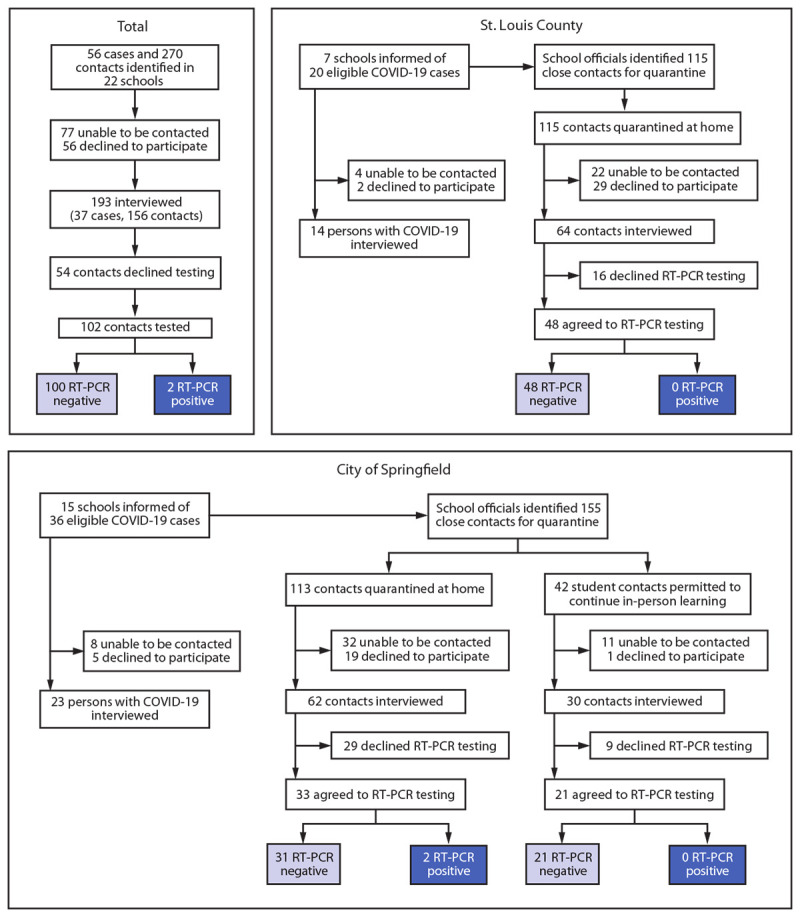 Figure 1
Peer Reviews
No public reviews on file for this paper yet. If you reviewed it on a platform where reviews are public (OpenReview, ICLR, NeurIPS, ICML), you can paste yours below so the community can read it here.
Videos
No videos yet. Explain this paper in a talk, walkthrough, or lecture? Add one.
Taxonomy
TopicsCOVID-19 and Mental Health · SARS-CoV-2 detection and testing · SARS-CoV-2 and COVID-19 Research
Many kindergarten through grade 12 (K–12) schools offering in-person learning have adopted strategies to limit the spread of SARS-CoV-2, the virus that causes COVID-19 (1). These measures include mandating use of face masks, physical distancing in classrooms, increasing ventilation with outdoor air, identification of close contacts,* and following CDC isolation and quarantine guidance† (2). A 2-week pilot investigation was conducted to investigate occurrences of SARS-CoV-2 secondary transmission in K–12 schools in the city of Springfield, Missouri, and in St. Louis County, Missouri, during December 7–18, 2020. Schools in both locations implemented COVID-19 mitigation strategies; however, Springfield implemented a modified quarantine policy permitting student close contacts aged ≤18 years who had school-associated contact with a person with COVID-19 and met masking requirements during their exposure to continue in-person learning.§ Participating students, teachers, and staff members with COVID-19 (37) from 22 schools and their school-based close contacts (contacts) (156) were interviewed, and contacts were offered SARS-CoV-2 testing. Among 102 school-based contacts who received testing, two (2%) had positive test results indicating probable school-based SARS-CoV-2 secondary transmission. Both contacts were in Springfield and did not meet criteria to participate in the modified quarantine. In Springfield, 42 student contacts were permitted to continue in-person learning under the modified quarantine; among the 30 who were interviewed, 21 were tested, and none received a positive test result. Despite high community transmission, SARS-CoV-2 transmission in schools implementing COVID-19 mitigation strategies was lower than that in the community. Until additional data are available, K–12 schools should continue implementing CDC-recommended mitigation measures (2) and follow CDC isolation and quarantine guidance to minimize secondary transmission in schools offering in-person learning.
A student, teacher, or staff member who received a positive SARS-CoV-2 nucleic acid amplification test or antigen test result and who had been physically present at the school or a school-associated event while potentially infectious was most often reported to school officials within 1–2 days of receipt of laboratory results. School officials initiated contact tracing to identify contacts in the school environment¶ within 12–24 hours of notification. In Springfield, school officials assessed whether student contacts met criteria for a modified quarantine based on information from the contact tracing investigation. During December 7–18, 2020, an investigation team from Washington University in St. Louis, Saint Louis University, and CDC invited eligible** persons with COVID-19 and their contacts to participate in the pilot investigation within 12–24 hours of identification by school officials. Overall numbers of identified contacts in the school environment were available for analysis regardless of participation and were used to characterize the number of school contacts identified per case.
To collect more detailed contact tracing information and epidemiologic data, a trained interviewer conducted a standardized telephone interview with 1) participants aged ≥18 years, 2) participants aged 12–17 years and/or their parents or guardians, and 3) parents or guardians of participants aged <12 years. Data were entered into and managed in a REDCap database (version 9.5.5; Washington University in St. Louis) and analyzed using SAS (version 9.4; SAS Institute). Contacts were monitored prospectively until 14 days after their last exposure. Saliva samples were collected from persons with COVID-19 soon after they agreed to participate and from contacts 5–8 days after their last exposure; samples were tested for SARS-CoV-2 by reverse transcription–polymerase chain reaction (RT-PCR).†† Whole genome sequencing (97%–99% coverage) was conducted on RT-PCR–positive saliva samples using Oxford Nanopore Technologies MinION sequencing at CDC (3). For each contact who received a positive SARS-CoV-2 RT-PCR test result, the investigation team followed a case determination protocol to ascertain whether school-based secondary transmission was probable, possible, or unlikely§§ (4,5). To gather data on mitigation measures implemented in schools, standardized interviews were conducted with school officials representing 57 K–12 schools (12 St. Louis County schools and 45 Springfield schools). This project was reviewed and approved by the Washington University in St. Louis Institutional Review Board and by CDC and was conducted consistent with applicable federal law and CDC policy.¶¶
All schools offered in-person learning, and all but one offered full- or part-time virtual learning. Among all schools, 9,216 of 30,558 (30%) students were participating in virtual learning only, and 21,342 (70%) attended in-person school at least part-time. Data on implemented mitigation strategies were reported for 55 schools, and 100% implemented a mask mandate. In addition, in at least some classrooms, 100% of schools spaced desks ≥3 ft apart, 27% spaced desks ≥6 ft apart, and 98% placed physical barriers between teachers and students. Ninety-eight percent had handwashing or hand sanitizing stations available at school entrances, and 100% had stations available in cafeterias or other dining areas, restrooms, and classrooms. Modifications to increase ventilation to prevent COVID-19 were reported by 98% of schools: 91% opened windows or doors, 87% used fans, 93% decreased occupancy in spaces where ventilation with outdoor air could not be increased, and 5% replaced or updated heating, ventilation, and air conditioning systems.
School officials identified 56 persons with COVID-19 who had a total of 270 contacts with school-based exposure and monitored them until the end of their isolation or quarantine period (Figure). All 326 persons were eligible for participation in the pilot investigation (interview, saliva testing, or both); among these, 193 (59%) agreed to participate. Participants included 37 (66%) persons with COVID-19 and 156 (58%) contacts from 22 of the 57 participating schools. Among participating persons with COVID-19 and their contacts, 65% and 88%, respectively, were students. Distributions by gender, age, and race/ethnicity among participating persons with COVID-19 and contacts were similar (Table). The number of identified contacts per participating person with COVID-19 ranged from 1 to 35 (median = 5).
Fifty-four of the 156 participating contacts declined testing; among the 102 who were tested, two (2%) received positive SARS-CoV-2 test results (Figure). These two contacts were from separate schools in Springfield and were contacts of two different persons with COVID-19 (persons A and B) (5% of participating persons with COVID-19). School-based secondary transmission was probable for both contacts based on their exposure histories and symptom and testing timelines. One student contact of person A (a student in the same grade) received a positive test result 6 days after exposure. Although no sequencing data were available, the student contact had no other known sources of exposure. One student contact of person B (an elementary school teacher) received a positive SARS-CoV-2 test result 7 days after exposure in the classroom (<3 ft for >15 minutes) and had no other known exposure sources. The consensus sequence generated from whole genome sequencing of the student’s saliva sample was nearly identical to that of person B, differing by only one nucleotide. Because neither contact of person A or B who received a positive test result met the criteria for Springfield’s modified quarantine, they completed their quarantine at home.*** Of the 168 contacts who did not receive testing from the investigation team, none was identified by school officials as having received positive test results during the 14 days after their last school-based exposure.
In the Springfield school district that implemented a modified quarantine, 131 (85%) of 155 contacts were students, 82 (63%) of whom agreed to participate in the pilot investigation; 42 (51%) participants met criteria for a modified quarantine and continued in-person learning during their quarantine period, 30 (71%) of whom were interviewed. Among 52 student contacts who did not meet modified quarantine criteria and were interviewed, the most common reasons student contacts did not meet modified quarantine criteria were unmasked exposure (31; 60%), athletic activity contact (11; 21%), and lunch or recess contact (seven; 13%). Testing results were available for 21 (70%) of 30 students who participated in the modified quarantine and were interviewed, and none received a positive SARS-CoV-2 test result.
Discussion
Schools across the United States have adopted various strategies to limit the risk for SARS-CoV-2 transmission and reduce disruptions to in-person learning (1). In-person school has psychosocial and health benefits beyond educational enrichment for many children, particularly those who depend on school-based services for physical, nutritional, and mental health support (6). Various mitigation strategies were implemented by the 55 surveyed schools with available data, including face mask mandates, increased physical distancing in classrooms, use of physical barriers to separate teachers from students, increased ventilation with outdoor air, and virtual learning options.
In this 2-week pilot investigation in K–12 schools that had implemented multiple strategies to limit SARS-CoV-2 transmission, school-based secondary transmission involving 37 participating students, teachers, and staff members with COVID-19 was identified among only two (2%) of 102 tested school close contacts. In both instances of probable school-based secondary transmission, each person with COVID-19 infected only one other person in the school environment. No outbreaks were identified in participating schools, despite the 2-week cumulative community incidence of 711 COVID-19 cases per 100,000 persons in St. Louis County††† and 996 in Springfield–Greene County.§§§ Considering that only two probable school-based secondary transmission cases were identified, the 2-week school incidence would have been approximately eight cases per 100,000 persons, <1% of the average community incidence in the two sites over the same time period.¶¶¶ These findings are consistent with other studies that have reported that despite high community SARS-CoV-2 transmission, schools that implemented multicomponent measures to reduce spread reported lower in-school transmission (7,8) unless lapses in these measures occurred (9).
The Springfield school district, which implemented a modified quarantine for certain students, permitted 42 student contacts to continue in-person learning during their quarantine period; 30 of these contacts were interviewed, and none of the 21 students who received testing had a positive test result. Assuming that an average 10-day quarantine period**** results in 8 missed school days, an estimated 240 person-days of in-person learning were saved by implementing the modified quarantine for these student contacts. However, the testing data for participating student contacts in modified quarantine are insufficient to recommend that other schools nationwide adopt a modified quarantine policy; additional data are needed.
The findings in this report are subject to at least five limitations. First, school contact tracing might not have identified all close contacts. Second, participation in the investigation project was 59%, possibly because of COVID-19 testing fatigue or other factors cited by persons who declined to participate. Third, not all possible mitigation strategies or school characteristics that might have affected school-based secondary transmission were assessed, and whether masks were worn appropriately was not assessed. Fourth, symptom status, mitigation practices, exposure histories, and underlying medical conditions of persons who participated might have differed from those who did not. Therefore, these findings might not be representative of all persons in the participating schools and might not be generalizable to other schools. Finally, persons who were infected with SARS-CoV-2 but who did not receive testing in this investigation might have been missed, particularly if they were asymptomatic and did not receive testing elsewhere.
The findings from this pilot investigation suggest that implementation of CDC-recommended SARS-CoV-2 mitigation measures in schools might help reduce school-based transmission. The absence of positive test results among student contacts who participated in a modified quarantine raises important epidemiologic questions that require additional study, including the effect of modified quarantine on school-based SARS-CoV-2 secondary transmission and specific criteria for a modified quarantine. The pilot investigation did not include sufficient data to answer these questions; however, data from a more extensive ongoing investigation in six urban, suburban, and rural Missouri public school districts representing approximately 70,000 students, teachers, and staff members will help address these important public health concerns. Until additional data are available, K–12 schools should continue implementing SARS-CoV-2 mitigation strategies that include mask use policies, physical distancing, increased ventilation, and attention to hand hygiene (2) and follow CDC isolation and quarantine guidance to minimize secondary transmission of SARS-CoV-2 in schools offering in-person learning.
SummaryWhat is already known about this topic?Many kindergarten through grade 12 (K–12) schools have implemented strategies to limit school-associated SARS-CoV-2 transmission.What is added by this report?In 22 participating K–12 schools implementing multiple COVID-19 mitigation strategies, school-based SARS-CoV-2 secondary transmission was detected in two of 102 tested close contacts of 37 persons with COVID-19. Among 21 tested student contacts participating in a modified quarantine, all SARS-CoV-2 test results were negative.What are the implications for public health practice?Schools implementing strategies including mask mandates, physical distancing, and increased ventilation had much lower SARS-CoV-2 transmission than in the community. K–12 schools should continue implementing these measures and following CDC isolation and quarantine guidance to minimize secondary transmission in schools.
The reference list from the paper itself. Each links out to its DOI / PubMed record.
- 1Honein MA, Barrios LC, Brooks JT. Data and policy to guide opening schools safely to limit the spread of SARS-Co V-2 infection. JAMA 2021;325. 10.1001/jama.2021.037433497433 PMC 8938683 · doi ↗ · pubmed ↗
- 2CDC. Operational strategy for K–12 schools through phased prevention. Atlanta, GA: US Department of Health and Human Services, CDC; 2021. https://www.cdc.gov/coronavirus/2019-ncov/community/schools-childcare/operation-strategy.html
- 3Paden CR, Tao Y, Queen K, Rapid, sensitive, full-genome sequencing of severe acute respiratory syndrome coronavirus 2. Emerg Infect Dis 2020;26:2401–5. 10.3201/eid 2610.20180032610037 PMC 7510745 · doi ↗ · pubmed ↗
- 4Arons MM, Hatfield KM, Reddy SC, ; Public Health–Seattle and King County and CDC COVID-19 Investigation Team. Presymptomatic SARS-Co V-2 infections and transmission in a skilled nursing facility. N Engl J Med 2020;382:2081–90. 10.1056/NEJ Moa 200845732329971 PMC 7200056 · doi ↗ · pubmed ↗
- 5Meredith LW, Hamilton WL, Warne B, Rapid implementation of SARS-Co V-2 sequencing to investigate cases of health-care associated COVID-19: a prospective genomic surveillance study. Lancet Infect Dis 2020;20:1263–71. 10.1016/S 1473-3099(20)30562-432679081 PMC 7806511 · doi ↗ · pubmed ↗
- 6Masonbrink AR, Hurley E. Advocating for children during the COVID-19 school closures. Pediatrics 2020;146:e 20201440. 10.1542/peds.2020-144032554517 · doi ↗ · pubmed ↗
- 7Macartney K, Quinn HE, Pillsbury AJ, ; NSW COVID-19 Schools Study Team. Transmission of SARS-Co V-2 in Australian educational settings: a prospective cohort study. Lancet Child Adolesc Health 2020;4:807–16. 10.1016/S 2352-4642(20)30251-032758454 PMC 7398658 · doi ↗ · pubmed ↗
- 8Falk A, Benda A, Falk P, Steffen S, Wallace Z, Høeg TB. COVID-19 cases and transmission in 17 K-12 schools—Wood County, Wisconsin, August 31–November 29, 2020. MMWR Morb Mortal Wkly Rep 2021;70:136–40. 10.15585/mmwr.mm 7004 e 333507890 PMC 7842817 · doi ↗ · pubmed ↗