The arrow of time: Advancing insights into action control from the arrow version of the Eriksen flanker task
K. Richard Ridderinkhof, Scott A. Wylie, Wery P. M. van den Wildenberg, Theodore R. Bashore, Maurits W. van der Molen

TL;DR
This paper reviews the development and impact of the arrow version of the Eriksen flanker task, a key tool in studying action control in cognitive psychology.
Contribution
The paper provides a comprehensive tribute to the origins and evolution of the arrow flanker task and its influence on understanding action control.
Findings
The arrow flanker task has been pivotal in revealing developmental trends in action control.
It has helped identify action control deficits in neuropsychiatric disorders.
The task is used to study enhanced action control in elite athletes.
Abstract
Since its introduction by B. A. Eriksen and C. W. Eriksen (Perception & Psychophysics, 16, 143–49, 1974), the flanker task has emerged as one of the most important experimental tasks in the history of cognitive psychology. The impact of a seemingly simple task design involving a target stimulus flanked on each side by a few task-irrelevant stimuli is astounding. It has inspired research across the fields of cognitive neuroscience, psychophysiology, neurology, psychiatry, and sports science. In our tribute to Charles W. (“Erik”) Eriksen, we (1) review the seminal papers originating from his lab in the 1970s that launched the paradigmatic task and laid the foundation for studies of action control, (2) describe the inception of the arrow version of the Eriksen flanker task, (3) articulate the conceptual and neural models of action control that emerged from studies of the arrows flanker…
Genes, proteins, chemicals, diseases, species, mutations and cell lines named across the full text — each resolved to its canonical identifier and authoritative record.
Click any figure to enlarge with its caption.
 Figure 1
 Figure 2
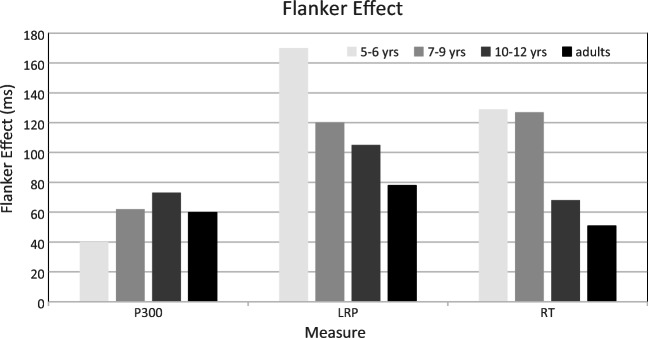 Figure 3
 Figure 4
Peer Reviews
No public reviews on file for this paper yet. If you reviewed it on a platform where reviews are public (OpenReview, ICLR, NeurIPS, ICML), you can paste yours below so the community can read it here.
Videos
No videos yet. Explain this paper in a talk, walkthrough, or lecture? Add one.
Taxonomy
TopicsNeural and Behavioral Psychology Studies · Motor Control and Adaptation · Sport Psychology and Performance