Employment among people with schizophrenia or bipolar disorder: A population‐based study using nationwide registers
Minna Holm, Heidi Taipale, Antti Tanskanen, Jari Tiihonen, Ellenor Mitterdorfer‐Rutz

TL;DR
This study examines employment rates and factors influencing employment among people with schizophrenia or bipolar disorder in Sweden.
Contribution
The study provides population-based insights into employment trends and associated factors for individuals with schizophrenia or bipolar disorder.
Findings
Employment rates dropped significantly after the first diagnosis for both schizophrenia and bipolar disorder.
Higher education, older age at diagnosis, and no substance use were linked to better employment outcomes.
Men with bipolar disorder had higher employment rates than women.
Abstract
To assess the employment rate and the related background factors among people with schizophrenia or bipolar disorder. We identified all people in Sweden aged 18–64 years diagnosed with schizophrenia or bipolar disorder in nationwide registers in the years 2006–2013. The identified individuals were grouped by main activity or source of income. The association between background factors and employment was analyzed with generalized estimating equations (GEE). Three years before the first psychosis or bipolar disorder diagnosis, 24% of the individuals with schizophrenia and 45% of the individuals with bipolar disorder were employed. However, the employment rate dropped around the time of the first diagnosis. Five years later, 10% of the individuals with schizophrenia and 34% of the individuals with bipolar disorder were employed. The most important factors associated with employment after…
Genes, proteins, chemicals, diseases, species, mutations and cell lines named across the full text — each resolved to its canonical identifier and authoritative record.
Click any figure to enlarge with its caption.
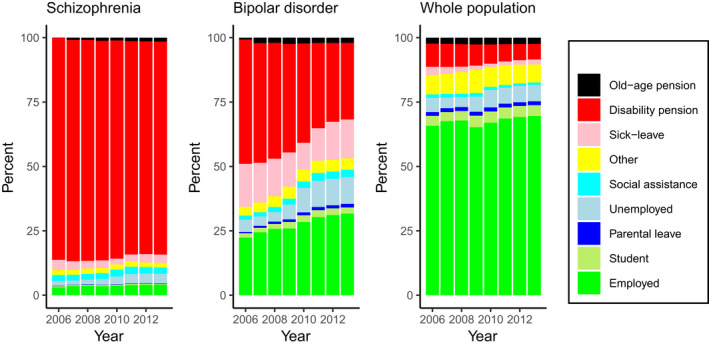 Figure 1
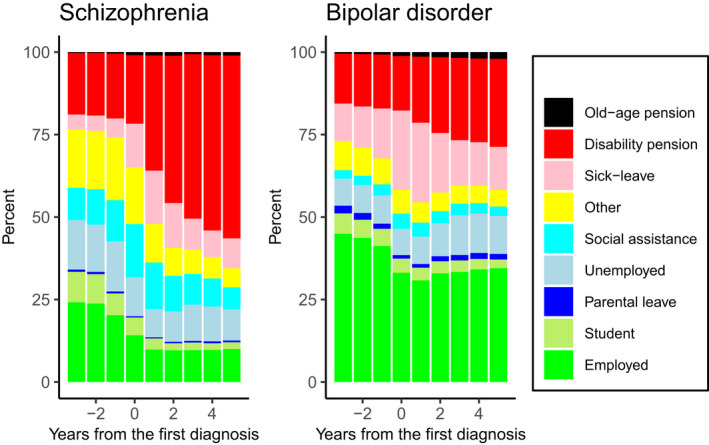 Figure 2
Peer Reviews
No public reviews on file for this paper yet. If you reviewed it on a platform where reviews are public (OpenReview, ICLR, NeurIPS, ICML), you can paste yours below so the community can read it here.
Videos
No videos yet. Explain this paper in a talk, walkthrough, or lecture? Add one.
Taxonomy
TopicsBipolar Disorder and Treatment · Schizophrenia research and treatment · Obsessive-Compulsive Spectrum Disorders