Lipidation of Antimicrobial Peptides as a Design Strategy for Future Alternatives to Antibiotics
Taylor Rounds, Suzana K. Straus

TL;DR
This review explores how adding fatty acids to antimicrobial peptides can improve their effectiveness against drug-resistant bacteria.
Contribution
The study identifies optimal fatty acid chain lengths for enhancing antimicrobial activity while minimizing toxicity.
Findings
Lipidated HDPs with acyl chain lengths of 8–12 carbons showed improved antibacterial activity.
Short HDPs with longer acyl chains tended to be more active.
Charge and hydrophobicity of HDPs had little impact on antibacterial activity.
Abstract
Multi-drug-resistant bacteria are becoming more prevalent, and treating these bacteria is becoming a global concern. One alternative approach to combat bacterial resistance is to use antimicrobial (AMPs) or host-defense peptides (HDPs) because they possess broad-spectrum activity, function in a variety of ways, and lead to minimal resistance. However, the therapeutic efficacy of HDPs is limited by a number of factors, including systemic toxicity, rapid degradation, and low bioavailability. One approach to circumvent these issues is to use lipidation, i.e., the attachment of one or more fatty acid chains to the amine groups of the N-terminus or a lysine residue of an HDP. In this review, we examined lipidated analogs of 66 different HDPs reported in the literature to determine: (i) whether there is a link between acyl chain length and antibacterial activity; (ii) whether the charge and…
Genes, proteins, chemicals, diseases, species, mutations and cell lines named across the full text — each resolved to its canonical identifier and authoritative record.
Click any figure to enlarge with its caption.
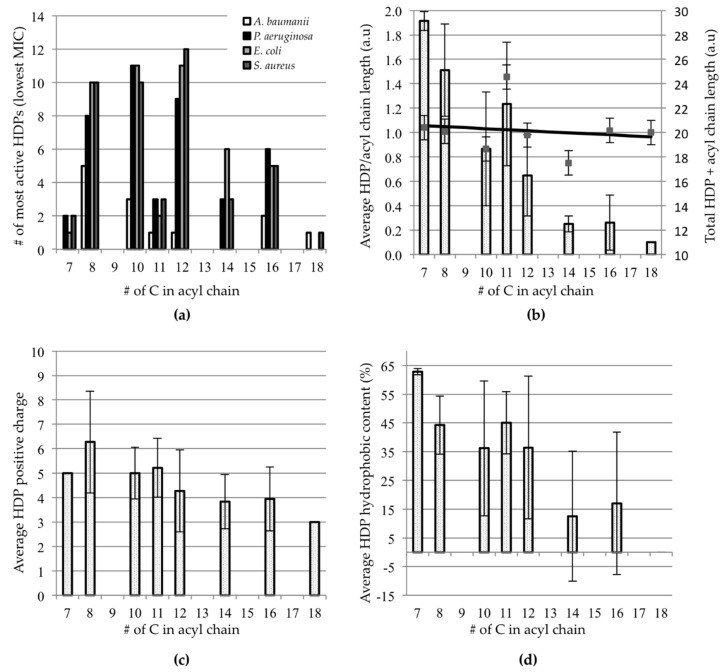 Figure 1
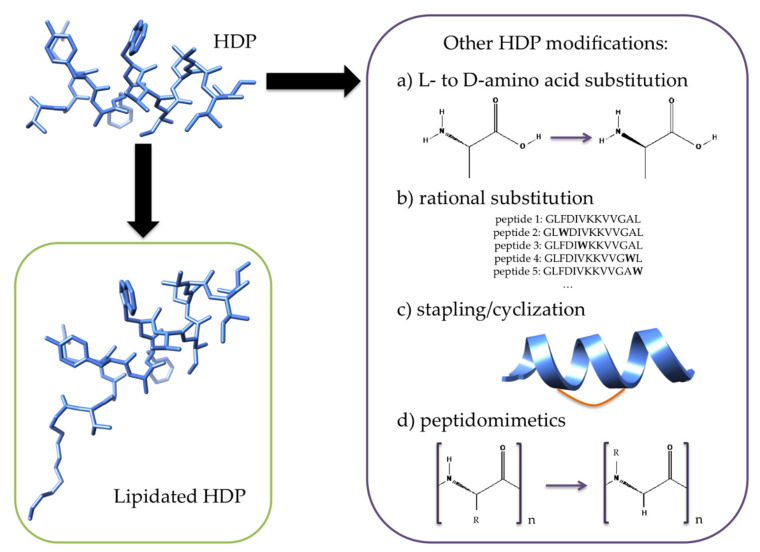 Figure 2
Peer Reviews
No public reviews on file for this paper yet. If you reviewed it on a platform where reviews are public (OpenReview, ICLR, NeurIPS, ICML), you can paste yours below so the community can read it here.
Videos
No videos yet. Explain this paper in a talk, walkthrough, or lecture? Add one.
Taxonomy
TopicsAntimicrobial Peptides and Activities · Biochemical and Structural Characterization · Chemical Synthesis and Analysis