Probing CO2 Reduction Pathways for Copper Catalysis Using an Ionic Liquid as a Chemical Trapping Agent
Gui‐Rong Zhang, Sascha‐Dominic Straub, Liu‐Liu Shen, Yannick Hermans, Patrick Schmatz, Andreas M. Reichert, Jan P. Hofmann, Ioannis Katsounaros, Bastian J. M. Etzold

TL;DR
This paper shows how ionic liquids can help understand how copper catalysts reduce CO2 into different products, offering new insights into the reaction process.
Contribution
The novel use of ionic liquids as a chemical trapping agent to probe CO2 reduction reaction mechanisms on copper catalysts.
Findings
Ionic liquids selectively suppress C2+ products like ethylene and ethanol in CO2 reduction.
The method helps disentangle complex reaction networks by altering product distributions.
This approach provides new guidelines for modulating CO2 reduction reaction properties.
Abstract
The key to fully leveraging the potential of the electrochemical CO2 reduction reaction (CO2RR) to achieve a sustainable solar‐power‐based economy is the development of high‐performance electrocatalysts. The development process relies heavily on trial and error methods due to poor mechanistic understanding of the reaction. Demonstrated here is that ionic liquids (ILs) can be employed as a chemical trapping agent to probe CO2RR mechanistic pathways. This method is implemented by introducing a small amount of an IL ([BMIm][NTf2]) to a copper foam catalyst, on which a wide range of CO2RR products, including formate, CO, alcohols, and hydrocarbons, can be produced. The IL can selectively suppress the formation of ethylene, ethanol and n‐propanol while having little impact on others. Thus, reaction networks leading to various products can be disentangled. The results shed new light on the…
Genes, proteins, chemicals, diseases, species, mutations and cell lines named across the full text — each resolved to its canonical identifier and authoritative record.
Click any figure to enlarge with its caption.
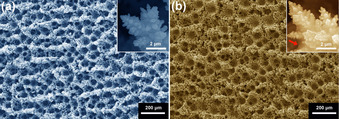 Figure 1
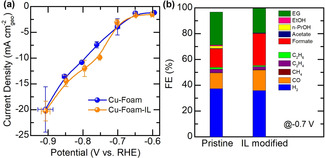 Figure 2
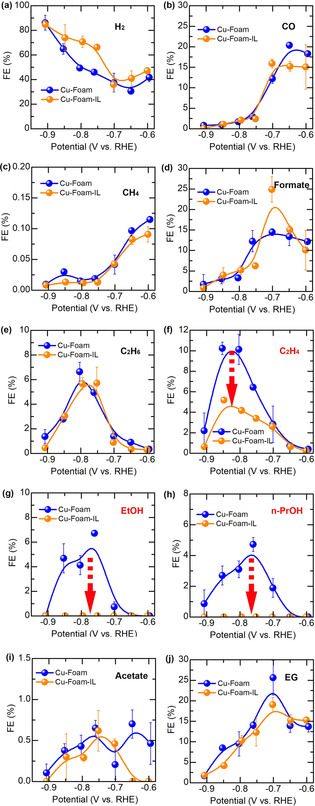 Figure 3
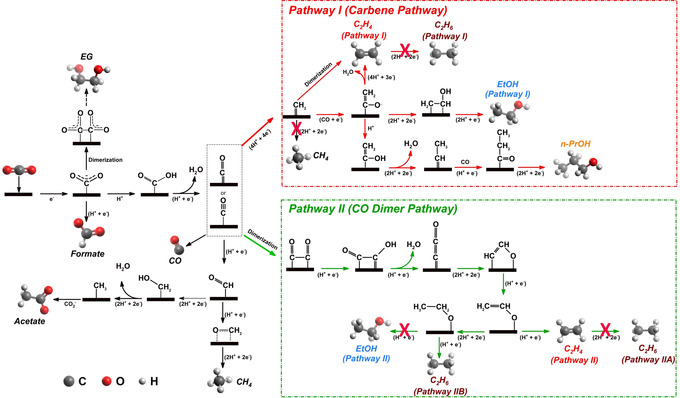 Figure 4
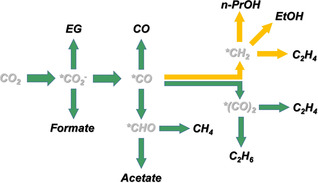 Figure 5
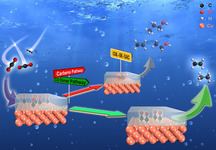 Figure 6
Peer Reviews
No public reviews on file for this paper yet. If you reviewed it on a platform where reviews are public (OpenReview, ICLR, NeurIPS, ICML), you can paste yours below so the community can read it here.
Videos
No videos yet. Explain this paper in a talk, walkthrough, or lecture? Add one.
Taxonomy
TopicsCO2 Reduction Techniques and Catalysts · Ionic liquids properties and applications · Carbon dioxide utilization in catalysis