Shifting material source of Chinese loess since ~2.7 Ma reflected by Sr isotopic composition
Wenfang Zhang, Jun Chen, Gaojun Li

TL;DR
This study shows that the source of dust on the Chinese Loess Plateau shifted over millions of years, which has implications for understanding long-term climate changes.
Contribution
The study identifies a gradual shift in dust sources from the Qilian to the Gobi Altay Mountains over the past 2.7 million years using Sr isotopic analysis.
Findings
The source of eolian dust on the CLP remained unchanged on orbital timescales.
A gradual shift in dust source from Qilian to Gobi Altay Mountains occurred over 2.7 million years.
Tectonic uplift and climate changes, including winter monsoon intensification, influenced the dust source shift.
Abstract
Deciphering the sources of eolian dust on the Chinese Loess Plateau (CLP) is fundamental to reconstruct paleo-wind patterns and paleo-environmental changes. Existing datasets show contradictory source evolutions of eolian dust on the CLP, both on orbital and tectonic timescales. Here, the silicate Sr and Nd isotopic compositions of a restricted grain size fraction (28–45 μm) were measured to trace the source evolution of the CLP since ~2.7 Ma. Our results revealed an unchanged source on orbital timescales but a gradual source shift from the Qilian Mountains to the Gobi Altay Mountains during the past 2.7 Ma. Both tectonic uplift and climate change may have played important roles for this shift. The later uplift of the Gobi Altay Mountains relative to the Qilian Mountains since 5 ± 3 Ma might be responsible for the increasing contribution of Gobi materials to the source deserts in Alxa…
Genes, proteins, chemicals, diseases, species, mutations and cell lines named across the full text — each resolved to its canonical identifier and authoritative record.
Click any figure to enlarge with its caption.
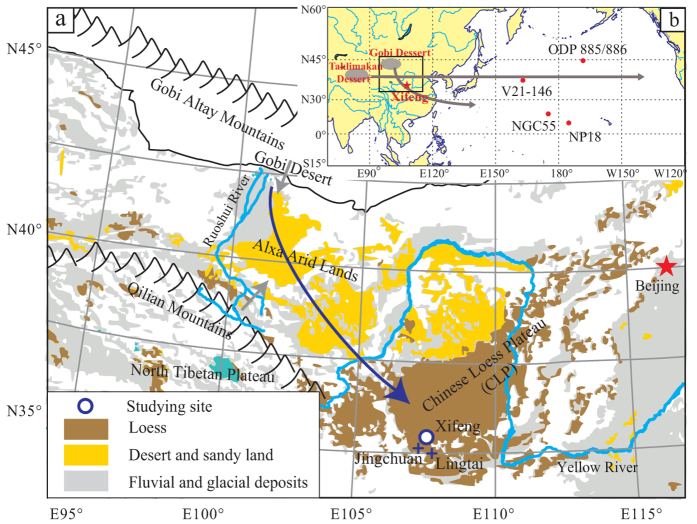 Figure 1
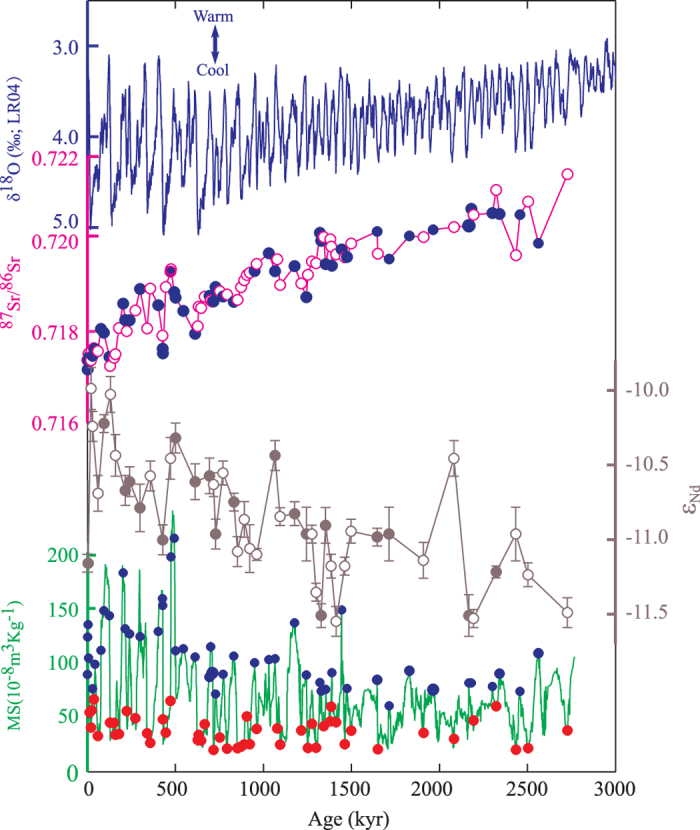 Figure 2
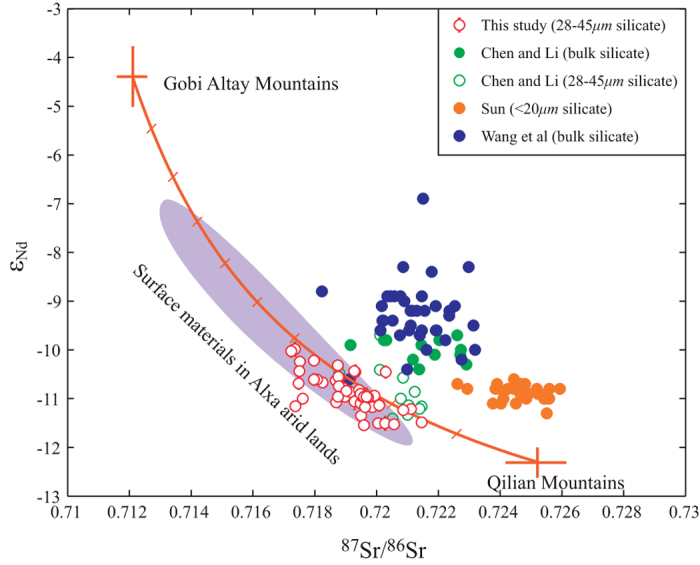 Figure 3
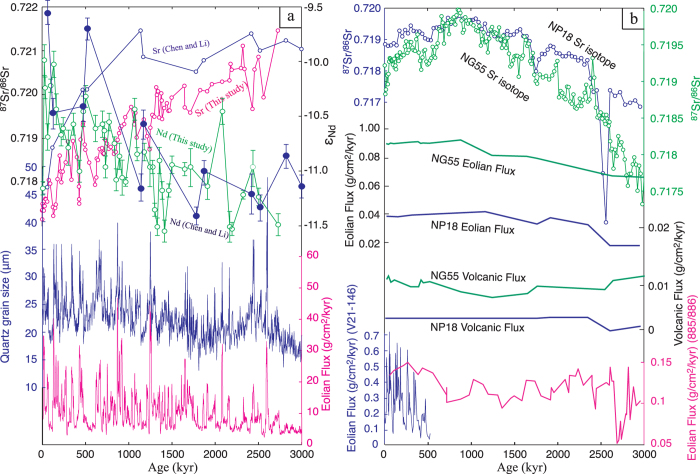 Figure 4
Peer Reviews
No public reviews on file for this paper yet. If you reviewed it on a platform where reviews are public (OpenReview, ICLR, NeurIPS, ICML), you can paste yours below so the community can read it here.
Videos
No videos yet. Explain this paper in a talk, walkthrough, or lecture? Add one.
Taxonomy
TopicsGeology and Paleoclimatology Research · Geology and Paleoclimatology Research · Aeolian processes and effects
The eolian deposits on the Chinese Loess Plateau (CLP) provide a valuable archive for paleo-environmental changes12. The CLP began to receive massive atmospheric dust since at least the late Oligocene34, which has been affected by three notably prominent exogenic processes of the late Cenozoic, namely the uplift of Tibetan Plateau, the Cenozoic cooling, and the retreat of the Paratethys567. Many of paleo-proxies have been developed assuming an unchanged source region8910. Thus, source research is crucial to understand the paleo-proxies developed for the loess deposits on the CLP.
The radiogenic isotopic tracers, such as Nd, Sr and Pb isotopes, have been widely used to trace the source of eolian dust on the CLP and its response to the tectonic and climatic oscillations1112131415. Combined with other mineral and geochemical tracers16171819, a similar conclusion seems to be reached in recent years that Alxa arid lands, which receive materials mainly from the Gobi Altay Mountains to its north and the Qilian Mountains to its south through fluvial systems^13^, are the main source regions for the late-Pleistocene loess20. However, it is still controversial that whether the detrital source of eolian dust on the CLP changed on both orbital and tectonic timescales.
According to the unchanged Nd isotopes, Jahn et al.21 suggested no provenance shift on orbital timescales. In contrast, the electron spin resonance signal intensity and crystallinity index of fine-grained quartz and detrital zircon ages suggested that the provenance of loess and paleosol on the CLP is heterogeneous and spatially variable at least during last glacial-interglacial cycle172223. Recently, Che and Li19 reported more datasets of detrital zircon ages with less statistical uncertainties; Nie and Peng24 conducted detailed studies on the assemblage of heavy minerals. Both of the two studies indicated no glacial-interglacial and spatial change in eolian source for the loess on the CLP. These controversies may be originated from the different size fractions of dust particles on the CLP, as the electron spin resonance signal intensity and crystallinity index are based on fine-grained quartz, while detrital zircon age distributions and heavy minerals analysis are based on the coarse particles.
On tectonic timescales, the shifting Sr, Nd, and Pb isotopic compositions of the <20 μm silicate fractions at the boundary of loess-paleosol and red clay indicated a source shift possibly in response to the gradual additions of relatively young orogenic materials by glacial grinding in central Asia1525. However, Wang et al.26 argued that the decreasing ^87^Sr/^86^Sr ratios over the past 2.5 Ma may reflect increasing grain size rather than source shift while the small changes in ε_Nd_ values might be within the external analytical error. Considering the relatively small variations of Nd isotopic composition of the source materials, the controversies on the source shift of Asian dust might be solved by Sr isotopic composition when the influence of grain size and pedogenic alternation on the ^87^Sr/^86^Sr ratio are carefully considered.
The Sr isotopic composition of sediments can be strongly dependent on the grain size distribution and chemical weathering2728. The influence of grain size on the ^87^Sr/^86^Sr ratio may be excluded by using restricted grain size fraction. Previous investigation indicates that the grain size effect is mainly contributed by the clay minerals in the <2 μm size fraction28. The <2 μm clay fraction has much higher ^87^Sr/^86^Sr ratio than the >2 μm fractions while the >2 μm fractions have very similar ^87^Sr/^86^Sr ratios due to the limited changes in the content of clay minerals28. Thus, the usage of <20 μm size fraction in tracing dust sources25 may exaggerate the influence of grain size change on the ^87^Sr/^86^Sr ratio. Recently, Chen and Li14 used the silicate Sr isotopic compositions of a specific grain size (28–45 μm) fraction as a sensitive source tracer. Combined with Nd isotopic composition, they concluded that this specific grain size Sr isotopic composition is mainly controlled by the source change other than eolian sorting14. The data of Chen and Li14 indicated the source shift of the CLP over the past 2.6 Ma, but the details of the source shift are still unclear due to the low-resolution data (only 10 data point).
This work provides a high-resolution (~30 thousand years per sample) silicate Sr isotopic records of the 28–45 μm grain size fraction of the eolian dust on the CLP since ~2.7 Ma. Combined with Nd isotopic data, the paper aims to constrain the source evolution of the eolian deposits on the CLP on both orbital and tectonic timescales. This work also discusses the possible source shift of Asian dust reflected in the Pacific sediments, based on the ^87^Sr/^86^Sr data of eolian dust extracted from the north Pacific sediments in previous study29.
Results
Samples for Sr and Nd analysis were collected from the Xifeng site (35.45 °N, 107.49 °E) on the central CLP (Fig. 1a) and the locations of the Pacific sites cited for comparisons are illustrated in Fig. 1b. The ^87^Sr/^86^Sr ratios of the 28–45 μm silicate fractions (donated as ^87^Sr/^86^Sr* hereafter) of the loess and paleosol samples show a gradually decreasing trend of about 0.004 since ~2.7 Ma (Supplementary Table S1; Fig. 2). No obvious glacial-interglacial variations in ^87^Sr/^86^Sr* have been observed based on neighboring loess and paleosol samples. The gradually decreasing trend of ^87^Sr/^86^Sr* since ~2.7 Ma is consistent with the records in Jingchuan and Lingtai sections142526 (Fig. 3). The mean value of ^87^Sr/^86^Sr* in this study (0.718978, n = 97) is slightly lower than that of Lingtai site (0.720292, n = 10) by Chen and Li14 based on the same grain size fraction. As expected, the mean value of ^87^Sr/^86^Sr* in this study (0.718978, n = 97) is about 0.006 lower than that of the <20 μm silicate fractions of the Jingchuan section (0.724730, n = 66)25 and is 0.002 lower than that of the bulk silicate fractions of the Lingtai section (0.721130, n = 43)26. Opposite trends of ^87^Sr/^86^Sr ratio between the Xifeng section and the Pacific cores have been observed during 3 and 0.8 Ma (Fig. 1b and Fig. 4). However, the CLP records and Pacific cores show similar decreasing trend of the ^87^Sr/^86^Sr ratio of Asian dust since 0.8 Ma (Fig. 4a and Fig. 4b). The ε_Nd_ value of Xifeng section shows an increasing trend by 1.5ε unit since ~2.7 Ma (Supplementary Table S2; Fig. 2).
Discussion
The limited variations of ^87^Sr/^86^Sr* between the neighboring loess and paleosol layers (Fig. 2) imply an unchanged eolian source on the CLP during the glacial-interglacial cycles. However, it may be argued that ^87^Sr/^86^Sr* is not sensitive enough to reflect the subtle source changes and the influence of source shifts on ^87^Sr/^86^Sr* is offset by the effect of grain size changes (Fig. 4). We think such possibilities are very unlikely since potential source shift to the Gobi Altay Mountains17 would largely decrease ^87^Sr/^86^Sr* due to the low ^87^Sr/^86^Sr ratio of Gobi materials11131420. The possible increasing grain size in the 28–45 μm fraction during glacial times3031 will decrease the ^87^Sr/^86^Sr ratio.
It has been shown that the ^87^Sr/^86^Sr ratio of the clay particles is about 0.006 higher than that of other grain size fractions11, but the maximum variation of grain size would only introduce less than 0.001 change in the ^87^Sr/^86^Sr ratios of bulk silicate1420. Thus, the observed 0.004 shift of the ^87^Sr/^86^Sr* over the past 2.7 Ma (Fig. 2) may not introduced by sorting process but mainly reflect source change. The primary control of source shift on ^87^Sr/^86^Sr* is also supported by the long term shift in ε_Nd_ values (Fig. 2). Unlike Sr isotope, Nd isotope has been commonly used as a robust source tracer with minimal effects from mineral sorting27. The negative correlation between Nd and Sr isotopes lies on the binary mixing line between the Gobi Altay Mountains and the Qilian Mountains (Fig. 3), confirming binary source evolution of the eolian deposits on the CLP131419. Thus, the gradual decreasing ^87^Sr/^86^Sr* and increasing ε_Nd_ values reflect a gradual source shift of the CLP from the Qilian Mountains to the Gobi Altay Mountains since ~2.7 Ma (Fig. 3).
The source shift of eolian dust on the CLP over the past ~2.7 Ma might be related to tectonic and climatic changes. It has been shown that the CLP receives eolian dust mainly from the Alxa arid lands by prevailing near surface winds1314 (Fig. 1a). However, Alxa arid lands only act a sediment holder rather than a producer. It receives materials mainly from the Gobi Altay Mountains and the Qilian Mountains through fluvial systems13. Mountain processes are the most important mechanisms that produce the silt particle of the loess deposits32. Mountain erosion is a strong function of relief33. The differential uplift history between the Qilian Mountains and the Gobi Altay Mountains may have modulated the relative contribution of debris from the two mountains to the CLP. Considering a relative stable Gobi Altay Mountains, the progressive uplift of North Tibetan Plateau has been inferred to explain the decreasing ε_Nd_ values of Asian dust since the middle Miocene13. However, the evidence of late Pliocene uplift of the Tibetan Plateau is controversial34. The uplift of the Gobi Altay Mountains since 5 ± 3 Ma35 may increase the relative material contribution of the Gobi materials to the Alxa arid lands, and finally the CLP.
The decreasing trend of ^87^Sr/^86^Sr* over the past ~2.7 Ma also seems to match the gradual cooling trend of global climate or growth of Northern Hemisphere glaciations as reflected by the oxygen isotope of benthic foraminifera36 (Fig. 2), implying control of climate change on the source shift. Climate change may modulate the eolian source on the CLP by several means. Global cooling is normally accompanied with the drop of snow line and growth of mountain glacial. Glaciation is one of the most efficient ways of physical erosion37. Thus, the glacial on the Gobi Altay Mountains produced more materials to the Alxa arid lands. Strengthened Siberia High and thus Asian winter monsoon73031 in response to global cooling would transport more materials38 from the Gobi Altay Mountains to the Alxa arid lands (Fig. 4a and Fig. 1a).
The source shift of eolian dust on the CLP might be reflected in the Pacific sediments. Previous studies indicated that the eolian dust in the north central Pacific sediments is mainly derived from the arid lands of Asian interior through westerly winds while the dust deposited in circum-Pacific regions is dominated by volcanic ash39. Taklimakan desert in northwest China is suggested to be one of the most important sources for long-range eolian dust transport by westerly jet stream404142. Occasionally, Gobi dust can also be lifted into the middle troposphere and transport to East Asia and north Pacific Oceans43 (Fig. 1b).
The pacific sediments show very different evolutionary patterns of Sr isotopic composition compared to the loess on the CLP (Fig. 4a and Fig. 4b). It has been noticed that the north central Pacific sediments are the mixtures of eolian dust from Asian interior arid areas with more radiogenic Sr isotopic composition and volcanic ash with less radiogenic Sr isotopic composition2939. Considering a relatively constant volcanic activity over the past 3 Ma44, the increasing ^87^Sr/^86^Sr ratios of pacific sediments between 3 and ~0.8 Ma might be caused by increasing Asian dust flux in response to aridification of Asian interior since ~2.7 Ma (Fig. 4b). The decreasing ^87^Sr/^86^Sr ratios since ~0.8 Ma may attribute to the increasing addition of the Gobi dust because contribution of Asian dust dominated the eolian deposits during this period and thus the ^87^Sr/^86^Sr ratio is not sensitive to the changing relative contribution of Asian dust and volcanic ash. The Earth’s climate changed fundamentally after middle Pleistocene transition with the dominant periodicity of glacial cycles shifting from 41 ka to 100 ka45. The full glacial climate after middle Pleistocene transition strengthened winter monsoon, which transported more materials from the Gobi Altay Mountains with lower ^87^Sr/^86^Sr ratios to the Pacific Oceans. The increasing eolian flux in the Pacific core V21–14646 since ~0.5 Ma and ODP site 885/88647 since ~0.8 Ma may have conformed to this climate evolution (Fig. 1b and Fig. 4b).
Methods
The eolian deposits at the Xifeng site consist of tens of loess and paleosol alternations deposited over the past ~2.7 Ma and the red-clay formation aged from ~6.2 Ma to ~2.7 Ma. The chronology of loess and paleosol deposits have been well constrained by magnetostratigraphy48 as well as orbital tuning based on climate proxies of grain size and magnetic susceptibility30.
The 97 samples for Sr isotopic analysis are selected based on magnetic susceptibility (Fig. 2). Paleosol layers are characterized by high magnetic susceptibility due to the enhanced pedogenesis during the warm and wet interglacial period while loess layers of low magnetic susceptibility are product of glacial climate49. Both samples of high and low magnetic susceptibility are selected for most of the loess and paleosol alternations. The purpose of this sampling strategy is two fold. The neighboring loess layer and paleosol layer have very different grain sizes. Such difference is even larger than the long-term shift of grain size over the past 2.7 Ma50. Thus, the samples of neighboring loess and paleosol may help to examine if the restricting 28–45 μm grain-size would eliminate the effect of grain size on the ^87^Sr/^86^Sr signal. Second, the glacial loess may have different eolian source compared to the interglacial paleosol22. Thus, the sampling strategy could also eliminate possible bias of the samples to loess or paleosol layers, which enables us to detect the long-term source shift over the past ~2.7 Ma.
To remove carbonate fraction, the selected samples were dissolved in diluted acetic acid (0.5 mol/L) after Chen et al.11 in the ultrasonic bath for about 10 minutes. Then, the remaining silicate fractions were sieved to obtain 28–45 μm grain size fraction. The extracted 28–45 μm silicate fractions were digested in a mixture of HNO_3_+HF solution. The Sr and Nd elements in the digested solution were then purified using standard ion exchange techniques. The determination of Sr and Nd isotopes were preformed on a Neptune plus Multi-Collector Inductively Coupled Plasma Mass Spectrometer (MC-ICP-MS) at the Department of Earth Sciences, Nanjing University. Instrumental bias was corrected to ^86^Sr/^88^Sr of 0.1194 and ^146^Nd/^144^Nd of 0.7219, respectively. The Sr standard SRM987 and Nd standard JMCNd_2_O_3_ were periodically measured to check the reproducibility and accuracy of isotopic analyses with mean ^87^Sr/^86^Sr ratio of 0.7102387 ± 42 (external standard deviation, n = 10) and mean ^143^Nd/^144^Nd ratio of 0.5120997 ± 15, respectively. Epsilon Nd values (ε_Nd_) were calculated using chondritic values of ^143^Nd/^144^Nd = 0.51263851. The analytical results and samples information are listed in Supplementary Table S1 and Supplementary Table S2.
Additional Information
How to cite this article: Zhang, W. et al. Shifting material source of Chinese loess since ~ 2.7 Ma reflected by Sr isotopic composition. Sci. Rep. 5, 10235; doi: 10.1038/srep10235 (2015).
Supplementary Material
Supporting Information
The reference list from the paper itself. Each links out to its DOI / PubMed record.
- 1An Z. S. The history and variability of the East Asian paleomonsoon climate. Quatern. Sci. Rev. 19, 171–187, 10.1016/S 0277-3791(99)00060-8 (2000). · doi ↗
- 2Chen J. et al. Zr/Rb ratio in the Chinese loess sequences and its implication for changes in the East Asian winter monsoon strength. Geochim. Cosmochim. Ac 70, 1471–1482, 10.1016/j.gca.2005.11.029 (2006). · doi ↗
- 3Guo Z. T. et al. Onset of Asian desertification by 22 Myr ago inferred from loess deposits in China. Nature 416, 159-163 , 10.1038/416159 a (2002).11894089 · doi ↗ · pubmed ↗
- 4Qiang X. K. et al. New eolian red clay sequence on the western Chinese Loess Plateau linked to onset of Asian desertification about 25 Ma ago. Sci China Earth Sci 54, 136–144, 10.1007/s 11430-010-4126-5 (2011). · doi ↗
- 5An Z. S., Kutzbach J. E., Prell W. L. & Porter S. C. Evolution of Asian monsoons and phased uplift of the Himalayan Tibetan plateau since Late Miocene times. Nature 411, 62–66, 10.1038/35075035 (2001).11333976 · doi ↗ · pubmed ↗
- 6Ding Z. L., Derbyshire E., Yang S. L., Sun J. M. & Liu T. S. Stepwise expansion of desert environment across northern China in the past 3.5 Ma and implications for monsoon evolution. Earth Planet Sc. Lett. 237, 45–55, 10.1016/j.epsl.2005.06.036 (2005). · doi ↗
- 7Ramstein G., Fluteau F., Besse J. & Joussaume S. Effect of orogeny, plate motion and land sea distribution on Eurasian climate change over the past 30 million years. Nature 386, 788–795 (1997).
- 8Chen J., An Z. S. & Head J. Variation of Rb/Sr Ratios in the Loess-Paleosol Sequences of Central China during the Last 130,000 Years and Their Implications for Monsoon Paleoclimatology. Quatern. Res. 51, 215–219 (1999).