Wrist disarticulation associated with Monteggia fracture
Monsef El Abdi, Jonathan Bassinga

Abstract
Genes, proteins, chemicals, diseases, species, mutations and cell lines named across the full text — each resolved to its canonical identifier and authoritative record.
Click any figure to enlarge with its caption.
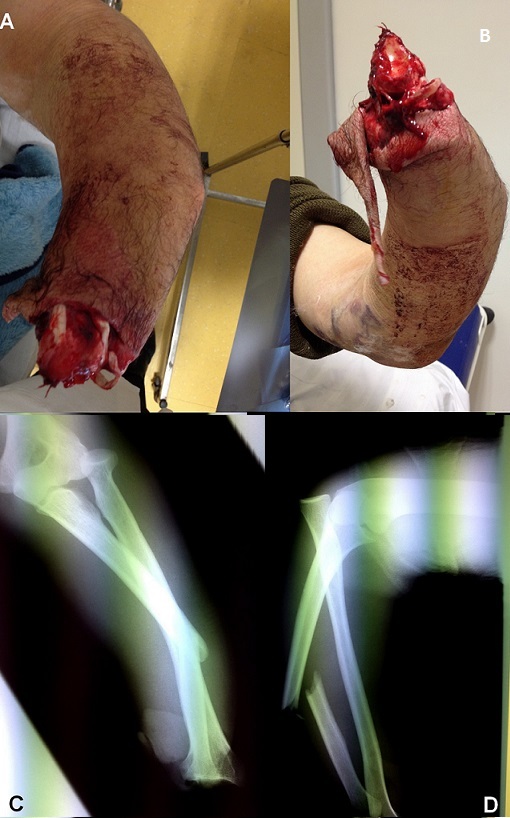 Figure 1
Peer Reviews
No public reviews on file for this paper yet. If you reviewed it on a platform where reviews are public (OpenReview, ICLR, NeurIPS, ICML), you can paste yours below so the community can read it here.
Videos
No videos yet. Explain this paper in a talk, walkthrough, or lecture? Add one.
Taxonomy
TopicsElbow and Forearm Trauma Treatment · Orthopedic Surgery and Rehabilitation · High-Velocity Impact and Material Behavior
Image in medicine
A 50-year-old man, right-handed farmer, was admitted to the emergency department after undergoing an agriculture accident. Physical examination on admission revealed a left wrist disarticulation with a deformity of the ipsilateral elbow and forearm (A and B). Plain radiography showed a fracture of the ulna shaft as well as dislocation of the radial head. This radiological finding, also called Monteggia fracture-dislocation, was associated with a radiocarpal amputation of wrist-joint (C and D). Monteggia fracture-dislocation with wrist amputation is an uncommon condition. The patient was treated successfully with closed reduction of the elbow dislocation and internal fixation of the ulna fracture. The evolution was satisfactory.
(A and B) clinical features in patient at admission showing wrist disarticulation with a deformition of the elbow and forearm; (C and D) radiography objectified a Monteggia fracture-dislocation with a radiocarpal amputation of wrist-joint