Researches on Mathematical Relationship of Five Elements of Containing Notes and Fibonacci Sequence Modulo 5
Zhaoxue Chen

TL;DR
This paper explores a mathematical link between traditional Chinese medicine concepts and the Fibonacci sequence modulo 5.
Contribution
The study introduces new number series and arrangements linking TCM's five elements to Fibonacci patterns modulo 5.
Findings
Key number series 12534 and 31542 were derived from Fibonacci sequence modulo 5.
Three new arrangements of the five elements of containing notes correlate with these Fibonacci subsequences.
The findings suggest a novel mathematical basis for traditional Chinese medicine theories.
Abstract
Considering the five periods and six qi's theory in TCM almost shares a common basis of stem-branch system with the five elements of containing notes, studying the principle or mathematical structure behind the five elements of containing notes can surely bring a novel view for the five periods and six qi's researches. By analyzing typical mathematical rules included in He tu, Luo shu, and stem-branch theory in TCM as well as the Fibonacci sequence especially widely existent in the biological world, novel researches are performed on mathematical relationship between the five elements of containing notes and the Fibonacci sequence modulo 5. Enlightened by elementary Yin or Yang number grouping principle of He tu, Luo shu, the 12534 and 31542 key number series of Fibonacci sequence modulo 5 are obtained. And three new arrangements about the five elements of containing notes are then…
Genes, proteins, chemicals, diseases, species, mutations and cell lines named across the full text — each resolved to its canonical identifier and authoritative record.
Click any figure to enlarge with its caption.
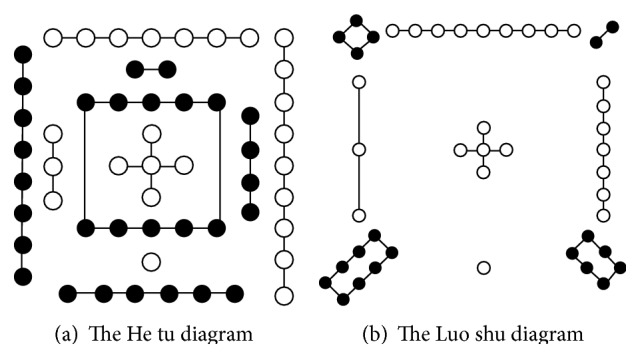 Figure 1
Peer Reviews
No public reviews on file for this paper yet. If you reviewed it on a platform where reviews are public (OpenReview, ICLR, NeurIPS, ICML), you can paste yours below so the community can read it here.
Videos
No videos yet. Explain this paper in a talk, walkthrough, or lecture? Add one.
Taxonomy
TopicsFractal and DNA sequence analysis · Machine Learning in Bioinformatics