An update of the macaque testis proteome
Tao Zhou, Yueshuai Guo, Zuomin Zhou, Xuejiang Guo, Jiahao Sha

TL;DR
This paper updates the rhesus macaque testis proteome to improve genome annotation and understanding of spermatogenesis.
Contribution
The study provides a refined and expanded testis proteome with evidence for predicted genes and Y chromosome proteins.
Findings
74,433 peptides corresponding to 9,247 protein groups were identified.
The dataset supports proteogenomic annotation of the macaque genome.
It offers insights into the mechanisms of macaque spermatogenesis.
Abstract
The genome sequence of rhesus macaque is a draft version with many errors and is lack of Y chromosome annotation. In the present dataset, we reanalyzed the previously published macaque testis proteome. We searched for refined protein sequences, potential Y chromosome proteins and transcripts predicted proteins in addition to the latest Ensembl protein sequences of macaque. A total of 74,433 peptides corresponding to 9247 protein groups were identified, and the data are supplied in this paper. The updated version of macaque testis proteome provided evidences for predicted genes or transcripts at the peptide level. It can be used for further in-depth proteogenomic annotation of macaque genome and is useful for studying the mechanisms of macaque spermatogenesis.
Genes, proteins, chemicals, diseases, species, mutations and cell lines named across the full text — each resolved to its canonical identifier and authoritative record.
Click any figure to enlarge with its caption.
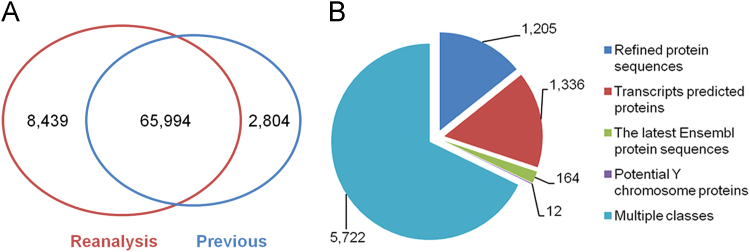 Figure 1
Peer Reviews
No public reviews on file for this paper yet. If you reviewed it on a platform where reviews are public (OpenReview, ICLR, NeurIPS, ICML), you can paste yours below so the community can read it here.
Videos
No videos yet. Explain this paper in a talk, walkthrough, or lecture? Add one.
Taxonomy
TopicsGenetic and Clinical Aspects of Sex Determination and Chromosomal Abnormalities · Immunotherapy and Immune Responses · Sperm and Testicular Function
Specifications tableTableSubject areaBiologyMore specific subject areaReproductive biologyType of dataTableHow data was acquiredMass spectroscopy, LTQ Orbitrap Velos (ThermoFinnigan, San Jose, CA)Data formatAnalyzedExperimental factorsProtein samples were reduced with 5 mM DTT, alkylated with 14 mM IAA, and digested using sequencing grade trypsin.Experimental featuresDigested peptides were separated using an ion exchange column prior to HPLC–MS/MS with subsequent data analysis of protein identification.Data source locationNanjing, ChinaData accessibilityThe data are with this paper.
Value of the data
- •The macaque testis proteome was reanalyzed using refined and integrated protein sequences.
- •A total of 8439 new peptides than previously reported were identified.
- •Novel experimental evidences for the expression of macaque predicted genes and transcripts.
Data, experimental design, materials and methods
1
Experimental design
1.1
The rhesus macaque (Macaca mulatta) is a non-human primate model which is widely applied in biomedical researches including reproductive physiology and male contraception [[1,2]](#bib1 bib2). We previously constructed the proteome of adult macaque testis by liquid chromatography-tandem mass spectrometry (LC-MS/MS) [3]. However, the genome sequence of macaque is a draft version with many errors and is lack of Y chromosome annotation [[4,5]](#bib4 bib5). The protein sequence database for previous macaque testis proteome is released in November 2010 (Ensembl 60) [6]. Recently, a refined macaque genome assembly and the transcriptome of macaque testis were released [7]. Thus, it is necessary to update the proteome to obtain a more precise understanding of the protein composition of macaque testis. In the present dataset, we used the latest sequence databases to reanalyze the proteome of macaque testis.
Materials and methods
2
Testis samples and ethics statement
2.1
Testis samples were obtained from two adult male macaques with normal fertility via operation. All procedures were approved in advance by the Institutional Animal Care and Use Committee of Kunming Biomed International, and the animal facilities were accredited by the Association for Assessment and Accreditation of Laboratory Animal Care International.
Protein extraction and LC-MS/MS analysis
2.2
For protein extraction, decapsulated testes were cut into small pieces and dissolved in 8 M Urea, 75 mM NaCl, 50 mM Tris, 1 mM NaF, 1 mM β-glycerophosphate, 1 mM sodium orthovanadate, 10 mM sodium pyrophosphate, 1 mM PMF, and 1% (v/v) protease inhibitors cocktail. And then testis proteins were extracted via ultrasonic method. The extracted proteins from the two macaques were individually used for subsequent proteomic analyses.
Testis proteins were reduced with 5 mM DTT/25 mM NH_4_HCO_3_ at 56 °C for 20 min, alkylated with 14 mM IAA/25 mM NH_4_HCO_3_ in the dark at room temperature for 30 min. Then the protein mixture was diluted using 25 mM Tris–HCl (pH 8.2) to reduce the concentration of urea to 1.6 M, mixed with trypsin (sequencing grade modified trypsin, Promega, WI, USA) at a trypsin: protein ratio of 1:200, and was incubated at 37 °C overnight. TFA was added at a final concentration of 0.4% to terminate the digestion reaction. Extracts were subjected to C18 SPE on Sep-Pak cartridges. The resulting peptides were dissolved in SCX Buffer A.
The peptide mixture was separated using an ion exchange PolySulfoethyl A HPLC column (2.1 mm ID×20 cm, 5 μm, 200 Å, PolyLC) with the UltiMate® 3000 HPLC systems at a flow rate of 200 μl/min. Peptide analysis was performed using the LTQ Orbitrap Velos (Thermo Finnigan, San Jose, CA) coupled directly to an LC column. An MS survey scan was obtained for the m/z range 350–1800, and MS/MS spectra acquired from the survey scan for the 20 most intense ions (determined using Xcalibur mass spectrometer software in real time). Dynamic mass exclusion windows of 60 s were used, with siloxane (m/z 445.120025) as a lock mass.
Data analysis
2.3
The raw files were processed using MaxQuant version 1.3.0.5 [8]. The database search was performed against the combined sequences from the Ensembl macaque protein sequences (updated in May 2015) [6], the refined macaque protein sequences (MacaM_v7.6.8) [7], conceptual translated protein sequences using macaque transcriptome [7], potential Y chromosome expressed proteins extracted from the UniProt database (updated in June 2015) [9], and the standard MaxQuant contaminant sequences. Carbamidomethyl (C) was set as a fixed modification. Variable modifications were Oxidation (M) and N-term Acetylation (Protein N-term).The mass tolerance for precursor ions was set to 20 ppm at the first search as applied in Maxquant for initial mass recalibration. For the main search, the mass tolerance for precursor ions was set to 6 ppm. The mass tolerance for fragment ions was set to 0.5 Da. Enzyme specificity was set to be fully cleaved by trypsin, and the maximum missed cleavage sites permitted was two. The false discovery rate (FDR) of the identification was estimated by searching against the databases with the reversed amino acid sequences. The site, peptide and protein FDR were all set to 0.01. The minimum peptide length required was six. At least one unique peptide is required for protein report.
Data
3
In summary, a total of 74,433 peptides corresponding to 9247 protein groups were identified as the new version of macaque testis proteome based on the results of two biological replicates. The detailed information including protein accessions, peptide counts, sequence coverage, score, and intensity for each identified protein group is listed in Supplementary Table 1. The detailed information including protein accessions, peptide sequence, charges, score and intensity for each peptide is listed in Supplementary Table 2. Compared with previous study, the present dataset identified 8439 more peptides (Fig. 1A). Most of the novel peptides could be used to refine current macaque gene annotation (Fig. 1B). The updated macaque testis proteome provided evidences for predicted genes or transcripts at the peptide level. It can be used for further in-depth proteogenomic refinement of macaque genome and also provides resources for studying the mechanisms of macaque spermatogenesis.
Funding sources
This work was supported by Grants from the 973 Program (2012CBA01306), and the Chinese Natural Science Funds (81222006).
The reference list from the paper itself. Each links out to its DOI / PubMed record.
- 1Marshall G.R.Ramaswamy S.Plant T.M.Gonadotropin-independent proliferation of the pale type A spermatogonia in the adult rhesus monkey (Macaca mulatta)Biol. Reprod.7320052222291575814910.1095/biolreprod.104.038968 · doi ↗ · pubmed ↗
- 2Vande Voort C.A.Tollner T.L.The efficacy of ultrasound treatment as a reversible male contraceptive in the rhesus monkey Reprod. Biol. Endocrinol.102012812297110610.1186/1477-7827-10-81PMC 3447693 · doi ↗ · pubmed ↗
- 3Wang J.Xia Y.Wang G.Zhou T.Guo Y.In-depth proteomic analysis of whole testis tissue from the adult rhesus macaque Proteomics 142014139314022461063310.1002/pmic.201300149 · doi ↗ · pubmed ↗
- 4Zhang X.Goodsell J.Norgren R.B.Jr.Limitations of the rhesus macaque draft genome assembly and annotation BMC Genom.13201220610.1186/1471-2164-13-206PMC 342647322646658 · doi ↗ · pubmed ↗
- 5Gibbs R.A.Rogers J.Katze M.G.Bumgarner R.Weinstock G.M.Evolutionary and biomedical insights from the rhesus macaque genome Science 31620072222341743116710.1126/science.1139247 · doi ↗ · pubmed ↗
- 6Kinsella R.J.Kahari A.Haider S.Zamora J.Proctor G.Ensembl Bio Marts: a hub for data retrieval across taxonomic space Database (Oxford)20112011 bar 03010.1093/database/bar 030PMC 317016821785142 · doi ↗ · pubmed ↗
- 7Zimin A.V.Cornish A.S.Maudhoo M.D.Gibbs R.M.Zhang X.A new rhesus macaque assembly and annotation for next-generation sequencing analyses Biol. Direct 92014202531955210.1186/1745-6150-9-20PMC 4214606 · doi ↗ · pubmed ↗
- 8Cox J.Mann M.Max Quant enables high peptide identification rates, individualized p.p.b.-range mass accuracies and proteome-wide protein quantification Nat. Biotechnol.262008136713721902991010.1038/nbt.1511 · doi ↗ · pubmed ↗