Carotid sinus massage for diagnosis in narrow QRS tachycardia
I.R. Henkens, K. Zeppenfeld, A.D. Hauer

Abstract
Genes, proteins, chemicals, diseases, species, mutations and cell lines named across the full text — each resolved to its canonical identifier and authoritative record.
Click any figure to enlarge with its caption.
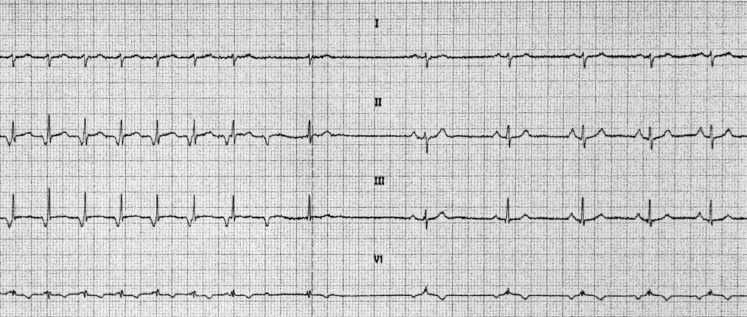 Figure 1
Peer Reviews
No public reviews on file for this paper yet. If you reviewed it on a platform where reviews are public (OpenReview, ICLR, NeurIPS, ICML), you can paste yours below so the community can read it here.
Videos
No videos yet. Explain this paper in a talk, walkthrough, or lecture? Add one.
Taxonomy
TopicsCardiac Arrhythmias and Treatments · Cardiovascular Syncope and Autonomic Disorders · Cerebral Venous Sinus Thrombosis
A 50-year-old woman without a prior medical history was referred to the emergency room by a general practitioner because of palpitations. Two hours before, the patient had experienced her heart suddenly beating faster, but was otherwise feeling well. She was not using any medicine and denied substance abuse. Physical examination did not reveal any abnormalities except for a high pulse frequency. The ECG in Fig. 1 was recorded while performing carotid sinus massage.Fig. 1ECG during carotid sinus massage
Questions
-
What is the most likely diagnosis of the tachycardia?
-
What is the likely origin of the eighth QRS complex?
-
What is the potential explanation for the morphology of the ninth QRS complex?
Answer
You will find the answer elsewhere in this issue.