Ultrafast electron dynamics at the Dirac node of the topological insulator Sb2Te3
Siyuan Zhu, Yukiaki Ishida, Kenta Kuroda, Kazuki Sumida, Mao Ye, Jiajia Wang, Hong Pan, Masaki Taniguchi, Shan Qiao, Shik Shin, Akio Kimura

TL;DR
This paper studies the behavior of electrons near a special point in a material called Sb2Te3, which could help in developing new spintronic devices.
Contribution
The study reveals ultrafast electron dynamics at the Dirac node in Sb2Te3 with a completely unoccupied Dirac point above the Fermi energy.
Findings
Excited electrons in the upper Dirac cone of Sb2Te3 have longer lifetimes than those below the Dirac point.
The reduced density of states near the Dirac point explains the observed inverted population of electrons.
Abstract
Topological insulators (TIs) are a new quantum state of matter. Their surfaces and interfaces act as a topological boundary to generate massless Dirac fermions with spin-helical textures. Investigation of fermion dynamics near the Dirac point (DP) is crucial for the future development of spintronic devices incorporating topological insulators. However, research so far has been unsatisfactory because of a substantial overlap with the bulk valence band and a lack of a completely unoccupied DP. Here, we explore the surface Dirac fermion dynamics in the TI Sb2Te3 by time- and angle-resolved photoemission spectroscopy (TrARPES). Sb2Te3 has an in-gap DP located completely above the Fermi energy (EF). The excited electrons in the upper Dirac cone stay longer than those below the DP to form an inverted population. This was attributed to a reduced density of states (DOS) near the DP.
Genes, proteins, chemicals, diseases, species, mutations and cell lines named across the full text — each resolved to its canonical identifier and authoritative record.
Click any figure to enlarge with its caption.
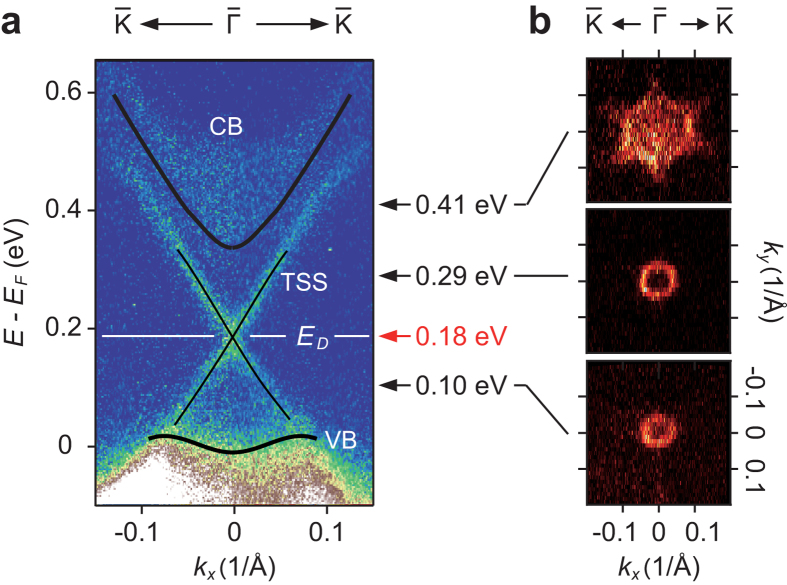 Figure 1
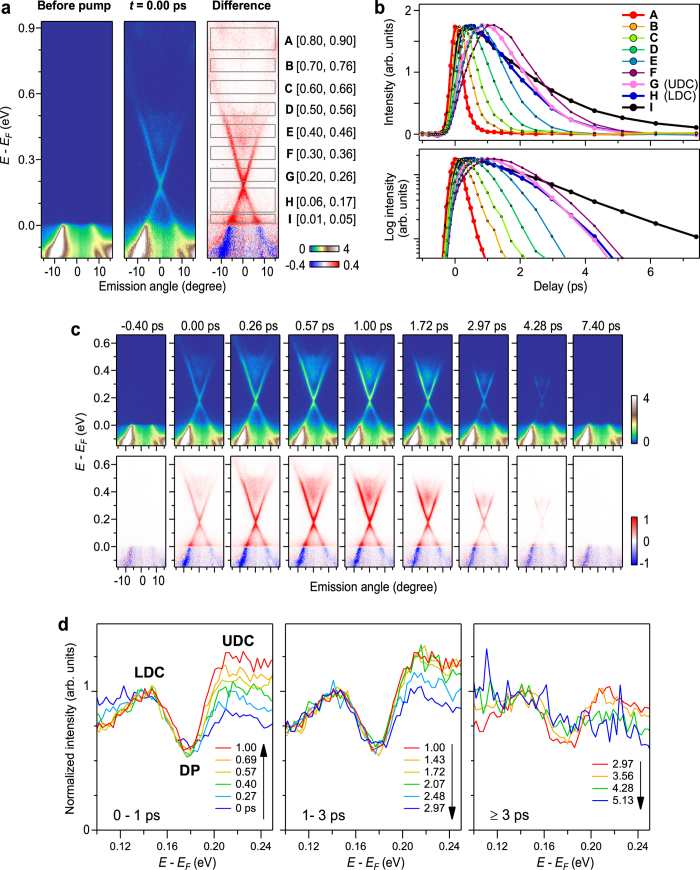 Figure 2
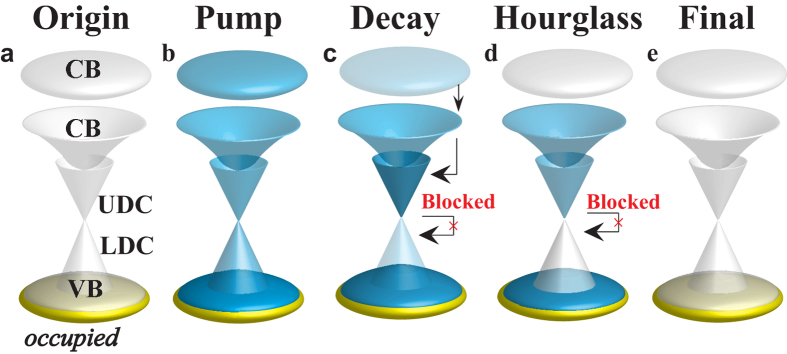 Figure 3
 Figure 4
 Figure 5
 Figure 6
Peer Reviews
No public reviews on file for this paper yet. If you reviewed it on a platform where reviews are public (OpenReview, ICLR, NeurIPS, ICML), you can paste yours below so the community can read it here.
Videos
No videos yet. Explain this paper in a talk, walkthrough, or lecture? Add one.
Taxonomy
TopicsShape Memory Alloy Transformations