GATA2 deficiency in children and adults with severe pulmonary alveolar proteinosis and hematologic disorders
Matthias Griese, Ralf Zarbock, Ulrich Costabel, Jenna Hildebrandt, Dirk Theegarten, Michael Albert, Antonia Thiel, Andrea Schams, Joanna Lange, Katazyrna Krenke, Traudl Wesselak, Carola Schön, Matthias Kappler, Helmut Blum, Stefan Krebs, Andreas Jung, Carolin Kröner

TL;DR
This study shows that GATA2 deficiency can cause severe pulmonary alveolar proteinosis and hematologic disorders, especially in children and adults without GM-CSF auto-antibodies.
Contribution
The study identifies GATA2 mutations as a novel cause of PAP in patients with hematologic disorders and highlights the importance of interdisciplinary collaboration for diagnosis and treatment.
Findings
Half of the GM-CSF auto-antibody negative PAP patients had GATA2 sequence variations, two of which were disease-causing.
Two patients with GATA2 deficiency showed a typical phenotype, including a previously undescribed feature of cholesterol pneumonia.
Successful treatment of a child with MDS and PAP was achieved through whole lung lavages and stem cell transplant.
Abstract
The majority of cases with severe pulmonary alveolar proteinosis (PAP) are caused by auto-antibodies against GM-CSF. A multitude of genetic and exogenous causes are responsible for few other cases. Goal of this study was to determine the prevalence of GATA2 deficiency in children and adults with PAP and hematologic disorders. Of 21 patients with GM-CSF-autoantibody negative PAP, 13 had no other organ involvement and 8 had some form of hematologic disorder. The latter were sequenced for GATA2. Age at start of PAP ranged from 0.3 to 64 years, 4 patients were children. In half of the subjects GATA2-sequence variations were found, two of which were considered disease causing. Those two patients had the typical phenotype of GATA2 deficiency, one of whom additionally showed a previously undescribed feature – a cholesterol pneumonia. Hematologic disorders included chronic myeloic leukemia,…
Genes, proteins, chemicals, diseases, species, mutations and cell lines named across the full text — each resolved to its canonical identifier and authoritative record.
Click any figure to enlarge with its caption.
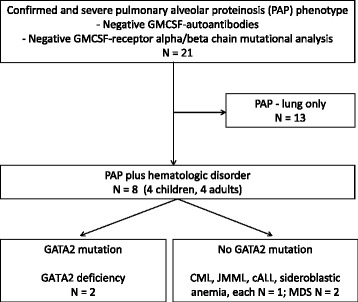 Figure 1
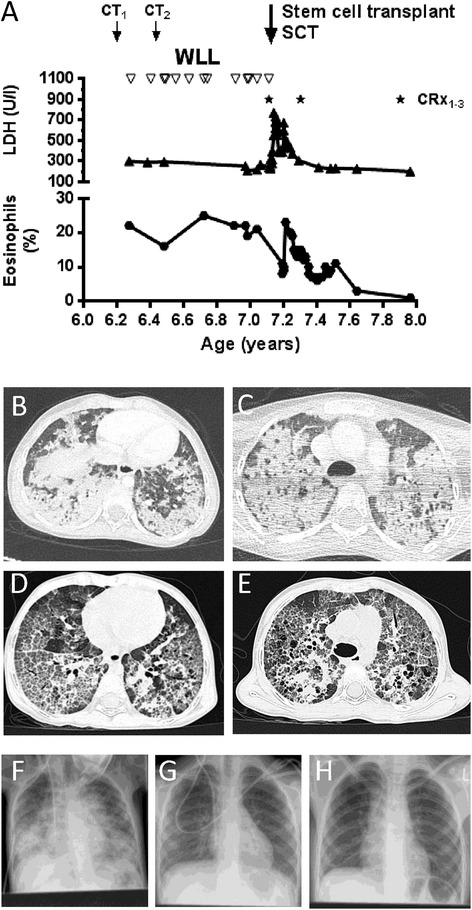 Figure 2
Peer Reviews
No public reviews on file for this paper yet. If you reviewed it on a platform where reviews are public (OpenReview, ICLR, NeurIPS, ICML), you can paste yours below so the community can read it here.
Videos
No videos yet. Explain this paper in a talk, walkthrough, or lecture? Add one.
Taxonomy
TopicsMedieval and Early Modern Iberia · Historical Art and Architecture Studies · Medieval Iberian Studies