Detecting Genetic Interactions for Quantitative Traits Using m-Spacing Entropy Measure
Jaeyong Yee, Min-Seok Kwon, Seohoon Jin, Taesung Park, Mira Park

TL;DR
This paper introduces a new method to detect gene-gene interactions for quantitative traits using entropy measures without assuming specific distribution forms.
Contribution
The novel contribution is a nonparametric method for evaluating conditional entropy to detect genetic interactions in quantitative traits.
Findings
The method successfully identifies main effects and genetic interactions for quantitative traits.
It does not require assuming a specific distribution form like Gaussian for phenotypic data.
The approach is robust and applicable to various phenotypic association data.
Abstract
A number of statistical methods for detecting gene-gene interactions have been developed in genetic association studies with binary traits. However, many phenotype measures are intrinsically quantitative and categorizing continuous traits may not always be straightforward and meaningful. Association of gene-gene interactions with an observed distribution of such phenotypes needs to be investigated directly without categorization. Information gain based on entropy measure has previously been successful in identifying genetic associations with binary traits. We extend the usefulness of this information gain by proposing a nonparametric evaluation method of conditional entropy of a quantitative phenotype associated with a given genotype. Hence, the information gain can be obtained for any phenotype distribution. Because any functional form, such as Gaussian, is not assumed for the entire…
Genes, proteins, chemicals, diseases, species, mutations and cell lines named across the full text — each resolved to its canonical identifier and authoritative record.
Click any figure to enlarge with its caption.
 Figure 1
 Figure 2
 Figure 3
 Figure 4
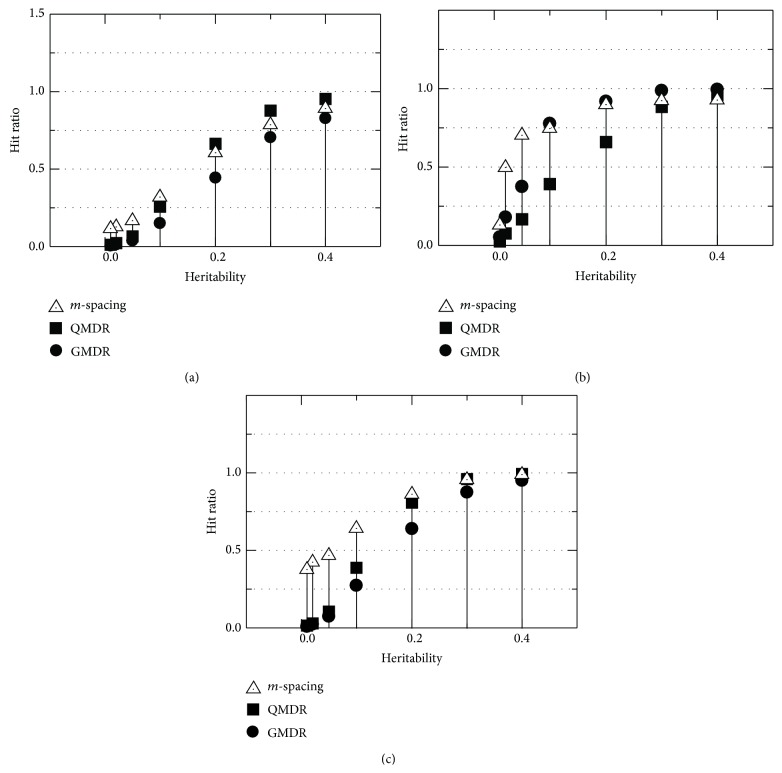 Figure 5
Peer Reviews
No public reviews on file for this paper yet. If you reviewed it on a platform where reviews are public (OpenReview, ICLR, NeurIPS, ICML), you can paste yours below so the community can read it here.
Videos
No videos yet. Explain this paper in a talk, walkthrough, or lecture? Add one.
Taxonomy
TopicsChemical Synthesis and Characterization