Efficient Estimation of Mutation Rates during Individual Development by Minimization of Chi-Square
Shi-Meng Ai, Jian-Jun Gao, Shu-Qun Liu, Yun-Xin Fu

TL;DR
This paper introduces a computationally efficient method to estimate mutation rates during cell divisions in Drosophila melanogaster development.
Contribution
A new chi-square minimization approach is proposed as a computationally efficient alternative to maximum likelihood estimation for mutation rate inference.
Findings
The chi-square minimization method is asymptotically consistent with maximum likelihood estimation.
The new method eliminates computational bottlenecks in mutation rate inference.
Reanalysis of Drosophila mutation data using the new method produced similar mutation rate estimates.
Abstract
Mutation primarily occurs when cells divide and it is highly desirable to have knowledge of the rate of mutations for each of the cell divisions during individual development. Recently, recessive lethal or nearly lethal mutations which were observed in a large mutation accumulation experiment using Drosophila melanogaster suggested that mutation rates vary significantly during the germline development of male Drosophila melanogaster. The analysis of the data was based on a combination of the maximum likelihood framework with numerical assistance from a newly developed coalescent algorithm. Although powerful, the likelihood based framework is computationally highly demanding which limited the scope of the inference. This paper presents a new estimation approach by minimizing chi-square statistics which is asymptotically consistent with the maximum likelihood method. When only at most one…
Genes, proteins, chemicals, diseases, species, mutations and cell lines named across the full text — each resolved to its canonical identifier and authoritative record.
Click any figure to enlarge with its caption.
 Figure 1
 Figure 2
 Figure 3
 Figure 4
 Figure 5
 Figure 6
 Figure 7
 Figure 8
 Figure 9
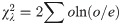 Figure 10
 Figure 11
 Figure 12
 Figure 13
 Figure 14
 Figure 15
 Figure 16
 Figure 17
 Figure 18
 Figure 19
 Figure 20
 Figure 21
 Figure 22
 Figure 23
 Figure 24
 Figure 25
 Figure 26
 Figure 27
 Figure 28
 Figure 29
 Figure 30
 Figure 31
 Figure 32
 Figure 33
 Figure 34
 Figure 35
 Figure 36
 Figure 37
 Figure 38
 Figure 39
 Figure 40
 Figure 41
 Figure 42
 Figure 43
 Figure 44
 Figure 45
 Figure 46
 Figure 47
 Figure 48
 Figure 49
 Figure 50
Peer Reviews
No public reviews on file for this paper yet. If you reviewed it on a platform where reviews are public (OpenReview, ICLR, NeurIPS, ICML), you can paste yours below so the community can read it here.
Videos
No videos yet. Explain this paper in a talk, walkthrough, or lecture? Add one.
Taxonomy
TopicsEvolution and Genetic Dynamics · Chromosomal and Genetic Variations · Genetic diversity and population structure