RAD sequencing and genomic simulations resolve hybrid origins within North American Canis
L. Y. Rutledge, S. Devillard, J. Q. Boone, P. A. Hohenlohe, B. N. White

TL;DR
This study uses DNA analysis to clarify the evolutionary origins of eastern wolves and related species in North America, aiding conservation efforts.
Contribution
The study provides new genomic evidence supporting the eastern wolf as a distinct species and clarifies hybrid origins of related Canis types.
Findings
Eastern wolves are a distinct genomic cluster with no evidence of hybridization with grey wolves or western coyotes.
Genomic simulations reveal the hybrid origins of Great Lakes-boreal wolves and eastern coyotes.
The findings offer critical insights for wolf conservation debates in eastern North America.
Abstract
Top predators are disappearing worldwide, significantly changing ecosystems that depend on top-down regulation. Conflict with humans remains the primary roadblock for large carnivore conservation, but for the eastern wolf (Canis lycaon), disagreement over its evolutionary origins presents a significant barrier to conservation in Canada and has impeded protection for grey wolves (Canis lupus) in the USA. Here, we use 127 235 single-nucleotide polymorphisms (SNPs) identified from restriction-site associated DNA sequencing (RAD-seq) of wolves and coyotes, in combination with genomic simulations, to test hypotheses of hybrid origins of Canis types in eastern North America. A principal components analysis revealed no evidence to support eastern wolves, or any other Canis type, as the product of grey wolf × western coyote hybridization. In contrast, simulations that included eastern wolves as…
Genes, proteins, chemicals, diseases, species, mutations and cell lines named across the full text — each resolved to its canonical identifier and authoritative record.
Click any figure to enlarge with its caption.
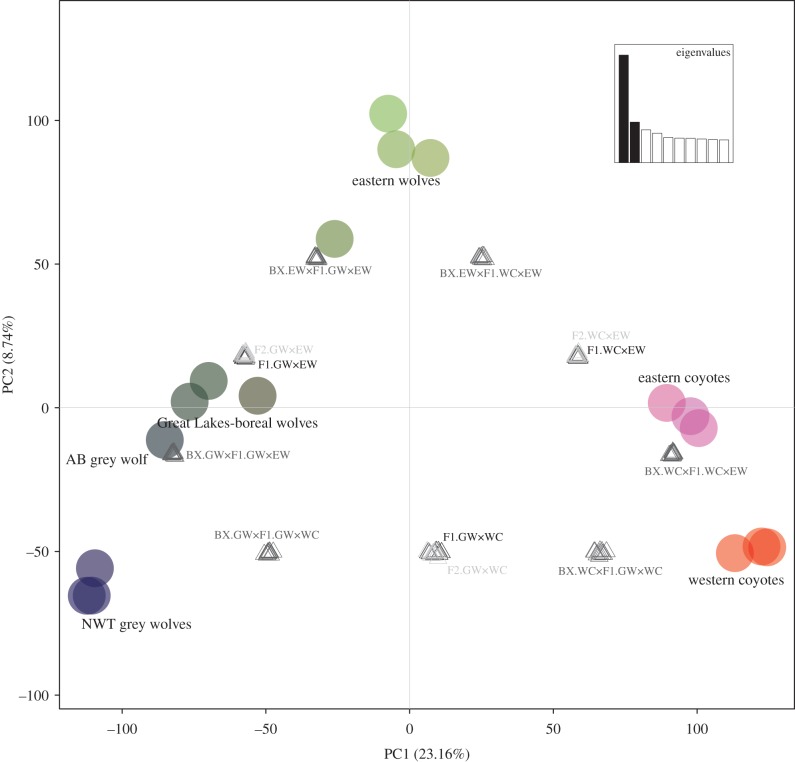 Figure 1
Peer Reviews
No public reviews on file for this paper yet. If you reviewed it on a platform where reviews are public (OpenReview, ICLR, NeurIPS, ICML), you can paste yours below so the community can read it here.
Videos
No videos yet. Explain this paper in a talk, walkthrough, or lecture? Add one.
Taxonomy
TopicsHistorical Linguistics and Language Studies · Spanish Linguistics and Language Studies · Linguistic Studies and Language Acquisition