Confounding dynamic risk taking propensity with a momentum prognostic strategy: the case of the Columbia Card Task (CCT)
Łukasz Markiewicz, Elżbieta Kubińska, Tadeusz Tyszka

TL;DR
The study shows that the HOT version of the Columbia Card Task mixes risk-taking behavior with beliefs about trends, leading to misleading results.
Contribution
The paper reveals that dynamic risk measures like the CCT-HOT are influenced by beliefs in trend continuation, not just risk preference.
Findings
Momentum subjects turn over more cards in the HOT version of the CCT.
The COLD version does not show this trend-based behavior.
Dynamic risk measures may be biased by trend beliefs.
Abstract
Figner et al. (2009) developed the Columbia Card Task (CCT) to measure risk-taking attitudes. This tool consists of two versions: in the COLD version the decision maker needs to state in advance how many cards (out of 32) they want to turn over (so called static risk taking), in the HOT version they have the possibility of turning over all 32 cards one-by-one until they decide to finish (dynamic risk taking). We argue that the HOT version confounds an individual’s willingness to accept risk with their beliefs in trend continuation vs. trend reversal in a prognostic task. In two experimental studies we show that people believing in trend continuation (momentum subjects) turn over more cards than those believing in trend reversal (contrarians) in the HOT version of the task. However, this is not the case in the COLD version. Thus, we provide evidence that, when considered as a dynamic…
Genes, proteins, chemicals, diseases, species, mutations and cell lines named across the full text — each resolved to its canonical identifier and authoritative record.
Click any figure to enlarge with its caption.
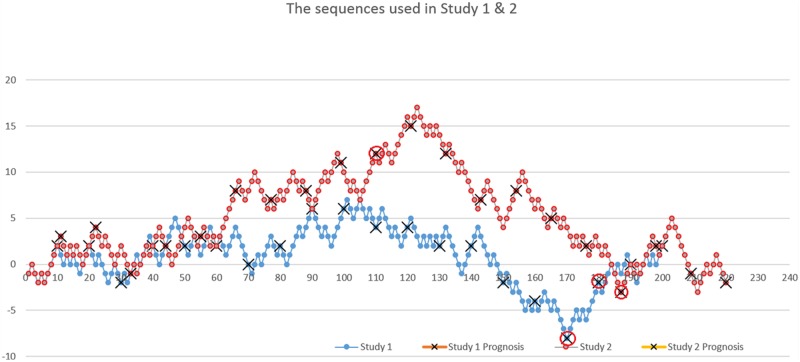 Figure 1
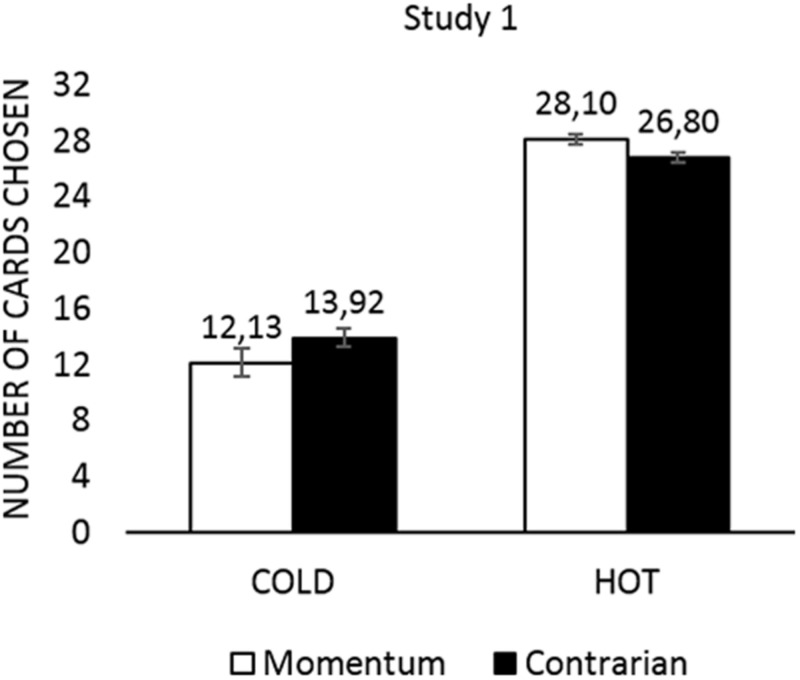 Figure 2
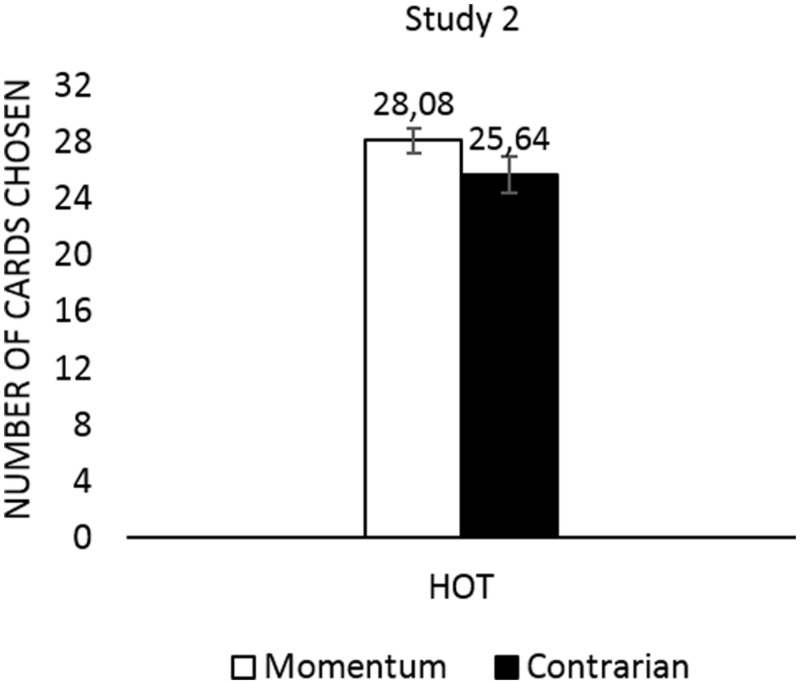 Figure 3
Peer Reviews
No public reviews on file for this paper yet. If you reviewed it on a platform where reviews are public (OpenReview, ICLR, NeurIPS, ICML), you can paste yours below so the community can read it here.
Videos
No videos yet. Explain this paper in a talk, walkthrough, or lecture? Add one.
Taxonomy
TopicsDecision-Making and Behavioral Economics · Decision-Making and Behavioral Economics · Behavioral Health and Interventions