Confident difference criterion: a new Bayesian differentially expressed gene selection algorithm with applications
Fang Yu, Ming-Hui Chen, Lynn Kuo, Heather Talbott, John S. Davis

TL;DR
This paper introduces a new Bayesian method for identifying genes that are differentially expressed between different conditions, which outperforms existing methods in both simulated and real data.
Contribution
The confident difference criterion is a novel Bayesian gene selection algorithm that improves detection of differentially expressed genes.
Findings
The confident difference criterion methods outperform existing methods in identifying differentially expressed genes in simulations.
The proposed methods successfully identified more clinically important genes in a real dataset.
Theoretical connections are established between the new method and Bayes factor approaches under normal-normal models.
Abstract
Recently, the Bayesian method becomes more popular for analyzing high dimensional gene expression data as it allows us to borrow information across different genes and provides powerful estimators for evaluating gene expression levels. It is crucial to develop a simple but efficient gene selection algorithm for detecting differentially expressed (DE) genes based on the Bayesian estimators. In this paper, by extending the two-criterion idea of Chen et al. (Chen M-H, Ibrahim JG, Chi Y-Y. A new class of mixture models for differential gene expression in DNA microarray data. J Stat Plan Inference. 2008;138:387–404), we propose two new gene selection algorithms for general Bayesian models and name these new methods as the confident difference criterion methods. One is based on the standardized differences between two mean expression values among genes; the other adds the differences between…
Genes, proteins, chemicals, diseases, species, mutations and cell lines named across the full text — each resolved to its canonical identifier and authoritative record.
Click any figure to enlarge with its caption.
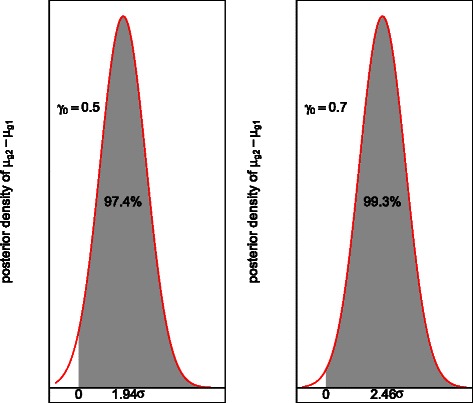 Figure 1
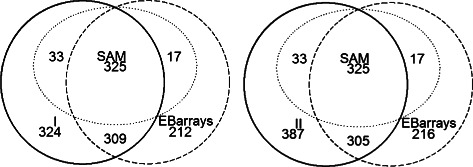 Figure 2
Peer Reviews
No public reviews on file for this paper yet. If you reviewed it on a platform where reviews are public (OpenReview, ICLR, NeurIPS, ICML), you can paste yours below so the community can read it here.
Videos
No videos yet. Explain this paper in a talk, walkthrough, or lecture? Add one.
Taxonomy
TopicsLiterature, Culture, and Aesthetics