Behavioural adaptations of argulid parasites (Crustacea: Branchiura) to major challenges in their life cycle
V.N. Mikheev, A.F. Pasternak, E.T. Valtonen

TL;DR
This paper explores how fish lice parasites adapt their behavior to survive and reproduce, impacting fish health and suggesting ways to control them.
Contribution
The paper reviews recent insights into the behavioral adaptations of Argulus spp., emphasizing aggregative behaviors and their role in mitigating population dilution.
Findings
Argulus spp. exhibit aggregative behavior to enhance mating success and reduce population dilution.
These parasites manipulate host behavior and choice, impacting fish health and acting as disease vectors.
Understanding their behavior is crucial for developing eco-friendly control methods for argulosis.
Abstract
Fish lice (Argulus spp.) are obligate ectoparasites, which contrary to most aquatic parasites, retain the ability to swim freely throughout the whole of their life. In fish farms, they can quickly increase in numbers and without effective control cause argulosis, which results in the reduced growth and survival of their fish hosts. The morphology of Argulus spp, including their sensory organs, is suitable for both parasitism and free-swimming. By spending a considerable amount of time away from their host, these parasites risk being excessively dispersed, which could endanger mating success. Here we present a review of recent studies on the behaviour of Argulus spp, especially the aggregative behaviour that mitigates the dilution of the parasite population. Aggregation of parasites, which is especially important during the period of reproduction, occurs on different scales and involves…
Genes, proteins, chemicals, diseases, species, mutations and cell lines named across the full text — each resolved to its canonical identifier and authoritative record.
Click any figure to enlarge with its caption.
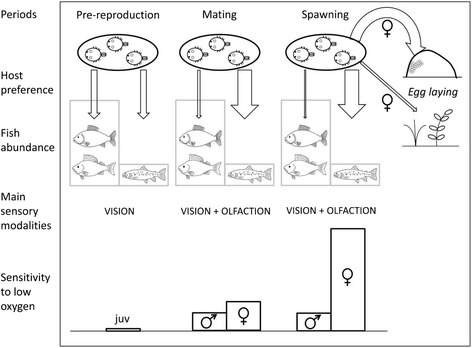 Figure 1
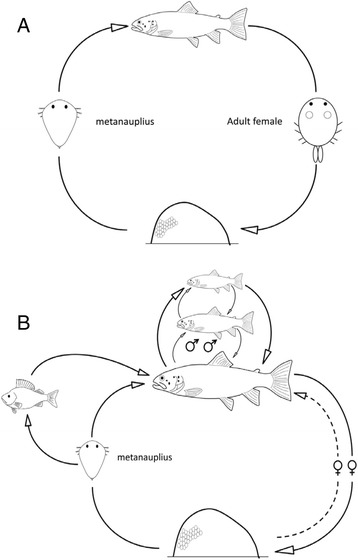 Figure 2
Peer Reviews
No public reviews on file for this paper yet. If you reviewed it on a platform where reviews are public (OpenReview, ICLR, NeurIPS, ICML), you can paste yours below so the community can read it here.
Videos
No videos yet. Explain this paper in a talk, walkthrough, or lecture? Add one.
Taxonomy
TopicsParasite Biology and Host Interactions · Parasite Biology and Host Interactions · Myxozoan Parasites in Aquatic Species