Periodic almost-Schrödinger equation for quasicrystals
Igor V. Blinov

TL;DR
This paper introduces a new method to calculate electron behavior in quasicrystals using a modified Schrödinger equation in higher-dimensional spaces.
Contribution
The novel approach enables exact electronic structure calculations for quasicrystals without relying on non-exact methods.
Findings
A modified Schrödinger equation is used in higher-dimensional spaces to model quasiperiodic potentials.
The method provides exact results for electronic structures of quasicrystals.
This approach avoids expensive and non-exact computational techniques.
Abstract
A new method for finding electronic structure and wavefunctions of electrons in quasiperiodic potential is introduced. To obtain results it uses slightly modified Schrödinger equation in spaces of dimensionality higher than physical space. It enables to get exact results for quasicrystals without expensive non-exact calculations.
Genes, proteins, chemicals, diseases, species, mutations and cell lines named across the full text — each resolved to its canonical identifier and authoritative record.
Click any figure to enlarge with its caption.
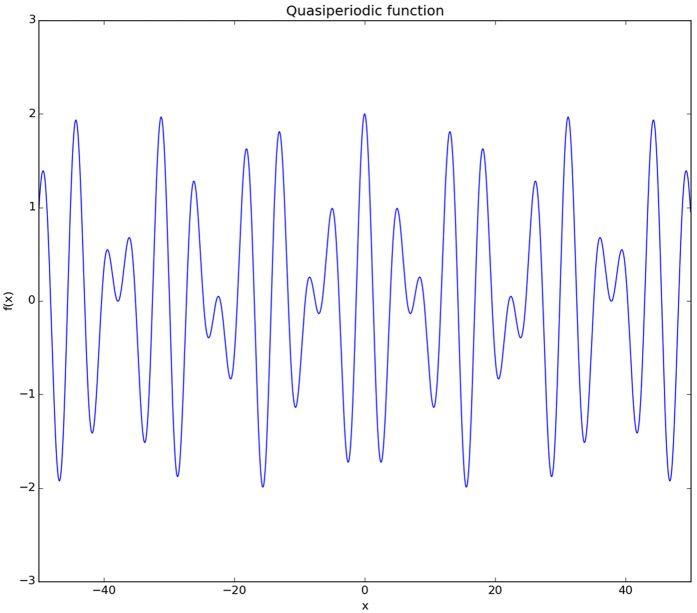 Figure 1
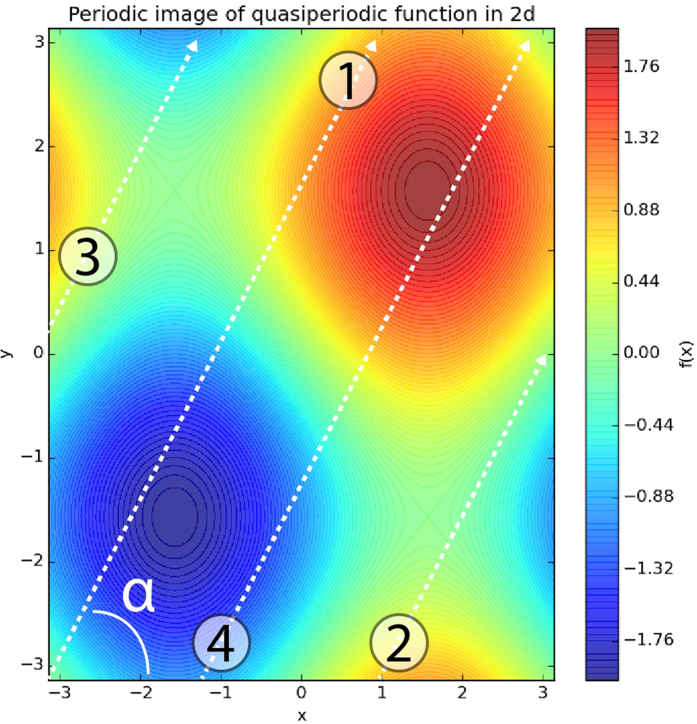 Figure 2
 Figure 3
 Figure 4
 Figure 5
 Figure 6
 Figure 7
 Figure 8
 Figure 9
 Figure 10
 Figure 11
 Figure 12
 Figure 13
 Figure 14
 Figure 15
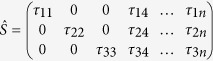 Figure 16
 Figure 17
 Figure 18
 Figure 19
 Figure 20
 Figure 21
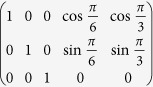 Figure 22
 Figure 23
 Figure 24
 Figure 25
 Figure 26
 Figure 27
 Figure 28
 Figure 29
 Figure 30
 Figure 31
 Figure 32
 Figure 33
 Figure 34
 Figure 35
Peer Reviews
No public reviews on file for this paper yet. If you reviewed it on a platform where reviews are public (OpenReview, ICLR, NeurIPS, ICML), you can paste yours below so the community can read it here.
Videos
No videos yet. Explain this paper in a talk, walkthrough, or lecture? Add one.
Taxonomy
TopicsQuasicrystal Structures and Properties · Topological Materials and Phenomena · Advanced Chemical Physics Studies