Microbial Inactivation in the Liquid Phase Induced by Multigas Plasma Jet
Toshihiro Takamatsu, Kodai Uehara, Yota Sasaki, Miyahara Hidekazu, Yuriko Matsumura, Atsuo Iwasawa, Norihiko Ito, Masahiro Kohno, Takeshi Azuma, Akitoshi Okino

TL;DR
A multigas plasma jet was used to kill microbes in liquid, with carbon dioxide and nitrogen plasmas showing strong sterilization effects.
Contribution
The study identifies singlet oxygen and OH radicals as key reactive species responsible for microbial inactivation using multigas plasma.
Findings
Carbon dioxide plasma generated the most singlet oxygen and effectively killed general bacteria and some fungi.
Nitrogen plasma produced the most OH radicals and killed multiple types of microorganisms, including spores and viruses.
Antioxidants confirmed that singlet oxygen and OH radicals were primarily responsible for microbial inactivation.
Abstract
Various gas atmospheric nonthermal plasmas were generated using a multigas plasma jet to treat microbial suspensions. Results indicated that carbon dioxide and nitrogen plasma had high sterilization effects. Carbon dioxide plasma, which generated the greatest amount of singlet oxygen than other gas plasmas, killed general bacteria and some fungi. On the other hand, nitrogen plasma, which generated the largest amount of OH radical, killed ≥6 log of 11 species of microorganisms, including general bacteria, fungi, acid-fast bacteria, spores, and viruses in 1–15 min. To identify reactive species responsible for bacterial inactivation, antioxidants were added to bacterial suspensions, which revealed that singlet oxygen and OH radicals had greatest inactivation effects.
Genes, proteins, chemicals, diseases, species, mutations and cell lines named across the full text — each resolved to its canonical identifier and authoritative record.
Click any figure to enlarge with its caption.
 Figure 1
 Figure 2
 Figure 3
 Figure 4
 Figure 5
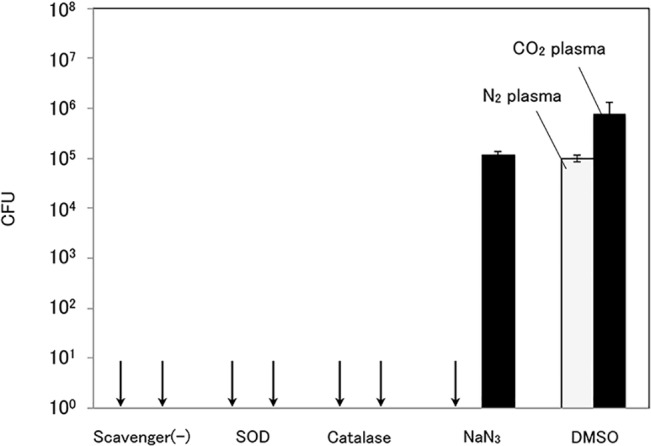 Figure 6
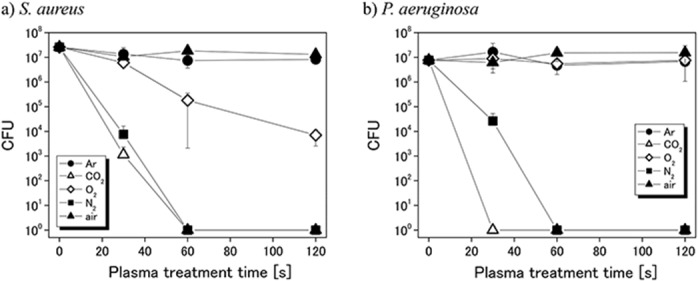 Figure 7
 Figure 8
 Figure 9
 Figure 10
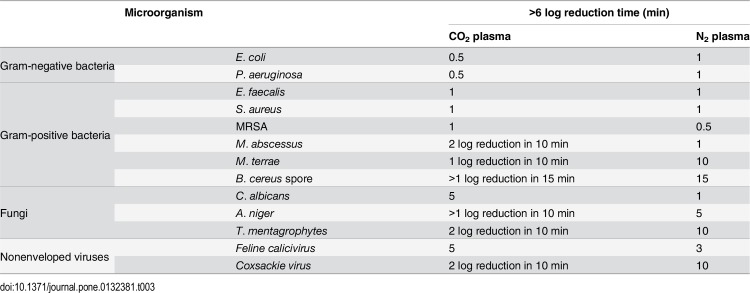 Figure 11
Peer Reviews
No public reviews on file for this paper yet. If you reviewed it on a platform where reviews are public (OpenReview, ICLR, NeurIPS, ICML), you can paste yours below so the community can read it here.
Videos
No videos yet. Explain this paper in a talk, walkthrough, or lecture? Add one.
Taxonomy
TopicsPlasma Applications and Diagnostics · Medical and Biological Ozone Research · Cardiovascular and Diving-Related Complications