Factors Influencing Production of Fusaristatin A in Fusarium graminearum
Anne Hegge, Rikke Lønborg, Ditte Møller Nielsen, Jens Laurids Sørensen

TL;DR
This study identifies optimal conditions for producing fusaristatin A, a bioactive compound from the fungus Fusarium graminearum.
Contribution
The study reveals environmental factors and cultivation methods that maximize fusaristatin A production.
Findings
YES medium with pH 7.5 and temperature 25–30 °C is optimal for fusaristatin A production.
Fusaristatin A production is over four times higher in stationary cultures than in agitated ones.
Fusaristatin A is stored intracellularly in the mycelium and not secreted into the liquid.
Abstract
Fusarium graminearum is a ubiquitous plant pathogen, which is able to produce several bioactive secondary metabolites. Recently, the cyclic lipopeptide fusaristatin A was isolated from this species and the biosynthetic gene cluster identified. Fusaristatin A consists of a C24 reduced polyketide and the three amino acids dehydroalanine, β-aminoisobutyric acid and glutamine and is biosynthesized by a collaboration of a polyketide synthase and a nonribosomal peptide synthetase. To gain insight into the environmental factors, which controls the production of fusaristatin A, we cultivated F. graminearum under various conditions. We developed an LC-MS/MS method to quantify fusaristatin A in F. graminearum extracts. The results showed that yeast extract sucrose (YES) medium was the best medium for fusaristatin A production and that the optimal pH was 7.5 and temperature 25–30 °C. Furthermore,…
Genes, proteins, chemicals, diseases, species, mutations and cell lines named across the full text — each resolved to its canonical identifier and authoritative record.
Click any figure to enlarge with its caption.
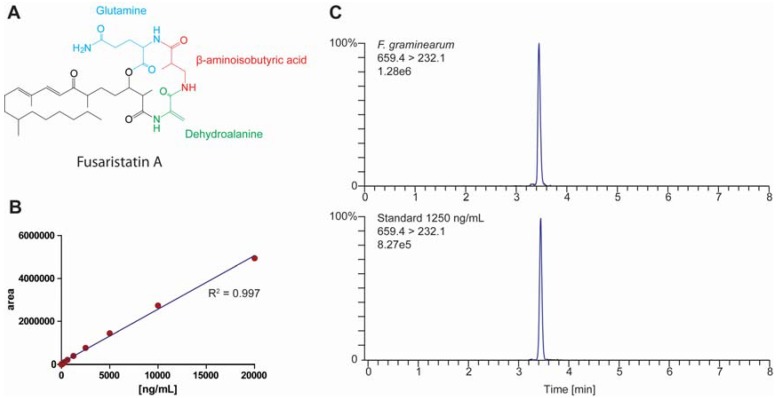 Figure 1
 Figure 2
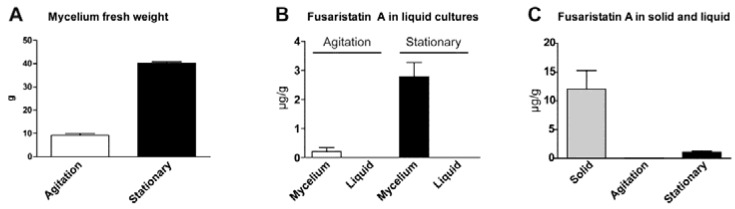 Figure 3
Peer Reviews
No public reviews on file for this paper yet. If you reviewed it on a platform where reviews are public (OpenReview, ICLR, NeurIPS, ICML), you can paste yours below so the community can read it here.
Videos
No videos yet. Explain this paper in a talk, walkthrough, or lecture? Add one.
Taxonomy
TopicsScientific Research and Discoveries