Muscular anatomy of an entoproct creeping-type larva reveals extraordinary high complexity and potential shared characters with mollusks
Julia Merkel, Bernhard Lieb, Andreas Wanninger

TL;DR
The study reveals that a larval form of entoprocts has an unusually complex muscular system, suggesting a close evolutionary relationship with mollusks.
Contribution
The discovery of a highly complex larval musculature in entoprocts and shared features with mollusks provides new morphological evidence for their evolutionary link.
Findings
The entoproct creeping-type larva has the most complex musculature known in lophotrochozoan larvae.
Shared muscle structures between entoproct larvae and mollusks support a close evolutionary relationship.
The larval musculature includes novel structures like frontal organ retractors and longitudinal prototroch muscles.
Abstract
Entoprocta (Kamptozoa) is an enigmatic, acoelomate, tentacle-bearing phylum with indirect development, either via a swimming- or a creeping-type larva and still debated phylogenetic position within Lophotrochozoa. Recent morphological and neuro-anatomical studies on the creeping-type larva support a close relationship of Entoprocta and Mollusca, with a number of shared apomorphies including a tetraneurous nervous system and a complex serotonin-expressing apical organ. However, many morphological traits of entoproct larvae, in particular of the putative basal creeping-type larva, remain elusive. Applying fluorescent markers and 3D modeling, we found that this larval type has the most complex musculature hitherto described for any lophotrochozoan larva. The muscle systems identified include numerous novel and most likely creeping-type larva-specific structures such as frontal organ…
Genes, proteins, chemicals, diseases, species, mutations and cell lines named across the full text — each resolved to its canonical identifier and authoritative record.
Click any figure to enlarge with its caption.
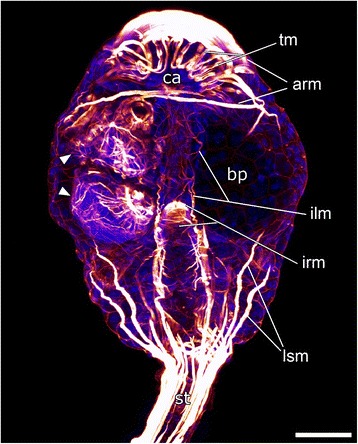 Figure 1
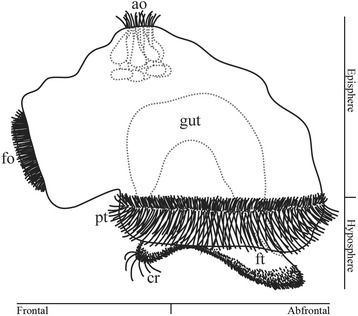 Figure 2
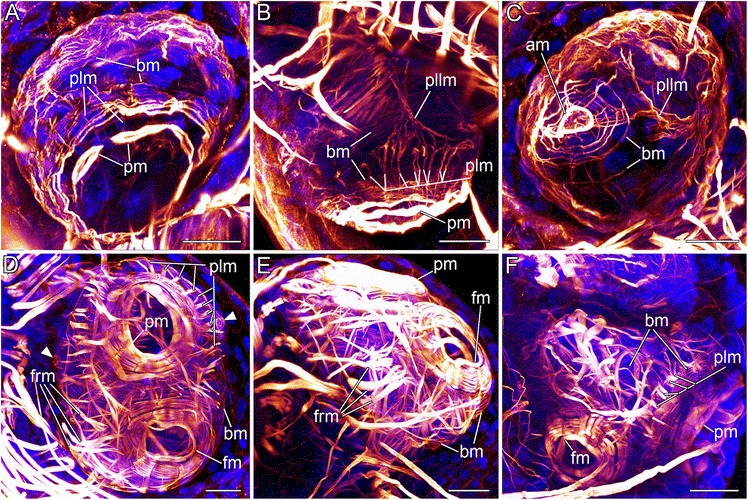 Figure 3
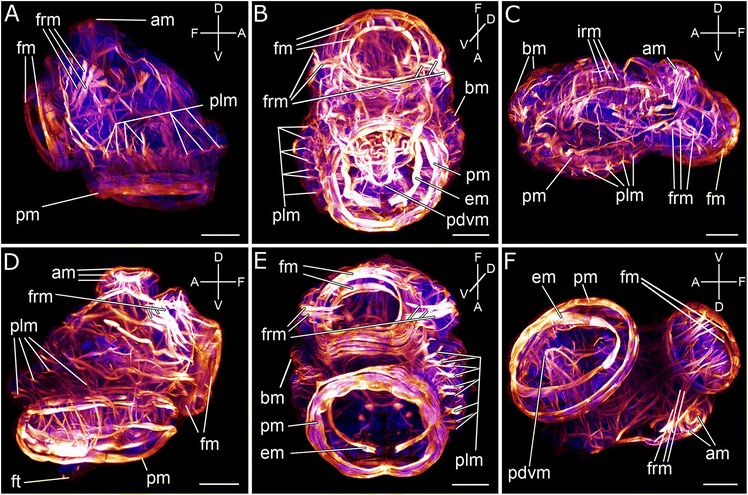 Figure 4
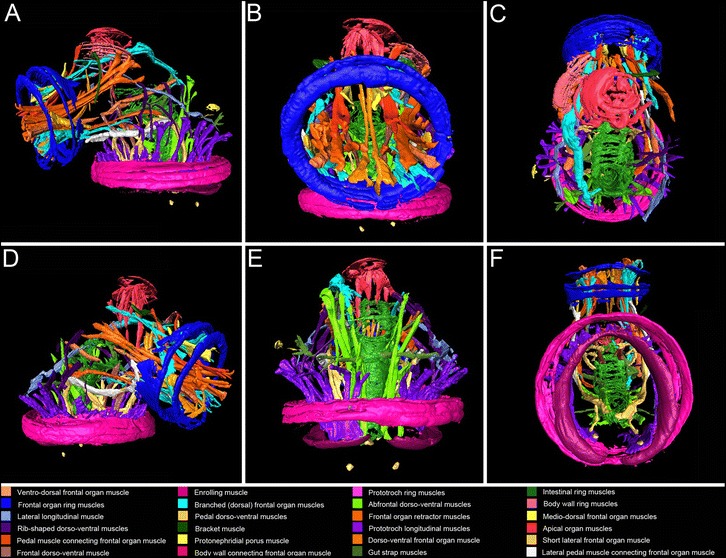 Figure 5
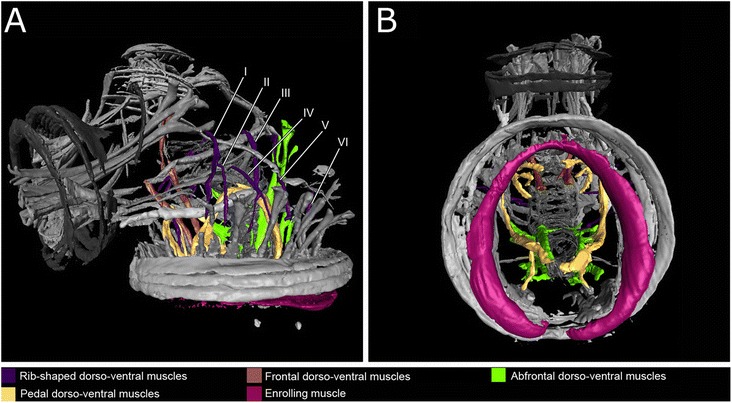 Figure 6
Peer Reviews
No public reviews on file for this paper yet. If you reviewed it on a platform where reviews are public (OpenReview, ICLR, NeurIPS, ICML), you can paste yours below so the community can read it here.
Videos
No videos yet. Explain this paper in a talk, walkthrough, or lecture? Add one.
Taxonomy
TopicsPlanarian Biology and Electrostimulation · Neurobiology and Insect Physiology Research · Mollusks and Parasites Studies