Discovery of the genus Formosiepyris Terayama, (Hymenoptera, Bethylidae) in Vietnam, with a description of a new species

Abstract
Genes, proteins, chemicals, diseases, species, mutations and cell lines named across the full text — each resolved to its canonical identifier and authoritative record.
Click any figure to enlarge with its caption.
 Figures 1–5
| 1 | Anterior margin of clypeus triangular | |
| – | Anterior margin of clypeus rounded | |
| 2 | Mandible with three teeth; posterior margin of head convex in full-face view; second antennomere as long as third antennomere; surface between median carina and inner submedian carina of propodeum with longitudinal striae | |
| – | Mandible with four teeth; posterior margin of head straight in full-face view; second antennomere shorter than third antennomere; surface between median carina and inner submedian carina of propodeum without longitudinal striae |
| 1 | Anterior margin of clypeus triangular; ocelli forming a right triangle in full-face view | |
| – | Anterior margin of clypeus rounded; ocelli forming an obtuse triangle in full-face view | |
| 2 | Head as long as wide, with posterior margin straight in full-face view; second metasomal tergite densely punctate | |
| – | Head wider than long, with posterior margin convex in full-face view (Fig. |
Peer Reviews
No public reviews on file for this paper yet. If you reviewed it on a platform where reviews are public (OpenReview, ICLR, NeurIPS, ICML), you can paste yours below so the community can read it here.
Videos
No videos yet. Explain this paper in a talk, walkthrough, or lecture? Add one.
Taxonomy
TopicsPlant and animal studies · Fossil Insects in Amber · Insect and Arachnid Ecology and Behavior
Introduction
The genus Formosiepyris Terayama, 2004 (Hymenoptera: Bethylidae: Epyrinae) was initially described based on three species, namely, Formosiepyris marishi Terayama, 2004 from Thailand, Formosiepyris shiva Terayama, 2004 from India and Formosiepyris takasago Terayama, 2004 from Taiwan (Terayama 2004). Subsequently, Formosiepyris rugulosus Xu & He, 2005 was described from Fujian Province, China, (Xu and He 2005). While all of these species are distributed in the Oriental region, Mugrabi and Azevedo (2010) and Azevedo et al. (2010) recorded several unidentified species of Formosiepyris in the United Arab Emirates and Madagascar, implying that the distribution and diversity of this genus require clarification.
In the course of our study on the hymenopteran fauna of Vietnam, we collected a male Formosiepyris specimen from Da Lat, Lam Dong Province, in southern Vietnam. Here we describe a new Formosiepyris species based on this male, and provide an updated key to the Oriental species.
Material and methods
The terminology follows that of Evans (1964), Azevedo (2001), and Terayama (2006). The following abbreviations were used in the description: HL, head length; HW, head width; WF, width of frons; LM, length of mesosoma; LPD, length of propodeal disc; WPD, width of propodeal disc; FWL, forewing length; TL, total body length; EL, eye length; POL, minimum distance between posterior ocelli; AOL, minimum distance from a posterior ocellus to nearest eye margin; OOL, minimum distance from a posterior ocellus to nearest eye margin; WOT, distance across and including posterior ocelli.
The holotype of Formosiepyris takasago deposited in the National Museum of Nature and Science Tsukuba, Japan, and a paratype of Formosiepyris marishi in the Terayama Collection were also examined for comparison. Character evaluations of the other two species, Formosiepyris shiva and Formosiepyris rugulosus, were based on the original descriptions (Terayama 2004; Xu and He 2005).
The holotype designated in this study has temporarily been deposited in the Laboratory of Entomology, Faculty of Agriculture, Tokyo University of Agriculture Atsugi, Japan, but it will be transferred to the Vietnam National Museum of Nature, Hanoi, Vietnam.
Taxonomy
Formosiepyris
Taxon classificationAnimaliaHymenopteraBethylidae
Genus
Terayama, 2004
Formosiepyris Terayama, 2004: 91. Type species: Formosiepyris marishi Terayama, 2004.
Diagnosis.
Head rounded; mandible with three or four teeth; median lobe of clypeus rounded or triangular; lateral lobe of clypeus undeveloped; eye covered with minute setae, large and convex; antenna with 13 antennomeres; posterior margin of pronotal disc and mesoscutum with transverse groove; posterolateral corner of propodeal disc with two pairs of small projections (Terayama 2004).
Distribution.
Oriental region and Afrotropical region (Species listed in the latter are not identified) (Terayama 2004; Xu and He 2005; Mugrabi and Azevedo 2010; Azevedo et al. 2010).
Host.
Unknown (Terayama 2004; Xu and He 2005).
Formosiepyris
vietnamensis
Taxon classificationAnimaliaHymenopteraBethylidae
Tsujii, Mita, Terayama, Pham & Okajima sp. n.
http://zoobank.org/BDE59050-88E1-4EC3-93C0-556D41100590
Type.
Holotype: male, Vietnam, Lam Dong Prov., Da Lat, near Tuyen Lam Lake, 11°53'00.1"N, 108°24'29.9"E, ca. 1420m, 15. III. 2013, collected by yellow pan trap, K. Tsujii leg.
Diagnosis.
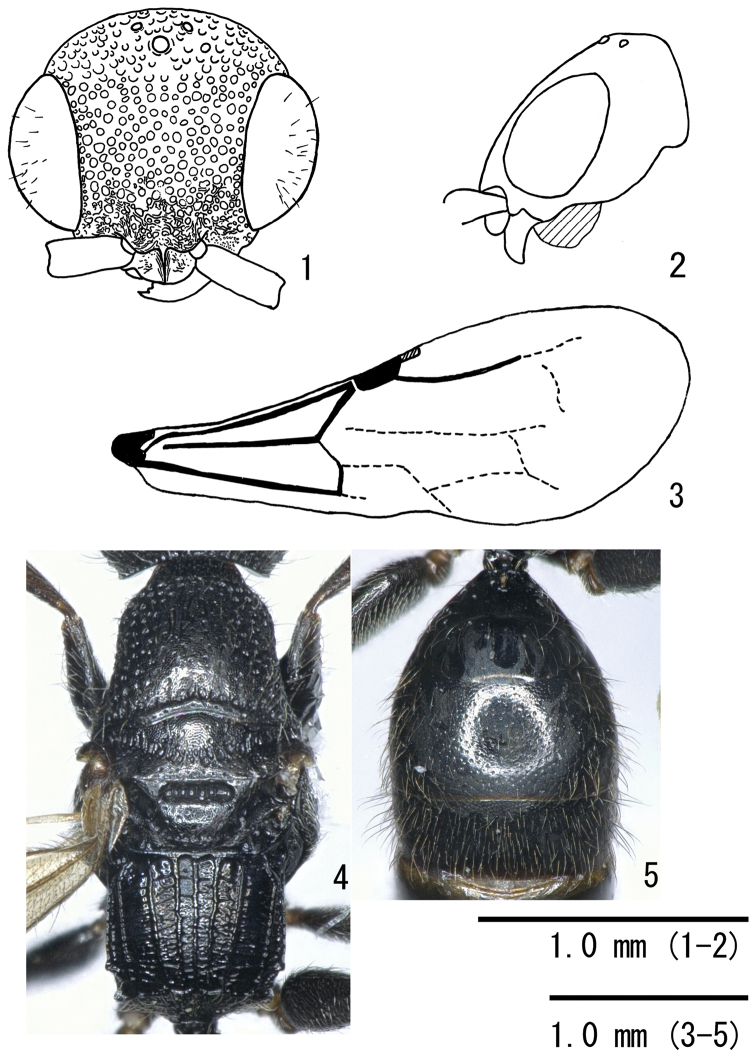
Mandible with three teeth; anterior margin of clypeus rounded (Fig. 1); surface between median carina and inner submedian carina of propodeum without longitudinal striae; second metasomal tergite with sparse small punctures, and with smooth interspaces except anterior 2/5 sparsely microreticulate (Fig. 5).
Formosiepyris vietnamensis sp. n., holotype male. 1 Head in full face view 2 head in lateral view 3 forewing in dorsal view 4 mesosoma in dorsal view 5 metasoma in dorsal view.
Description of male.
Measurements. HL 0.99 mm; HW 1.10 mm; WF 0.58 mm; LM 1.96 mm; LPD; 0.65 mm; WPD, 0.78 mm; FWL 2.78 mm; TL 4.90 mm. EL 0.56 mm; Malar space 0.89 mm. Hind wing 2.08 mm. Hind leg 2.68 mm.
Coloration. Body black, except dark brown apical half of mandible and yellowish brown tarsi. Wings faintly tinged with brown.
Head. Head 0.9 times as long as wide, with convex posterior margin in frontal view; frons and vertex densely and strongly punctated and microreticulate interspaces; maximum diameter of punctures ca. 0.3–0.5 mm. Posteroventral corner of gena forming dully projection (Fig. 2). Mandible with three teeth (Fig. 1). Anterior margin of clypeus rounded. The ratio of first five antennomeres as follows; 16: 7: 11: 11: 11. WF 1.05 times EL. Ocelli forming obtuse triangle; OOL 1.24 times WOT.
Mesosoma (Fig. 4). Pronotum punctated with microreticulate interspaces; punctures sparser than head; median longitudinal carina absent. Scutum punctated with microreticulate interspaces. Propodeal disc 0.83 times as long as wide, with five discal carinae; surfaces between carinae of propodeum without longitudinal striae; posterolateral corner of propodeal disc with two pairs of distinct projection; sublateral carina present. Hind femur 5.6 times as long as wide in lateral view. Hind leg with two tibial spurs as long as half of first tarsomere. Tarsal claws simple. Fore wing with short metacarpus, 0.4 times as long as pterostigma; transverse-median vein convex posteriorly.
Metasoma. First tergite 0.5 times as long as wide, smooth; second tergite 0.5 times as long as wide; second and third tergites punctated with sparsely located small punctures and smooth interspaces except microreticulated anterior 2/5 (Fig. 5).
Female. Unknown.
Etymology.
The specific name is from the type locality, Vietnam.
Hosts.
Unknown.
Distribution.
Oriental region: Vietnam (Lam Dong Province).
Remarks.
This species is similar to Formosiepyris marishi based on the convex posterior margin of the head in full-face view; having a punctated pronotum with microreticulate interspaces; punctures on pronotum sparser than those on head; and absence of longitudinal striae on propodeum surface between median carina and inner submedian carina. However, this species can be distinguished from Formosiepyris marishi by having a weakly rounded anterior margin of the clypeus; head wider than long; ocelli forming an obtuse triangle; second antennomere shorter than third antennomere; and second and third tergites with small sparsely located punctures and smooth interspaces, except for microreticulated anterior 2/5.
Key to species of Oriental Formosiepyris
Female (females of Formosiepyris takasago and Formosiepyris vietnamensis are unknown)
**: **
Male (males of Formosiepyris shiva and Formosiepyris rugulosus are unknown)
**: **
Supplementary Material
XML Treatment for Formosiepyris
XML Treatment for Formosiepyris vietnamensis
The reference list from the paper itself. Each links out to its DOI / PubMed record.
- 1Azevedo CO (2001) Systematics of the Neotropical Dissomphalus Ashmead (Hymenoptera, Bethylidae) of the bicavatus group. Revista Brasileira de Entomologia 45(3): 173–205.
- 2Azevedo CO Alencar IDCC Barbosa DN (2010) Order Hymenoptera, family Bethylidae. Arthropod Fauna of UAE 3: 388–411.
- 3Evans HE (1964) A synopsis of the American Bethylidae (Hymenoptera: Aculeata). Bulletin of the Museum of Comparative Zoology 132(1): 1–222.
- 4Mugrabi DF Azevedo CO (2010) Insecta, Hymenoptera, Bethylidae: Range extension and filling gaps in Madagascar. Check List 6: 62–63.
- 5Terayama M (2004) Formosiepyris, a new genus of the family Bethylidae (Hymenoptera, Chrysidoidea) from the Oriental Region, with a proposal of a new synonymy of genus. The Research Bulletin of Kanto Gakuen University, Liberal Arts 12: 91–99.
- 6Terayama M (2006) The Insects of Japan: Bethylidae (Hymenoptera). Touka Shobo, Fukuoka, 319 pp.
- 7Xu Z He J (2005) A new species of Formosiepyris Terayama, 2004 (Hymenoptera: Bethylidae) from China. Zootaxa 959: 1–4.