A surrogate-based inverse design framework for targeted diameter control of electrospun nanofibers
Mehrab Mahdian, Ferenc Ender, Tamas Pardy

TL;DR
This paper introduces a data-driven framework to precisely control the diameter of electrospun nanofibers using predictive modeling, reducing the need for trial-and-error experiments.
Contribution
The novel contribution is a surrogate-based inverse design framework combining XGBoost and PSO for targeted nanofiber diameter control.
Findings
XGBoost achieved high predictive accuracy (R² = 0.890) for nanofiber diameter modeling.
PSO optimization reached high inverse design accuracy (R² = 0.991, MAE ≈ 1.777 nm).
Applied voltage and solution concentration were identified as the most influential parameters.
Abstract
Electrospinning is a high-throughput technique for producing nanofibers. The diameter of such nanofibers governs key properties such as surface area, porosity, and mechanical strength. Precise diameter control is therefore crucial for applications from filtration to tissue engineering, yet optimizing processing conditions for targeted diameter fabrication typically relies on slow, costly trial-and-error experiments. This study presents a data-driven inverse-design framework that replaces traditional trial-and-error optimization with predictive modeling to achieve precise diameter control. Eleven regression models were evaluated on a dataset of 96 poly(vinyl alcohol) (PVA) experiments, with Extreme Gradient Boosting (XGBoost) emerging as the best surrogate (test \documentclass[12pt]{minimal} \usepackage{amsmath} \usepackage{wasysym} \usepackage{amsfonts}…
Genes, proteins, chemicals, diseases, species, mutations and cell lines named across the full text — each resolved to its canonical identifier and authoritative record.
Click any figure to enlarge with its caption.
 Figure 1
 Figure 2
 Figure 3
 Figure 4
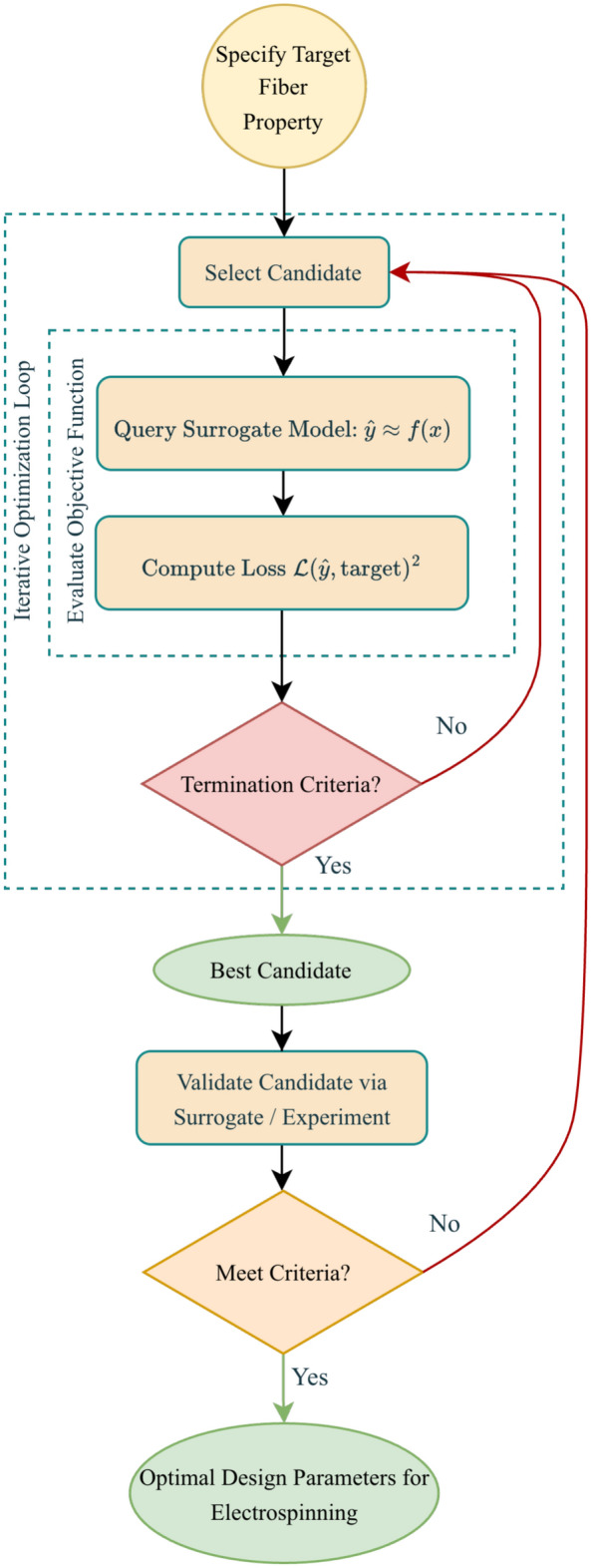 Figure 5
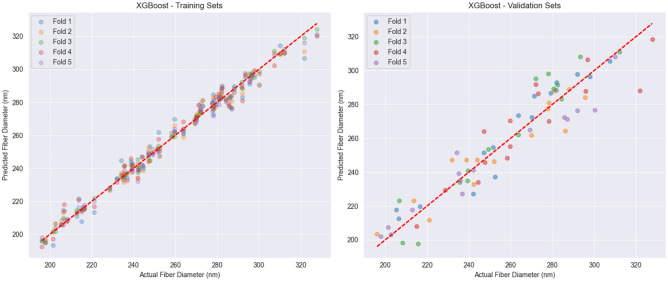 Figure 6
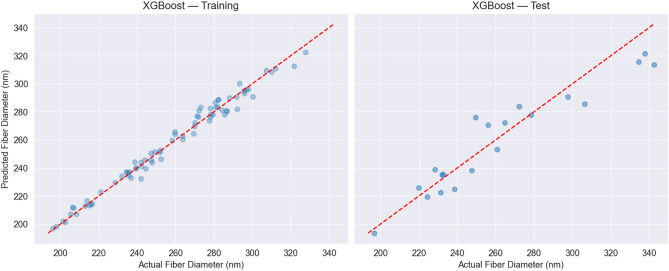 Figure 7
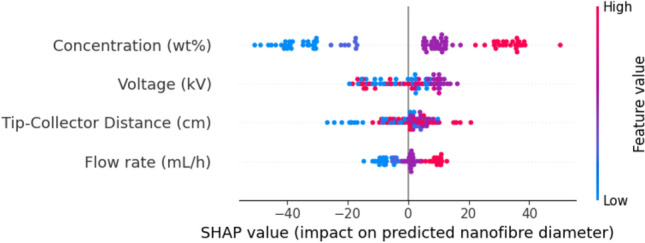 Figure 8
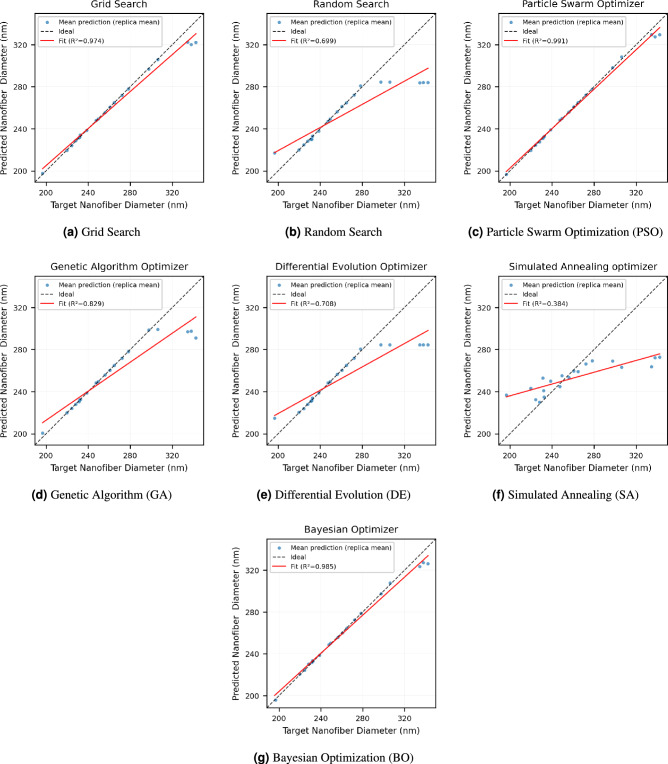 Figure 9
Peer Reviews
No public reviews on file for this paper yet. If you reviewed it on a platform where reviews are public (OpenReview, ICLR, NeurIPS, ICML), you can paste yours below so the community can read it here.
Videos
No videos yet. Explain this paper in a talk, walkthrough, or lecture? Add one.
Taxonomy
TopicsElectrospun Nanofibers in Biomedical Applications · Electrohydrodynamics and Fluid Dynamics · Advanced Multi-Objective Optimization Algorithms