Root segmentation beyond species boundaries: A generalizable framework for anatomical analysis
Yifei Qian, Yong En Kok, George Janes, Princia Nakombo-Gbassault, Brian Atkinson, Jonathan Atkinson, Molly Hanlon, Darren M. Wells, Michael P. Pound

TL;DR
This paper introduces a new framework for analyzing plant root anatomy that works across species and reduces the need for manual labeling.
Contribution
A two-stage segmentation framework that reduces annotation requirements and adapts to new species with minimal labeled data.
Findings
The framework achieves high accuracy across diverse plant species and imaging conditions.
It reduces deployment time and enables scalable root phenotyping for crop improvement.
Validation on pearl millet and sorghum shows state-of-the-art performance.
Abstract
Root anatomical features are critical for plant performance characterization, yet phenotyping at the anatomical scale remains limited by the extreme annotation burden of cellular segmentation. We present a two-stage segmentation framework that greatly reduces annotation requirements while maintaining high accuracy across diverse plant species and imaging conditions. Our approach decomposes multi-class segmentation into species-agnostic tissue identification followed by tissue type classification. By designing robust input representations invariant to imaging artifacts and morphological variations, our framework enables rapid adaptation to new species with fewer than 40 labeled images. Additionally, the first stage automatically generates tissue boundaries, transforming tedious manual tracing into simple tissue labeling. We validate our method on pearl millet, and sorghum root…
Genes, proteins, chemicals, diseases, species, mutations and cell lines named across the full text — each resolved to its canonical identifier and authoritative record.
Click any figure to enlarge with its caption.
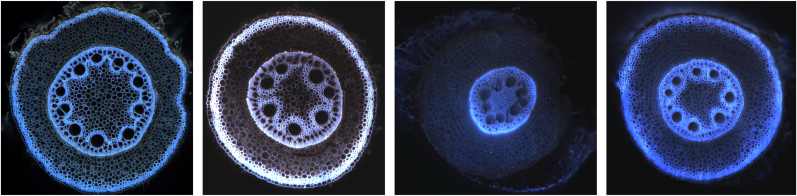 Figure 1
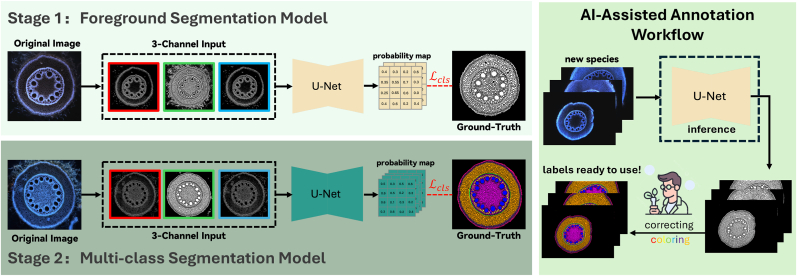 Figure 2
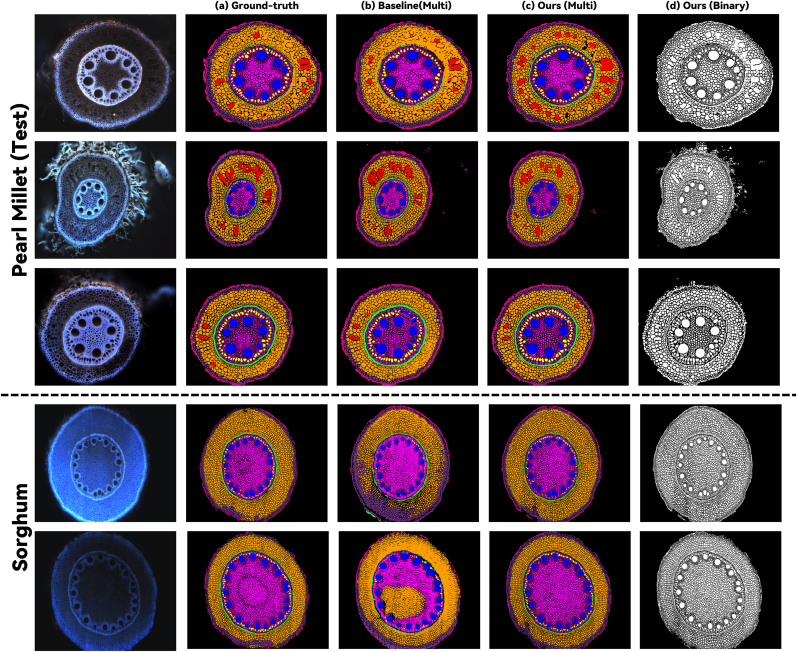 Figure 3
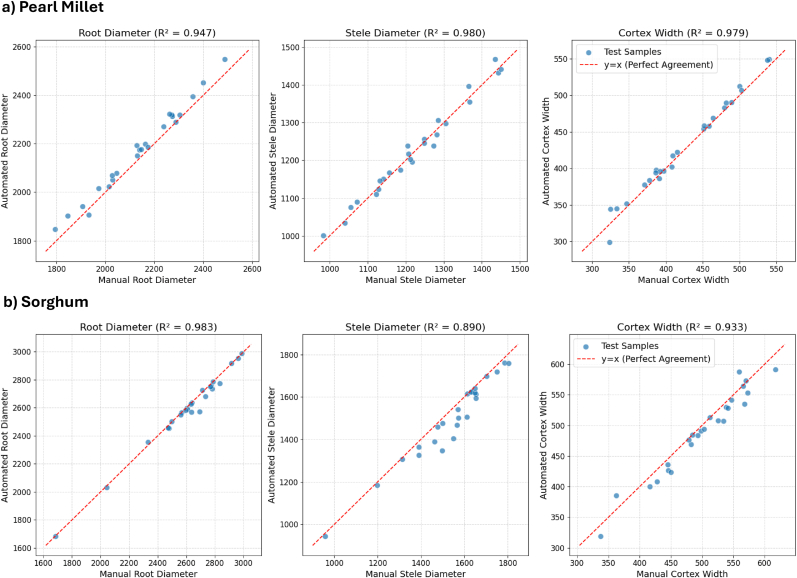 Figure 4
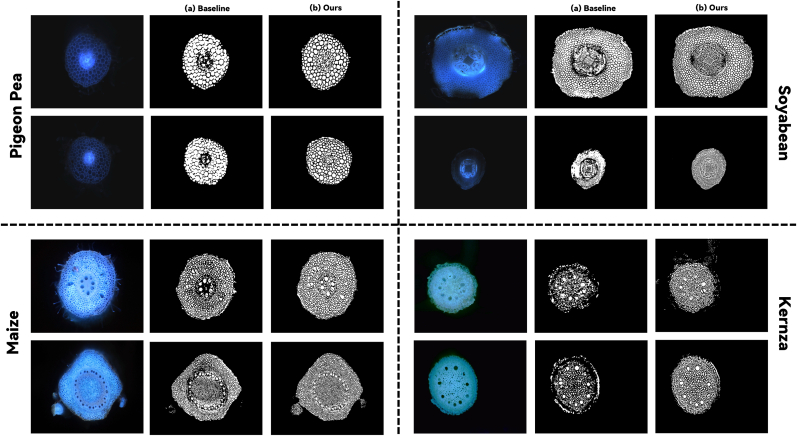 Figure 5
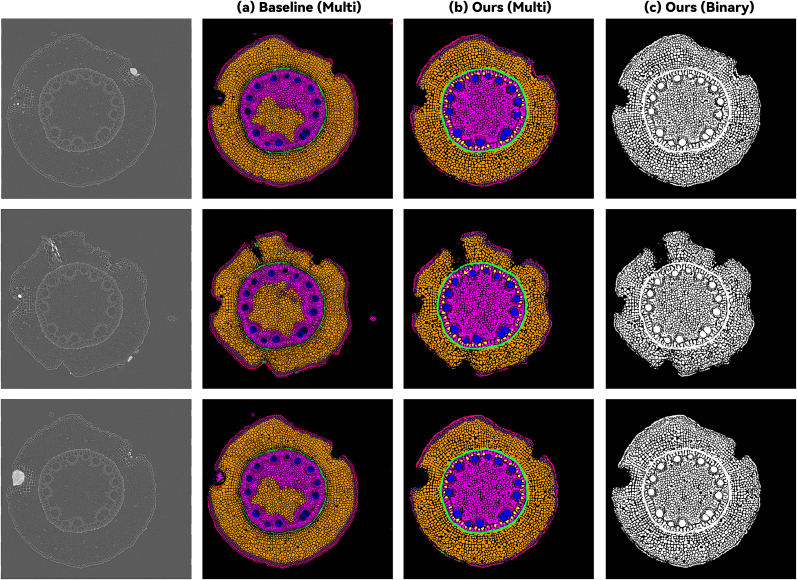 Figure 6
Peer Reviews
No public reviews on file for this paper yet. If you reviewed it on a platform where reviews are public (OpenReview, ICLR, NeurIPS, ICML), you can paste yours below so the community can read it here.
Videos
No videos yet. Explain this paper in a talk, walkthrough, or lecture? Add one.
Taxonomy
TopicsMorphological variations and asymmetry · Slime Mold and Myxomycetes Research · Plant Taxonomy and Phylogenetics