In vitro thyroperoxidase inhibition assessment by LC-ICP-MS-based L-tyrosine iodination assay: comparison with Amplex Ultrared assay and its modifications
Runze Liu, Jiří Novák, Jan Kuta, Marie Smutná, Klára Hilscherová

TL;DR
This study compares two in vitro assays for measuring thyroid peroxidase inhibition, finding that one is more sensitive and captures more steps of the enzyme's activity.
Contribution
The study introduces a more sensitive Tyr-I assay using HPLC-ICP-MS for thyroid peroxidase inhibition assessment compared to the AUR assay.
Findings
The Tyr-I assay demonstrated superior sensitivity in detecting TPO inhibition by measuring both peroxidation and iodination steps.
Fourteen out of twenty-one tested chemicals showed TPO-inhibition potential, with some effective concentrations as low as 15–74 nM.
Adding sodium iodide improved the AUR assay's sensitivity but still did not match the Tyr-I assay's performance.
Abstract
Disruption of the thyroid hormone (TH) system by environmental chemicals poses significant risks to human and wildlife health. Reliable in vitro assays are essential for assessing thyroid peroxidase (TPO) inhibition, which disrupts a key step in thyroid hormone (TH) synthesis, while adhering to 3R principles. This study aimed to compare the sensitivity and specificity of two types of in vitro assays, tyrosine iodination (Tyr-I) detected by HPLC-ICP-MS and Amplex UltraRed (AUR) and its modifications, using human HEK-TPOA7 cells and rat thyroid microsomes. It involved the evaluation of TPO inhibition by 21 chemicals (concentration range 0.002–200 µM) from diverse use categories, including industrial pollutants, pesticides, and pharmaceuticals. TPO-inhibition potential was indicated for 14 compounds. The Tyr-I assay, which measures the conversion of L-tyrosine to monoiodotyrosine,…
Genes, proteins, chemicals, diseases, species, mutations and cell lines named across the full text — each resolved to its canonical identifier and authoritative record.
Click any figure to enlarge with its caption.
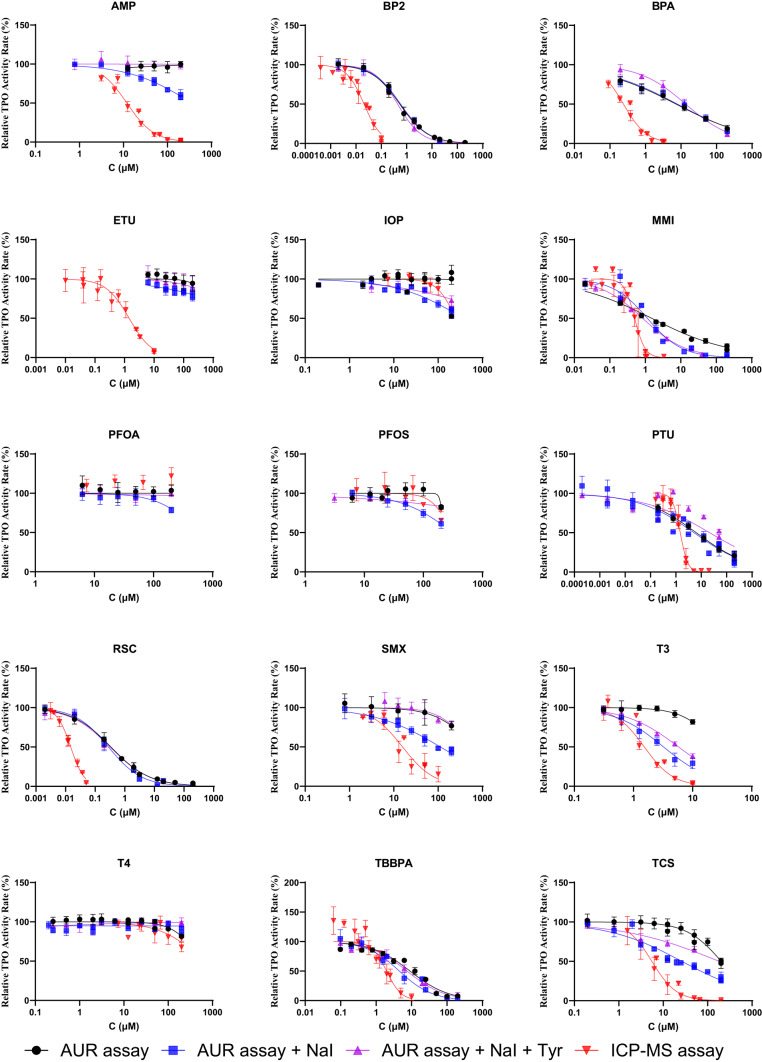 Figure 1
 Figure 2
 Figure 3
Peer Reviews
No public reviews on file for this paper yet. If you reviewed it on a platform where reviews are public (OpenReview, ICLR, NeurIPS, ICML), you can paste yours below so the community can read it here.
Videos
No videos yet. Explain this paper in a talk, walkthrough, or lecture? Add one.
Taxonomy
TopicsThyroid Disorders and Treatments · Effects and risks of endocrine disrupting chemicals · Pesticide Exposure and Toxicity