Comparative toxicity of plant protection products, their active substances and mixtures in zebrafish embryos and HepaRG cells
Bente Nissen, Alkiviadis Stagkos-Georgiadis, Martin Krauss, Denise Bloch, Wibke Busch

TL;DR
This study compares the toxicity of plant protection products and their ingredients in zebrafish embryos and liver cells, showing that whole products can be more toxic than their individual components.
Contribution
The study demonstrates that whole PPP formulations can be more toxic than their active substance mixtures, emphasizing the need for holistic risk assessment.
Findings
Plant protection products were more or equally toxic compared to their active substance mixtures in zebrafish embryos and HepaRG cells.
Co-formulants in PPPs increased internal concentrations of active substances in zebrafish embryos, leading to higher toxicity than predicted by concentration addition models.
Integrated in vitro and in vivo approaches are needed for accurate safety assessments of plant protection products.
Abstract
The intensive use of plant protection products (PPPs) is essential in modern agriculture to ensure food security. PPPs are complex formulations of active substances (ASs) and co-formulants, yet regulatory risk assessment primarily focuses on AS toxicity, often overlooking combined effects. This study assessed the toxicity of three commercial PPPs, their AS-mixtures, and a co-formulant using the in vitro HepaRG liver cell assay and the in vivo zebrafish embryo toxicity test (ZFET). Product 1 contained the AS Benzovindiflupyr (Benzo), and Product 2 contained Benzo and Prothioconazole (Pro). Product 3 contained Pro and Tebuconazole (Teb) and the co-formulant N,N-Dimethyldecanamide (DDA), which was singled out for further investigation. AS were tested in different concentration ranges from 0.03 to 105 µmol/L in the ZFET and from 12.8 to 454.8 µmol/L in HepaRG cells. AS-mixtures were tested…
Genes, proteins, chemicals, diseases, species, mutations and cell lines named across the full text — each resolved to its canonical identifier and authoritative record.
Click any figure to enlarge with its caption.
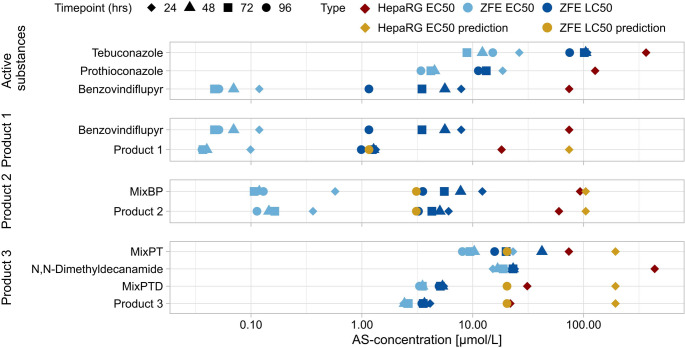 Figure 1
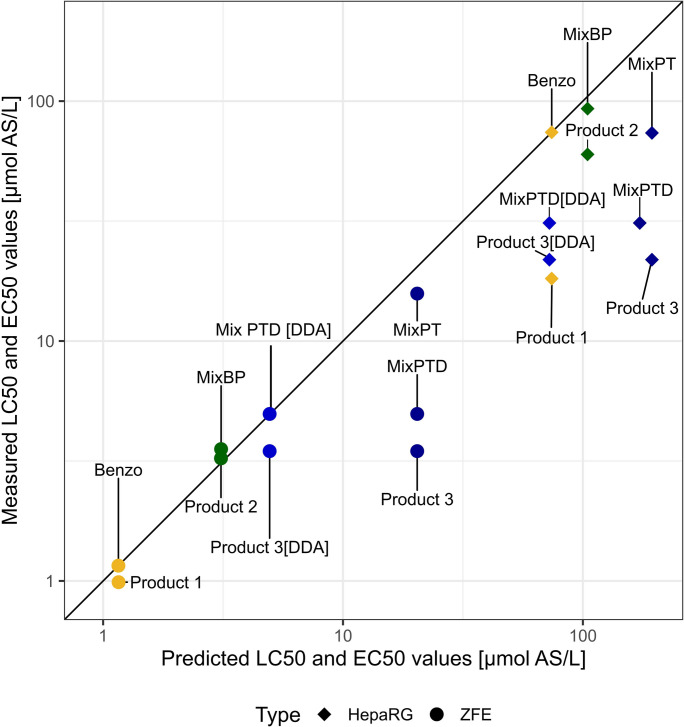 Figure 2
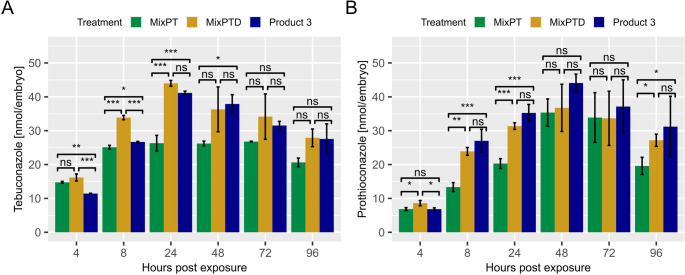 Figure 3
Peer Reviews
No public reviews on file for this paper yet. If you reviewed it on a platform where reviews are public (OpenReview, ICLR, NeurIPS, ICML), you can paste yours below so the community can read it here.
Videos
No videos yet. Explain this paper in a talk, walkthrough, or lecture? Add one.
Taxonomy
TopicsPesticide Exposure and Toxicity · Immunotoxicology and immune responses · Animal testing and alternatives