Longitudinal Evaluation of Glucose Profile and Obesity Using Continuous Glucose Monitoring, Bioelectrical Impedance Analysis, and Computed Tomography Fat Scan in a Patient Who Achieved Diabetes Remission After Laparoscopic Sleeve Gastrectomy Duodenojejunal Bypass
Yoshinori Ozeki, Takayuki Masaki, Takaaki Noguchi, Shotaro Miyamoto, Yuichi Yoshida, Koro Gotoh, Yuichi Endo, Masafumi Inomata, Hirotaka Shibata

TL;DR
This paper shows that LSG/DJB surgery leads to significant weight loss and diabetes remission, as tracked by glucose monitoring and body composition analysis over one year.
Contribution
The study provides a detailed longitudinal analysis of diabetes remission and body composition changes after LSG/DJB using multiple monitoring techniques.
Findings
LSG/DJB led to complete diabetes remission and significant improvement in glucose control over 12 months.
Abdominal fat mass decreased while muscle mass was preserved, as shown by CT and BIA.
CGM revealed a dramatic increase in time-in-range, indicating better glucose stability post-surgery.
Abstract
Laparoscopic sleeve gastrectomy/duodenojejunal bypass (LSG/DJB) aids weight loss and improves type 2 diabetes mellitus (T2DM) in patients with obesity. Herein, we present a 1-year longitudinal evaluation using continuous glucose monitoring (CGM), bioelectrical impedance analysis (BIA), and computed tomography (CT) fat scans after LSG/DJB in a patient with obesity and T2DM. Our patient was a 33-year-old female with obesity and T2DM who had been treated with intensive insulin therapy (50 units/d) before LSG/DJB. Preoperatively, the patient had uncontrolled diabetes, with a fasting blood glucose level of 252 mg/dL and HbA1c of 10.0%. Moreover, the CGM showed 1%, 99%, and 0% time-in range (TIR), time-above range, and time-below range, respectively. LSG/DJB significantly increased the 3-, 6-, and 12-month TIR to 96%, 93%, and 89%, respectively, and decreased the time-above range to 4%, 7%,…
Genes, proteins, chemicals, diseases, species, mutations and cell lines named across the full text — each resolved to its canonical identifier and authoritative record.
Click any figure to enlarge with its caption.
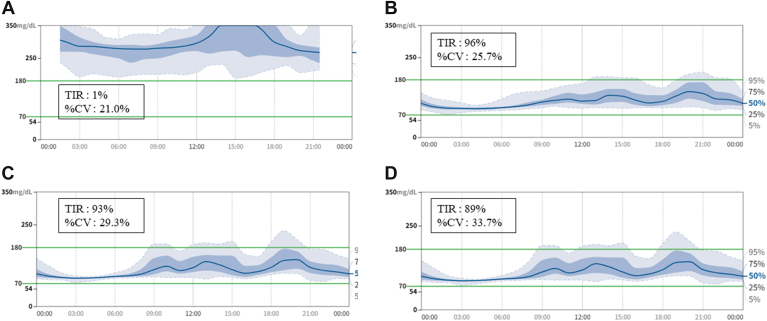 Figure 1
Peer Reviews
No public reviews on file for this paper yet. If you reviewed it on a platform where reviews are public (OpenReview, ICLR, NeurIPS, ICML), you can paste yours below so the community can read it here.
Videos
No videos yet. Explain this paper in a talk, walkthrough, or lecture? Add one.
Taxonomy
TopicsBariatric Surgery and Outcomes · Body Composition Measurement Techniques · Nutrition and Health in Aging